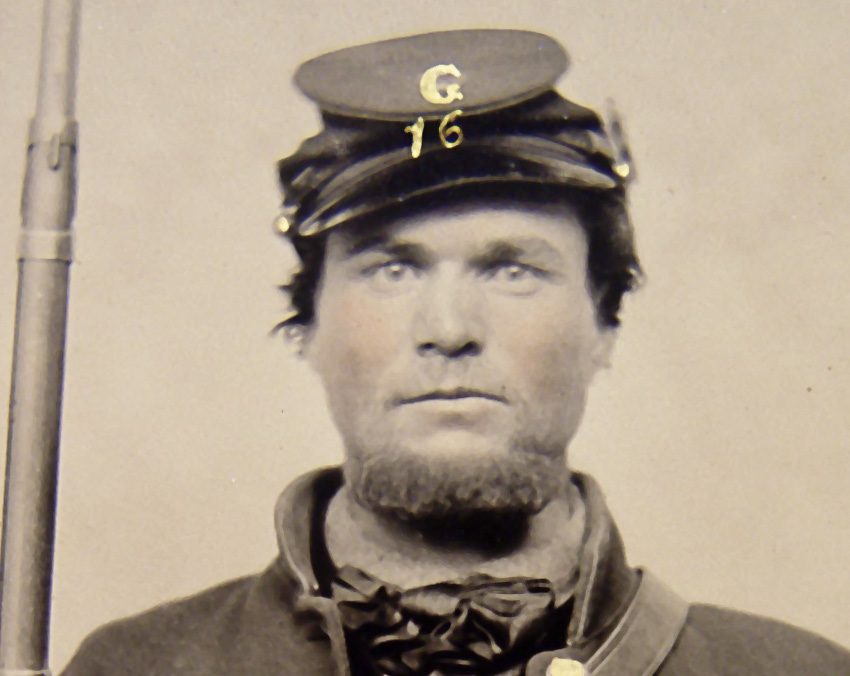
Smith of the 16th Wisconsin Company G. Smith enlisted on November 11, 1861, and was discharged on March 14, 1863, due to an unspecified disability.1 The company was nicknamed the “Chippewa Valley Guards” and was comprised mostly of men from
PHOTO ANALYSIS Horace H. Smith, 16th Wisconsin Infantry, Company G.
By Craig L. Barry
his is an unusual gold-tinted tin-type of a Union Civil War soldier identified as Horace H. Northern Wisconsin. Horace Smith in late March, where, along with the was from the unincorporated town of 25th Missouri and 12th Michigan, Rock Falls, Wisconsin, while most of they made up the Sixth Division under his comrades hailed from Eau Claire General Prentiss. They held the left end and the surrounding area. The 16th of Grant’s line at Shiloh (Seay Field) Wisconsin was organized at Camp and were involved in the action early on Randall, mustered into service on April 6, 1862, at 4:55 a.m. (In fact, the January 31, 1862, and was ordered first officer killed at Shiloh was Captain to St. Louis, Missouri, on March 13. Saxe of the 16th Wisconsin.) Overall, They proceeded to Pittsburg Landing the unit took moderate casualties. They later fought at Iuka and Corinth and remained in Mississippi much or less of 1862, moving toward Vicksburg during the First Campaign until being driven back into Tennessee after the disaster at Holly Springs in late 1862. In November, the nine companies making up A through I were consolidated into five companies, having been “reduced through casualties of battle and sickness.”2
The History of the 16th Wisconsin Regiment does not specify where or how Horace H. Smith was injured or what his disability may have been. It only lists the casualties in “major” battles and those killed in action. He is not listed among the wounded. Horace H. Smith was discharged as disabled in March 1863, meaning it resulted from the 1st Vicksburg Campaign in late 1862. It raises an interesting point: there were various skirmishes and encounters (large and small) in Mississippi throughout plain kepis or forage caps, and the remaining 10% wore Hardee hats, only some of which carried the regulation brass hardware.
As far as his personal appearance, Horace H. Smith has a neatly trimmed, if longer, goatee with no mustache. It appears to complement his hairstyle, which is also longer and somewhat disheveled. He seems well nourished, even robust in appearance. His fatigue blouse is unbuttoned, which reveals a double-breasted civilian vest, a civilian shirt, and a dark silk bow tie. We cannot see below the waist, but more than likely, he is wearing the standard military bootee, waxed flesh out. The image is unusual for its clarity and detail, which is very rare in an early war tin type. This image was most likely taken shortly after enlistment in late 1861.
Janet Hewitt, Roster of Union Soldiers 1861–1865: Wisconsin Volunteers; War of the Rebellion, 1861–1865; Volumes I and II; compiled by Authority of the Wisconsin Legislature, Democrat Printing Company, (Madison, Wisconsin); 1886, p. 117.
E.B. Quinner, The Military History of Wisconsin: 16th Infantry, Clarke & Company (Chicago), 1866, p. 632-643.
This was the Diary of Horace Smith of the 154th NY, who was sent to Belle Island (near Richmond) after being captured at Gettysburg in mid-1863.
Kurt Holman, Insignia of the Common Union Soldier, www.westernfederalblues.com. This article first appeared in Camp Chase Gazette in March 1991.
Craig L. Barrywasbornin Charlottesville, Va. Heholdshis BA and Mastersdegreesfrom UNC (Charlotte). CraigservedThe Watchdog Civil War Quarterlyas Associate Editorand Editorfrom 2003– 2017. The Watchdogpublishedbooksandcolumnson 19th-centurymaterial. Heistheauthorofseveral booksincludingThe Civil War Musket: A Handbookfor Historical Accuracy(2006, 2011), The Unfinished Fight: Essayson Confederate Material CultureVol. I and II (2012, 2013). Hehasalsopublishedfourbooksinthe Supplierstothe Confederacyserieson English Arms & Accoutrements, Quartermasterstoresandother Europeanimports.