In-depth account of the 1st and 2nd U.S. Sharpshooters
Thunderbolt to the Rebels: The United States Sharpshooters in the Civil War. By Darin Wipperman. Maps, tables, notes, appendix, bibliography, index. 362 pp., 2025. Hard cover. $34.95.
Reviewed by Robert L. Durham
In the early months of the Civil War, engineer, inventor, and noted marksman Hiram Berdan proposed organizing a group of accomplished marksmen from across the United States. The U.S. government approved the formation of two regiments, the 1st and 2nd U.S. Sharpshooters. To be selected by Berdan, the men would have to pass a hard test: place 10 shots within a 10-inch-diameter circle at 200 yards. In this volume, Darin Wipperman tells the story of these two remarkable regiments.
Although Berdan enlisted his soldiers with a promise they would be armed with Sharps rifles, many would first be armed with standard issue rifles. Clothed in green uniforms for camouflage, the distinctive uniforms made them conspicuous focuses for Confederate skirmishers. The green uniforms also warned the Confederate troops that they were facing expert marksmen.
Berdan imagined the sharpshooters would be used in front of the main command. There, they would especially target enemy officers. However, many Federal officers did not appreciate or fully understand what the 1st and 2nd had to offer. They often placed these special soldiers in the main battle lines to fight as infantrymen, a waste of a unit that was ahead of its time. Berdan considered the two regiments a brigade, with himself as the brigadier general. He constantly lobbied Congress and President Lincoln to allow him to raise more sharpshooter companies. However, this never happened; instead, he was commissioned as a colonel, in command of the 1st Sharpshooters only.
The two regiments never served together, often serving in separate corps. During the Peninsula Campaign, they did not even serve in the same army. The 1st served on the Peninsula with the Army of the Potomac, taking part in the Seven Days Battles. The 2nd served in the Army of Virginia, with little to do until the Battle of Second Bull Run.
Antietam, Gettysburg, the Overland Campaign, and the Petersburg Campaign would be major trials for the sharpshooters. In all, their casualty rates were high. The Petersburg Campaign, especially, served to highlight the special talents the men of the sharpshooter regiments offered. Manning the trenches fronting Petersburg, enemy troops soon learned to keep their heads down when facing the deadly Sharps rifles of the 1st and 2nd U.S. Sharpshooters.
Wipperman inserts many tables, providing numbers and names, for the wounded and dead. This book is a treasure trove for genealogists with an interest in the 1st and 2nd U.S. Sharpshooters. The author provides personal information on many of the Federal marksmen. He has found many eyewitness accounts, which he uses to enliven his book with quotations. Through these primary sources, we learn much about the daily lives of these remarkable soldiers, and piercing details of their battle experiences. This is an excellent source on the 1st and 2nd Sharpshooters and should be of interest to all Civil War buffs.
One thing to note: Simon and Schuster has acquired Stackpole Books, and there is no longer a link to Stackpole. When I checked, Simon and Schuster does not have this book in its catalog. However, it is available on various online bookstores.
Robert L. Durhamretiredfromthe Defense Logistics Agencyin 2004. Heisnowafreelancewriterandhas hadnumerousarticlespublishedinvarioushistorical publications.
Extensive Work With Solid Research
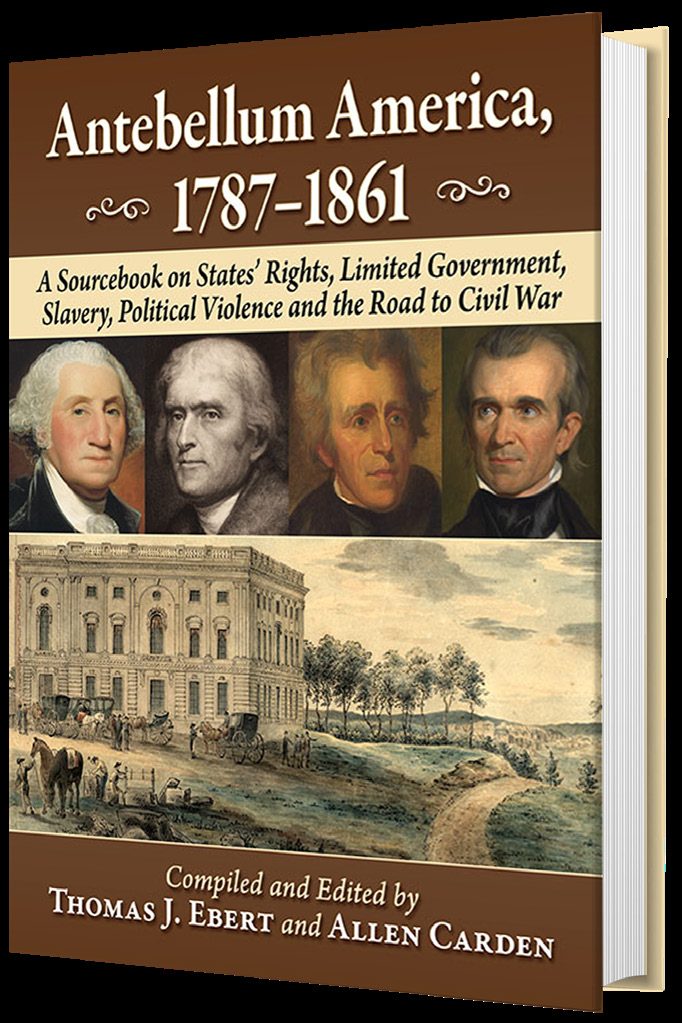
Antebellum America, 1787–1861: A Sourcebook on States’ Rights, Limited Government, Slavery, Political Violence, and the Road to the Civil War. Compiled and Edited by Thomas J. Ebert and Allen Carden. Appendix, Bibliography, and Index, 364 pp. 2025. McFarland & Company, Softcover, $95.
Reviewed by John D. Fowler
The American Civil War is arguably the single most important event in the history of the United States, rivaled only by the American Revolution and the Second World War. Yet, while the Revolution brought the republic into existence and World War II made the nation the dominant power on the planet, the Civil War largely determined what sort of nation the republic would be. Long-held disputes concerning national versus state power, along with the paradox of slavery in a republic based on freedom, were finally resolved on the nation’s battlefields during the great calamity of 1861–1865.
The story of how the nation reached the point of civil war is the subject of Antebellum American, 1787–1861. Thomas J. Ebert, a retired reference and documents librarian at California State University, Fresno, and associate vice president for academic personnel, along with Allen Carden, a professor emeritus of history and former president of Fresno Pacific University, offer readers a treasure trove of more than 145 documents in an effort to explore the coming of the conflict.
Any documentary collection must focus on a theme since all documents on a particular subject cannot possibly be included or organized. The theme of this volume is essentially to describe how slavery became intertwined with the broad political debate on the nature of the federal system. From the beginning of the new American nation, a divide existed over whether the nation should have a strong national government or be a loose confederation of states. This divide was ignored by the Founders, who hoped debate would eventually solve the issue. Moreover, they also ignored the incompatibility of slavery with the ideas of the Revolution and again hoped that debate and time would solve the problem. The authors offer a compelling look at the nation as it moves forward and tries to reconcile two major issues that ultimately prove beyond political compromise or resolution.
The book begins with a short preface that sets the stage for an analysis of the period. The main text is organized into four sharply chronological chapters covering the Federalist Era (September 17, 1787–March 4, 1801), the Age of Jefferson (March 4, 1801–March 4, 1829), the Age of Jackson (March 4, 1829–March 4, 1849), and the Road to Civil War (March 4, 1849–April 12, 1861). Following the chapters is a small appendix providing extremely short biographical sketches of major figures in antebellum America. The bibliography is brief but includes noteworthy works covering the period, and the large, detailed index is quite useful. This volume is actually a companion to another documentary collection by the authors, Abraham Lincoln and His Times: A Sourcebook on His Life, His Presidency, Slavery and Civil War (McFarland, 2023). This collection is organized similarly, but with eight chapters and more than 400 primary sources, making it a truly nice companion volume to Antebellum America.
In sum, Ebert and Carden have compiled an excellent collection of primary documents for historians interested in the coming of the Civil War. This is not a volume for the casual reader. It is clearly geared to the serious student who wants a detailed examination of the major issues of the period. Official documents, including speeches, letters, essays, and legal documents, make up the bulk of the book. It is a valuable resource. It walks the reader through the political philosophies, debates, and clashes that characterized the establishment and maintenance of the American republic from the Constitution to the Civil War. Together with the Lincoln sourcebook, the primary source documents allow readers to understand various perspectives and to form a more complete picture of a complex and important era. The only downside is the price, especially given that these documents are widely available at no cost to anyone willing to search for them. While historians and serious students of the war may decide to purchase either or both books for their collections, college students and the average reader may find it far too cost-prohibitive. This is a shame because the editors have presented two solid volumes that deserve a wide audience.
John D. Fowler, Ph.D., istheauthorofseveralbooksand articlesonthe Civil Warera. HeistheauthorofBreaking the Heartland: The Civil Warin Georgia.
The Fighting Paymaster
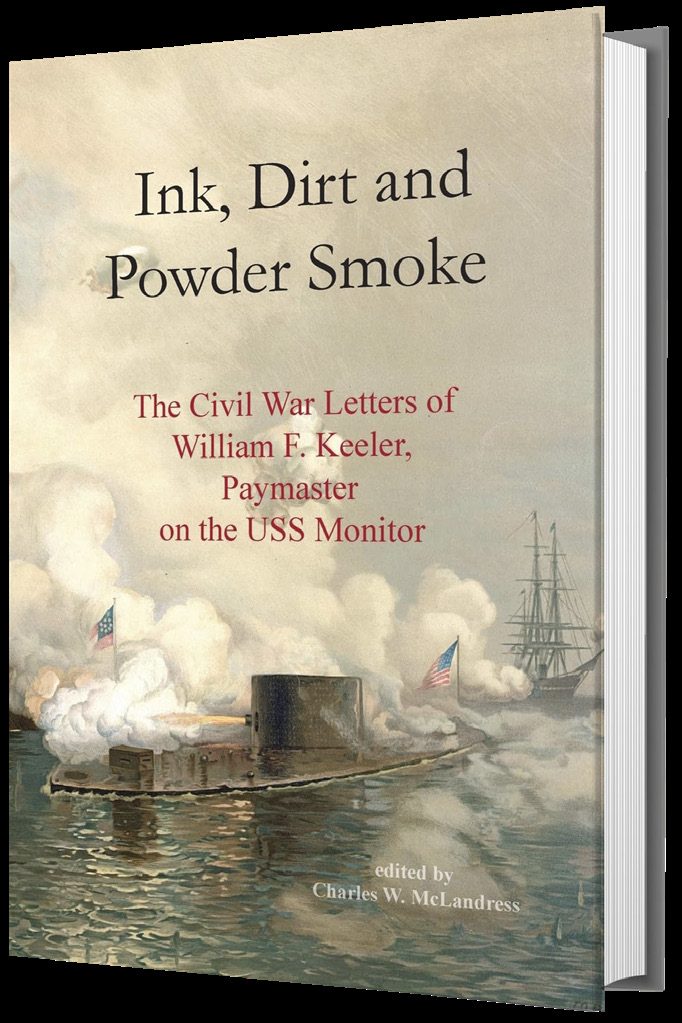
Ink, Dirt, and Powder Smoke: The Civil War Letters of William F. Keeler, Paymaster on the USS Monitor. Edited by Charles W. McLandress. Photographs, maps, drawings, footnotes, appendix, biographical notes, bibliography, index, abbreviations, 647 pp., Seal River Publishing, softbound, $33.87.
The title of this book is slightly misleading; it is a biography of Keeler from birth to death, divided into three parts: before the war, during the war, and after the war. As expected, during the war, the preponderance of the text is at 96%. Parts 1 and 3 are worth reading; they give a complete picture of an interesting, although obscure, Civil War veteran.
A paymaster in the Federal Navy (called purser in other navies and the merchant service) was the ship’s shopkeeper; he provided clothing, stationery, and small stores, such as tobacco, soap, candles, thread, buttons, needles, jack knives, etc. He also kept the ship’s accounts and paid the officers and crew.
The letters are mostly in chronological order; exceptions are explained. They are mostly about service on either the Monitor or the Florida. Most of the letters are to his wife Anna, so there is almost always a paragraph or two about friends and family. The editor does an impressive job of identifying these people and their relationship to Keeler in footnotes. Readers can be thankful that most of these paragraphs are short. The letters confirm the veracity of the well-known aphorism that war is long periods of boredom interrupted by short periods of terror.
The Monitor went down on December 31, 1863, in a storm off Cape Hatteras. Keeler described his escape as “narrow.” In February of 1864, Keeler joined the Florida as paymaster. The Florida was a side wheel steamer that spent the rest of the war blockading Wilmington, North Carolina, with the North Atlantic Blockading Squadron.
Keeler was not a sailor; he had, however, spent a couple of years at sea as a passenger going to and from the gold fields of California. For a landsman, he had a good understanding of the nautical world he lived in. He was forever explaining nautical procedures, customs, and manouevres to Anna using nautical terms and using them correctly. One interesting example, from a letter dated March 4, 1862, was about the effect of the wind related to Monitor’s sailing because of her almost nonexistent freeboard: “We are finally ready for a start & are now only waiting for a favorable wind, not to fill our ‘billowing’ sails, but to give us smooth water.” While he didn’t have a battle station, he always tried to be useful in combat.
In the March 9, 1862, battle with the Virginia (which he always refers to as the Merrimac), after the voice pipes went out, he passed messages from the captain in the pilot house to other parts of the ship as needed.
Keeler was a typical low-level Federal Navy staff officer, someone even Civil War navy buffs probably couldn’t identify. If you are interested in the day-to-day life of such a character during the war, you will enjoy this book.
William Dyerisaretiredarchitectlivingin Atlanta, GA. Forthelastfewyears, hehasbeentheproofreader forCivil War Navy—The Magazine, focusedespeciallyonthe accuracyofnauticalreferences. Hehaswrittenarticles forthatmagazine, andhecreatedthe Nautical Terminology
Vicksburg: A Two-Volume Engaging Set
The Vicksburg Campaign, 1863: Grant’s Failed Offensives. By Chris Mackowski. Illustrations, Photographs, Artworks, Maps, Bibliography, and Index, 128 pp. 2025. Casemate Publishers, Softcover, $24.95
The Vicksburg Campaign, 1863: The Inland Battles, Siege, and Surrender. By Chris Mackowski. Illustrations, Photographs, Artworks, Maps, Bibliography, and Index, 128 pp. 2025. Casemate Publishers, Softcover, $24.95 Reviewed by John D. Fowler
The Union campaign for Vicksburg is one of the great struggles of the Civil War. The fall of the Confederate bastion gave Federal forces control of the Mississippi, provided relief to Midwestern farmers who now had access to the Mississippi River and New Orleans, and demonstrated Ulysses S. Grant’s ability as an operational commander.
In a two-volume set by Casemate Publishers, historian Chris Mackowski explores this pivotal campaign. The first volume covers Grant’s failed offensives in the early stages of the campaign, while the second covers the final Union drive for the city, including the various battles, the siege, and the surrender of Vicksburg. These books by Casemate are reminiscent of their publishing rival Osprey’s campaign series volumes. Profusely illustrated with period and contemporary photos, maps, and sidebars, the volumes are a visual delight. Moreover, the text is clear and engaging and provides the reader with a solid account of the campaign without unnecessary detail. For the novice who is unfamiliar with the campaign, the books would be an amazing introduction, but for well-read students of the war, they hold nothing new. The story of Vicksburg has been told many times in numerous volumes. However, Casemate is writing for a specific audience, one that is generally not knowledgeable of the campaign and one that appreciates the production value of a plethora of glossy images.
The author, Chris Mackowski, is perhaps best known as the editor and chief of the digital history platform Emerging Civil War and as the managing editor of the award-winning Emerging Civil War Series published by Savas Beatie. He is a prolific author, having written or edited more than two dozen books. Interestingly, he is also a writing professor at the Jandoli School of Communication at St. Bonaventure University in New York, which helps explain the wellwritten nature of his works, including the two discussed here.
Taken together, the volumes offer a nice overview of the campaign. The first, Grant’s Failed Offenses, begins with an introduction that places the campaign in context. The preceding chapters discuss the first attempts to capture the city with greater detail given to Chickasaw Bayou, Yazoo Pass, and Steel’s Bayou. The volume also contains short profiles of the various commanders as well as interesting discussions of technology, especially in regard to naval weaponry, ship design, and fortifications. The second, Siege and Surrender, is similar, with solid coverage of the assault at Port Gibson, the battles of Raymond, Jackson, and Champion Hill, as well as the siege and the surrender of the city. The sidebars covering command profiles are also present.
In sum, these volumes were designed as an introduction to the subject and are best suited for those unfamiliar with the Vicksburg campaign who desire a quick and entertaining overview. In that role, they are excellent resources. Although the two books are technically designed as separate volumes, to really understand the campaign, one would need both. Another group that might appreciate the texts is battlefield visitors who would enjoy the succinct text, the maps, and the general overview of the campaign as they explore the places where actions occurred. However, while wargamers and military history buffs will find the maps, artwork, and illustrations they have come to expect, these Casemate books lack the same level of detail on troop movements, uniforms, and weapons as is normally found in the Osprey texts.
Inside Baseball
Conflict and Controversy in the Confederate High Command: Davis, Johnston, Hood and the Atlanta Campaign of 1864. By Dennis B. Conklin, II. Maps, photographs, bibliography, footnotes, index, appendices, 320 pp., 2025. Savas Beatie, www.savasbeatie.com. $32.95, hardcover.
Reviewed by Gould Hagler Mitch: So you hate baseball?
Bonnie: No, I like baseball. I just never understood how you guys can spend so much time discussing it. I have been to games, but I don’t memorize… who played third base for Pittsburgh in 1960.
Mitch and Ed (simultaneously): Don Hoak
Many people who read Civil War News are like the characters played by Billy Chrystal and Bruno Kirby in the 1991 movie City Slickers, while in the broader world, most people resemble the character played by Helen Slater. Conflict and Controversy in the Confederate High Command by Dennis Conklin is written for the Eds and Mitches of the Civil War world.
In this careful study, Conklin delves into the history and historiography of the Atlanta Campaign in a way that will grab and hold the attention of readers who (if I may continue the metaphor) already know who played third for the Pirates in 1960. These readers want to learn more about Hoak’s batting average and other stats; about controversies involving him and other players; about questionable plays and disputed calls; about a manager’s decision to put him back into the lineup after an injury. And, of course, they want to know how sportswriters have judged the third baseman and his team throughout his career.
The foregoing, from the review’s title on down, is a nearly identical repeat of what I wrote in a 2021 review of a previous book on the Atlanta Campaign. I could think of no better way to begin this review.
Conflict and Controversy is an updated version of the author’s 2013 doctoral dissertation at the University of Southern Mississippi. In this analysis of the Atlanta Campaign, Conklin provides a well-written narrative of the action and an assessment of the key figures whose decisions affected the course of the fighting. Many readers will be familiar with what the participants themselves wrote and what historians have written about this decisive and muchstudied campaign. Conklin offers a critical review of the literature, with emphasis on writers who have delved into some of the more controversial issues.
In the opening chapter, Conklin states three fundamental problems which contributed to the Confederacy’s failure in this vital campaign, all of which were under the control of the president: lack of a centralized command system; Davis’s tendency to allow personal animus to influence his decisions about strategy and personnel; and back-channel communications, outside the chain of command, tolerated and even encouraged by the commander-in-chief.
These and other controversies are well-known. Regarding such issues, Conklin does not present any strikingly different assessments. Rather, his conclusions are more a matter of emphasis than a radical re-interpretation of characters and events. Davis gets poor marks, perhaps the poorest in the class. Johnston comes off better, getting more credit for a willingness to attack than is usually attributed to him. Hood earns a low score for several reasons, including his direct communications with Davis and his angling to get the top job. Conklin is also critical of Hardee, bitter about being passed over for command. Some lines on this scorecard are devoted to Georgia’s governor, Joseph Brown, whose stubbornness kept the state’s militia out of the action at the first stage of the campaign, at Dalton, where a little bit of extra help could have gone a long way.
A lack of resources plagued the Confederacy from its beginning to its end, further hampering its efforts to win independence. There was plenty of blame to go around.
One controversial aspect of the campaign, the affair at Cassville, is discussed at some length. First, the planned attack was called off. The second plan, to stand and fight, was also aborted. An appendix is devoted to the diary of Lt. Thomas Mackall, a member of Johnston’s staff. One’s assessment of the Cassville controversy will depend largely on which version (there are five) one accepts as the most reliable. (Read this appendix when you are well-rested and fortified with strong coffee.)
Much has been written about what the Army of Tennessee did, and didn’t do, at Cassville and other places on the map between Dalton and Atlanta. I am sure there is more to come. Stay tuned.
Never Before Published Accounts
The National Tribune was founded in Washington, D.C. in 1877 as an eight-page monthly publication. In its first issue the paper declared itself to be “A monthly journal devoted to the interests of the soldiers and sailors of the late war.” A year later it started printing soldier’s reminiscences of the Civil War. This was so successful that in 1881 the paper became a weekly publication and became a counter point to Confederate Veteran magazine. The Tribune ceased publication in 1943.
This is familiar territory for Stephen Davis, a columnist for Civil War News and the author of numerous books and articles about Maj. Gen. William T. Sherman’s Atlanta Campaign. Out of almost one thousand articles published in the Tribune about the campaign, he has selected 118 articles, arranged chronologically in the order that the events happened. Some of them have never been published before in a book.
Within the book the reader will find fascinating pieces, such as the belief among many of Sherman’s staff officers that Maj. Gen. James Birdseye McPherson, commander of the Army of the Tennessee, was almost fired after his failure at Snake Creek Gap. There is also debate over which regiment deserved credit for the artillery fire that killed Confederate corps commander Lt. Gen. Leonidas Polk, at Pine Mountain, Ga. Tales of the jubilation within Sherman’s army of Confederate Gen. Joseph Johnston being replaced By Gen. John Bell Hood. And who captured and recaptured Union Capt. Francis DeGress’ artillery at the Battle of Atlanta.
There are also stories of human drama. One soldier recounted assisting in the amputation of the leg of Col. Americus V. Rice of the 57th Ohio, which was the first article about the Atlanta campaign published in the Tribune in June 1879. Another soldier writes about finding McPherson’s body during the Battle of Atlanta. There is even a letter from Sherman himself dated August 10, 1864, to a pre-war friend in Tennessee blaming the South for the war.
Arguably, the most poignant account deals with Union medical personnel coming across a damaged cabin occupied by an old woman and the young widow of a Confederate soldier who had just given birth. The staff immediately gave the mother and child as much care as they could provide and sent for a Chaplin to baptize the child. (The child was christened “Shell-Anna.”)
Soon afterwards, Maj. Gen. John “Black Jack” Logan, commander of the XV Corps came by to see what was going on and was informed that he was the child’s godfather. Logan took pity on the family and ordered his men to fix up the cabin and “suggested” that the soldiers present should share their rations with the family. In addition, Logan gave the mother a gold coin.
The stories are annotated by Davis who points out what the authors got right, or wrong. He also provides background in the events surrounding the tales. Often in other books this reviewer finds such annotations excessive to the point of annoying, but Davis found the right balance and his comments help but never hinder the narrative.
For anyone with an interest in the Atlanta Campaign, this book is must read.
Tom Elmorewroteabout Sherman’s Armyin 2012’sA Carnivalof Destructionpublishedbythe Jogglingboard Pressaswellinnumerousmagazinearticles. Transparency Note: Elmoreand Davishavecollaboratedinthepast.
The Fifth and Sixth Installments On Mosby
A Tour Guide and History of Col. John S. Mosby’s Combat Operations in Central Virginia. By Donald C. Hakenson and Charles V. Mauro. Illustrated, bibliography, index, HMS Productions, Inc., 2025, 354 pp., softcover. $30.
This book is the fifth in a monumental series covering the exploits of Col. John S. Mosby and his Rangers. It thoroughly details 145 locations in Virginia, principally in the counties of Alexandria, Clarke, Culpepper, Fairfax, Fauquier, Frederick, Madison, Orange, Rappahannock, Shenandoah, and Warren Counties, where Mosby’s