An individual who came immediately to mind was one Carlo Camilius (Charles) DeRudio, a former Italian aristocrat and anarchist associated with a plot to assassinate French Emperor Louis Napoleon in Paris during January 1858 using three homemade bombs. Eight people in the Emperor’s entourage were killed, and although a hunk of metal tore through his hat, Emperor Louis Napoleon was not among them.
Four men were arrested for the crime: Felice Orsini, Giuseppi Pieri, Antonio Gomez, and Charles DeRudio.
DeRudio falsely claimed to be a beer salesman from Portugal named DeSelva, who was living in London. He was subsequently sentenced to life in prison on Devil’s Island for his role in the plot. Gomez was also spared, while Orsini and Pieri got the guillotine. Later, in 1858, DeRudio and several other inmates escaped from Devil’s Island in a hollowed-out log and made their way to the British Guianas and, from there, booked more conventional transportation to England. During his time away, he found the political climate in England had changed. Once back in London, DeRudio attempted to capitalize on his notoriety but failed.
The bomb-making material used by the Italian anarchists was traced back to England. France began to mass troops near Boulogne, signaling their intention to invade “perfidious Albion” to seek retribution. The English, in turn, started temporarily arming civilians to meet the threat in what was called the Panic of 1859. This resulted in “the Second Volunteer Movement.” The militarily disaster-prone French wisely never invaded, but the British Volunteers of the time were keen on the idea of holding on to their arms, a right we take for granted as constitutionally protected in America. Still, it is an unknown thing in other parts of the world, especially those governed by a monarchy. By
By Craig L. Barry
question arose about whether past indiscretions might prevent someone otherwise qualified from serving in the U.S. military during the Civil War. 1861, 170,000 British volunteers were organized into units often named for the county where the men lived, such as the 4th Herefordshire Volunteers. The vast majority of the Volunteer units were rifle or light infantry companies. A good deal of the surplus equipment from the Second Volunteer movement found its way to the Southern states during the Civil War.
In 1860, DeRudio emigrated to New York City and, during the Civil War, enlisted as a private in the 79th NY Highlanders. He was at the Siege of Petersburg for two months. Based on his military background, he sought an officer’s commission and was awarded a 2nd Lieutenancy with the USCT in Florida. According to author Evan S. Connell, “The (U.S.) government seldom holds a man’s liabilities against him if he may otherwise be useful.” Such was the case with 2nd Lieutenant Charles DeRudio. He spent the remainder of the Civil War “chasing Confederates and cattle around Florida” and was honorably discharged on January 5, 1866.
DeRudio rejoined the Army in 1867, served during the Indian Wars, and found himself reassigned to Company E, 7th Cavalry, under Major Marcus Reno. He was at the Battle of the Little Big Horn in July 1876. DeRudio was again lucky, he was detached from Company E, which went with George A. Custer to another company under Major Reno. As a result, he avoided having his name added to a battlefield monument in Montana.
Since Since
Lieutenant DeRudio was also known for being one of the two officers present at that battle to carry a saber. The rest of the regiment’s sabers were packed up in wooden boxes and left behind at the Powder River supply depot. Carrying a saber was viewed by most officers as unnecessary and could also be risky. Major Henry Colt, brother of the famous gun maker Samuel Colt, disabled himself while jumping over a ditch while carrying his saber. However, DeRudio always carried a sword because it was a sign of status and rank when he was in an Austrian Military Academy as a teenager and later in the Italian military during the First Italian War of Independence during the late 1840s. At any rate, at some point during the Battle of the Little Big Horn in 1876, he lost his sword, and it was never recovered.
He continued service with the 7th Cavalry during the 1877 Nez Perce War. He later served in North Dakota, Texas, and New Mexico, and retired from the military in 1896 at the age of 64. He died in California in 1910. While not especially well-liked by his peers, who considered him a bit of a blowhard, historian Charles Mills noted that DeRudio was actually a pretty good officer. “He was not a chronic drinker or gambler and knew what he was doing at the head of a column of enlisted men.” Charles DeRudio was also quite lucky to survive as a participant both a major international scandal and then the Little Big Horn.
Craig L. Barrywasbornin Charlottesville, Va. Heholdshis BA and Mastersdegreesfrom UNC (Charlotte). CraigservedThe Watchdog Civil War Quarterlyas Associate Editorand Editorfrom 2003– 2017. The Watchdogpublishedbooksandcolumnson 19th-centurymaterial. Heistheauthorofseveral booksincludingThe Civil War Musket: A Handbookfor Historical Accuracy(2006, 2011), The Unfinished Fight: Essayson Confederate Material CultureVol. I and II (2012, 2013). Hehasalsopublishedfourbooksinthe Supplierstothe Confederacyserieson English Arms & Accoutrements, Quartermasterstoresandother Europeanimports.
Ulysses S. Grant
From preservation efforts at historic sites to reaching its 160th battlefield preserved, 2024 marked a landmark year for the American Battlefield Trust. The national nonprofit organization engaged in legal battles to stop development on hallowed ground, reached millions of students with its educational resources and brought historic sites to life through innovative technology.
Last autumn, an acquisition at Goldsborough, N.C., marked the organization’s 160th battlefield saved, it was one of the 26 battlefields where the Trust saved land through 39 individual transactions. Other transactions completed at battlefields include Antietam, Md.; Brandy Station, Va.; Champion Hill, Miss.; Franklin, Tenn.; Gettysburg, Pa.; Shiloh, Tenn.; White Oak Road, Va., and more.
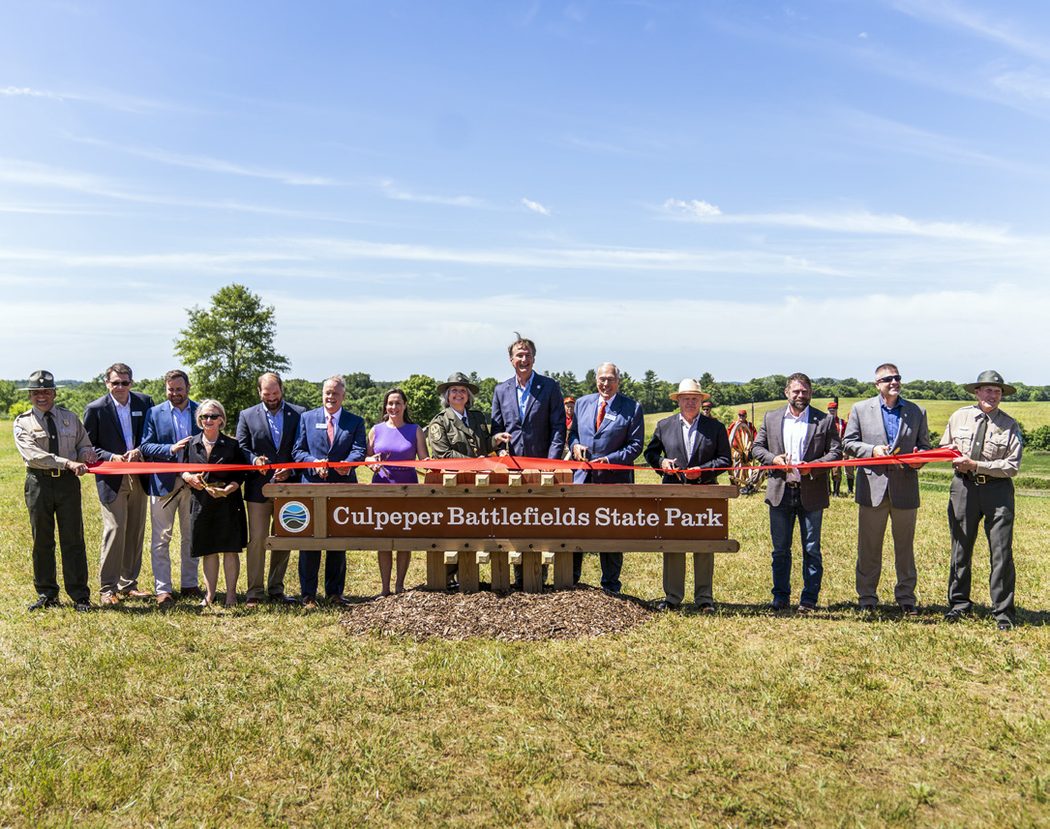
A particular highlight of the year was the dedication of the Culpeper Battlefields State Park, which marked the culmination of nearly three decades of preservation work by the Trust. The 43rd unit of the Virginia State Park system opened with more than 263 acres of saved land donated by the Trust and its partners centered on Fleetwood Hill at Brandy Station, with more than 2,000 more acres expected in the future.
The Trust also transferred significant landscapes totaling over 625 acres to the National Park Service in 2024 including properties at Chancellorsville within Fredericksburg and Spotsylvania National Military Park, Fort Gregg within the Richmond National Battlefield Park, Hatcher’s Run within Petersburg National Battlefield, Mill Springs Battlefield National Monument, Saratoga National Historical Park, Shiloh National Military Park, and Vicksburg National Military Park.
Digitally, Trust education efforts continued to expand in reach, surpassing more than 100 million views on YouTube, launched the Boom Goes the History podcast, and passed the milestone of sending 50,000 students to experience historic sites through the History Field Trip Grant Program.
On the legislative front, the Trust celebrated passage of the American Battlefield Protection Program (ABPP) Enhancement Act, a bipartisan reform bill sponsored by 67 senators and representatives. The legislation, passed as part of the Expanding Public Lands Outdoor Recreation Experiences Act, refines the already successful ABPP, going even further to ensure the preservation, restoration, and interpretation of America’s hallowed ground.
In early March, the Trust launched a campaign to save 161 acres across five tracts of Western Theater battlefield land. From Fort Hindman and Fort Henry on the Kentucky/ Tennessee border to Brown’s Ferry, Chattanooga, and Spring Hill in Tennessee, to Bentonville in North Carolina, each battlefield bore witness to the events that eventually propelled the war to its close.
The total land value for these tracts is a staggering $3.8 million. Fortunately, the Trust expects to obtain state and federal preservation grants along with a donation from one of the landowners, leaving just $70,000 left to raise.
At Fort Hindman, Kentucky, also associated with Fort Henry in Tennessee, the Trust is targeting a small but highly valuable waterfront tract for preservation, as the area is currently threatened by high-density residential development.