Forgotten Kansas Union Soldier and U.S. Senator
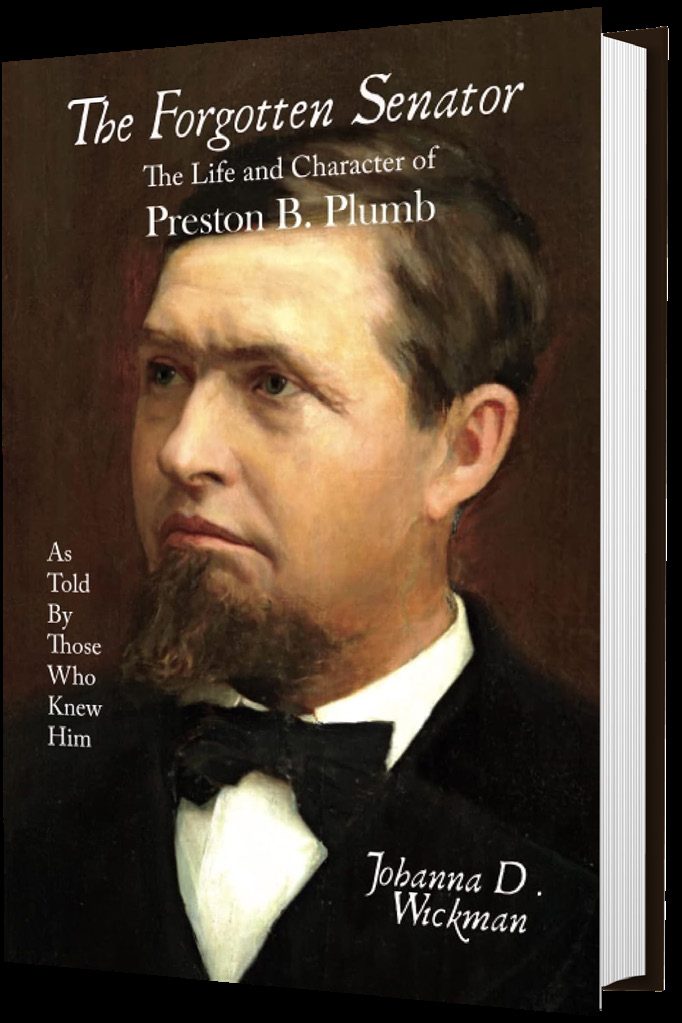
The Forgotten Senator: The Life and Character of Preston B. Plumb, by Johanna D. Wickman. Forward, acknowledgments, introduction, notes, photographs, drawings, bibliography, 364 pp., 2023, Bellis Perennis Publishing, www.prestonplumb.com, trade paperback, $29.95.
Reviewed by Joseph A. Derie
Preston B. Plumb was by turns a journalist, publisher, banker, merchant, Kansas state politician, Union soldier, and U.S. senator from Kansas. He was a founder of Emporia, Kansas, in the late 1850s and lived there for the remainder of his life except when serving in the Civil War and representing Kansas in the senate.
Plumb’s service during the Civil War was as an officer in the 11th Kansas Cavalry. It was the 11th Kansas Infantry when he was commissioned into it but was redesignated and mounted after the Battle of Prairie Grove. Plumb saw service as a company commander, regimental executive officer, and commander. He fought rebels, guerrillas, bushwhackers, and Native Americans after being sent to Camp Dodge, Dakota Territory, to guard the Overland Trail and its telegraph lines in early 1865. He saw hard service at the Battles of Cane Hill, Prairie Grove, and Westport. One of the most interesting parts of the book is about his commanding troops chasing Quantrill after they sacked Lawrence, Kansas.
The author states that she felt a biography of Plumb was due because of his service to Kansas as a businessman and politician, his Civil War service, and his service as a U.S. senator from Kansas at a time when U.S. senators were elected by the state legislature. In the Senate, where he served for almost 15 years before his death, he sat on several important committees where, among other things, he ramrodded the bill creating the Department of Agriculture, created forestry rules which later became the Forestry Service and was Chairman of the Senate Committee for Public Lands which set policy, rules and regulations for the settling the West. Wherever Plumb was, he was noted for his industry and ethics.
Rather than writing a traditional biography the author has chosen to tell his story using first-person sources from Plumb’s contemporaries, mined from various sources including the research materials from the long-out-of-print 1910 biography of Plumb written by an author hired by the family.
The Forgotten Senator: The Life and Character of Preston B. Plumb is written and presented in an interesting style. The reader sees Plumb as his contemporaries saw him. It will be of special interest to those with an interest in Kansas history; the Kansas, Missouri, and Trans-Mississippi Theatre during the Civil War; the Dakota Territory at the end of the Civil War; and late nineteenth-century U.S. politics. It is well recommended.
Captain Joe Derieisalongtime Civil Warbuffwitha specialinterestin Civil Warnavalhistoryandthe Civil War inthe West. Heisaretired USCG officerandalicensed officerofthe Merchant Marine, currentlyself-employed asamarinesurveyorandmarineaccidentinvestigatorin Portland, OR.
The Long Path to Rebellion in Missouri
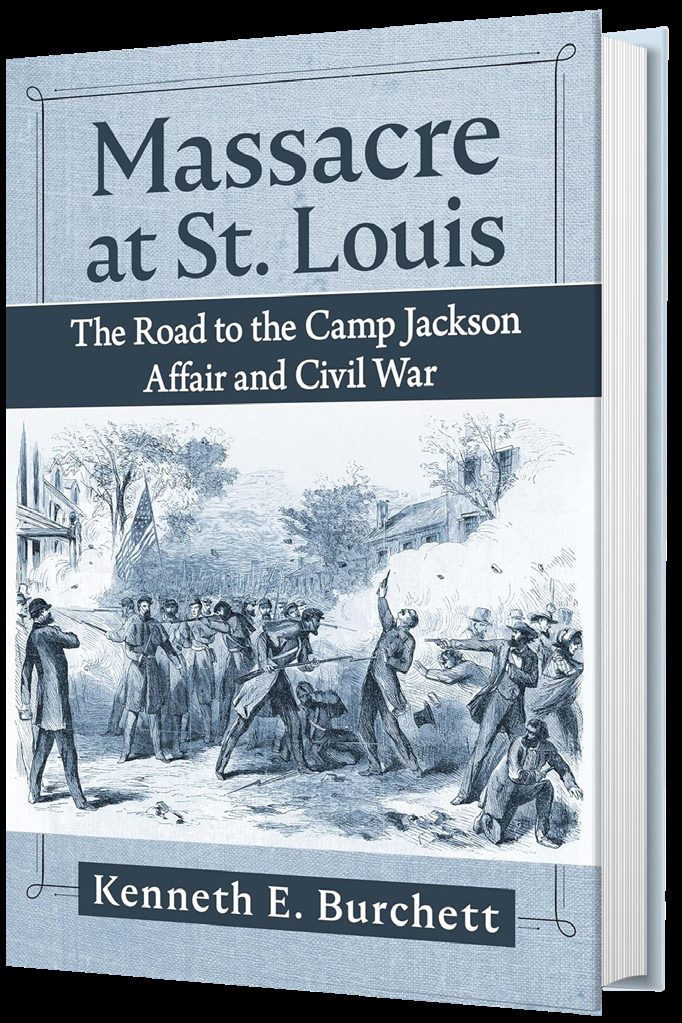
Massacre at St. Louis: The Road to the Camp Jackson Affair and Civil War. By Kenneth E. Burchett. 69 photographs, maps, notes, bibliography, index, 340 pp., McFarland & Co. Publishers, www.mcfarlandbooks.com, (7” x 10” softcover). $49.95.
In his newest book titled Massacre at St. Louis: The Road to the Camp Jackson Affair and Civil War, retired professor Kenneth Burchett offers readers what may be the most detailed and minutiae-laden account of antebellum Missouri in the opening month of the Civil War. The author asserts that during the forty years following the 1820 Missouri Compromise, that state had been a crisis in the making and then the storm center of rebellion.
The book is constructed in ten sections; each part covering broadscale subjects and events that transpired over the preceding four decades. The Missouri Compromise’s creation and repeal, the Kansas-Nebraska Act, John Brown, the ethnic German influence, among others, are all widely discussed. Most importantly, Burchett argues that the slavery issue was the omnipresent cancer lurking behind and within all others. These events slowly set the stage for the Civil War’s beginning scenes in Missouri and what led to the “massacre” at St. Louis and Camp Jackson.
The well-known core facts of the title events are how in May 1861, Union Captain Nathaniel Lyon and several hundred men went into St. Louis to secure that city’s federal arsenal and avert a secessionist takeover of Missouri. The military importance of the arsenal cannot be overstated. It was a major arms depot whose strategic location made it a crucial resource for control of water-borne traffic along the Mississippi and Missouri Rivers.
After safeguarding the arsenal, Lyon and about 6,000 newly-mustered in Federal volunteers then moved on May 10 against “Camp Jackson.” The camp was occupied by secessionist-leaning Missouri state militiamen. The camp was located in St. Louis’s Lindell Grove, about four and one-half miles from the arsenal and named for Missouri’s secession-leaning governor Clairborne Jackson. Those Missourians had, in fact, been plotting a takeover of the armory, though with ample well-trained U.S. Army regulars now stationed at the arsenal, such a takeover was unlikely. Lyon succeeded in forcing a surrender from the heavily outnumbered secessionist camp and in the process captured some 800 militiamen.
Following that showdown, Lyon’s men encountered crowds of angry citizens. After several pistol shots were fired from the mob, the Union soldiers responded in kind. According to some reports, the soldiers fired wildly into the now panic-stricken crowd that included unarmed women and children. The entire affair lasted only a few minutes. With an admirable amount of sleuthing, Burchett sifts through the conflicting eyewitness accounts to determine where and when all the firing came from. Based on his research, Burchett suggests that at least 50 civilians died from gunshot wounds with as many as another 150 wounded; all during the gunfight that became known in some quarters as the “St. Louis massacre.”
The actual military aspects of the Camp Jackson affair are explained by the author in exacting detail over the last fifty pages of the book. Therefore, most of this book is a detailed analysis of antebellum Missouri’s creation and development coupled with the swirling cascade of political events that led to the start of the Civil War. To wit, the Confederate firing on Fort Sumter occurs only after 155 pages of background context that is truly illuminating. This is the type of in-depth research that makes the reader realize that those pro-Union and Southern-sympathizing men did not just fall from the sky onto those deadly St. Louis streets.
text. There is no shortage of sourcing, either, as the book contains over 2,100 endnotes. An ample number of period street maps of St. Louis are also utilized on which the author has overlaid unit positions and routes of march.
While the May 10, 1861, events at Camp Jackson may be familiar to Civil War students, the in-depth analysis that Professor Burchett goes into in explaining how and why Missouri and St. Louis arrived at that fateful day is truly admirable. Massacre at St. Louis stands as a solid onevolume source for any reader with an interest in the Trans- Mississippi theater or Civil War-era Missouri.
Paul Taylorisanaward-winningauthorofninebooks pertainingtothe American Civil Warera. Hislatestbook, ’Tis Not Our War: Avoiding Military Serviceinthe Civil War North, waspublishedin June 2024 by Stackpole Books.
Seldom Written About Topic – A Must Read
Faith of the Fathers: The Comprehensive History of Catholic Chaplains in the Civil War. By Robert J. Miller. Bibliography, endnotes, index, appendices, photographs, tables. 480 pp., 2025. University of Notre Dame Press. www.undpress.nd.edu, hardback, $45.00.
The author of this excellent study of chaplains and chaplaincy is a retired Catholic priest who has studied his subject for two decades. Fr. Miller is a past president of the Chicago Civil War Round Table and the author of seven other books, one of which also relates to Civil War Catholic chaplains.
Fr. Miller begins his study with chapters providing basic data about the chaplains and their work. Most were immigrants from Europe. Many were members of religious orders (i.e., Jesuits, Franciscans, Dominicans, and other, lesser-known orders); others were diocesan priests, seconded from their regular parish duties. Official chaplains held the rank of captain. Some were regimental chaplains; others served in hospitals or were assigned to military posts. Many priests had no official status, but did chaplain duties when armies passed through or when temporary hospitals were established in their communities. Fr. Miller’s count includes a total of 126 Catholic chaplains, 74 Union, and 52 Confederate.
It was all tough duty, especially for the regimental chaplains, who went wherever the soldiers marched, sharing the hardships of the campaign. Priests were in short supply; all were overworked.
Of special interest are the accounts of two chaplains who ministered to prisoners, one a Southern priest who cared for the Federals imprisoned at Andersonville, the other a Northern priest who cared for Confederates at Camp Douglas.
The Catholic fathers preached, of course, as did their Protestant colleagues, but there was greater emphasis on saying Mass and administering the sacraments, central parts of the Catholic faith. It was common for Catholic chaplains to spend hours upon hours hearing confessions from men facing the likelihood of death in battle. During and after the fighting a regimental chaplain would be on the battlefield, tending to the wounded and dying, hearing their confessions and administering last rites. Soldiers also relied on priests’ non-spiritual aid, such as letter writing and delivering their pay and packages to express offices. Often, of course, they would see that a fallen soldier’s personal effects were sent to his family.
Several chapters are devoted to brief biographical sketches of all the chaplains, typically one page or two in length, covering their pre- and post-war lives as well as their service in the war.
Many of these sketches contain very interesting anecdotes, some of which relate to encounters with people well-known to students of the war. Philip Sheridan, Mary Surratt, Henry Wirz, William Rosecrans, David Stanley, James Longstreet, Edwin Stanton and other familiar names pop into the story from time to time. A priest’s encounter with Sheridan provides one good example. After being bamboozled by a Catholic Confederate chaplain, the angry general arrested the next one he encountered, a man wholly innocent of the acts that raised the general’s ire. After two months in prison the priest was released, and as he departed he gave the “ungentlemanly” general a serious dressing down. He also stubbornly refused to sign a loyalty oath.
Due in part to the hardships they endured, many of these men died early. Many others, however, lived long and productive lives after the war. A few were very prominent, including one who became the second American to become a cardinal.
The bibliography includes numerous secondary sources and about 20 primary sources, including letters, diaries and memoirs written by the chaplains and others.
Faith of the Fathers covers a lot of ground and tells a great deal about an aspect of the Civil War that receives scant attention. However, as thorough as it is, this work does not tell the whole story: in the epilogue Fr. Miller lists 20 areas related to the topic that call for more detailed scholarly attention.
Dominion of Starvation
The “Immortal Six Hundred” and the Failure of the Civil War POW Exchange Process. By John F. Schmutz. Illustrated, Notes, Appendices, Bibliography, Index, McFarland Publishing Company, www.mcfarlandbooks.com, 2025, 301 pp., hardcover. $75.
After learning that Union prisoners were placed in harm’s way outside Charleston, 600 Confederate officers were transferred from Fort Delaware to act as human shields in Charleston Harbor. They were placed in front of a federal battery bombarding Charleston into submission. Most of these Confederate prisoners had been captured at Spotsylvania Court House, Gettysburg, Petersburg, Port Hudson, and the Wilderness. Initially sent to Fort Delaware, they were transferred to Morris Island and eventually to Fort Pulaski.
Throughout their incarceration, this book paints a thorough picture, through voluminous primary source accounts, newspaper articles, medical reports, and postrelease interviews, of the horrible conditions of starvation, freezing temperatures, scurvy, diarrhea, and pneumonia experienced by the captives. The cruelty of commanders like Colonel Edward Hollowell, Major General John Foster, Secretary of War Edwin Stanton, and General Ulysses Grant prolonged the prisoners’ incarceration; adopting a policy of retaliation rations nearly starved them all to death. Thwarted at every attempt to strike a deal for a general exchange of prisoners, created conditions for meager, often spoiled, rotten, and wormy rations, which further increased sickness and death among the prisoners. In General Grant’s words, he was trying to prevent these prisoners from rejoining their units and prolonging the war.
Humanity gave way to military expediency. The original Dix-Hill agreement for prisoner exchanges, prompted by media coverage of prison camp horrors and public pressure, was ignored. The result was the ruined health and lives of prisoners who were kept in freezing conditions, poorly clothed, malnourished, and verbally abused. Their diets consisted of wormy crackers, spoiled meat, rancid meal, and brackish water. Once the prisoners’ suffering became known after the war’s end, the question arose, “How could civilized men treat their fellow man in such a cruel manner?” Ultimately, no Northern politician or military leader was held responsible for the systematic abuse of Confederate prisoners.
John Schmultz does an excellent job of telling, not only the story of the 600 immortals and their torture, but also a thorough analysis of the exchange process that failed to materialize. First-person accounts proliferate the book to tell the story from ex-prisoners’ pens. These stories are imbued with tales of daily hunger, verbal assaults, broken promises, and thwarted escape attempts.
An added bonus is an extensive appendix covering the postrelease lives of many of the immortal six hundred. Another appendix on Civil War prisons covers the horrible results of political decisions sanctioning retribution, starvation, and torture, both physical and psychological. While many books and articles have been written on Civil War prisoners of war, this book stands out as a comprehensive study, told in large part in the prisoners’ own words, adding a uniquely human picture to this wartime travesty. It is highly recommended for those wishing to explore the depths of man’s inhumanity to man.
Dr. Wayne L. Wolfis Professor Emeritusat South Suburban Collegeand Past Presidentofthe Lincoln-Davis Civil War Roundtable. Hehaswrittennumerousbooksand
For current events visit
Racing Schooner America Served the Confederacy and the U.S. Navy (Twice)
The Last Days of the Schooner America: A Lost Icon at the Annapolis Warship Factory, by David Gendell. Author’s note, forward, acknowledgments, introduction, notes, bibliography, index, 345 pp, 2024, Lyons Press, www.rowman.com, hardback, $34.95.
The racing schooner America was built in 1851 to race against the best British yachts. It won a race around the Isle of Wight in 1851 and was awarded a silver trophy. Since then, that trophy has been called the “America’s Cup” and is the most prestigious trophy in sailboat racing. Millions have been spent on state-of-the-art vessels from many countries to win that prize.
After that race America went through periods of boom and bust until its sad demise during WWII. Rescued from a mudflat in England, it was in Charleston in the early days of the Confederacy. Purchased by the Confederate government, it became a dispatch boat and blockade runner until being scuttled in a creek off the St. John River after the fall of Jacksonville, Fla.
Raised and taken into the U.S. Navy, it was armed and served as a blockader off Charleston until being sent North to serve as a training vessel for the U.S. Naval Academy, then in Newport, RI. After the war, it was purchased by Benjamin “Beast” Butler as his personal yacht. Refitted and sailing in style, it remained in the family until 1916.
The vessel returned to the Naval Academy as a training vessel after WWI, and was used until the early 1930s, when it was left to rot. In 1940, its history was noted and the Naval Academy contracted to have it rebuilt by the Annapolis Yacht Yard, a local boat yard. World War II intervened, and work on the vessel ceased while the yard built wooden PT boats and subchasers for the U.S. Navy. The neglected vessel was further damaged when the roof of the shed it was stored in collapsed due to snow accumulation. The damaged vessel was moved again and left outside. Eventually, it was determined that America was too damaged to repair and that it should be broken up to free up space for a PT boat to be built.
Some histories state that the vessel was burnt, ignoring the problems of burning a vessel in a boat yard. Witnesses still alive in the 1990s when the author began his research stated the vessel was broken apart in November 1942, and its remains were taken to a landfill. Souvenir parts of the vessel are still found in Annapolis and elsewhere. Much of the remaining part of the book is given over to the Annapolis Yacht Yard, and its work building wooden boats for the Navy in WWII.
The Last Days of the Schooner America is well written, well researched, and interesting. It is obviously a niche book of special interest to those with an interest in racing sailboats and the Schooner America itself, the Civil War in Florida, Civil War blockade runners and blockaders, and wooden boat building in WWII. It is well recommended.
Game-Changing Decisions at Galveston
Decisions of the Galveston Campaigns: Twenty-one Critical Decisions That Defined the Operations. By Edward T. Cotham Jr., Appendices, illustrated, notes, bibliography, index, University of Tennessee Press, utpress. org. 2024, 170 pp., softcover. $24.95 Reviewed by Wayne Wolf
Decisions of the Galveston Campaign is the twentieth book in the series that explores critical Civil War decisions that affected the outcome of battle, some intended consequences and some unforeseen results. As other volumes in this series, this book is not intended to be a comprehensive analysis of what happened. Rather it analyzes why events occurred as they did.
When Union forces captured Galveston, Texas, on October 8, 1862, the stage was set for a series of twenty-one critical decisions by Union and Confederate authorities that would ultimately lead to Confederate forces recapturing the city on January 1, 1863, and then holding it to the end of the war. Galveston thus became the last port open to the Confederacy.
While Jefferson Davis and Abraham Lincoln directed the strategic policy that made capturing Galveston (and preventing its capture) a goal, tactical decisions by Generals Nathanial Banks and John Magruder, and their subordinates, would ultimately decide the fate of Texas’ largest city. For example, a young lieutenant, Richard Dowling, and his forty soldiers, deciding to hold the fort at the Sabine Pass set the stage for recapturing Galveston. Likewise, General Magruder’s selection of Leon Smith to head the Confederate naval attack force proved crucial to altering the Union naval offensive when he courageously rammed the Harriet Lane and sent the remaining Union fleet fleeing Galveston Bay. The death of William Renshaw and the loss of the USS Westfield sent shockwaves through the Union fleet.
Additionally, Union Commodore Henry Bell’s timidity bought Southern troops time to reinforce shore defenses. General Nathaniel Banks’ decision to attempt to recapture Galveston with a two-pronged attack deprived both prongs of sufficient resources to achieve their objective. These game-changing decisions were made based on the best available, and usually incomplete, intelligence at the time. However, no one knew when they were made what the longterm consequences might be. Such is the nature of battle plans, where future implications cannot always be seen.
This book is clearly written, explores the various scenarios available to the decision makers, addresses the value of all alternatives, and thoroughly discusses the ramifications of the paths chosen. Yet, speculation still rests with the “what ifs” if another path were chosen. The reader is left with the available evidence to ponder this question. A walking tour guide of the battlefields and points of interest along the Texas coast is included. For any Civil War historian of Texas or of important naval engagements in the war, this book is a valuable resource and is highly recommended.
Dr. Wayne L. Wolfis Professor Emeritusat South Suburban Collegeandtheauthorofnumerousbooksand articlesonthe Civil WarincludingTwo Years Beforethe Paddlewheel, Heroesand Roguesofthe Civil War.
Nathan Bedford: First with the Most?
Reckoning with the Devil: Nathan Bedford Forrest in Myth and Memory. By Court Carney. Endnotes, index, photographs, bibliography: 232 pp., 2024, Baton Rouge, Louisiana State University Press, lsupress.org. Hardcover, $44.95.
Reviewed by Salvatore Cilella
Like most historical figures, Nathan Bedford Forrest, C.S.A., has been examined, re-examined, and studied throughout the past 160 years. He has most popularly been remembered as the perpetrator of the massacre at Fort Pillow, the originator of the term “The fustest with the mostes,” and the father of the Ku Klux Klan.
Forrest’s legacy was formed between 1868 and 1931 with four biographies. The last one, written by Andrew Nelson Lytle, solidified Forrest in myth and fact. All four downplayed his role as a master slave owner. After all, “he never broke up families” as he sold off a slave or two. (90) A later biography perpetuated the notion that despite his embrace of the institution of slavery, Forrest “was kind, humane, and extremely considerate of his slaves.” (83)
Court Carney, in his new book Reckoning with the Devil: Nathan Bedford Forrest in Myth and Memory, carefully and skillfully unravels the chameleon-like reputation of one of the South’s most colorful and menacing characters to come out of the Civil War. Carney bases his examination of Forrest on Forrest’s lucrative early slave trading in Memphis. He argues that occupation gave Forrest his credentials to join the Confederate Army, rise in the ranks, and achieve notoriety through his military achievements. He was also able to translate his early slave trading into an image of white, male superiority in post-war Memphis society.
Carney mines the available sources to probe Forrest’s reputation at Fort Pillow, his deification at Memphis in 1905, Forrest as history and fiction, Forrest’s hypersexuality, and