Civil War History of Charleston’s Castle Pinckney
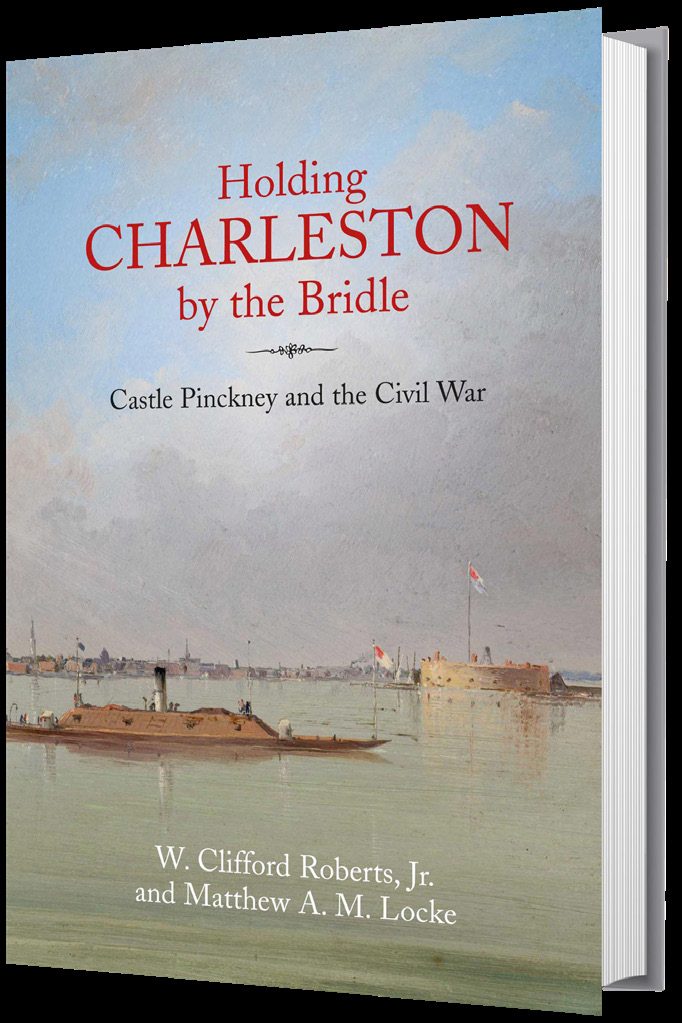
Holding Charleston by the Bridle: Castle Pinckney and the Civil War. By W. Clifford Roberts, Jr. and Matthew A. M. Locke. Map, glossary, illustrations, appendices, bibliography, index, 259 pp., Aug. 2024. Savas Beatie LLC, www.savasbeatie.com, $32.95.
Reviewed by C. Michael Harrington
This book is the first full-length history of Charleston’s historic Castle Pinckney. The book nicely complements Richard Hatcher’s recent book, Thunder in the Harbor: Fort Sumter and the Civil War I recommend adding Castle Pinckney to any tour of Charleston’s Civil War fortifications. Reading this new title before you go will make your visit to Castle Pinckney even more rewarding.
The authors tell the story of Castle Pinckney chronologically, beginning with building the fort on the eve of the War of 1812 as part of America’s “second system” of coastal fortifications. Named for South Carolina’s Revolutionary War general, Charles Cotesworth Pinckney, the horseshoe-shaped, two-tiered fort was built mostly of brick and stone and situated on Shute’s Folly, a marshy island near the center of Charleston harbor.
As the antebellum period wore on, Castle Pinckney gradually lapsed into a sleepy artillery post that sometimes went unmanned and, at other times, served as a prison for hapless POWs of the Seminole Wars, a kind of nineteenthcentury Guantanamo.
Half the book’s 14 chapters focus on Castle Pinckney during the Civil War. A week after South Carolina’s secession from the Union on Dec. 20, 1860, Charleston militia took bloodless possession of the nearly abandoned Castle Pinckney. Southern troops would hold the fort continuously until Confederate forces evacuated Charleston in mid-February 1865.
During the nearly four years of war, Castle Pinckney played a secondary yet significant role to Forts Sumter, Johnson, and Moultrie in defending Charleston and its harbor. Its guns seldom fired, and the fort avoided concentrated bombardment. Nonetheless, sporadic Federal artillery fire progressively reduced Castle Pinckney’s masonry walls, requiring extensive re-enforcement with earth and sand. Much like Fort Sumter, the war saw Castle Pinckney progress from a militarily obsolete brickwork into a modern earthen battery.
The three concluding chapters of the book recount the checkered history of Castle Pinckney since the end of the Civil War. Used during Reconstruction as a prison for both civilians and soldiers, for nearly 40 years thereafter the fort served as a supply depot for the U.S. Lighthouse Service. After World War I, control of the fort bounced around among several generally disinterested federal and state authorities before coming to rest with the Sons of Confederate Veterans. A non-profit foundation organized by the SCV in 2013 is nowadays responsible for the fort’s stewardship, the biggest challenge being the on-going struggle to preserve the fort from rising sea levels that have reduced Shute’s Folly Island from 224 acres to barely 40.
Like Savas Beatie books generally, this book is artfully crafted. Set in double-spaced, 12-point type, the text is easy on older eyes. Notes are placed at the foot of pages, sparing readers the tedium of tracing them to the back of the book. The only map in the book depicts Charleston harbor in 1863. The forepart of the book also includes a helpful glossary of significant fortification terms like “Martello tower” and “fraise” as well as thumbnail biographies of the book’s main characters. Profuse photos and other illustrations complement the text; all are remarkably sharp and clear. Eighteen appendices present a wide variety of supplemental material, including the fort’s 1861 armaments inventory, muster rolls or rosters of Confederate troops stationed at the fort, and lists of the 54 Mass. Inf. POWs confined there during the war.
The authors, Roberts and Locke, write well. Both reside in the Charleston area. A published Civil War historian, Roberts is active in historical preservation. Locke serves as an appointed Guardian of Castle Pinckney and works there with other archaeologists and conservationists.
As the 10-page bibliography attests, the authors researched their subject to a fare-thee-well. Besides combing through multitudinous period newspapers and other printed material, they mined manuscript collections and investigated multiple websites.
I recommend this book as a nice addition to the historiography of the four-year Federal siege of Confederate Charleston. Prospective visitors to Charleston, including those who had not considered including Castle Pinckney in their itineraries, will find this book especially worthwhile.
C. Michael Harringtonisaretiredlawyer, residingin Houstonand Galveston. Theauthorofseveralpublished articleson South Carolinasoldiers, Mikehaslectured to Civil Warorganizationsin Houstononmultiple topics, including Yale’s Confederatealumniand South Caroliniansinthewar. Mikeisalsoapastpresidentof the Houston CWRT.
The Story Behind An Extraordinary Photograph
For This We Fight: Saving a National Treasure. By Ross J. Kelbaugh. Bibliography, index, illustrations, appendices. 69 pp., 2023, privately printed, hardcover $24.95, paperback $14.95.
Reviewed by Jonathan W. White
In 2006, I published an essay called “An Unlikely Database” in Perspectives on History: Newsmagazine of the American Historical Association in which I argued that eBay could be “an unprecedented research tool” and an “an ever-changing ‘library collection’” for scholars who were willing to patiently and consistently wade through it. Indeed, if historians are disciplined in how they search on eBay, they can find manuscripts and artifacts that will change the way we think about the past. For This We Fight: Saving a National Treasure is a testament to the power of eBay as a tool for preserving history.
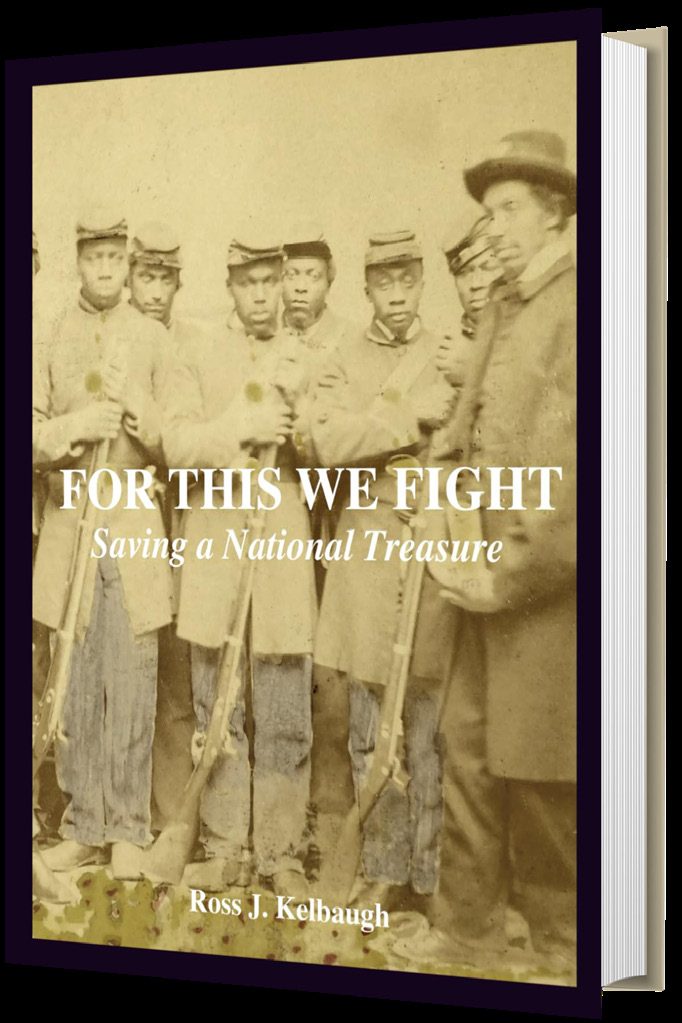
In 2011, Civil War photography collector Charles T. Joyce found an extraordinary image on eBay, featuring twelve identified black men who served in the Union army.
The photograph had been given to U.S.
Christian Commission delegate Francis Huntington Snow by one of the men in the image. Snow recorded each man’s name on the mount and left it to his daughter, along with other photographs and a wartime ledger. Snow’s daughter eventually put these items in storage in Kansas. When she instructed the storage company to trash them because they were too expensive to ship, the shipping agent disregarded her instructions and kept the items in his attic. Years later, his descendants discovered them in the attic and, being told that they were of some value, consigned them to be sold on eBay. Joyce purchased them, then recently sold them to the author of this book, Ross J. Kelbaugh, who plans to transfer them to the National Gallery of Art so that they can be preserved, studied, and enjoyed by future generations.
The photograph was taken at L’Ouverture Hospital in Alexandria, Virginia, which had been built at an old slave market at 1315 Duke Street; the building is now owned by the City of Alexandria and operates as the Freedom House Museum. Kelbaugh rightly notes that this image is “the only known copy of a group of U.S. Colored Troops under arms where they are all identified.” Ronald Coddington, editor of Military Images and one of the most prominent collectors of Civil War photography, published the photograph in his magazine in 2016, noting that it is “without a doubt one of the most historically significant Civil War images to surface in recent times.”
The men featured in the image were part of a burial detail. Some had been born free, while others had emerged from slavery. They served in seven different U.S. Colored Infantry units (the 19th, 22nd, 26th, 27th, 28th, 30th and 31st). Several had been wounded at the Battle of the Crater on July 30, 1864. The most prominent member of the group, Rev. Chauncey Leonard, was an army chaplain who had several interactions with Abraham Lincoln.
The book includes a brief biographical sketch of each man. Supplementing the history and biographical sketches are excerpts from Francis Snow’s diary, such as what he wrote on August 9, 1864: “No visitor at L’Overture [sic] Hospital would for a moment cherish the shadow of a doubt concerning the bravery of the negro troops on Sat. July 30th [at the Crater]. The charge is utterly false that the battle was lost on account of their cowardly behavior.” One wishes Kelbaugh had included more of Snow’s diary entries in the book. They would have made For This We Fight a valuable primary source for students of the Civil War.
For This We Fight could be better organized. For instance, Kelbaugh mentions a burial protest petition throughout the text but does not explain what it was until chapter 6. He also could have benefited from consulting recent scholarship on African Americans during the Civil War. For example, the section on Chauncey Leonard cites a book from the 1880s rather than the recent books on Lincoln and African Americans that offer important new information about Leonard’s life, Leonard both wrote to and met with Lincoln. Nevertheless, this book tells a fascinating story of an important photograph. It is amazing to think that the image came so close to being thrown away, and that it was saved through an online auction on eBay.
Jonathan W. Whiteisprofessorof American Studies at Christopher Newport Universityandtheauthoror editorof 19 books, includingA Greatand Good Man: Rare, First-hand Accountsand Observationsof Abraham Lincoln (2024), co-editedwith William J. Griffingof Spared & Shared. A Greatand Good Manisacollection ofpreviouslyunpublishedprimarysourcesabout Lincoln, mostofwhichappearedoneBay.
Untrained Militiaman to Major General
Author James Pula, professor emeritus of history at Purdue, has given us a superb military biography of Daniel Butterfield, a general with whom most of us are not wellacquainted. Dr. Pula notes that while Butterfield “is often mentioned in passing in books and articles, few authors have examined his various roles in detail.” That situation is now remedied.
In his late 20s and working as a superintendent in one of his father’s several business enterprises, Butterfield joined the militia and was elected colonel of the 12th New York State Militia in 1859. He devoted himself to the serious study of the military art and, with war on the horizon, trained his unit to the highest standard. As the war progressed, the self-taught officer served in various capacities in both the Eastern and Western Theaters. He earned a commission in the regular army and commanded troops at the regimental, brigade, division, and corps levels. The rapid rise of this amateur raised some eyebrows and caused some consternation among the West Pointers. The units he led fought in the Peninsula Campaign, and at Seven Pines, the Seven Days Battles, Antietam, and Fredericksburg (where he commanded the V Corps). He served as Maj. Gen. Joseph Hooker’s chief-of-staff at Chancellorsville and remained in this position under Maj. Gen. George Meade at Gettysburg.
After Gettysburg, Butterfield went to Tennessee with Hooker, again as his chief-of-staff. Although he preferred a combat role, he served with distinction where he was needed. Later, during the Atlanta Campaign, Butterfield commanded a division in the Army of the Cumberland under Maj. Gen, George Thomas.
Beset with various illnesses, Butterfield took sick leave in June 1864 before the climactic battles around Atlanta. Afterwards he undertook several assignments but did not return to the field during the war’s last months.
Weaving the details of Butterfield’s story into the overall narrative, the author describes his subject’s various roles and assesses his performance. Butterfield wins high marks both as a commander in combat and as chief-of-staff. Pula goes into some detail about Butterfield’s work in the latter role, under Hooker, Meade, and Hooker again. For those readers who never gave much thought to all the things a chief-of-staff did, this book is a good place to learn.
No career is free of disappointments and few are not peppered with a controversy or two. Pula also covers these aspects of Butterfield’s record. Two disappointments involve Meade, who took Butterfield’s place as commander of the V Corps after Fredericksburg and who, when in army command, did not retain Butterfield as his chief-of-staff after Gettysburg. It seems that Butterfield held a grudge: in his testimony before the Joint Committee on the Conduct of the War he sided with the anti-Meade faction, supporting accusations against Meade that Pula says, “he knew were false allegations.”
In addition to leading troops in battle and carrying out the demanding duties of a chief-of-staff, Butterfield made other contributions to the war effort. Pula covered these as well. Butterfield was responsible for the composition of “Taps,” a tune we all know. He introduced a bugle call unique to his own brigade, so his men would be alerted that the bugle command they were about to hear was meant for them. In 1862, he wrote Camp and Outpost Duty for Infantry, a manual that was adopted army-wide. He devised badges to identify corps and division, symbols that allowed quick identification of units and, as well, promoted esprit de corps.
The final chapter of Daniel Butterfield summarizes the general’s long and distinguished postwar career, years devoted to business, philanthropy, civic leadership, and veterans’ affairs. Butterfield died in 1901. His widow lobbied successfully to get permission to bury the general at West Point, an honor rarely extended to men who were not graduates of the Academy. Pula does not record the reaction of the surviving professional military men who, decades before, were rankled by the swift rise of this amateur.
Charles Cowlam: Tinker, Tailor, Soldier, Spy
A Wonderful Career in Crime: Charles Cowlam’s Masquerades in the Civil War Era & Gilded Age. Frank W. Garmon Jr. End notes, index, photographs, bibliography; 242 pp., 2024, Baton Rouge, Louisiana State Press, https://lsupress.org/. $45.
Reviewed by Salvatore Cilella
In 1980, Frank Abagnale published his “autobiography” entitled “Catch Me If You Can.” According to Abagnale, he impersonated a Pan Am airline pilot while passing off $2.5 million in bad checks. He bragged that he passed himself off as a teacher and a lawyer. In 2002, Stephen Spielberg brought Abagnale’s story to the screen starring Leonardo DiCaprio in the lead role. Even though much of Abagnale’s story was tall tales, he served prison time in Europe and the US for the provable ones. Abagnale’s 20th century journey was nearly a mirror of Charles Cowlam’s 19th century escapades.
The Civil War, Reconstruction, Jim Crow, and the Gilded Age, all crammed into the last half of the 19th Century, offered scoundrels like Cowlam to be anyone they wanted to be. Throughout his career, Cowlam outperformed Abagnale. He was alternately and sequentially, a convict, spy, detective, candidate, swindler, bigamist, and Civil War veteran. He was a confidence man and flimflam artist in the broadest sense of the word. According to author, Frank W. Carmon, Jr., “he possessed a remarkable talent for blending into new surroundings and ingratiating himself with the leading power brokers.”
Only 19 when he was convicted in a Norfolk, Va., courtroom for stealing $4,000 in postal revenues from the post office in Portsmouth, after being incarcerated in Ohio for breaking and entering and robbing a household in Ohio in 1856, after his arrest in Michigan, his birthplace, in 1853. The postal gig landed him in Federal prison in Richmond, but his plea for mercy moved the jury to petition President Buchanan to release him.
Buchanan was preoccupied with a nation slipping away and never acted on the request. Then Cowlam’s incarceration prompted the strangest tale of all. From his jail cell, in the spring of 1861, he petitioned newly elected President Abraham Lincoln for a pardon. His appeal was successful with one major detail: Virginia seceded from the union on April 17, and Lincoln’s response came in May. Once it came, Governor John Letcher refused to honor it on the basis that Virginia had left the Union, and he had no choice but to reject it. Cowlam then appealed to Jefferson Davis, who granted him a pardon and release from prison. The final solution placed Cowlam in the unenviable position of being rejected by one president and then pardoned by two other presidents within a few years.
Additionally, Cowlam was able to solicit some of the more well-known figures of the time to plead his case. “Michigan congressman Francis W. Kellogg appealed to Buchanan’s secretary of state, Lewis Cass…to intercede on Cowlam’s behalf.”
Cowlam’s journey through the federal system prompts questions concerning prisoners in southern federal facilities after the outbreak of war. What happened to them? Were they left to rot? Were they transferred to local jails?
Cowlam’s release was the start of a series of sham, conman episodes that built on one another. It began when he pawned himself off as a Union spy who spent much of the war behind enemy lines, and he claimed he had information pertinent to the Lincoln assassination board of inquiry. That experience led to, preposterously, positions as a detective with the Internal Revenue Service and the British government in Ireland and England.
Returning to America, within the context of reconstruction, Cowlam next became a U.S. Marshall in Florida, an appointment from President Ulysses Grant. He convinced Florida Republicans to let him run for congress. When the Federal Marshall deception was uncovered, and Grant reversed his decision, Cowlam disappeared only to resurface in New York City where he set his conman sights on the well-to-do. As author Garmon points out “New York was the ultimate stomping ground for a nineteenth-century charlatan. Cowlam profited from the anonymity that the city offered.” There he founded a fraudulent movement called the Order of the Patrons of Industry, patterned after the farmer’s organization The Grangers, and ostensibly to help urban workingmen. He started a newsletter called the Scythe which promoted the organization’s objectives. The uncovering of his scheme is a classic Hollywood combination of Laurel and Hardy and a tabloid expose. Author Garmon must have had a terrible time keeping a straight face while researching and writing this section.
Cowlam wasted no time in New York. At night, he took to the bright lights and lonely, vulnerable women, a few of whom he was simultaneously married, becoming a serial bigamist.
If Cowlam’s life was a black-and-white Saturday afternoon-at-the-movie serial, the final act was a grand ending. In 1886, he presented himself to the Central Branch of the National Home for Disabled Volunteer Solders in Dayton, Ohio, as Union Colonel Livingston Grahame! He claimed that a “paralysis of the brain,” prevented him from revealing his military service to authorities.
Author Garmon has done a masterful job in pulling together the slim strands of evidence of an outrageous chameleon who lived a charmed life in a country in turmoil. He is an excellent narrator who must have had a wonderful time undertaking this project. This is simply an enjoyable and well-documented book and look at late 19th century America. The Wonderful Career of Charles Cowlam is a wonderful read. America loves its con men.
After 43 yearsinthemuseumfield, Cilelladevoteshis timetocollecting Americanprints, maps, andwriting. Hehaswrittenextensivelyon Emory Upton: Upton’s Regulars: A Historyofthe 121st New York Volunteersinthe Civil War(Kansas, 2009); atwo-volumeCorrespondence of Major General Emory Upton, (Tennessee, 2017), receivedthe 2017–2018 American Civil War Museum’s Founders Awardforoutstandingeditingofprimary sourcematerials. Heedited Upton’sloveletters 1868- 70 tohiswife—Till Death Do Us Part(Oklahoma, 2020) and The Memoirsof Dewitt Clinton Beckwithof Upton’s Regulars (McFarland, 2023).
Lynchburg Prisoner of War Camp an Exception to the Rule
Reviewed by Jonathan A. Noyalas
On September 5, 1864, a train carrying approximately 400 Union prisoners of war (POWs) arrived in Annapolis, Maryland. Once they received appropriate medical care, scores of these veterans shared their stories about the horrors they experienced in prison camps in the Confederate capital and Lynchburg, Virginia. One veteran, according to a newspaper correspondent for the pro-Union Vicksburg Herald, reported twelve days later that “the condition of the Union prisoners at Lynchburg is more horrible even than those at Libby prison.” While this statement may not be surprising, this thoroughly researched work contests the idea that the prisoner-of-war camp in Lynchburg, established in 1862, was even remotely similar to such hellholes as Andersonville, Libby, or Belle Isle.
Clifton Potter, Jr., retired from the University of Lynchburg, aims to reveal that the experiences of thousands of POWs in the Lynchburg camp were remarkably better than elsewhere throughout the Confederacy. In advancing this argument, Potter corroborates historian William Hesseltine’s nearly century-old argument that the horrific experiences Union prisoners of war endured did not stem from the Confederacy’s sinister desire to punish Union soldiers captured in battle. Instead, it resulted from “the Confederacy’s poor planning, bureaucratic incompetence, and a critical lack of resources.”
Potter cogently asserts that the camp at Lynchburg proved an exemplar of how prison camps should be operated. In addition to impeccable management beginning with Colonel George Gibbs in 1862, Potter convincingly demonstrates how Lynchburg’s role as a hub for Confederate medical care where thirty-two structures served as Confederate general hospitals by the war’s end, contributed mightily to high survival rates among Union POWs sent to the “Hill City.” For example, during the period from mid-June to mid-August 1862, the mortality rate for Union POWs was 1.56%, significantly lower than other camps throughout the Confederacy.
While the author ably demonstrates that Union soldiers confined in Lynchburg had a significantly better chance of surviving their captivity, Potter does not minimize Union prisoners’ sufferings. For some, such as George Watson, a veteran of the 90th Pennsylvania Volunteer Infantry wounded in the right leg and captured at the Battle of Wilderness, survival depended upon enslaved people. After Watson connected with a childhood friend, George Gamble, who worked at the Lynchburg Locomotive Works and loaned Watson $200, Watson relied on the help of an unidentified enslaved woman to acquire things that aided his recovery. In addition to procuring crutches, the woman purchased food to supplement Watson’s daily diet of pork and cornbread.
This book’s strength undeniably rests upon the author’s stellar exploration of the Lynchburg camp, but it offers appreciably more. Beyond an overview of the 1864 Lynchburg Campaign, in which Confederate General Jubal Early bested his counterpart, Major General David Hunter, the book offers important insight into Lynchburg’s early history. The author’s exploration of Lynchburg during the secession crisis is particularly notable. Additionally, the book’s concluding chapter offers valuable details about the war’s aftermath in Lynchburg, including the work of the Freedmen’s Bureau in educating black people. An appendix of burial records for Union POWs who died in Lynchburg enhances this superb study.
Today, few vestiges of the Lynchburg prisoner-of-war camp, which occupied approximately thirty acres, remain. The area that once served as the camp is currently home to E.G. Glass High School. Potter’s exceptional history, worthy of much praise and little criticism, has rescued this camp’s history and the stories of the thousands who passed through it from the depths of historical obscurity. Those interested in deepening their understanding of POW camps and the Civil War era in Virginia will find Potter’s skillfully researched and engaging study beneficial.
Jonathan A. Noyalasisdirectorof Shenandoah University’s McCormick Civil War Institutein Winchester, Virginia, aprofessorin Civil War Era Studiesat Shenandoah University, andfoundingeditor ofJournalofthe Shenandoah Valley Duringthe Civil War Era. Heistheauthororeditorofsixteenbooks, includingmostrecently“The Blood-Tinted Watersofthe Shenandoah,” publishedby Savas Beatie.
A successful general in the Civil War, Adelbert Ames became a central personage in Mississippi’s Reconstruction politics
Adelbert Ames, the Civil War, and the Creation of Modern America. By Michael J. Megelsh. Photos, maps, notes, bibliography, index. 320 pp., 2024. The Kent State University Press. www.kentstateuniversitypress.com. Paperback. $39.95.
Reviewed by Robert L. Durham
Born in 1835 on the rocky coast of Maine, Adelbert Ames was much more worldly than others his age. His father, a ship captain, often took his family along on his journeys. A sailor in his own right, Adelbert became a mate on a clipper ship, and a merchant seaman on his father’s ship.
Ames entered West Point in 1856 and graduated in May 1861, fifth in his class. Commissioned in the artillery as a lieutenant and assigned to the 5th U.S. Artillery, Ames was wounded in the thigh at the Battle of 1st Bull Run. He was brevetted major for his actions in the battle and would later, in 1893, receive the Medal of Honor. After convalescence, Ames saw action in the Peninsular Campaign, being commended and receiving a brevet promotion to lieutenant colonel for his deeds at Malvern Hill.
Next promoted to colonel of volunteers, he received command of the 20th Maine Infantry and molded them into a top-notch unit. Initially, the men of the 20th disliked their young colonel but eventually grew to know the value of the discipline Ames insisted upon. Ames and the men of the 20th developed a love that endured throughout the war and afterward when Ames attended their reunions.
The first action of Ames and the 20th Maine was at Fredericksburg, where they participated in one of the hopeless charges on Marye’s Heights. Ames was promoted to brigadier-general in time for the Gettysburg campaign. Assigned to a division in General Howard’s Corps, he fought in the disastrous defense of Barlow’s Knoll. When General