John McElroy’s Andersonville Memoir (1879)
A curious calculation has passed through our mind, based on this information.
We find that this would make 1800 feet, equal to 600 yards, or more than a quarter of a mile of dead Yankees.
A procession of wagons, one to each man, reckoning 20 feet to the wagon, would make a line 6000 feet or more than a mile long.
To bury them side by side, would require a trench 600 feet long, equal to 200 yards, 7 feet wide and five feet deep.
It would require 120 men to dig the graves.
200 carpenters to make boxes. 25 drivers to the wagons.
25 assistants to bury them.
At 50 feet to each coffin the sum total would be 15,000 feet.
To the funeral cortege we will allow for charity’s sake, 00000000 mourners.1
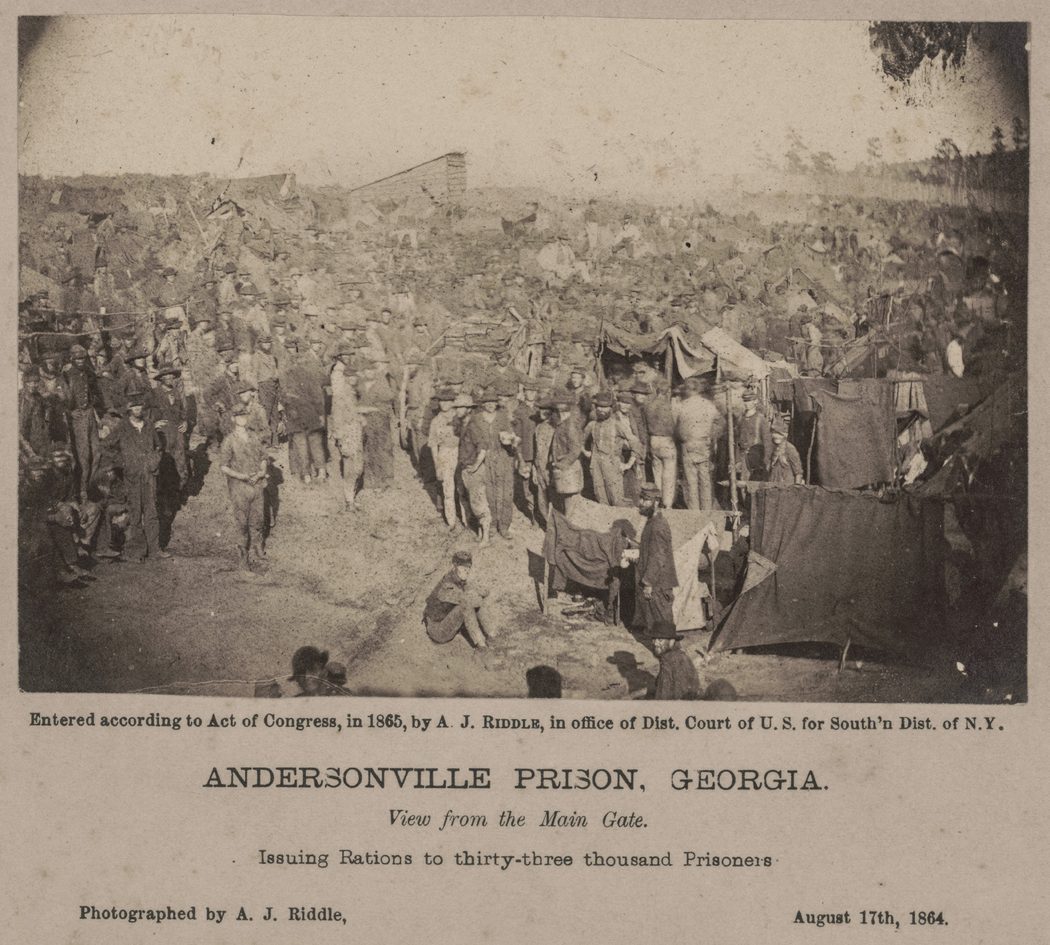
Thus did the Atlanta Daily Intelligencer on August 19, 1864, celebrate the horrendous mortality among Union prisoners confined at Camp Sumter, the Confederate prison facility near Andersonville, a hundred miles southwest of Atlanta. It thus cannot be said that wartime Southerners were unaware of what was going on at one of the conflict’s deadliest prisons. Indeed, amidst the intense passions prevalent in the war’s now-third year, celebrating dead enemy soldiers could be understandable, if today morally reprehensible.
The war was not even over when prisoners of war of both sides began writing lurid accounts of fiendish mistreatment at the hands of their captors.2 If the South had Andersonville, the North had Elmira, whose 24 per cent death rate exceeded that of Camp Sumter.3 To Americans riled with wartime hatred of the enemy, reading about shocking prison conditions stoked intense passions anew. Yet newspapers such as the New York Times and Richmond Dispatch accused their governments of coddling enemy POWs.4 Vengeful partisans could even take satisfaction that so many enemy soldiers died in confinement. (Historians count 30,000 Northern, 26,000 Southern.5)
Thus the literary stage was set for ex-Rebels and former Yankees to tell harrowing stories of their captivity. Decimus et Ultimus Barziza (one of the war’s great names) wrote of his stay at Johnson’s Island in 1865.6 Willard Glazier’s The Capture, the Prison Pen, and the Escape came out the next year, relating how, after his escape from a South Carolina encampment, blacks helped guide him to safety.7
The Andersonville bookshelf starts with Eugene Forbes, Diary of a Soldier (1865) and includes the memoir by Warren Lee Goss of the 2nd Massachusetts Heavy Artillery (1867).8The Southern Side: or Andersonville Prison (1876), by R. Randolph Stevenson, shows that just a decade after Appomattox, Northerners and Southerners were arguing about Andersonville mortality and who was to blame; Stevenson was in charge of the prison hospital in August 1864.9
In steps John McElroy’s Andersonville.10
McElroy was born in Kentucky in 1846. He was living in St. Louis working as a printer’s apprentice when the war broke out. Though just sixteen in 1863, he enlisted as a private in the 16th Illinois Cavalry. In a skirmish in southwestern Virginia, January 1864, he was captured, sent to Richmond, and for a short while was imprisoned there. In February he was one of the first Union captives to be transferred to the brand-new Rebel stockade near Andersonville. He suffered through the terrible summer of 1864, committing to memory the harrowing captivity he would later write about.
McElroy was transferred that October to a new Rebel prison in southeast Georgia, then to several others before the war ended. Afterward he moved to Chicago and resumed printing work before resettling in Toledo, Ohio, where he became an editor of the Toledo Blade. In 1884 he moved his wife and family to Washington. There
he became managing editor, then proprietor of the National Tribune, the weekly paper dedicated to publishing Union soldiers’ recollections.11
As a writer John McElroy was quite eclectic. A novel, The
Red Acorn (1883), follows the Army of the Cumberland’s First Division, Fourteenth Corps through Stones River.12 In 1896 McElroy’s History of Slavery in the U.S. explained that cotton was languishing in the South when Eli