April 2024 Hell’s Infernal at Gettysburg
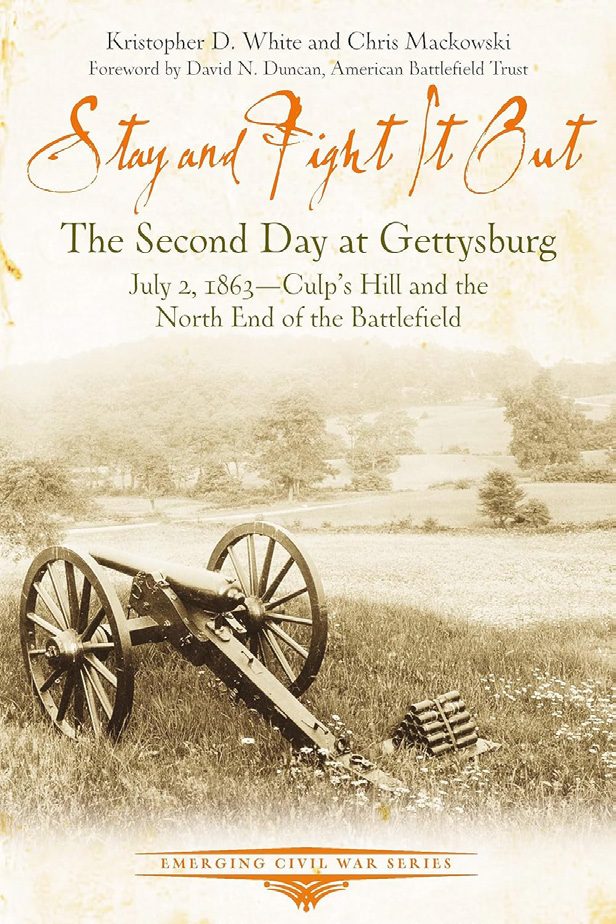
Stay and Fight It Out: The Second Day at Gettysburg, July 2, 1863—Culp’s Hill and the North End of the Battlefield. By Kristopher D. White and Chris Mackowski. Illustrated, Appendices, Savas Beatie, www.savasbeatie.com/ 2023, 168 pp., softbound, $16.95.
Reviewed by Wayne L. Wolf
As Gen. Robert E. Lee spent the night of July 1, 1863, formulating his battle tactics, while in physical discomfort, Gen. George Meade, having arrived late on the battlefield, began consolidating thousands of reinforcements in strategic positions. Gen. Meade’s immediate thought was to attack the Army of Northern Virginia and halt the progress the Rebels had achieved on July 1, 1863. Topographical impediments, and an early morning attack by Gen. James Longstreet on the Federal left, tactically dictated a defensive posture. Cemetery Hill, McNight’s Hill, and Culp’s Hill became the Union defensive line where Gen. Meade could “stay and fight it out.”
As Day 2 dawned on Gettysburg, Confederate forces attacked and advanced. Each thrust was repelled, leaving the oak and hickory forests looking like a desolate and forbidden picture of carnage. Cemetery Hill and Culp’s Hill had provided the Union with clear fields of fire, a series of stone walls for protection, and a height advantage over the charging Rebels. The Yanks likewise controlled all three roads by which supplies and reinforcements could be fed to Meade’s troops.
Publishers/Authors Send your book(s) for review to:
Mount Pleasant, SC 29466 April 2024
While July 1 had belonged to the Confederates, July 2 solidified the Federal defensive positions and held the rebels to their successes at Devil’s Den, the Peach Orchard, lower Culp’s Hill, and portions of the Emmittsburg Road. Gen. Meade’s commanders all agreed they were in a strong position to defend against any attack. Likewise, they had cemented two of their objectives, secure Baltimore and Washington and keep their lines of communication and retreat open. Conversely, Gen. Robert E. Lee had failed to alter his flawed attack plan and decided to let it play out without the necessary cohesion or coordination. This set the stage for the disaster on Day 3.
Included in this book are four appendices that lay out walking tours of downtown Gettysburg, a driving tour of Culp’s Hill, the extensive efforts to preserve Culp’s Hill, and the early art and photography of Culp’s Hill and East Cemetery Hill. These allow the visitor to experience both the battle’s movement and the human side of the conflict. As is the case with previous literary endeavors by Kristopher White and Chris Mackowski, they utilize extensive research, primary source material, photography, and human interest tidbits to craft a superb, readable account of the crucial northern flank on the second day at Gettysburg. This book is part of the Emerging Civil War Series, and like the other volumes in this series, deserves a place on the shelf of every historian interested in Gettysburg. The authors, and publisher Savas Beatie, deserve praise for their continuing efforts to tell the story of the Civil War factually, dispelling myths that have no basis, and painting a picture of the sacrifices of the men who fought for their values, homes and country.
Wayne L. Wolf is Professor Emeritus at South Suburban College and Past President of the Lincoln-Davis Civil War Roundtable. He is the author of numerous books and articles including Heroes and Rogues of the Civil War, They Saw the Elephant, and The Last Civil War Scout.
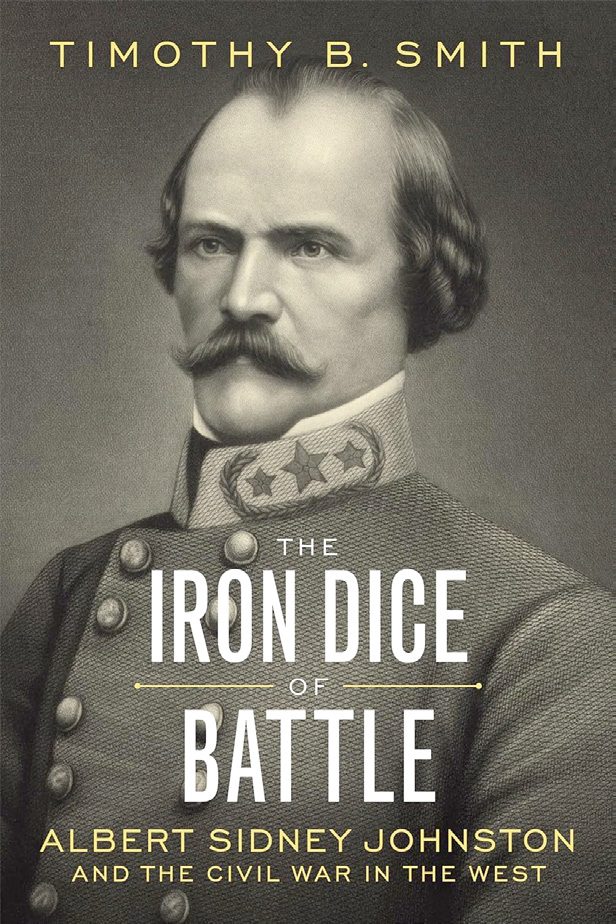
The Iron Dice of Battle: Albert Sidney Johnston and the Civil War in the West. Timothy B. Smith. Maps, photographs, bibliography, endnotes, index. 248 pp., 2023. Louisiana State University Press. lsupress.org. $39.95, hardcover.
At the outbreak of the Civil War Albert Sidney Johnston was considered by many to be the South’s premier soldier. His death at Shiloh and the loss of that critical battle were serious blows. It was thought, during and after the war, that if only a bullet had not pierced an artery in Johnston’s leg on the Shiloh’s first day, things could have been different.
Timothy Smith is an historian at the University of Tennessee at Martin and a prolific author. In his newest work Smith analyzes Johnston’s career and assesses the general’s qualities as a commander. Was he as capable as his contemporary and postwar supporters claimed? How valid are the harsh critiques of some modern historians? How serious a setback did the Confederacy suffer when Johnston bled to death in the afternoon of April 6, 1862; and how might the course of the war have changed if Johnston had lived?
The Iron Dice of Battle is a “think-piece,” the author states in the preface, not a full biography. The first two chapters deal quickly with Johnston’s early life and pre-Civil War career. The West Pointer served two stints in the United States Army, separated by service in the Army of the Republic of Texas. He then resigned his commission to join the Confederacy. Smith posits that one trait Johnston exhibited earlier in his life, his propensity to take inordinate risks, adversely affected his performance as a commander in the Civil War.
Johnston was commissioned as a full general in the Southern army, second in seniority among the five initial holders of that rank. He was immediately sent to command Department No. 2, a vast region stretching from Cumberland Gap to the Mississippi River and beyond. He served in this capacity until his death. Chapters 3 through 6 and a conclusion constitute Smith’s insightful think-piece.
There are two biographies of Smith’s subject, one written by the general’s son William (1879) and one by Charles Roland (1964). Roland also authored a shorter work on Johnston, published in 2000. Smith discusses these authors’ positive assessments of Johnston’s generalship and compares them to the writings of more recent historians, mainly Thomas L. Connelly and Larry J. Daniel, whose appraisals are largely negative, sometimes harshly so.
Though Smith writes that “the truth lies somewhere in the middle” of the contrasting views, his conclusions place him closer to Daniel and Connelly than to William Johnston and Roland.
Johnston’s job, defending a line several hundred miles in length, was a tough one. The resources at his command were grossly inadequate for the task at hand; most of his subordinate generals were mediocrities and some far worse; the region’s geography, mainly its river system, favored the Federals, the side with the strong brown-water navy.
Johnston made mistakes. He put too much trust in the generals under his command, failed to assert his authority over them, and make sure they were doing what had to be done. In Smith’s words he was “too gentlemanly and lenient with his subordinates.” Several times Smith uses the word “meek,” an adjective not often employed to describe generals leading troops in war.
In Smith’s view, Johnston’s most serious flaw was the trait
Want to Advertise in Civil War News?
mentioned above, his proclivity to make unwise, high-stake bets when things weren’t working out for him. A commander must take risks, but Johnston frequently crossed the line, Smith writes, between “acceptable risk taking to irrational behavior.” Of course, his other shortcomings were sometimes the reason he believed he had to throw the dice and hope for the best.
Much went wrong in Kentucky and Tennessee in the early months of 1862 and during the precipitous retreat that followed the loss of Forts Henry and Donelson. The blame for this disaster was partly Johnston’s. However, considering the strategy dictated by Richmond, the lack of men and arms, and the geographical realities, it is difficult to see how any commander could have done much better. As for Shiloh, the high-stakes battle necessitated by the debacle in February, Smith argues that the outcome would not have been different if Johnston had remained in command on day two. Smith writes: “Beauregard did not throw away Johnston’s victory; in fact, there was no victory to throw away.”
Nevertheless, Smith concludes that Johnston’s death did serious harm to the Southern cause. “While it is debatable how much of a difference his death made on the field of Shiloh itself, it is actually in the future command of the western Confederacy that Johnston’s absence was most significant.” The story of the western armies under the leadership of Johnston’s successors is well-known. In the book’s conclusion, Smith quotes Jefferson Davis: the loss of Sidney Johnston “was the turning point of our fate; for we had no other hand to take up his work in the West.”