February 2024
Opposing Ward’s Brigade was Col. Edmond Atkinson’s Georgia brigade. Fueled from their successful push of Meade’s troops, they stormed against Ward’s men near the railroad.
The disorder caused by Meade’s retreating regiments did not help the situation. Ward noted that Meade’s “officers, instead of attempting to rally them, endeavored to create a panic among my troops, holding up their hands and exclaiming, ‘Go back!
Col. Elijah Walker continued to lead the 4th Maine after Fredericksburg. Wounded in the leg at Gettysburg, he returned after recovering and fought in the Overland Campaign before mustering out in June 1864, after three years of service. (Find a Grave)
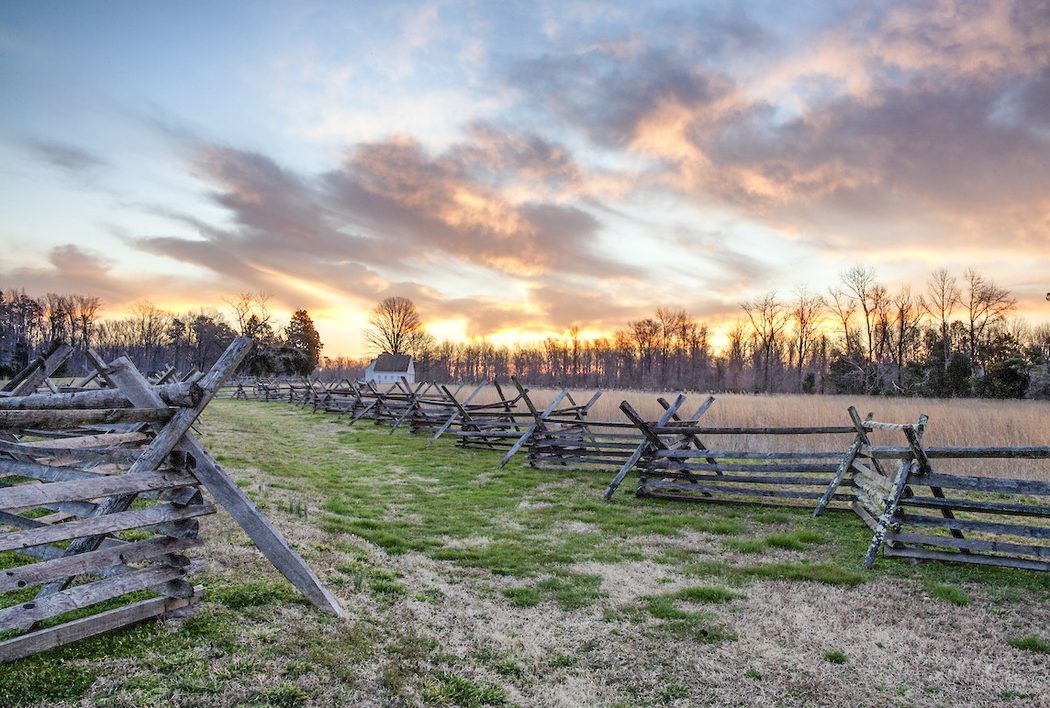
Some of the regiments in Hobart’s brigade had to navigate ditch fences similar (but deeper) to this one that still exists at Slaughter Pen Farm. (Tim Talbott)
go back!’” Lt. Col. Birney stated that at this point: “We were now under a heavy fire from the fields and woods on the left and front.” Some of Ward’s men moved over the railroad and encountered Atkinson’s Confederates “posted in great strength in several lines on the slope beyond the railroad, and not ceasing to pour in upon us a deadly and unbroken fire.” The 38th tried to continue advancing, but after taking casualties including “9 of its officers and 79 of its men... wounded and 14 killed,” they and the 40th New York retreated. Both Lt. Col. Birney and Lt. Col. Nelson Gesner (40th) received wounds but each refused to leave the field.
Col. Walker’s 4th Maine also became discombobulated. With the 38th and 40th New York retreating, the Confederates easily flanked the 4th Maine. The regiment’s major, William L. Pitcher, was killed in the fighting. Ward estimated that he lost 300 out of 800 men “in less than five minutes” near the railroad tracks. Claiming the capture of 200 Confederates, Ward explained that “Many of them were taken in consequence of their being unable to escape the impetuosity of our charge, and others were taken beyond the railroad from their rifle pits... .”
While the three regiments were retreating, the 57th Pennsylvania came to their support. Meeting Atkinson’s Confederates, the 57th “repulsed them most gallantly.” Ellis Strouse of the 57th recalled that they “marched by the flank, until we cleared a battery of ours in front, when Colonel [Charles T.] Campbell gave the command, ‘By company into line,’ and then, ‘Forward into line on first company,’ which was executed, in beautiful order, under a murderous fire of the enemy, who had by this time had driven some of our troops from the woods, and were coming upon us, yelling, as they advanced, like savages. Our men soon got into position in a ditch, but we could not return his fire for fear of shooting our own men.” In doing so, the 57th lost Col. Campbell, who received “a severe wound in the arm and side” and 52 soldiers became prisoners.
Col. Asher Leidy’s 99th Pennsylvania received orders
from Birney to rally the retreating Pennsylvania Reserves but failed to stem the withdrawing tide. They then assisted Col. Regis De Trobriand’s 55th New York. Like Col. Campbell, Col. Leidy also received a severe wound.
As Ward’s brigade attempted to reconstitute itself, brigades led by Gen. John C. Robinson and Gen. Hiram Berry, along with several artillery batteries kept the Confederates in check until darkness fell over the terrible scene of suffering.
Not surprisingly, losses for Ward’s regiments were rather lopsided depending on what orders they received. The 57th Pennsylvania led the brigade in casualties with 150, one-third of them prisoners. William Birney’s 38th New York suffered 133 casualties, and the 40th New York, which fought beside them had 123. The other regiment on the front lines, the 4th Maine, lost
120 men. Ward’s regiments that provided support for retreating infantry or artillery included the 99th Pennsylvania, 66 casualties; the 3rd Maine, 29; and 55th New York, 8.
To date, CVBT has helped save over 400 acres of Fredericksburg battlefield land.
Persevering to Protect 29 Acres of Civil War Hallowed Ground in Virginia
In late fall of 2023, the Trust launched a campaign to help protect 29 critical acres of battlefield land in the Old Dominion at Glendale and Gaines’ Mill-Cold Harbor. These battlefields were host to some of the bloodiest fighting of the entire Civil War, oftentimes resulting in inconclusive outcomes. Nonetheless, altogether these sites bore witness to more than 40,300 total casualties.
Altogether, the cost of these tracts is more than $1.1 million. However, thanks to anticipated federal and Virginia state grants, the Trust is left to raise $209,500. Thus, every dollar donated will be matched more than five times in value.
At Glendale, the targeted 12acre tract played a pivotal role in the 1862 battle. On June 30, Confederate General James Longstreet’s brigades advanced east across this very land in an assault against Union General Philip Kearny’s division. The attack was turned back by the Federals, resulting in heavy Confederate casualties. Today, the tract is largely intact and
maintains its wartime appearance. Due to its location along an important roadway, the tract is considered prime for residential development, presenting an urgent threat for preservationists.
At Gaines’ Mill-Cold Harbor, 17 sought-after acres span territory from both battles and are lauded by historians and preservationists as imperative in helping to tell the complete stories of the 1862 Peninsula Campaign and 1864 Overland Campaign. The 1862 Battle of Gaines’ Mill represents Confederate General Robert E. Lee’s first victory as commander of the Army of Northern Virginia, resulting in over 15,000 combined casualties from six hours of fighting. Just two years later, the Battle of Cold Harbor saw Ulysses S. Grant’s Federals fail to penetrate Confederate defenses in a fierce fight. With particular significance to the latter battle, this tract contains Union II Corps entrenchments on its southern edge and lunettes to its north.
Save 15 Acres at Willoughby’s Run in Gettysburg
In October, the Trust initiated a multi-year campaign to protect hallowed ground at Gettysburg representing “First Blood at Willoughby’s Run.” These 15 acres include the same “shallow valley” Shelby Foote described when he wrote, “… down into the shallow valley…two [Confederate] brigades started through the standing grain, the skirmishers whooping and firing as they went … leading the way into the greatest battle of the war.”
Following generous contributions from hundreds of Trust donors, the organization fell short by $78,000 when the November 20 deadline came around. As such, the Trust could not sacrifice the property to steamrollers, and dipped into its “rainy-day” fund and reallocated money earmarked for other priorities. But now, the organization must raise the remaining $78,000 in order to rise out of the red.
Situated between McPherson Ridge and Herr’s Ridge along the Chambersburg Pike, and just past Willoughby’s Run, the 15-acre property witnessed fierce combat during the opening phase of battle on July 1, 1863. Recent efforts to preserve the land were fueled by plans for extensive residential development, which were successfully thwarted following robust local advocacy. The developer’s request for permits to
construct a sprawling apartment complex was ultimately denied, underscoring the significance of preserving this historic terrain.
Through a series of goodfaith negotiations, the Trust and the developer were able to reach mutually agreeable terms for the Trust’s purchase of the land in collaboration with other preservation allies. After taking ownership of the property in November, the Trust will also begin envisioning a landscape restoration plan that removes intrusive 21st century elements but retains the original clubhouse currently leased by the Gettysburg Day Spa.
Ensuring the enduring legacy of the sprawling battlefield, the Trust and its members have played a pivotal role in preserving nearly 1,240 acres at Gettysburg over the past two-plus decades. To learn more about this preservation effort, visit www.battlefields.org/15AcresWilloughbyRun.
Trust Lauds Inclusion of Preservation- Minded Efforts by Virginia Governor Glenn Youngkin
After taking office two years ago, Virginia Governor Glenn Youngkin has continued to demonstrate his commitment to protecting and preserving the Old Dominion’s historic resources by helping establish a new state park in Culpeper County. The upcoming Culpeper Battlefields State Park will be created from the donation of approximately 1,700 acres previously protected by the American Battlefield Trust and donated to the Commonwealth of Virginia. In late December, when announcing his proposed biennial budget, Governor Youngkin solidified his legacy as a leading advocate for historic preservation.
The released budget proposal allocates appropriate funds for staffing and administering the new facility, helping ensure that the state park becomes a prominent recreational destination in the county. In addition, the governor has also called for an increase in funding for the Virginia Battlefield Preservation Fund, allocating $5.2 million next year and $5 million in the following year. This successful state matching grant program, aimed at protecting historic battlefield lands associated with the Revolutionary War, War of 1812 and the Civil War, has helped preserve more than 10,000 acres since 2006.
Lawsuit Against Orange County Board of Supervisors Enters Discovery Phase
As part of an ongoing lawsuit related to the unlawful approval of the Wilderness Crossing megadevelopment, the American Battlefield Trust, along with several preservation groups and private citizens, filed a demand for sworn responses and documents from Orange County and its Board of Supervisors.
This discovery demands that the Board produce all plans for the project, much of which should have been previously disclosed to the public. On the same evening it appeared on the agenda, the Wilderness Crossing project—the largest rezoning in Orange County history—was approved despite overwhelming public opposition.
It would result in the construction of up to 5,000 residences and hundreds of acres of industrial and commercial development, virtually all on land within or adjacent to the historic boundaries
of Wilderness threatening irreplaceable historical and archaeological resources and diminishing the appreciation of surviving resources.
The plan voted on by the Board differed from what was advanced by the Planning Commission, including a massive increase in permitted square footage of data center and warehouse distribution space, from five million to more than 30 million. Much of this extremely pertinent information intentionally obscured and not appropriately evaluated, in clear violation of Virginia law.
Learn more about this ongoing advocacy battle at: battlefields. org/wilderness-crossing.
Collaborative Exhibit on the American Revolution will Crisscross the Country
From an website to an in-demand popup exhibition, the American Revolution collaborative American Battlefield Trust and the Daughters of the American Revolution (DAR), is beginning
Experience, a project of the a new phase in its quest to connect modern audiences with the fascinating story of our nation’s origin. The exhibition will travel to scores of libraries, historical societies and museums through the spring of 2025, introducing visitors to a cast of historical characters with diverse experiences throughout the conflict and the places they visited on their journey.
The exhibit, containing 12 panels and three interactive kiosks, draws from documents and objects in DAR’s collection, as well as the Trust’s industry leading digital interpretation resources. The National Park Service’s American Battlefield Protection Program provided $200,000 in matching funds in the inaugural round of its Battlefield Interpretation Grants to create the traveling exhibit, which has been met dollar for dollar by DAR and further supported by individual Trust donors.
A longer-term mounting of the exhibit will remain at DAR’s national headquarters in Washington, with pop-up iterations opening January 2024 at venues in New York, Ohio, and Texas. Individual DAR chapters across the nation have partnered with institutions in their communities to offer venues for the exhibit, booking its current complement of copies to capacity; further inquiries will be