By Craig L. Barry
ground-peas or ground-nuts—were useful as an alternate source of protein, at least in emergencies. Since cooking facilities and other equipment were scarce, Confederate soldiers roasted their ration of peanuts over the campfire or shelled and fried them in leftover grease. The notion of whether peanuts were eaten boiled comes up from time to time, and as much as boiled peanuts are enjoyed as a snack in the Deep South today, there is no known evidence Civil War soldiers preparing them that way. The problem is that this method of prepared required a fair amount of salt, which was in scarce supply and more needed elsewhere.
Regardless of preparation, peanuts produced a high protein ration that was light in weight and could easily be carried by a soldier on the march. A good handful in the shell provides 200 calories, 10 grams of carbohydrate and the same of fat, and 6 grams of protein. As a nutrient, “a pound of peanuts... provides approximately the same energy value (in calories) as 2 pounds of beef, 1.5 pounds of Cheddar cheese, 9 pints of milk, or 36 medium-size eggs.”
A raw or “green peanut” is not green in color. It takes a hundred (or more) frost free days to grow peanuts for consumption, and they are usually available from May through November primarily in nine Southern states. Peanuts grow best in sandy soil, especially along the coast or just inland. The varieties are quite different, though. The king of the American peanut family is the so-called “Virginia.” This variety has the largest kernel and is only grown in Southeast Virginia (Suffolk, Waverly, Wakefield, Surry, etc.) and Northeastern North Carolina in the sandy soil just inland from the coast. The low country of South Carolina and the Georgia/Alabama region grows what is known as the common “Runner” variety, which features o discussion of Southern Civil War rations would be complete without including peanuts. Period accounts suggest that when bread and meat were scarce, peanuts—a/k/a goober peas, pindars, on the cob, and then remove it and others that use frozen corn kernels rather than fresh corn. The parched corn can be eaten as is, added to boiling water to make porridge, or was used to thicken stews.
Finally, that staple of the Confederate soldier’s diet called “Cush” was made in a variety of ways and this well-known recipe is courtesy of Bell E. Wiley from The Life of Johnny Reb: The Common Soldier of the Confederacy. However, it operates on the presumption that both beef and salt pork are also on hand.
“We take some salt pork and fry the grease out then we cut some cold beef in small pieces and put it in the grease, then pour in water and stew it like hash. Then we crumble corn bread or biscuit in it [some soldiers made mush or paste of flour or meal and added one of both of these at this point instead of crumbs] and stew it again til all the water is out then we have Confederate cush.”
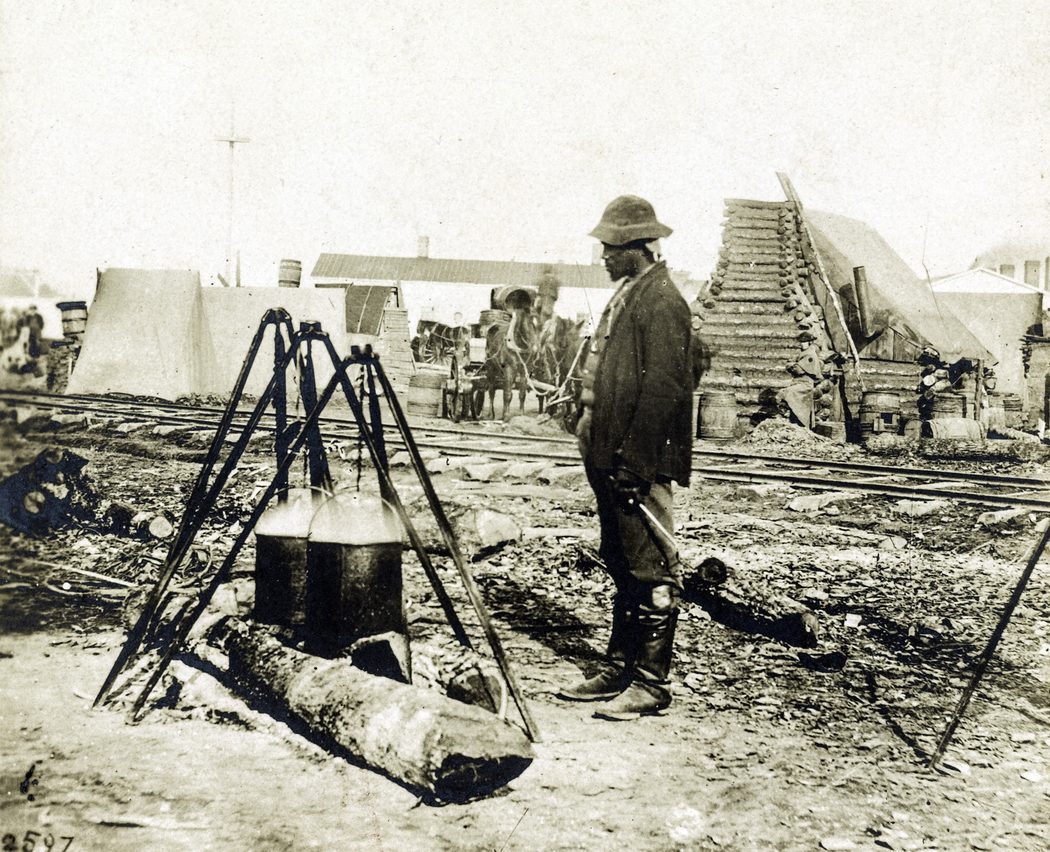
This may not sound appetizing, but it kept body and soul together. The problem was not with the rations so much as what the soldier did with it. Few individual soldiers knew much about cooking. The men pooled their resources and delegated cooking responsibilities to those most able to cook. However, there was not much material to work with. While on campaign there was not much available besides a campfire, the same monotonous rations and a frying pan.
Craig L. Barrywasbornin Charlottesville, Va. Heholdshis BA and Mastersdegreesfrom UNC (Charlotte). CraigservedThe Watchdog Civil War Quarterlyas Associate Editorand Editorfrom 2003– 2017. The Watchdogpublishedbooksandcolumnson 19th-centurymaterial. Heistheauthorofseveral booksincludingThe Civil War Musket: A Handbookfor Historical Accuracy(2006, 2011), The Unfinished Fight: Essayson Confederate Material CultureVol. I and II (2012, 2013). Hehasalsopublishedfourbooksinthe Supplierstothe Confederacyserieson English Arms & Accoutrements, Quartermasterstoresandother Europeanimports.