Homage to their Distinguished Mentor
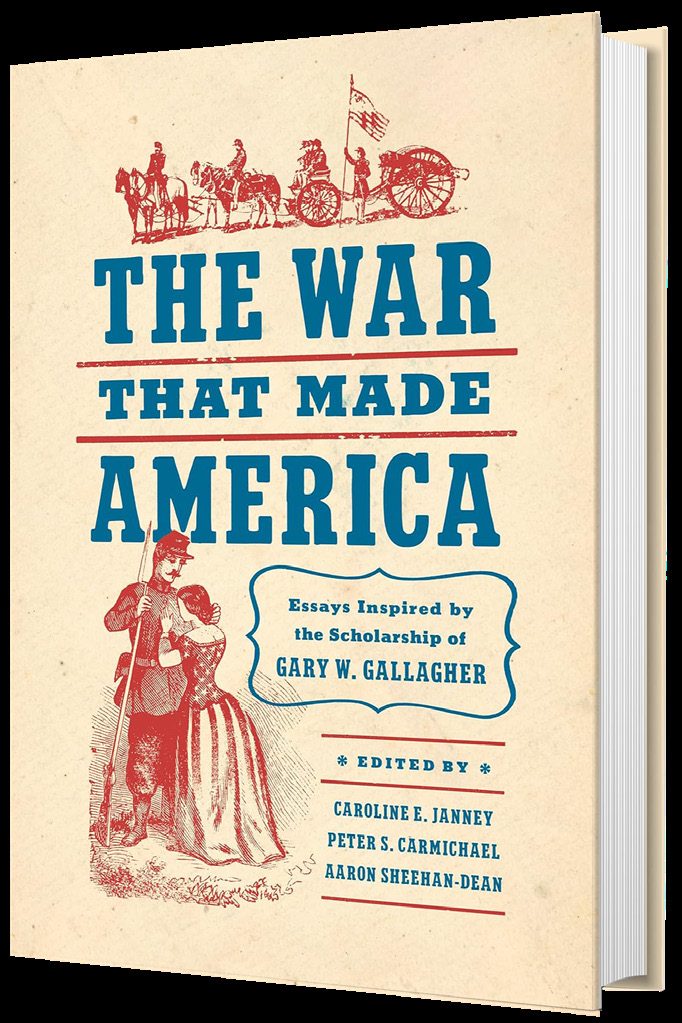
The War that Made America: Essays Inspired by the Scholarship of Gary W. Gallagher.Edited by Caroline E. Janney, Peter S. Carmichael, Aaron Sheehan-Dean. Introduction, footnotes, index, 269 pp, 2024, University of North Carolina Press, www.uncpress.org, hardback $99.00, paperback $32.95.
Reviewed by Joseph A. Derie
The War that Made America: Essays Inspired by the Scholarship of Gary W. Gallagher is a labor of love by three scholars who were mentored by the noted Civil War scholar. Dr. Gallagher’s contribution to Civil War history scholarship and historiography are legendary, and essays in his honor, to add to his many honors, are more than appropriate.
The introduction starts out with an overview of his career, scholarship, and publications. The editors were all mentored by Dr. Gallagher, and it is obvious from their comments that besides being a distinguished scholar, he is an all-around good guy.
The volume is divided into three sections: Nations at War, Intersections of War, Constructing the Past, and an Epilogue: Taking the Shape of the War. The authors of the essays are all noted Civil War scholars with distinguished publications.
Nations at War consists of three essays. Of particular note are the essays entitled Protecting Their Interest: Native American Governance in the Confederacy and Apples and Oranges and Hardtack: On the Use of Comparison in Civil War History. Regarding Protecting Their Interest who knew that there were Native American delegates to the Confederate Congress? With regards to Apples and Oranges and Hardtack the author sums it up nicely when he states: “Comparative history ….will never replace standard historical investigation. But it can illuminate the way we understand the US Civil War.” The third essay is entitled The Confederacy’s Use of Nationalism and Vice Versa.
Intersections at War consists of three essays. The subjects consist of “Robert E. Lee as an Engineer, Soldier and Modernizer,” the trial of the guerrilla John W. McCue after Appomattox, and Robert W. Smalls’ land distribution in Port Royal, South Carolina, before and after the Civil War.
Constructing the Past consists of three essays. The subjects consists of “Erasing Violence from the Civil War Record,” Jubal Early’s consolidation of history following the Civil War, and “White Northern Veteran Writers and their Narratives of the Civil War.
The War that Made America: Essays Inspired by the Scholarship of Gary W. Gallagher contains nothing but well-written, scholarly, noteworthy and interesting essays. There is something for every Civil War scholar and buff in the volume. It is a fitting tribute to Dr. Gallagher and is very highly recommended.
CAPT Joe Derieisalongtime Civil Warbuffwitha specialinterestin Civil Warnavalhistoryandthe Civil Warinthe West. Heisaretired USCG officeranda licensedofficerofthe Merchant Marine, currently self-employedasamarinesurveyorandmarineaccident investigatorin Portland, OR.
Groundbreaking Study of Antimlitarism
Reviewed by Jonathan A. Noyalas
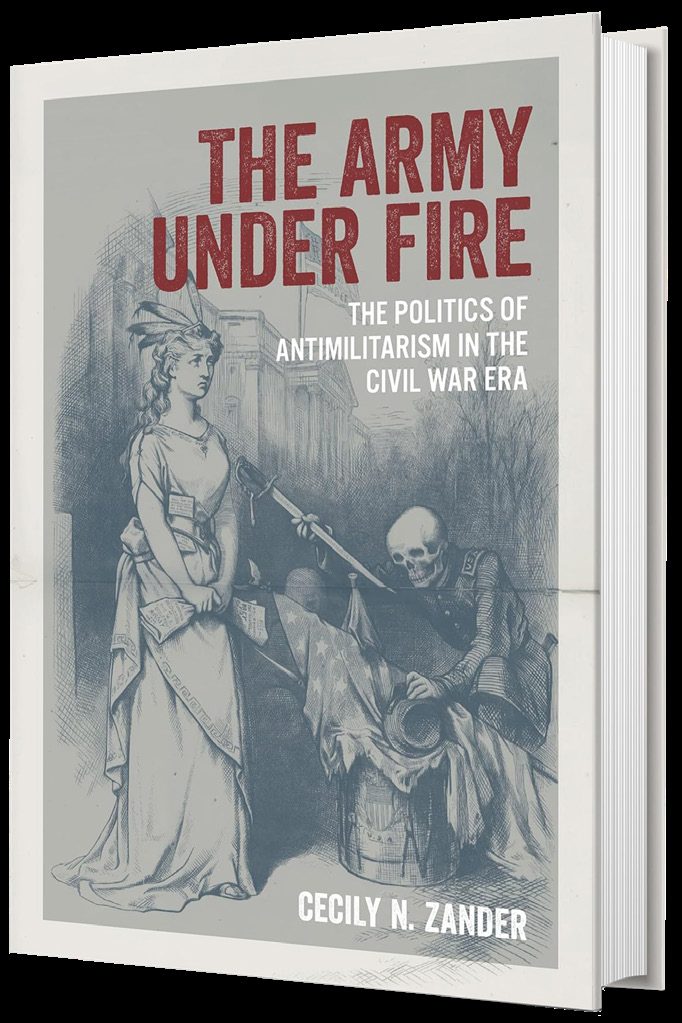
As a teenage boy Robert Milroy dreamed about studying at West Point and having a lifelong career in the regular army. Unfortunately for Milroy, who rose to the rank of major general in the volunteer army during the Civil War, his father, Samuel, opposed his son’s ambitions. He prohibited Robert from attending West Point as he thought a professional army had no rightful place in a republic. The “unconquerable prejudices” Milroy’s father harbored toward the regular army were not unusual. Despite historians’ awareness that distrust against professionally trained officers and a national standing army existed in the decades before, during, and after the Civil War no study prior to this one has delved as thoroughly into trying to understand why antimilitarism existed during one of the most tumultuous periods in the nation’s history.
Throughout this elegantly written, prodigiously researched, and cogently crafted volume, Zander, a professor at Texas Women’s University and a rising star in the field, explores why a portion of Americans harbored distrust of a professional army. Despite the important work the regular army performed from the early 1850s through Reconstruction, Zander bluntly asserts that the “army was not loved.” The book’s central question is why?
The author convincingly argues that antimilitarism accelerated in the United States during the 1850s as members of the newly established Republican Party viewed the regular army as an instrument to aid in slavery’s expansion and enforcement of the 1850 Fugitive Slave Law. Among the moments Zander explores to bolster this assertion is the intervention of regular troops in the spring of 1854 to return Anthony Burns, an enslaved man who fled to Boston, Massachusetts, to his Virginia enslaver.
With the Civil War’s outbreak in the spring of 1861 Zander demonstrates that doubt as to whether professional soldiers could be trusted to fight and defeat the Confederacy ran rampant among Republicans. This uncertainty, the author argues, prompted Republicans throughout the conflict to incessantly diminish the deeds of regulars and praise the work of the citizen soldiers who comprised the lion’s share of the Union army. For instance, Zander highlights Senator Zachariah Chandler’s campaign to condemn the efforts of professional soldiers in the victory at Fort Donelson and emphasize the role that volunteers played in this significant early victory. Chandler’s was, as Zander notes, a curious claim considering that three West Point graduates, Generals Ulysses S. Grant, James B. McPherson, and Charles F. Smith, played crucial roles.
While Zander persuasively posits that antimilitarism among Republicans stemmed from the party’s efforts to destroy slavery, the author also notes that not all Republicans were in lockstep throughout the war. For example, when President Abraham Lincoln called for an expansion of the regular army by eight infantry regiments and one each of artillery and cavalry in the spring of 1861, Lincoln confronted opposition from within the party. Opposition from members of his own party was of course something Lincoln contended with throughout his presidency.
As much as Republicans might have detested the regular army, this thoughtful volume reveals its importance to implementing Reconstruction policies. With all volunteer soldiers mustered out of service by the autumn of 1867, the regular army proved the only mechanism to ensure that Republican policies could be implemented and the rights of Black people protected. Zander’s keen analysis not only reveals the inner turmoil Republicans felt as they attempted to balance their distrust of the regular army with their recognition of its value in conducting their programs it also brings clarity as to why Reconstruction failed, a question with which historians have grappled for decades. In the end, Zander posits that Republicans’ distrust of professional soldiers and desire to save money ended Reconstruction four years earlier than historians traditionally claim. This assertion, like all good history does, will certainly spark debate among scholars. There is no denying, however, that Zander’s argument is a convincing one.
In the book’s acknowledgments Zander offers “an apology for bringing yet another book about the American Civil War era into this world.” While the number of books published annually continues at an astounding pace only a small portion each year are worthy of note. This is such a book. Zander certainly does not need to apologize for bringing such an impeccably researched, thoughtfully crafted, and groundbreaking volume into the world.
Jonathan A. Noyalasisdirectorof Shenandoah University’s McCormick Civil War Institutein Winchester, Virginia, aprofessorin Civil War Era Studiesat Shenandoah University, andfoundingeditor ofJournalofthe Shenandoah Valley Duringthe Civil War Era. Heistheauthororeditorofsixteenbooks includingmostrecently“The Blood-Tinted Watersofthe Shenandoah,” publishedby Savas Beatie.
Fantastic Biography of ANV’s Greatest Cavalryman
Reviewed by Robert L. Durham
Above all else, J. E. B. (Jeb) Stuart loved being a soldier, from his entry into West Point in 1850 until his 1864 death at Yellow Tavern. In Stuart’s case, it is difficult to separate the soldier from the man. Even in his many flirtations with the weaker sex, a proclivity which often led to criticism, he did not stray far from his love for the military. Jeb appointed many of the more attractive of his feminine admirers to honorary positions on his staff. Edward G. Longacre has done a magnificent job of providing a portrait of Stuart as both a soldier and a man.
Longacre studied hundreds of primary and secondary sources to present a picture of both Jeb’s military career and elements of his personal character. Stuart’s early biographers tended toward hero-worship, omitting most negative aspects of his personality. For these, the author relied mainly on contemporary letters that were not influenced by posthumous idolatry. Vainglorious, ambitious, overly sensitive to criticism, Stuart had his share of human foibles.
As a cavalry commander, Jeb had no peer in the Eastern Confederacy. He excelled at intelligence gathering but at times, especially during the Gettysburg campaign, he failed miserably. As a combat commander, he could hold his own with anyone. From his Regular Army battle experience against the Cheyenne, to taking command of Stonewall Jackson’s Corps after Jackson’s wounding, he showed himself to be expert in controlling all service branches, cavalry, artillery, and infantry. There are even some who believe he should have been retained in command of Jackson’s Corps after Jackson’s death.
Stuart shone when on a raid behind enemy lines, finding Federal flanks and weak points, dispensing destruction on enemy supply depots, and capturing wagon trains. Yet, even here, he sometimes let his penchant for raiding, and the publicity it garnered, get away with him.
Edward Longacre is an authority on cavalry operations in the East, and it shows in this volume. Among other books he has written are the award winning The Cavalry at Gettysburg and an account of the First Battle of Bull Run, The Early Morning of War. I enjoyed this work immensely and recommend it to all with an interest in the Civil War. Those with a special attraction for Confederate horsemen during the war will find this book indispensable.
Robert L. Durham, retiredfromthe Defense Logistics Agency, isafreelancewriterwhohaswrittenarticles andreviewsfornumeroushistoricalpublications. A lifelonghistorybuff, herecentlywentbacktocollegefor hishistorydegree.
Noyalas’s Newest Book Reveals Shenandoah’s Similarities to the Rest of the South
Slavery and Freedom in the Shenandoah Valley During the Civil War Era by Jonathan A. Noyalas. Maps, photos, notes, index, 250 pp., 2021. University Press of Florida, https://upf.com. $26.95 paperback, hardcover. $85.00 Reviewed by Noah F. Crawford
In the past decade, Jonathan Noyalas, the Director of the McCormick Civil War Institute at Shenandoah University, has established himself among the foremost authorities on one of the Civil War’s most contested geographic area. Historians have long characterized the Shenandoah Valley as a region distinct in many ways from much of the Confederate South, aligned with Thomas Jefferson’s vision
A Much-Needed Reappraisal of Albert Sydney Johnston
The Iron Dice of Battle: Albert Sidney Johnston and the Civil War in the West, by Timothy B. Smith. Maps, photos, notes, biblio., index. 244 pp. Louisiana State University Press, https://lsupress.org, 2023. Hardcover, $39.95.
Reviewed by Theodore P. Savas
Most students of the Civil War, especially those of us who have been in this game for many decades, were “instructed” from an early age that Albert Sidney Johnston was one of the great Southern generals of the war, his promising career and the untold possibilities that would have come cut short on the field at Shiloh April 6, 1862. Indeed, it is one of the great “what ifs” of the entire war. Not so fast, argues historian Timothy Smith in his new book The Iron Dice of Battle. As this new assessment makes clear, the man is significantly more complicated than we have been led to believe.
Once the other Johnston (Joseph E.) fell to wounds in late May 1862 and was replaced by Robert E. Lee, Confederate command in the Eastern Theater was locked in place and operated at the top of its game all the way to the end of the war. In contrast, the Western theater was almost always in some state of chaos. Before Smith, the only significant study of the subject at hand was Charles Roland’s six-decadesold Albert Sidney Johnston: Soldier of Three Republics, which by today’s standards is nicely written but shallowly researched. Dr. Roland was in love with his subject and it shows. As Smith (and others) have pointed out, the turmoil in the West was evident throughout and, one could argue, had its genesis in Johnston’s entire seven-month tenure (Sept. 1861 – early April 1862) and it never recovered.
In what is essentially a series of outstanding essays linked together into a standalone monograph, The Iron Dice of Battle examines Johnston’s background, journey from California to Richmond to meet with his friend President Jefferson Davis, and his ascension to command Department No. 2. He arrived in Tennessee that first September of the war to discover that his sprawling department, which ran from the Appalachian range hundreds of miles west beyond the Mississippi River, was short of everything including men, arms, and good officers.
When Kentucky’s neutrality was breached by Leonidas Polk, Johnston had little choice but to push his front into the Blue Grass State. His entire line was vulnerable everywhere, and a defeat anywhere would collapse it. When Forts Henry and Donelson fell in February 1862, the front unraveled, Nashville was abandoned, and most of Tennessee was lost. Johnston eventually regrouped and reorganized in Corinth, Mississippi, drove north in a daring gambit to surprise Maj. Gen. U.S. Grant at Shiloh, nearly won a stunning victory on the first day, and was killed that afternoon. The army fought well but was driven from the field the following day.
Smith study is steeped in Johnston’s personality, habits, and characteristics, which he interlaces with his actions in the field and the home front to flesh out a three-dimensional human rather than the paper cutout with whom we grew up. Johnston was a gambler (hence the clever title), a poor judge of character, and too deferential. Indeed, Smith paints him as a weak leader who could not stand up and take command when needed. Leonidas Polk and Pierre Beauregard often ran roughshod over him or ignored his ideas/commands. Examples abound.
Despite having months on the ground, Johnston delegated building of Henry and Donelson to others and never visited the most important part of his line, the loss of which opened two major river routes into the heart of the Confederacy. Johnston, as Smith ably points out, never realized that his role as a department commander required an entirely different skillset than the one he employed or possessed. His actions and choices put his army in a position where he had no choice but to gamble everything on one desperate attack. A department commander had no business being in the front line of battle, which was where he was when he was mortally wounded.
Johnston had several admirable traits, of course. He was obviously smart, beloved by his troops and President Davis, and worked hard. He was also thrust into a nearly impossible position. But any fair assessment makes it clear that his actions, decisions, and leadership made matters worse, not better. Like many other generals, learning on the job took time; Lee, Grant, and Sherman being three good examples. If Johnston had lived, perhaps he could have turned around the state of affairs in the West. We will never know, but Smith more than implies that the man at the helm was not armed with the right personality and leadership abilities for the job at hand.
Johnston was not the military giant we were led to believe and could never have grown into the job like a Lee or a Grant, or so Smith argues. His study, however, is based on logic, reason, example, and research. The writing is crisp, the notes instructive, and the conclusions inescapable. Those interested in strategy and leadership issues should read The Iron Dice of Battle and decide for themselves.
Theodore P. Savasistheownerand Directorof Savas Beatie. Hegraduatedwitha BA in Historyfromthe Univ. of Northern Iowaanda Juris Doctoratefrom The Universityof Iowa Collegeof Law (With Distinction). He istheauthororeditorof 14 books.