Civil War research and scholarship. Contact email:
Lincoln and Immigration: Was Lincoln a WINO?
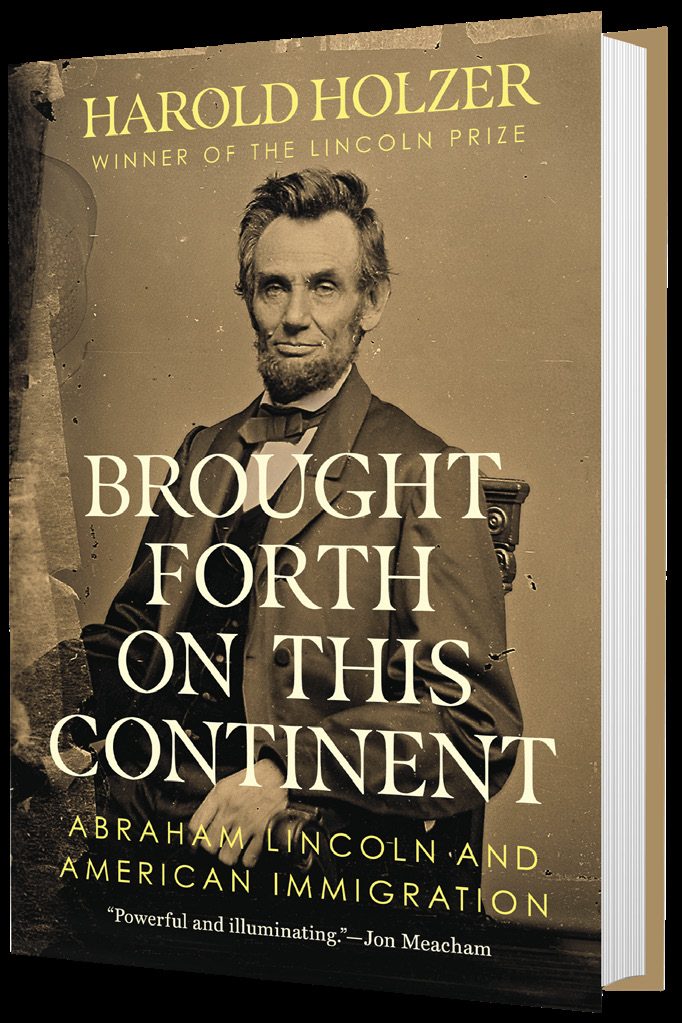
Brought Forth on This Continent: Abraham Lincoln and American Immigration. By Harold Holzer, notes, bibliography, index, 464 p., 2024. ISBN 978-0-451-48901-2. Penguin Random House, penguinrandomhouse.com, Hardcover, $35.
Reviewed by Salvatore Cilella
In a timely and remarkably relevant examination, Harold Holzer has crafted a new and important narrative of our 16th President and his relation to immigrants and immigration. Originally a Whig, Lincoln was able to fend off the increasingly important role the Know-Nothings played in the party’s politics in pre- Civil War America. Eventually, Lincoln spoke out forcefully against the growing anti-immigrant wave sweeping across the nation. He perceived the need to cultivate the new citizens as potential supporters at the ballot box.
The Whigs championed a strong central (but legislative) government and a weak executive. They favored subsidized national infrastructure projects such as roads, canals, a protective tariff, and a national bank. Many Whigs were staunchly anti-immigrant. During the 1840s, the Whig party pushed an ill-fated bill to limit, monitor, and tighten immigration policies, but new immigrants, including Catholics, aware of the Know-Nothing odor in the Whig party, tended to vote Democrat. Ironically, building infrastructure projects required manpower that was filled by Irish, German, Chinese, and other immigrants. As Holzer forcefully argues, after the 1844 anti-Irish riot in Philadelphia, Lincoln issued a statement in favor of lenient immigration policies. By 1852, Lincoln supported both European immigration and African emigration.
He saw the political potential in these new citizens. In 1858, German American Heinrich Theodore Canisius, editor and publisher of Freie Presse in Alton, Illinois, supported Lincoln’s bid for senate. Moving to Springfield, he launched the Illinois Staats-Anzeiger and began running articles favorable to Lincoln. In return, when Canisius needed capital to keep the paper running, Lincoln secretly advanced him $500 to become a silent partner in a German newspaper. The paper eventually folded and Lincoln lost his investment.
Lincoln rejected, as Holzer writes, “hostility to foreigners and Catholics.” He favored an easy path to naturalization stating that it should be “as convenient, cheap and as expeditious as possible.” He noted that the Constitution belonged “no less to the Catholic, than to the Protestant” and went on to insist that the Constitution “reprobate(s) and condemn(s) each and every thing in the Philadelphia riots, and the causes which led to them, from whatever quarter they may have come.” Holzer concludes “Lincoln (was) out of step with his own increasingly nativist base, perhaps even destined to become what might today be called a WINO (Whig in Name Only).”
Throughout Holzer’s excellent treatment he argues that Lincoln depended on the immigrant vote, especially German support. It and the Irish vote were complicated and vacillated according to events on the battlefield and the national scene. Both populations were affected by the 1848 Revolutions in Europe and the potato famine in Ireland. Holzer goes to great lengths to show Lincoln’s dealings with the German American population in Illinois and the necessity of German American support there and during the Civil War. Colorful figures such as Franz Sigel, Carl Schurz, and Alexander Shimmelfennig are constantly on and off the scene with plans, schemes, negotiations and deals. When the Union XI Corps, originally recruited by Sigel, folded at Chancellorsville under Stonewall Jackson’s flank attack, the anti-German attitude increased substantially.
Holzer outlines the rocky road Lincoln walked with such characters including General Thomas Francis Meagher, commander of the Irish Brigade.
Meagher originally supported the Confederacy; the fall of Fort Sumter changed his mind. The Irish support of the democratic party was related to emancipation which Irish working men despised. Although they supported the war effort to restore the union, Lincoln alienated them with the proclamation. The 1863 New York draft riots were the bloody manifestation of their rage. Yet in 1864, they voted for Lincoln.
Perhaps the most outrageous figure drawn by Holzer is Dr. Issachar Zacharie, a British-born Jewish podiatrist. Possibly a fraud, Zacharie treated Lincoln’s foot corns and “designed comfortable boots to cushion the President’s enormous feet.” In gratitude, Lincoln wrote three endorsements of the good doctor’s work, to which the New York Herald snarked “The President has been greatly blamed for not resisting the [emancipation] demands of the radicals, but how could the President put his foot down firmly when he was troubled with corns?” In return, Lincoln sent Zacharie to New Orleans to rebuild loyalty to the Union. He traveled extensively garnering support for Lincoln’s re-election, while showering the President with “edible gifts,” hominy, bananas, and apples. Zacharie failed to convince the war department that he should be hired to treat the foot sore armies of the Union. That didn’t stop him from adopting the title: “Late Chiropodist-General, United States Army.”
Lost in the flood of events of 1863, Lincoln’s annual message to Congress in December proposed an enlightened immigration bill to ease the path to naturalization for prospective new citizens. With that progressive step was an obligation for military duty. As Lincoln saw it, rights came with responsibility. Unfortunately, he did not live to see the bill come to fruition. Andrew Johnson signed it into law in June 1865.
In coming full circle, Holzer points out it would be the last generous federal legislation until 1965 when Lyndon Johnson signed the Immigration and Naturalization act.
What’s that cliché about history not rhyming, but repeating itself?
Salvatore Cilellaistheretired CEO ofthe Atlanta History Center. HeistheauthorofUpton’s Regulars, (Univ. of Kansas Press, 2009). HehaseditedThe Selected Correspondenceof General Emory Upton, 2 Volumes. (Univ. of Tennessee Press, 2017). A recipientofthe 2019 Founder’s Award, American Civil War Museum. Hehas edited“Till Deathdous Part,”thelovelettersof Emory and Emily Uptondocumentingtheirbriefandtragictwoyearmarriage (Universityof Oklahoma Press, 2020) andtheMemoirsof Dewitt Clinton Beckwith, of Upton’s Regulars, (McFarland Publications) Spring 2023.
A Kids’ Picture Book About A Woman Soldier
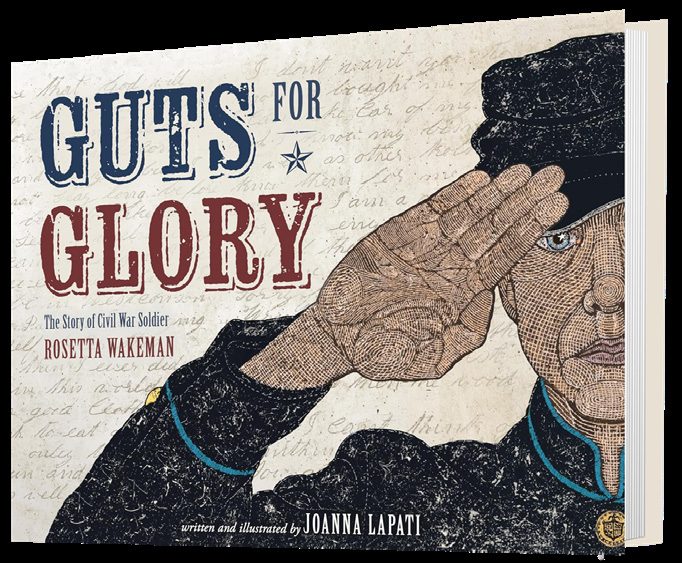
Guts for Glory: The Story of Civil War Soldier Rosetta Wakeman. Written and illustrated by Joanna Lapati. Drawings, glossaries, author’s note, 56 pp., 2024. Eerdmans Books for Young Readers, https://www.eerdmans.com, $19.99.
Reviewed by Jonathan W. White
As a senior at the University of M a s s a c h u s e t t s Dartmouth in 2000, Joanna Lapati began “randomly pulling books off the shelf”
at her university library when she came across An Uncommon Soldier: The Civil War Letters of Sarah Rosetta Wakeman, alias Pvt. Lyons Wakeman, 153rd Regiment, New York State Volunteers, 1862–1864 (1994). Lapati became fascinated with Rosetta’s story and began earnestly researching the Civil War—attending reenactments, reading books, and painting miniatures. Knowing that several hundred women dressed as soldiers and fought for the Union and the Confederacy, Lapati attempted to join a reenactment group. “Sorry, women soldiers are not authentic to the history of our regiment,” was the reply. But the second unit she approached, the 22nd Massachusetts Volunteers, permitted her to enlist. For six years Lapati learned about soldier life as a living historian, and she incorporated her experiences into the artwork in her first book, Guts for Glory.
Guts for Glory tells the story of Rosetta Wakeman, a young woman living in upstate New York while the Civil War was raging. Bored by farm work and family responsibilities, writes Lapati, Rosetta “wanted something... different. She wanted something more.” So one night the nineteen-year-old dressed in her father’s old clothes, bound her chest, cut her hair, and ran away, now calling herself Lyons Wakeman. For a time she found work transporting coal on the Chenango Canal, but she soon joined the 153rd New York Volunteer Infantry disguised as a man. On November 24, 1862, she wrote home, “I got $152 in money. I enlisted for 3 years or soon discharged. All the money I send you to spend it for the family in clothing or something to eat.”
For two years Rosetta served in the Union army, first in Virginia and later in Louisiana. She participated in the Battle of Sabine Cross Roads on April 8, 1864. As Lapati describes it, Rosetta “stood shoulder to shoulder with her comrades, ready to face the enemy,” and she “did not falter under a storm of fire and lead. She held her position, pushing Confederates back.” A week after the battle, Rosetta wrote home, “I feel thankful to God that he spared my life.... I pray to him that he will lead me safe through the field of battle and that I may return safe home.” Lapati concludes the book, “The war was not over, nor the risk of many more lives. But Lyons remained in the ranks, a place where she longed to be—supporting her family and serving her country.”
Readers will find more details about Rosetta’s life in a note at the end of the book, such as that she died of dysentery at the marine hospital at New Orleans on June 19, 1864. The note, two glossaries, and a timeline also provide more information and context about the Civil War and the experiences of women—both civilians and soldiers—during that period of national upheaval.
Lapati created the artwork using scratchboards, which she hoped would “convey a gritty and difficult time in American history.” It is beautifully done and quite evocative. Taken together, Guts for Glory is a compelling picture book that will introduce young readers to an historical figure who is not typically be found in the textbooks.
Jonathan W. Whiteisprofessorof American Studiesat Christopher Newport Universityandtheauthororeditor of 17 books, includingMy Daywith Abe Lincoln (2024), anearlyreaderchapterbookabout Abraham Lincoln’s youth.
Irish Immigrant Farmers Personal Accounts
The Boys of Diamond Hill- The Lives and Civil War Letter of the Boyd Family of Abbeville County, South Carolina.J. Keith Jones, ed. Notes, Photos, Bibliography, Index. 243 pgs. McFarland & Company, Inc., www.macfarlandpub.com. $39.95 Reviewed by Tom Elmore
This book is a collection of letters written from 1857 until 1871, primarily during the Civil War years of 1861– 1865. The patriarch of the family was Richard Boyd, an Irish immigrant who was a farmer in northwestern South Carolina. This book shares the letters home from his sons Andrew, Daniel, Presesley, Thomas, and William, and his son-in-law, Fenton Hall, who all served in the Confederate army.
The six young men, whose ages ranged from 14 to 25 in 1860, saw action in Virginia, Mississippi, Tennessee, and the Carolinas, giving a unique, holistic view of the war from different theatres. Accounts include the Battle of Fredericksburg and some personal experiences from some of the war’s most significant and lesser-known battles. One notable passage comes from Daniel, writing from Virginia in1861, refers to the conflict as a “civil war.” This is the only time this reviewer has seen the war being called that by a Confederate soldier.
Those looking for a heroic, glory-filled account of the war will be disappointed. Most of the letters are sad and tragic or have depressing undertones. Their biggest enemy was not the Union army but illness, boredom, inflation, and deprivation.
Death is a constant theme, for good reasons: Daniel was the lone letter writer to survive the war. Sadly, he did not live long after war, dying in 1871, presumably from cholera. William was mortally wounded at Gaines Mill, Robert was killed at the Battle of Maryland Heights, and Thomas at the Second Battle of Murfreesboro, all in 1862. Andrew died from measles in 1864. Fenton Hall was listed by Confederate army as captured by Union forces near Charleston in 1863, but his wife never heard anything about or from him again. Richard outlived all his sons, dying in 1875 at the age of 70.
Editor Jones kept the original spelling and grammar of the letters, which can make it difficult to read since some of the writers were semi-literate. But the biggest problem is that too much annotation is added to each letter. A summary is given before each letter along with some background information, which on occasion runs several pages. This slows the flow of the text and would have been better as endnotes. Also, maps of the places and battles mentioned would have been helpful.
This is the second edition of the book, the first having come out in 2011. In this version some factual errors have been corrected and newly discovered information and letters are presented. Especially welcomed are photographs believed to have been of Daniel and Pressely.
This is a raw, gritty, and occasionally graphic, firsthand account of the war that tears down any romanticized “moonlight and magnolias” notions that anyone may have of the Civil War.
Tom Elmorehaswrittenfivebooksandnumerous articlesabout South Carolinainthe Civil War.
A Valuable Family Treasure Reveals Important Insights
Reviewed by Jonathan A. Noyalas
James and Thirza David, farmers in northern Georgia, cherished the correspondence they received from family members during our nation’s most tumultuous era. As the Davids grew older they hoped the letters would be preserved as a family heirloom and passed from one generation to the next. From the moment the Davids entrusted the letters to the care of their daughter, Pillona, descendants have honored the Davids’s wish. While heirs always acknowledged the value of the letters to the family’s history, Edward Pulliam, the editor of this superb collection and the latest in the line entrusted with stewardship of these treasured family documents, recognized the value of making these letters available to a broader audience.
While the volume contains letters from 1847 into the early 1900s, the Civil War’s four years form the book’s core. Unsurprisingly the letters are filled with content one would expect from this era, weather, illness, the everyday difficulties confronted by soldiers, and hardships endured by family at home. Although historians will always find that content useful, the real value of these letters stems from the insight they offer into a variety of topics that illustrate the era’s complexities and how ordinary people coped with them.
Particularly interesting are letters between Pillona Alexander, the Davids’s daughter, and her husband Manning. The couple, married in 1857, like all husbands and wives during the conflict, sought ways to relieve the loneliness that war produced. Their letters reveal much about the role dreams played. For example, on April 14, 1862, Pillona wrote Manning, serving in the 43rd Georgia, that she dreamt about Manning “nearly every night.” While the dreams oftentimes brought Pillona comfort, they occasionally caused a sense of dread as she thought they portended something horrible might happen to Manning.
Additionally, the letters disclose much about how the war weighed on Confederate soldiers’ commitment to the war effort. Letters written in the war’s early days, as was typically the case, are filled with sentiments of invincibility and excitement. Those expressions waned as the war continued. Letters became brutally honest about the Confederacy’s fortunes in the war’s final months. For example in mid- September 1864, Manning Alexander wrote gloomily to Pillona about the Confederacy’s prospects in Georgia. Manning believed that without sufficient reinforcements, something he acknowledged the Confederacy did not possess, “so many noble and brave men should be sacrificed without any advantage.”
Those seeking to better understand how the presence of Union troops impacted enslaved people will find much worth in this collection. For instance, on August 2, 1864, Horatio David, the Davids’s youngest child and an officer in the 16th Georgia, offered advice to his mother, Thirza, about how the family should respond to the unruliness some of the family’s enslaved people exhibited when they learned of the presence of Major General William T. Sherman’s command. Horatio suggested that if the “rascality” did not cease immediately “blood” should “flow.”
Military historians focused on the conflict in Georgia, Tennessee, Mississippi, and Virginia will find much value in these letters. The letters are peppered with information about various campaigns, battles, and areas through which Confederate troops passed. On December 5, 1862, for example, Simeon David, a member of Georgia’s legislature before the conflict and a captain in the 14th Georgia, offered a compelling description of the Shenandoah Valley as his regiment made its way to Fredericksburg, Virginia, in the autumn of 1862. “I think the Valley of Virginia is the eden of the whole earth,” Simeon explained to his parents.
The letters, exhaustively contextualized by the edior, also provide a sobering reminder about the conflict’s tragic consequences. The section of postwar writings bares much about the Civil War’s economic impact and how human loss suffered during the conflict caused unquantifiable anguish for those left behind. Documents in the postwar section also provide useful details about the activities of the Ku Klux Klan.
The richness of this collection marks this volume as arguably one of the most important assemblages of Civil War era correspondence in recent years. Social and military historians owe a debt of gratitude to the editor for making these letters available to all.
Jonathan A. Noyalasisdirectorof Shenandoah University’s McCormick Civil War Institutein Winchester, Virginia, aprofessorin Civil War Era Studies at Shenandoah University, andfoundingeditorofJournal ofthe Shenandoah Valley Duringthe Civil War Era. He istheauthororeditoroffifteenbooksincludingmost recentlySlaveryand Freedominthe Shenandoah Valley duringthe Civil War Era, publishedbythe University Pressof Florida.
Great Tactical Analysis of a Little-Studied Battle
Contrasts in Command: The Battle of Fair Oaks, May 31-June 1, 1862. By Victor Vignola. Photos, maps, footnotes, appendices, bibliography, index. 269 pp., 2023. Savas Beatie. www.savasbeatie.com. Hardcover.. $34.95. Reviewed by Robert L. Durham
Until now, little has been written on the Battle of Seven Pines/Fair Oaks. Contrasts in Command concentrates on Fair Oaks, a portion of the battle even less has been written on. Stephen W. Sears, in his excellent To the Gates of Richmond: The Peninsula Campaign devotes only four pages to Fair Oaks. For many Civil War students, the main interest in the battle is the wounding of Gen. Joseph E. Johnston, which led to placing Gen. Robert E. Lee in command of the Army of Northern Virginia. Vignola has written a detailed, tactical study of the battle, going a lot further than that.
Victor’s focus is on the various leaders and a comparison of their command styles. Although the major commanders, Generals Johnston, James Longstreet, and Edwin V. “Bull” Sumner, get their fair share in Vignola’s study, he does not forget lower grade officers. At Fair Oaks, Col. William Dorsey Pender of the 6th North Carolina, commanded a brigade and pressed the attack on the Federal guns until the fruitlessness of taking them became obvious. Driving his men forward through knee-deep mud, his actions were observed by President Jefferson Davis. After the battle, Davis sought him out and promoted him to Brig. Gen., on the field. Pender later rose to division command.
Lieutenant Edward “Ned” Kirby commanded one of the Union artillery batteries assaulted by Pender and other Confederates forces. Each discharge of his guns drove them backward into the muck, and soldiers of the infantry regiments in support volunteered to help push them back into position. Kirby kept up the fire of his battery even when running low on ammunition. When he ran out of cannister, he fired shot with the fuses cut to explode as soon as they left the mouths of the cannon, like giant shotguns.
Vignola found it difficult to write of the Confederate side; few officers filed official reports. He had to fill in the blanks with research into letters, diaries, and journals. The result is a masterful tactical study of the battle, down to the regimental level. I highly recommend this book; it should be on the bookshelf of every Civil War buff. I placed my copy right next to my Sears volume.
Robert L. Durham, retiredfromthe Defense Logistics Agency, isafreelancewriterwhohaswrittenarticles andreviewsfornumeroushistoricalpublications. A lifelonghistorybuff, herecentlywentbacktocollegefora historydegree.
A Confederate Hero Rediscovered
John Yates Beall was a colorful Confederate who was well-known, feared, and considered to be nothing more than a pirate in the northern states during the last two years of the Civil War. He is virtually unknown today except by the rebellion’s most ardent students. In this traditional biography based significantly on Beall’s diary and letters, historian William C. Harris gives readers a full account of Beall’s relatively short life, from his birth in 1835 to his death on the gallows at Governor’s Island, New York, on Feb. 24, 1865.
Beall was born in Charles Town, Virginia (now West Virginia), to well off planter parents who owned twentynine slaves. He developed an unshakeable Old Testament