Civil War research and scholarship. Contact email:
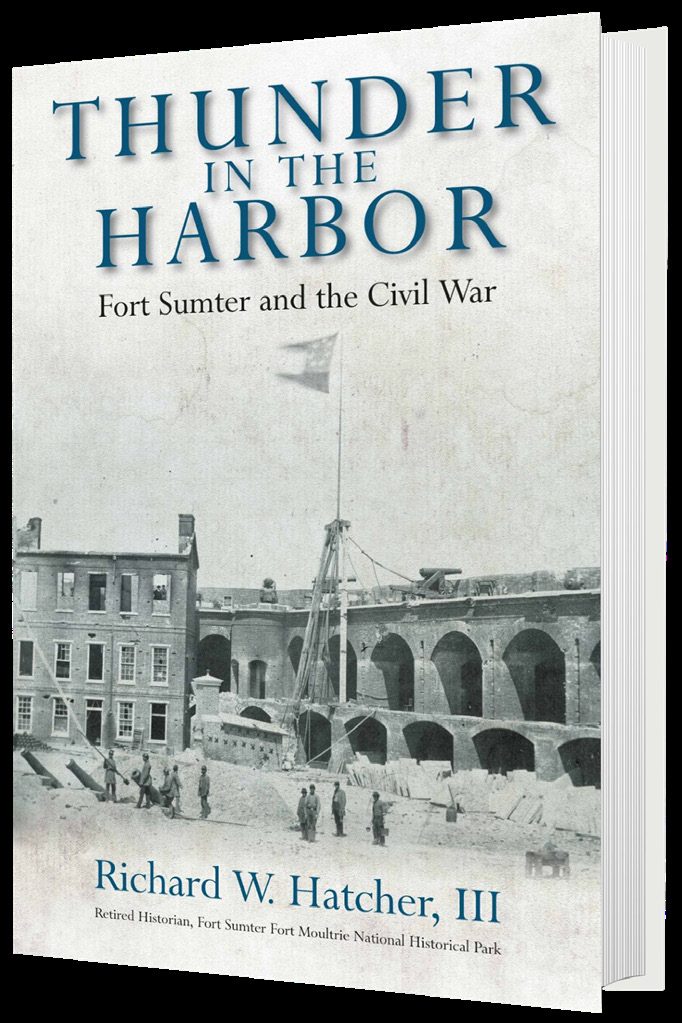
Exemplary New History of Fort Sumter
Reviewed by C. Michael Harrington
Travel Tip: If you are among the quarter million or more of Americans who plan to visit Fort Sumter this year, you would do well to read Robert Hatcher’s new history of that iconic fort before you embark. Even if you have been there, this book merits reading.
The author is the retired, long-time historian of Fort Sumter Fort Moultrie National Historical Park. There is no better authority to write the definitive history of Fort Sumter, beginning with its origin in the aftermath of the War of 1812, through its pivotal role in the Civil War, and finally to its transfer to the National Park Service after WW II.
Like government projects generally, the construction of Fort Sumter was slow and sporadic. In fact, it spanned decades. Construction was still ongoing on the eve of the Civil War. Built on a small artificial island in Charleston Harbor, this pentagonal masonry fort was designed to mount 135 guns with a garrison of 650 officers and men, although it never realized those dimensions in either guns or men.
Roughly 80 percent of Hatcher’s book details activities connected with Fort Sumter or its vicinity during the Civil War. That account begins in late December 1860 when Maj. Robert Anderson’s 1st U.S. Artillery occupied Fort Sumter surreptitiously and then held it tenaciously during a bloodless Confederate cannonade that persisted for about 34 hours in mid-April 1861. Only when prospects for resupply dissipated did Anderson yield up the fort to the enemy and sail North with his command.
Once Confederates occupied Fort Sumter, they held it for almost four years with a grim determination that bordered on fanaticism. The first two years of Rebel occupation went mostly untested, allowing the Confederates time to shore up the fort’s defenses. Things changed abruptly on April 7, 1863, when nine Federal ironclad warships steamed towards Fort Sumter, only to be driven back by a lethal crossfire from gunners posted at Fort Sumter and other Confederate batteries ringing the harbor. Five of the ironclads were disabled and another subsequently sank.
This failed naval attack proved only the beginning of a 22-months-long siege by land and sea of Charleston, Fort Sumter, and the city’s other outer defenses. During this siege, the defenders of Fort Sumter endured a sustained artillery bombardment that, by September 1863, had virtually eliminated Fort Sumter’s offensive capability, effectively transitioning the fort from an artillery to an infantry outpost.
By the time its garrison quietly joined the Confederate exodus from Charleston in mid-February 1865, Fort Sumter had withstood the impact of more than 46,000 solid shot and shells, totaling approximately seven million pounds of iron that left the fort a heap of earthen and masonry rubble.
Federal reoccupation of Fort Sumter witnessed the grand spectacle of Robert Anderson’s triumphal return and his raising the U.S. flag on the fourth anniversary of his surrender of the fort.
Despite the war’s proof of the vulnerability of stationary forts to artillery, Washington decided to reconstruct Fort Sumter. The former commander of Federal forces in South Carolina, Gen. Quincy Gillmore, remained in the Corps of Engineers after the war and oversaw reconstruction efforts from 1870 until shortly before his death in 1888. Several hurricanes and the devastating 1886 Charleston earthquake impeded progress. Undeterred by nature and slow congressional funding, Gillmore doggedly persisted to the point he came to resemble Captain Ahab, with Fort Sumter as his Moby Dick.
By the early twentieth century, the reconstructed Fort Sumter had morphed into a concrete artillery battery that was officially designated Battery Isaac Huger in honor of a local Revolutionary War general. Battery Huger was regarrisoned at the outbreak of WWII, and new guns were added in 1943, but never fired at an enemy.
The development of long-range naval guns and heavy bomber aircraft during WWII made Fort Sumter’s once strategic location in Charleston Harbor irrelevant. Fort Sumter was closed in 1947 and transferred to the National Park Service the next year. Today the fort is part of the Fort Sumter Fort Moultrie National Historical Park.
Fort Sumter is the focal point of this book, but some other famous events that occurred during the Civil War in Charleston Harbor and its environs come in for commentary, including the assault on Battery Wagner led by the 54 Mass. Inf. (and celebrated in the movie Glory), the bold commandeering of the CSS Planter by its enslaved crew, and the sinking of the USS Housatonic by the Confederate submarine, the H. L. Hunley.
Robert Hatcher tells a good story well. Hatcher enlivens his account with excerpts from the private correspondence of soldiers who garrisoned Fort Sumter, both Rebs and Yanks. The lengthy bibliography testifies to the painstaking research Hatcher put into writing this book.
Physically, this book is a joy to hold and read. The text is set in large, double-spaced type, making for easy reading. Footnotes are nicely placed at the bottom of pages instead of being huddled into the back of the book. Three well-drawn maps and a variety of photos and other images enhance the book’s readability.
Prospective visitors to Fort Sumter as well as readers interested in Civil War forts or the war in the Charleston area will find this book worthwhile. I recommend it highly.
C. Michael Harringtonisaretiredlawyer, residing in Houstonand Galveston. Theauthorofseveral publishedarticleson South Carolinasoldiers, Mike haslecturedto Civil Warorganizationsin Houston onmultipletopics, including Yale’s Confederate alumniand South Caroliniansinthewar. Mikeis alsoapastpresidentofthe Houston CWRT.
A New Look at Two Atlanta Campaign Controversies
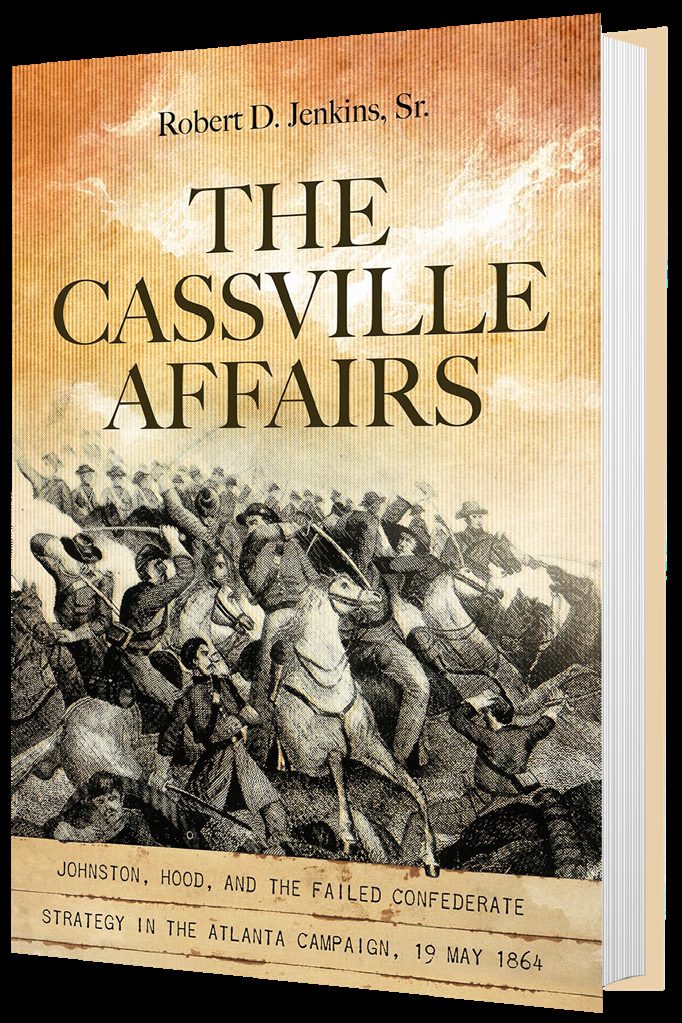
The Cassville Affairs: Johnston, Hood, and the Failed Confederate Strategy in the Atlanta Campaign, 19 May 1864. Robert D. Jenkins, Sr. Acknowledgments, introduction, exhibits, maps, road number key to maps, photographs, drawings, bibliography, index, 384 pp., 2024, Mercer University Press, mupress.org, hardbound. $39.00. Reviewed by Joseph A. Derie
Ever since Gen. Joseph Johnston evacuated Cassville, Ga., the evening of May 19, 1864, soldiers, politicians, and historians have been researching, arguing, and wondering exactly what happened while the Confederate Army of Tennessee occupied the village during 18-19 May. The two controversies evolve around a surprise attack that Lieutenant General John Bell Hood’s Corps was supposed to have launched against an unsupported wing of Gen. William T. Sherman’s Federal armies, and later a defensive battle that Joe Johnston was supposed to have fought from lines just south of Cassville. The circumstances around these decisions caused such a controversy that years after the war, while the two were traveling on a steamboat, Sherman asked Johnston what it was all about.
The long and the short of what was known, until publication of The Cassville Affairs, was that Hood did not attack because Federal cavalry appeared in his right rear due to a road left unguarded by Gen. Joe Wheeler’s cavalry. Secondly, Joe Johnston issued an order to be read out to his army, that he was going to make a stand in Cassville to defeat the Federal Army and stop them going further into Georgia, but shortly after that order, Johnston retreated south.
The author does an excellent job of setting the stage of how the Confederate Army was forced back to Cassville. His best work, however, is covering the two affairs using primary sources, especially maps either not used or available previously. The author has lived close to the battlefield for many years (forty-five minutes by his recounting) and knows the area intimately. The rural road network and the actual names of certain roads are key to much of the controversy as are differing, often self-serving, primary sources. One example is that an earlier version of Hood’s report on the campaign dated February 13, 1865, was printed in the March 25, 1865, Richmond Enquirer and reprinted in the New York Times on March 29, 1865. This is a slightly different version of the report found in an appendix to Hood’s Advance and Retreat.
The Cassville Affairs is heavily researched by the author and will be the definitive work on the subject for many years, possibly forever. It is hard to imagine any new sources that will not confirm the author’s findings or add anything but local color to the history of the Cassville Affairs. It is excellent history and will be of especial interest to those with an interest in the Civil War in the west and the Atlanta Campaign. It is very highly recommended.
CAPT Joe Derieisalongtime Civil Warbuffwitha specialinterestin Civil Warnavalhistoryandthe Civil Warinthe West. Heisaretired USCG officeranda licensedofficerofthe Merchant Marine, currently self-employedasamarinesurveyorandmarineaccident investigatorin Portland, OR.
Editor of Update Calls Letters “Clear-eyed, Candid, Informative”
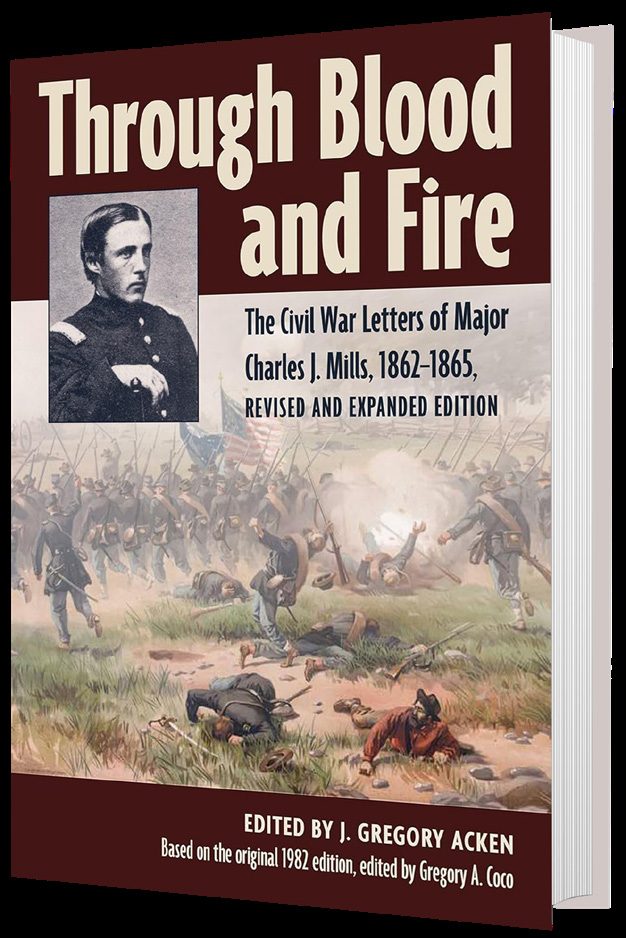
Through Blood and Fire: The Civil War Letters of Major Charles J. Mills, 1862–1865, Revised and Expanded Edition. Edited by J. Gregory Acken. Maps, photographs, bibliography, footnotes, index. 312 pp., 2023. The Kent State University Press. KentStateUniversityPress.com. Hardbound, $55.00.
Gregory Acken is an independent historian specializing in the writings of Civil War soldiers. In addition to the book under review, he has edited three collections of letters and diaries of other Federal officers. In this work, Acken presents 118 letters written by a Boston blueblood who served in the Army of the Potomac.
Charles J. Mills was a member of a well-to-do Boston family and a Harvard graduate, class of 1860. Failing in his effort to secure an army commission, Charley enlisted as a private in a Massachusetts militia unit which, unfortunately, was disbanded almost as soon as he signed up. He tried again to earn a commission by recruiting men for a regiment of volunteers, but failing to bring in enough recruits, he was again disappointed. His efforts finally paid off when, in August 1862, he was commissioned as a second lieutenant in the 2nd Massachusetts Infantry.
Lt. Mills’s first letters home describe the difficult marches he and his new comrades endured as they moved toward the battles in Northern Virginia and Maryland. The regiment was not engaged at Bull Run, but was in the thick of things at Antietam, where, after serving only one month, Mills was severely wounded by a shot which passed through both thighs.
For most men, such a wound would mean a one-way ticket home and a permanent goodbye to the military. However, after a year, Mills re-entered the service, even though his wounds left him partially lame. From the fall of 1863 through March 1865, he served as a staff officer, first under a regimental commander, then at the division level, and ultimately at the headquarters of the IX and then the II Corps.
Charley’s letters home, most to his mother, some to his father and a few to others, offer good descriptions of the movements of the army and the fighting; they comment on the qualities of the generals in charge and other officers nearer to his own rank; they express opinions on the larger issues military and political; and convey news about his college friends and others who served in various capacities.
From time to time, Charley showed his opinionated side as well as his superior attitude toward people not of his class and education. He preferred the company of gentlemen to that of roughs and had a rather odd prejudice against Pennsylvanians. He also had a low opinion of black soldiers and often, in a very casual way, used an impolite word in lieu of “black.” The reader also learns about his literary and sartorial preferences from the list of items he requests from home.
The last letter written by Mills was penned on March 31, 1865, addressed to his mother, hours before he was struck by a solid shot and killed instantly.
How this book came to be is an interesting story. In 1977, Gregory A. Coco bought a collection of artifacts that once belonged to Major Mills. Among the collection was a leather case of letters. Coco transcribed and edited the letters, which he self-published in 1982. The originals have been lost, both the 118 Coco published and the 80 or so others. Coco’s edition (only 300 copies) has been used by historians: I quickly found the 1982 edition listed in the bibliographies of four books on my own shelves. Aken’s edition builds on Coco’s original by providing useful footnotes and detailed editorial comments which add context to Mills’s account and supply information on the many characters who appear in the letters. With the publication of this book, the letters of Maj. Charles J. Mills can be read by a much wider range of Civil Warriors.
Gould Haglerisaretiredlobbyistlivingin Dunwoody, Ga. Heisapastpresidentofthe Atlanta Civil War Round TableandtheauthorofGeorgia’s Confederate Monuments: In Honorofa Fallen Nation,publishedby Mercer University Pressin 2014. Hehasbeenaregular contributortoCWNsince 2016. Hecanbereachedat
Lincoln’s Political Army
Wide Awake: The Forgotten Force That Elected Lincoln And Spurred The Civil War. By Jon Grinspan. Advance copy with only notes. Bloomsbury Publishing, bloomsbury. com, 2024, 322 pp., softcover, $32.00.
Little did Hartford, Connecticut, 19-year-old clerk Eddie Yergason, and his five fellow clerks, realize that they had started a movement that would help propel Abraham Lincoln to the White House. When they sewed their first black capes and caps, stole a few parade torches, and led a peaceful parade for the protection of anti-slavery speaker Cassius Clay, they set in motion the phenomena known as the Wide Awakes. This militaristic-looking movement was composed primarily of white, working-class youths but also included Northern anti-slavery adherents, radical European immigrants, xenophobic Know Nothings, and later women, freed slaves, and even anti-slavery Southerners. They became Lincoln’s political army and worked for Republican victories against a Democratic Party they felt was dominated by slave-owning Southern extremists.
This new “army” reflected the rough and tumble politics of antebellum America. It was an outgrowth of the political behavior characterizing the first half of the 19th Century and, in many aspects, reflected the political turmoil still evident in today’s political arena. Wide Awakes were known for the acute imagery they portrayed and their oblique ideals, anti-slavery, pro-democracy, and pro-labor versus old aristocracy and exploiters of class hostilities. To achieve their aims, they dressed alike to promote their equality, organized companies to maintain order, elected officers in a democratic manner, drilled in military style, and cheered in unison. Some estimates placed their membership, which grew rapidly before the 1860 election, at 500,000.
After achieving electoral victories at the state level, and then the presidency, they continued by making up the first Union volunteers at the outbreak of the Civil War, volunteered their clubhouses for recruiting stations, and encouraged enlistments to crush the Southern slaveholders. The Wide Awakes had become a symbol of everything Southerners feared about the North. Coincidentally, Northerners were ready to disregard Southern visions of Northern aggression. At the same time, Southerners were willing to follow through on their threats of secession. Thus, the greatest political movement in U.S. history brought about a Republican victory and simultaneously a terrible Civil War.
Jon Grinspan’s book is exceptionally well written and creates the sensation that the reader is actually caught up in the marching Wide Awake rallies. It is extensive in its documentation and well infused with primary source material. The only missing elements are the lack of photographs and newspaper accounts, all easily obtained, which would add immensely to the visual enhancement of the book. It is highly recommended for anyone desiring a thorough history of Wide Awakes and their impact on the 1860 election.
Dr. Wayne L. Wolfis Professor Emeritusat South Suburban Collegeand Past Presidentofthe Lincoln-Davis Civil War Roundtable. Hehaswrittenseveralbooksand articlesonthe Civil WarincludingHeroesand Roguesof the Civil War, The Last Confederate Scout, and Two Years Beforethe Paddlewheel. Hefrequentlylecturesat Civil Warroundtablesandeventsandextensivelyresearches thelifeofthecommonsoldier.
Two of the nation’s profound battlefield sites, Wilderness Battlefield and Minute Man National Historical Park, have once again found themselves listed among the 11 Most Endangered Historic Places in the United States. The designation serves as a reminder of the ongoing need to preserve these landscapes from the pressure of urban sprawl and development.
Announced by the National Trust for Historic Preservation in its annual listing, these battlefield areas, though partially shielded within units of the National Park System, require immediate action for their protection.
Known for its pivotal role in the 1864 Civil War Overland Campaign, the Wilderness stands as a testament to a turning point in the nation’s history. Yet, this hallowed ground is currently facing the looming threat of a 2,600-acre mixeduse development, that would essentially transform this land in Orange County, Virginia, into an expansive industrial data center and warehouse distribution building space. The Trust is currently the lead plaintiff in a lawsuit to overturn the rezoning previously approved by the Orange County Board of Supervisors.
Notably, this isn’t the first time the Wilderness has faced such issues. In 2010, the battlefield narrowly escaped the threat of a Walmart supercenter. Through concerted efforts, Walmart ultimately chose to build elsewhere, donating the original site to the Commonwealth of Virginia,
demonstrating the ability to harmonize development and preservation. Meanwhile, Minute Man National Historical Park, in Lexington and Concord, Massachusetts, finds itself in the shadow of Hanscom Field, the region’s largest noncommercial airport, which seeks to expand by adding a half-million square feet of impervious infrastructure, including 17 new hangars. As the park stands in the takeoff and landing flight paths to and from Hanscom, the expansion threatens to add increased flight traffic, which, in turn, could add to noise and visual intrusions at the Park, vehicular traffic, air quality and other environmental concerns. This isn’t the first time Minute Man has grappled with the effects of the airport before; it was previously on the Most Endangered list back in 2003.
The Trust has an extraordinary opportunity to save seven and a half acres of twice-hallowed ground that it has coveted for years. The land has significance in the two battles of Fredericksburg and was the site of artillery positions, observation areas, and command posts. Plus, it’s only a short walk from General Lee’s Headquarters atop Telegraph Hill, which is adjacent to National Park Service land. Unfortunately, the Trust isn’t the only one with eyes on it. With the land’s current zoning allowing for considerable residential construction, developers have been standing by for their chance at the property. Lucky for the Trust, when the landowner announced that he was ready to sell, he took the organization up on the chance to preserve a piece of our past rather than pave over it.
The Trust now has a contract with the landowner, but this prime real estate comes at a cost. Over the course of three years, we will be paying $1.525 million—and the first installment of $500,000 is quickly approaching.
With townhouses directly across the street from this property, it is easy to see the impact we can make if we stand together to prevent inappropriate development on and near to hallowed ground. Time and again, we have saved heart-wrenching and tide-turning history.
Fredericksburg was the scene of deadly combat, first, in December 1862, and again,