Civil War research and scholarship. Contact email:
Two Pennsylvania Brothers Writing Home
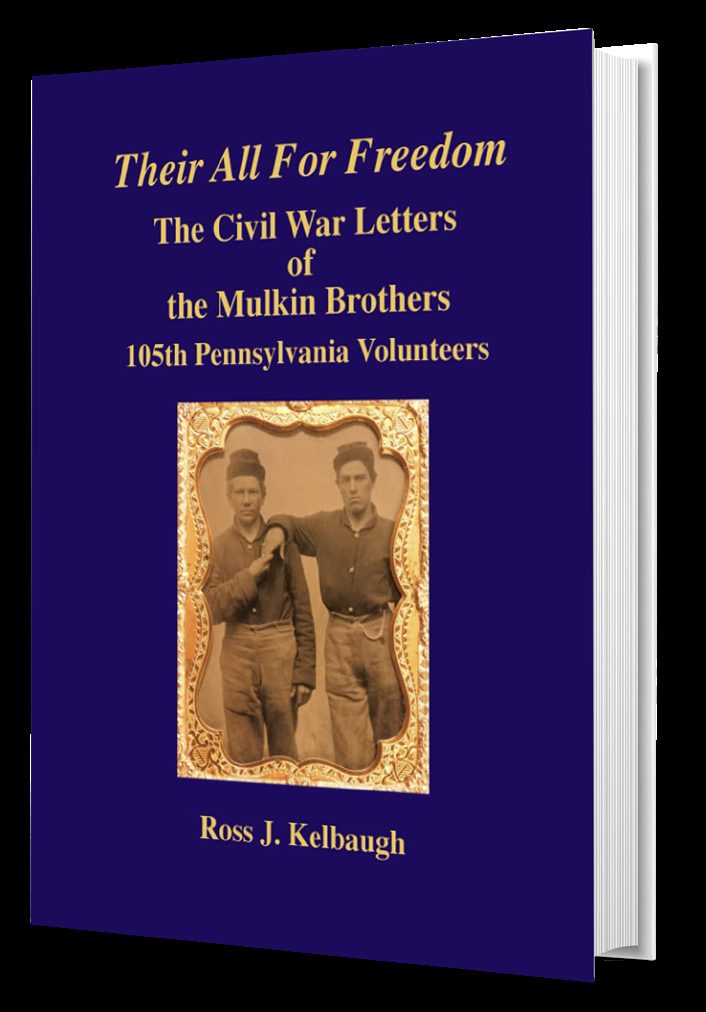
Their All For Freedom: The Civil War Letters of the Mulkin Brothers, 105th Pennsylvania Volunteers.By Ross J. Kelbaugh.Forty-three photos & illustrations, 76 pp., self-published (via Historic Graphics, LLC), $19.95. Reviewed by Paul Taylor
The 105th Pennsylvania Volunteer Infantry was organized at Pittsburgh, Penn., on September 9, 1861. It was there that James and William Mulkin were mustered into the regiment’s Company H on September 12 to fight for flag and Union. Soon thereafter, the Mulkin brothers began writing home about their experiences with most letters being sent to their younger brother, Thomas P. Mulkin. Their story may have been lost to history had author Ross J. Kelbaugh not discovered and then purchased their few remaining letters in the early 1970s for $35 at a local antique show. According to Kelbaugh, that small purchase began a decades-long tale of collecting, research, and discovery that resulted in this book. After careful transcription along with research at the National Archives’ Civil War pension files, the brothers’ story emerged.
The first letter is written from Washington, DC, dated September 17, 1861, and relays a new soldier’s typical excitement. Two from June and July 1862 describe action at the battles of Fair Oaks and then Malvern Hill. We learn how both brothers were captured at Bristol Station on August 26, 1862, but were paroled the next day, then sent by Union authorities to Camp Parole in Annapolis, Md.
William’s service record indicates he deserted from August 1862 through October 1863. He eventually returned to his regiment; however, he forfeited nine months’ pay and allowances as punishment for his deed. His lone lengthy letter to home following his return did not mention his desertion. William Mulkin died on May 7, 1864, from wounds received at the battle of the Wilderness. James, meanwhile, was medically discharged on February 18, 1863, due to tubercular consumption. He passed away soon thereafter.
Their All For Freedom contains a mere eighteen letters, thereby offering the reader only a glimpse into the lives of these two men and the 105th Pennsylvania Infantry. Due to the paucity of letters, this book most likely will offer little to serious students of the war other than those with an interest in the 105th Pennsylvania. On the other hand, it is obvious that producing this slender, self-published 8 ½ x 11 inch hardcover book was a labor of love for the author and for that he should be applauded. Kelbaugh added full-page color reproductions of the actual letters with full transcriptions, some contextual remarks about the regiment’s campaigns and parole camps, along with other numerous Civil War photos and color illustrations pertinent to the brothers’ story. The author rounds out the book by providing info on their father’s successful attempt to access William’s pension and lastly, the final search for each brother’s grave.
Note that at the time of writing this review, it appears that Historic Graphics, LLC may no longer exist online. Those wishing to purchase a copy can do so from Amazon.
Paul Taylorisanaward-winningauthorofeightbooks pertainingtothe Civil Warera. Hisnewestbookistitled’Tis Not Our War: Avoiding Military Serviceinthe Civil War North andwillbepublishedby Stackpole Booksinspring 2024.
Little did Hartford, Connecticut, 19-year-old clerk Eddie Yergason, and his five fellow clerks, realize that they had started a movement that would help propel Abraham Lincoln to the White House. When they sewed their first black capes and caps, stole a few parade torches, and led a peaceful parade for the protection of anti-slavery speaker Cassius Clay, they set in motion the phenomena known as the Wide Awakes. This militaristic-looking movement was composed primarily of white, working-class youths but also included Northern antislavery adherents, radical European immigrants, xenophobic Know Nothings, and later women, freed slaves, and even antislavery Southerners. They became Lincoln’s political army and worked for Republican victories against a Democratic Party they felt was dominated by slave-owning Southern extremists.
This new “army” reflected the rough and tumble politics of anti-bellum America. It was an outgrowth of the political behavior characterizing the first half of the 19th Century and, in many aspects, reflected the political turmoil still evident in today’s political arena. Wide Awakes were known for the acute imagery they portrayed and their oblique ideals, anti-slavery, pro-democracy, and pro-labor versus old aristocracy and exploiters of class hostilities. To achieve their aims, they dressed alike to promote their equality, organized companies to maintain order, elected officers in a democratic manner, drilled in military style, and cheered in unison. Some estimates placed their membership, which grew rapidly before the 1860 election, at 500,000.
After achieving electoral victories at the state level, and then the presidency, they continued by making up the first Union volunteers at the outbreak of the Civil War, volunteered their clubhouses for recruiting stations, and encouraged enlistments to crush the Southern slaveholders. The Wide Awakes had become a symbol of everything Southerners feared about the North. Coincidentally, Northerners were ready to disregard Southern visions of Northern aggression. At the same time, Southerners were willing to follow through on their threats of secession. Thus, the greatest political movement in U.S. history brought about a Republican victory and simultaneously a terrible Civil War.
Jon Grinspan’s book is exceptionally well written and
L i n c o l n ’ s P o l i t i c a l Army
Wide Awake: The Forgotten Force That Elected Lincoln And Spurred The Civil War. By Jon Grinspan. Advance copy with only notes. B l o o m s b u r y P u b l i s h i n g, bloomsbury.com, 2024, 322 pp., softcover, $32. Reviewed by Wayne Wolf creates the sensation that the reader is actually caught up in the marching Wide Awake rallies. It is extensive in its documentation and well infused with primary source material. The only missing elements are the lack of photographs and newspaper accounts, all easily obtained, which would add immensely to the visual enhancement of the book. It is highly recommended for anyone desiring a thorough history of Wide Awakes and their impact on the 1860 election.
Dr. Wayne L. Wolfis Professor Emeritusat South Suburban Collegeand Past Presidentofthe Lincoln-Davis Civil War Roundtable. Hehaswrittenseveralbooksandarticlesonthe Civil WarincludingHeroesand Roguesofthe Civil War, The Last Confederate Scout,andTwo Years Beforethe Paddlewheel. Hefrequentlylecturesat Civil Warroundtablesandevents andextensivelyresearchesthelifeofthecommonsoldier.
always engage them. Fortunately, I ran across a children’s book that effectively bridges the gap from ambivalence to interest.
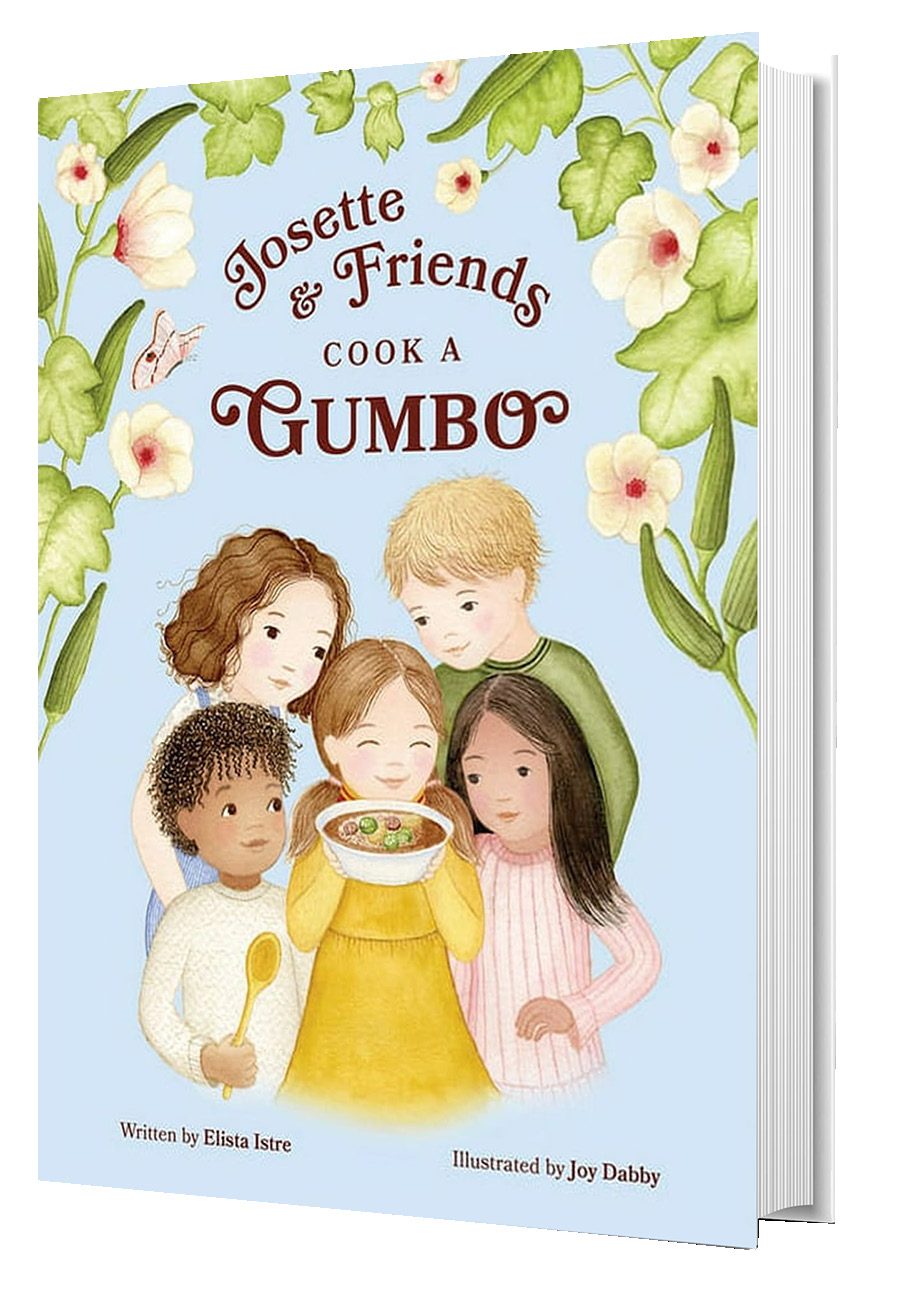
The subject of this volume is one of Louisiana’s most popular culinary specialties, gumbo and the various cultures that contributed their ingredients to the dish over the years. To enhance the specialty of this volume, author Dr. Elista Istre actively engages the youth attending her book signings. The kids are encouraged to follow the characters along in the story by adding handmade felt ingredients to the gumbo pot she suspends from a tripod over a faux campfire.
This book is an excellent primer for gumbo and its varied history throughout the state. After the story of Josette and her friends concludes, the author added a wonderful history of the meal and even the first documented mention of filé, a major ingredient in gumbo, by slaves in 1764. Let’s hope we see more history books like this one that cover the Civil War era.
I highly recommend this book for both children and those young
American History through a Child’s Eyes
Reviewed by Richard H. Holloway
One of the least favorite school subjects for many young students is history because dates and personages don’t at heart. It is a great history lesson kids can relate to and learn from. The best part is when the author mentions, “Just like people, no two gumbos are alike.” What an impactful statement demonstrating to kids that no matter where you’re from, like gumbo, it’s okay to be different!
Editor of Update Calls Letters “Clear-eyed, Candid, Informative”
Through Blood and Fire: The Civil War Letters of Major Charles J. Mills, 1862-1865, Revised and Expanded Edition. Edited by J. Gregory Acken. Maps, photographs, bibliography, footnotes, index. 312 pp., 2023. The Kent State University Press. KentStateUniversityPress.com. Hardback, $55.
Gregory Acken is an independent historian specializing in the writings of Civil War soldiers. In addition to the book under review, he has edited three collections of letters and diaries of other Federal officers. In this work, Acken presents 118 letters written by a Boston blueblood who served in the Army of the Potomac.
Charles J. Mills was a member of a well-to-do Boston family and a Harvard graduate, class of 1860. Failing in his effort to secure an army commission, Charley enlisted as a private in a Massachusetts militia unit which, unfortunately, was disbanded almost as soon as he signed up. He tried again to earn a commission by recruiting men for a regiment of volunt eers, but failing to bring in enough recruits, he was again disappointed. His efforts finally paid
off when, in August 1862, he was commissioned as a second lieutenant in
p y r ollc
the 2nd Massachusetts Infantry.
Lt. Mills’s first letters home describe the difficult marches he and his new comrades endured as they moved toward the battles in Northern Virginia and Maryland. The regiment was not engaged at Bull Run, but was in the thick of things at Antietam, where, after serving only one month, Mills was severely wounded by a shot which passed through both thighs.
For most men, such a wound would mean a one-way ticket home and a permanent goodbye to the military.
However, after a year, Mills reentered the service, even though his wounds left him partially lame. From the fall of 1863 through March 1865, he served as a staff officer, first under a regimental commander, then at the division level, and ultimately at the headquarters of the IX and then the II Corps.
Charley’s letters home, most to his mother, some to his father and a few to others, offer good descriptions of the movements of the army and the fighting; they comment on the qualities of the generals in charge and other officers nearer to his own rank; they express opinions on the larger issues military and political; and convey news about his college friends and others who served in various capacities. From time to time, Charley showed his opinionated side as well as his superior attitude toward people not of his class and education. He preferred the company of gentlemen to that of roughs and had a rather odd prejudice against Pennsylvanians. He also had a low opinion of black soldiers and often, in a very casual way, used an impolite word in lieu of “black.” The reader also learns about his literary and sartorial preferences from the list of items he requests from home.
The last letter written by Mills was penned on March 31, 1865, addressed to his mother, hours before he was struck by a solid shot and killed instantly. How this book came to be is an interesting story. In 1977, Gregory A. Coco bought a collection of artifacts that once belonged to Major Mills. Among the collection was a leather case of letters. Coco transcribed and edited the letters, which he self-published in 1982. The originals have been lost, both the 118 Coco published and the 80 or so others. Coco’s edition (only 300 copies) has been used by historians: I quickly found the 1982 edition listed in the bibliographies of four books on my own shelves. Aken’s edition builds on Coco’s original by providing useful footnotes and detailed editorial comments which add context to Mills’s account and supply information on the many characters who appear in the letters. With the publication of this book, the letters of Maj. Charles J. Mills can be read by a much wider range of Civil Warriors.
Fg Sporting Powders
Now Available Black Powder 1Fa•2Fa•3Fa•4Fa•7Fa 1Fg•2Fg•3Fg•4Fg
Masterful New Overview of Second Manassas
Never Such a Campaign: The Battle of Second Manassas, August 28-30, 1862. By Dan Welch and Kevin R. Pawlak. Maps, images, appendices, 192 pp., Savas Beatie LLC, savasbeat 2024. Softcover, $16.95.
Reviewed by C. Michael Harrington
This short, easy-to-read book is one of the newest additions to the popular Emerging Civil War Series. What makes this book particularly appealing is that Second Manassas (or Bull Run) is arguably the most overlooked and least documented major campaign of the entire Civil War. According to campaign scholar John Hennessy in his foreword to the text, this book is only the seventh study that “focus[es] in any significant way on the Second Manassas campaign.”
No sooner had General Robert E. Lee’s Army of Northern Virginia blunted the spring 1862 attempt of Maj. Gen. George McClellan’s Army of the Potomac to capture Richmond, than a new threat to Lee’s army and Virginia materialized. Unhappy with McClellan’s generalship, President Lincoln had summoned Maj. Gen. John Pope from the Western Theater to take command of the new Army of Virginia, which consolidated all Union troops in the East except those under McClellan. Just as a football team with two quarterbacks has no quarterback, Lincoln’s decision to divide command of Union forces in Virginia between two generals, especially two generals who both disliked and distrusted each other, would prove to be self-defeating.
Puffed up by his successes against lackluster Confederate commanders in the Western Theater, Pope brought to the East a harsher philosophy of war, one that targeted the Confederacy’s civil population as well as its military. In Lee’s eyes, Pope was not only a threat to Confederate communications and supply points in Central Virginia, he was also a “miscreant” who had to be suppressed.
The authors’ account of the campaign proceeds in chronological order, beginning with Lee’s July 27 decision to send the wing of his army commanded by Maj. Gen. Thomas “Stonewall” Jackson northward from Richmond to seek out Pope’s army, and ending with the Battle of Chantilly (or Ox Hill) fought in a thunderstorm on September 1. Between these two dates Jackson’s command waged several pitched battles with Pope’s troops, including Cedar Mountain on August 9 and the Brawner farm on August 28.
Jackson’s famous flanking march around Pope’s right in late August resulted in the destruction of the Federal supply depot at Manassas Junction and the temporary interruption of the Federal railroad network. Outnumbered and threatened with imminent attack, Jackson then formed a defensive line in an unfinished railroad cut near the First Manassas battlefield, just as Longstreet’s wing of Lee’s army was threading its way through lightly guarded Thoroughfare Gap, en route to linking up with Jackson’s wing.
On the morning of Aug. 29, Pope unleased the first of a series of disjointed attacks on Jackson’s entrenched line, employing troops from the Army of the Potomac as well as from his own Army of Virginia. Jackson’s line bent but did not break.
The next day, still obsessed with crushing Jackson and falsely believing Jackson was retreating, Pope ordered renewed assaults on Jackson’s hardpressed troops. Dismissing reliable intelligence that Longstreet’s men had arrived on the battlefield, Pope’s decision left his and McClellan’s attacking forces vulnerable to the powerful counterattack that Longstreet launched in late afternoon.
As the afternoon waned, only a spirited stand by an Ohio brigade on Chinn Ridge saved the Federals from a total rout. As it was, when darkness ended the fighting on August 30, all Federal troops were in steady retreat towards Washington. Lee had won his most thorough tactical and strategic victory of the war, although at the cost of at least 8,300 Confederate dead and wounded,
Co-authors Dan Welch and Kevin Pawlak are current or former Park Rangers in Virginia; and they are intimately familiar with the Manassas Campaign battlefields. They write well, too. Ten well-drawn maps and a profusion of photos and other illustrations complement and enliven the text. The several appendices include an incisive essay by Pawlak on how mistrust and miscommunication within the Federal high command contributed to the eventual Union defeat. The supplements also include a proposed driving tour of the campaign and an order of battle. There are no footnotes or endnotes, but the book ends with a “Suggested Reading” for those who want to dig deeper into the relatively thin historiography of Second Manassas.
This book merits a wide readership, especially by those interested in learning more about the Second Manassas Campaign and the battle, but who lack the enthusiasm or time to undertake John Hennessy’s near 500-page definitive history that Welch and Pawlak laud in their “Suggested Reading.”
C. Michael Harringtonisaretiredlawyer, residingin Houstonand Galveston. Hehasauthoredseveralpublishedarticleson South Carolinasoldiers, andlecturedto Civil Warorganizationsin Houston onmultipletopics, including Yale’s Confederatealumniand South Caroliniansinthewar. Heisapastpresidentofthe Houston CWRT.
“I Thank
Eliza Frances Andrews (1840–1931)
the Lord I
War-Time Journal of a Georgia Girl
Am Not a
Yankee...”
have won several prizes, including the Fletcher received a strong education and was a successful writer and educator. Her surely ranks among the most observant and intelligent wartime memoirs by a Southern woman.
Edited with commentary by Stephen Davis, I Thank the Lord I Am Not a Yankeeincludes selections of her wartime and postwar journals which are most expressive of her Confederate
patriotism and Southern pride.
Stephen Davisis author of ten books on the Civil War, most of which treat the Atlanta Campaign. His two recent volumes on Confederate General John Bell Hood
Pratt Award of the New York CWRT.