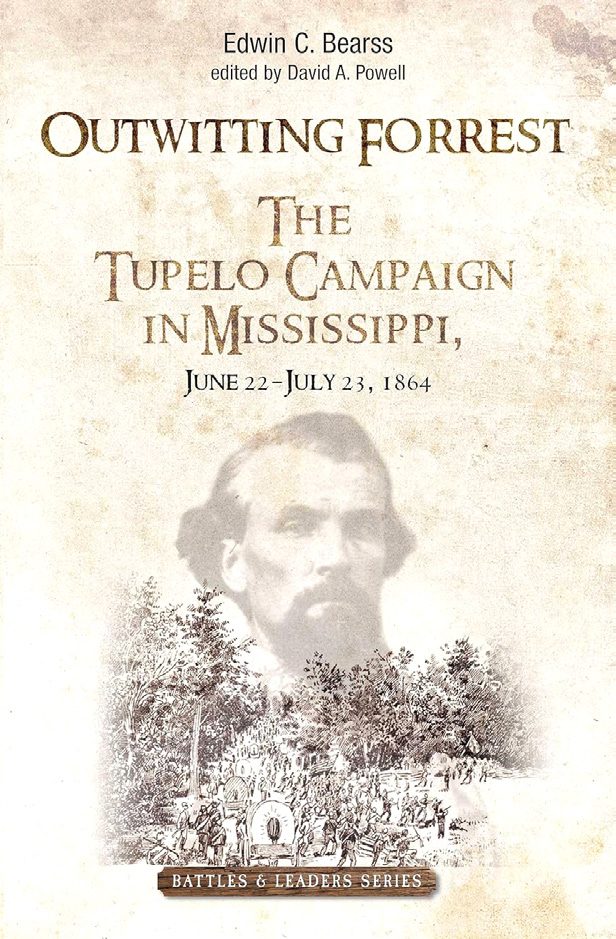
Outwitting Forrest: The Tupelo Campaign in Mississippi, June 22-July 23, 1864. By Edwin C. Bearss, edited by David A. Powell. Maps, photographs, appendices, bibliography, footnotes, index. 192 pp., 2023. Savas Beatie, LLC. www.savasbeatie.com, hardback, $29.95.
In 1969 the National Park Service commissioned Ed Bearss to conduct a study of the Battle of Tupelo with the aim of improving interpretation at the battlefield site in the small Mississippi city. The campaign that led up to the battle, and the battle itself, had theretofore received little attention. Bearss’s efforts resulted in a superb account of the 1864 campaign and its effect on the course of the war. The study, entitled The Tupelo Campaign, was published by the U.S. Department of the Interior. However, as very few copies were printed, the work’s impact was small and the campaign remained largely unstudied for several more decades.
Bearss, as most readers know, was a long-time National Park Service historian and a legendary figure in Civil War circles. Editor David Powell is a prolific historian, best known for his voluminous series on the Chickamauga Campaign. Powell’s editing touch was rather light. As he noted in the Foreword, “there was not much by way of dissenting scholarship and little new of discovery” since Bearss tackled the project over 50 years earlier. Powell’s additions fill in some blanks and offer biographical information on the many officers who populate Bearss’s narrative.
Relying on the Official Records, unit histories, and other sources, Bearss did a deep dive, a very deep dive. The study gives us a superb account of U.S. Maj. Gen. Andrew J. Smith’s expedition from Memphis into northeast Mississippi to chase down the Confederates under Maj. Gen. Nathan Bedford Forrest. The aim was to cripple Forrest, or at least keep him so occupied he could not head east and threaten the railroad supplying Sherman’s huge armies in Georgia. Bearss’s study chronicles the movements of the opposing armies as they marched from place to place and shifted about in response to each other’s movements. The reader gets a view of the broad battlescape and all the small particulars as well, down to the regimental and company level. The pages of Outwitting Forrest overflow with information about every aspect of the Tupelo Campaign and provide insights about the nature of the Civil War and war in general.
Want to Advertise in Civil War News?
In this campaign Forrest was not on his own, but was subordinate to Lt. Gen. Stephen D. Lee, who commanded the Department of Alabama, Mississippi, and East Louisiana. As the Confederate forces were stretched thin, Lee had to be ready to transfer troops to other areas threatened by the Federals. This need contributed to the decision to attack Smith on July 14, even though the Federals were superior in number and held a strong defensive position. Smith inflicted heavy losses on the troops under Lee and Forrest, but still was forced to retreat when their ammunition ran low and the hungry men found that the hard tack was spoiled and inedible.
Three chapters are devoted to Federal forces operating in other parts of Mississippi, pinning down Confederate units which otherwise could have moved north to bolster Forrest’s efforts, just as Smith’s movement was intended to keep Forrest away from the rail lines supplying Sherman. There were many moving parts.
This rich study is worthy of a close read, as the myriad details matter. The work, of course, does not overlook the forest for the trees. Bearss explains the big picture and concisely states the reasons the campaign was important. “Smith’s mission was to keep Forrest’s corps from wrecking the single-track over which General Sherman supplied his ‘Army Group’ in northwest Georgia,” Bearss wrote, “and to destroy Forrest’s command as an effective combat unit.” Smith’s mission was a success. Forrest’s losses at Tupelo took a terrible toll. Four of his brigades were “slaughtered,” Bearss stated, and afterwards would never “be capable of mounting an effective assault on a Union position;” the cars supplying Sherman’s armies kept rolling through middle Tennessee and north Georgia.
The Civil War and Pop Culture-Favorite Stories and Fresh Perspectives from the Historians at Emerging Civil War. Chris Mackowski and Jon Tracey, Editors. Footnotes, Photos, Illustrations, Index. 293 pages. Savas Beatie, www.savasbeatie.com, $32.95.
This book, consisting of thirtyseven essays taken from the Emerging Civil War blog (www.emergingcivilwar.com), looks at how the Civil War has embraced, and at times, even influenced American popular culture. A wide range of subjects are presented dealing with films, television, art, music, literature, poetry, reenacting, and even video and college football games.
Despite the diverse topics discussed there are two consistent themes. The first is that many writers credit their interest in the American Civil War with having seen or done something in one of the categories.
The other is that the “golden age” of the Civil War as a pop culture phenomenon, which lasted throughout most of the 20th century is now gone.
All the essays are good and well-arranged. They are generally written in a conversational tone, as opposed to being strictly academic, and thus easy to read. The authors seem more interested in discussion and encouraging readers to think, rather than being confrontational. As in any book of this nature, the reader will find some essays more interesting than others.
For this reviewer, two essays stood out. John M. Coski’s The Confederate Flag in Popular Culture points out that in the late 1940s, the United Daughters of the Confederacy (UDC) called for an end to the “misuse” of Confederate flags. They were appalled by how the banner had become part of pop culture. South Carolina displayed a Confederate flag over its State House dome and later its grounds until 2015. The Palmetto State passed a resolution in 1958 condemning the sale and manufacturing of Confederate flag beach towels. That same year, urged by the Sons of Confederate Veterans (SCV), the state’s General Assembly passed a series of laws making it illegal to manufacture or sell anything with a Confederate flag, except the flag itself.
The other is Sarah Kay Bierle’s What if There Were No Civil War Epics, in which the author asks what if the films Gone With the Wind, Glory, Gettysburg, Lincoln, and the Ken Burns documentary The Civil War had never been made. The author here asks if would there have been as much interest in the war as there is today had these films never been made. She also asks what type of impact the lack of these films would have on Civil War scholarship, the preservation of battlefields, and Americans’ perceptions of the war.
This an excellent book that will appeal not only to the casual Civil War buff but anyone with an interest in American pop culture.
February 2024
Reviewed by Dr. Wayne L. Wolf
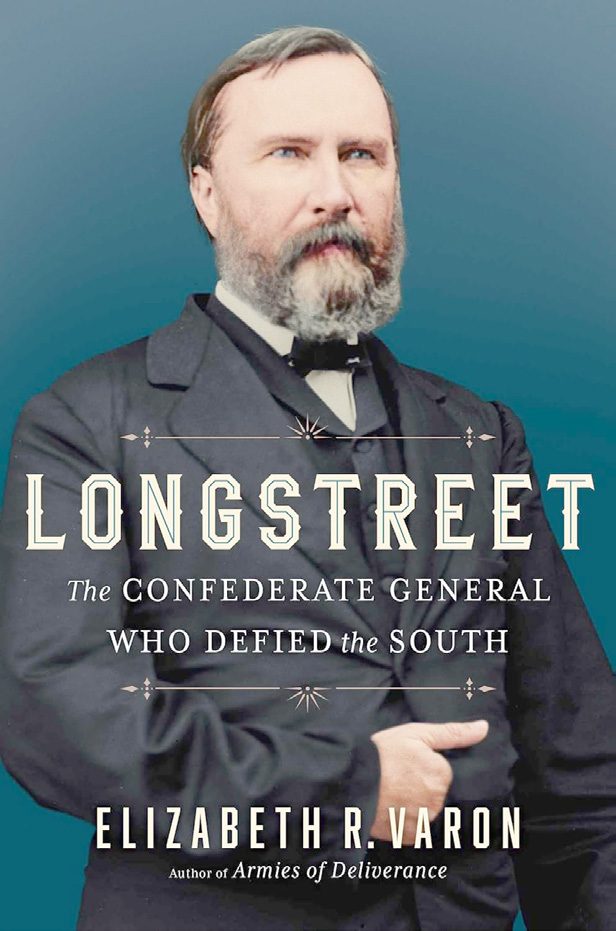
General James Longstreet was Robert E. Lee’s “war horse” who stood by him until the final surrender at Appomattox. Raised in a pro-slavery secessionist ideology, he fought to preserve that legacy during the war. Utilizing a basic defensive strategy, because his Mexican War service taught him its value, he sought to let the enemy strike his entrenched position and then counterattack when they had been weakened. This strategic viewpoint led to his tactical disagreement with Robert E. Lee at Gettysburg, and his later criticism of the strategy of both Lee and the Confederate high command, including President Jefferson Davis.
Furthermore, his characterization of General Grant’s surrender terms as generous and incentivizing the defeated Rebels to rebuild the South, began his descent into an acceptance of Radical Republican Reconstruction policies, which he felt were the surest path to peace and prosperity. He felt these policies would also attract badly needed Northern capital and technological expertise to assist the South in reviving its economy.
His praise for General Grant and his support of the Reconstruction amendments, including making African-Americans fully part of the body politic, began a decades long quest to answer his Southern critics who began questioning his war service and his rejection of the Lost Cause deification of
Lee and Davis. His critics felt the moral correctness of the war and the Rebel cause was being ridiculed by his adoption of Radical Republican policies.
Likewise, his acceptance of a series of federal positions, doled out by Republicans, i.e. Adjutant General of the Louisiana State Militia, Commissioner of the Board of Levees, Deputy Collector of Internal Revenue, Postmaster and U.S. Marshal for Northern Georgia, and Minister to the Ottoman Empire only fueled his detractors’ belief that he sold out to Northern Radical Republicans for his own financial gain. The Democratic press castigated him for his support of Republican policies and his quest to support black participation in the South’s rebuilding. Yet, today historians see his admiration for Northern industrialization and the potential it had for enhancing the South’s agricultural and industrial base, as benefiting the South and setting the stage for America’s place as a world power.
James Longstreet’s post war career exemplified his political about-face, cementing his reputation as a forward thinker that could reflect 21st century America. Yet, his stature as a Confederate hero was perhaps permanently damaged, his motives impugned, and his legacy trivialized.
Elizabeth Varon does an excellent job of not only tracing Longstreet’s career and contributions, but delves into the reasons for his actions, his justifications, and his desire to make a better life for all Southerners. He was generally misunderstood and perhaps today his wisdom might lend itself to solving many of America’s differences with race relations, states’ rights issues, and historical honesty. This book is highly recommended for an unbiased look at the career of a Southern hero.
Dr. Wayne L. Wolf is Professor Emeritus at South Suburban College, and the author of numerous books and articles including Two Years Before the Paddlewheel, Heroes and Rogues of the Civil War, They Saw The Elephant and The Last Civil War Scout. He is a frequent lecturer on the Civil War circuit.
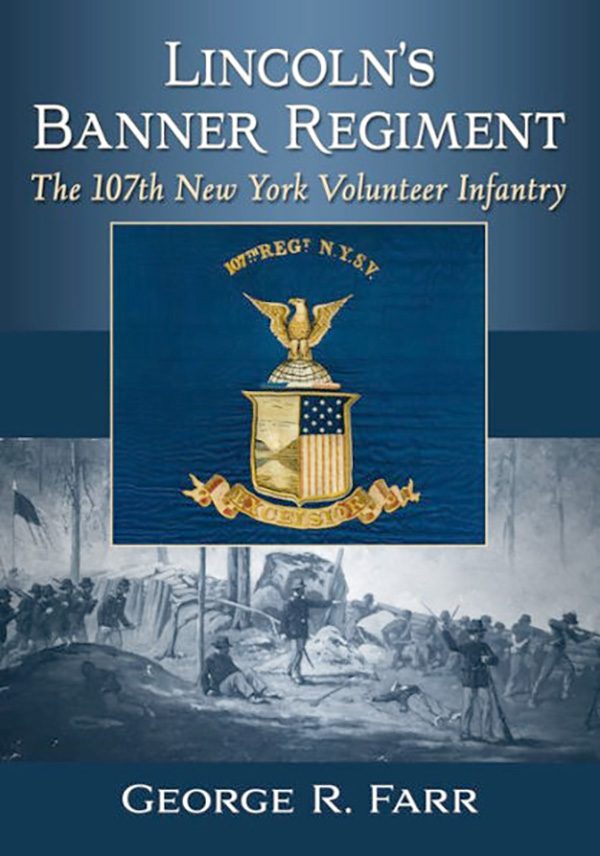
Lincoln’s Banner Regiment: The 107th New York Volunteer Infantry. By George R. Farr. Photos, maps, roster, chapter notes, bibliography, and index. 359 pp., 2023. McFarland & Company, Inc. www.mcfarlandpub.com. Paperback. $49.95.
Reviewed by Robert L. Durham
Researching the 107th New York Infantry has long been a labor of love for George Farr. His ample research comes through in the pages of this book.
The 107th was the only regiment to receive a regimental color from the president; Abraham Lincoln and Secretary of State William H. Seward presented the flag to the regiment when they arrived in Washington, DC. They were the first regiment to answer Lincoln’s call for 300,000 troops. The 107th never carried the color in battle, instead Secretary Seward kept it, returning the flag to the regiment after the war.
Protecting the capital by manning some of the many forts surrounding the city, they could hear sounds of the Battle of Second Bull Run from there. They regretted not taking part in the fight, especially when they saw the wounded and dead returning to the capital after the battle. The 107th became part of the Army of the Potomac in time to take part in the Battle of Antietam. There, although not actively engaged, they suffered a significant number of casualties, mainly from artillery fire.
At Fredericksburg, the 107th was not engaged. They did take part in the Mud March, although Farr does not make this fully clear. At Chancellorsville, they were again lightly involved near the Chancellor House (Farr calls it the Chancellorsville House). At Gettysburg, they held a position on Culp’s Hill but, again, were only lightly engaged. Careless editing here makes it seem that Pickett’s Charge took place on July 4th.
After Gettysburg, the 107th was sent west to take part in the Chattanooga and Atlanta Campaigns. At New Hope Church they experienced their most severe losses in the war. They were among the first troops to enter Atlanta after the Confederates abandoned it. Their final duties were in General Sherman’s March to the Sea and through the Carolinas. This account is especially valuable.
In this reviewer’s opinion, Farr incorporates too much of his research in the pages of this book. I enjoyed Lincoln’s
Current Event Listings To see all of this year’s current
Publishers/Authors Send your book(s) for review to:
Mount Pleasant, SC 29466
Civil War Artillery Book 392 page, full-color book, Civil War Artillery Projectiles – The Half Shell Book.
$89.95 + $10 media mail for the standard edition.
Banner Regiment but felt there were instances where much of the more detailed information was not required. He often quotes letters and newspaper accounts verbatim when it may have been better to paraphrase. Not for the casual reader, this book will prove invaluable for anyone interested specifically in the 107th New York Infantry. Of course, genealogists, or everyone with an ancestor in the 107th, are sure to find them in the pages of the book or in the roster.
Robert L. Durham, a freelance writer, is retired from the Defense Logistics Agency as a computer specialist. His articles have been published in many historical publications. A life-long history buff, he recently went back to college for a bachelor’s degree in history.
Force of a Cyclone: The Battle of Stones River, December 31, 1862 – January 2, 1863. By Caroline Ann Davis and Robert M Dunkerly. Photos, maps, appendices, order of battle, and suggested reading. 171 pp., 2023. Savas Beatie LLC. www.emergingcivilwar.com. Paperback. $16.95.
Force of a Cyclone is a new volume in Savas Beatie’s Emerging Civil War series. The series provides an overview of some of the Civil War’s more important battles. Davis and Dunkerly have done a masterful job of bringing the Battle of Stones River to life. Their book is much more than an overview; in 171 pages they provide all the information required for understanding the Battle of Stones River.
Their book tells the story of the campaign and battle from its beginnings in plans for a campaign laid in Washington, Richmond, Nashville, and Murfreesboro. General Braxton Bragg, the Confederate general commanding the Army of Tennessee, sat on the defensive in Murfreesboro, Tenn., in December 1862 as winter closed in. He did not expect an aggressive push from Nashville over the winter season. General William Rosecrans, the Union general in Nashville, found himself under pressure from the Washington administration to move against Bragg’s army.
Rosecrans began the Stones River campaign by advancing from Nashville toward Murfreesboro. By the morning of December 31, the Northern and Southern armies faced each other west of Murfreesboro. Both generals had the same battle plan, turning the other’s right flank. The Confederates struck first.
The Rebel assault pushed the Union right flank back until it almost doubled against their left flank, like a folding jack knife. The Yankees moved desperately to patch together a position that would protect their supply line to Nashville from being cut. They were successful and the Confederate attack burned itself out by the end of the day.
Both sides spent New Years Day recovering from the first day’s fighting and planning for the next day. On January 2, Bragg sent his right flank fighters, among them the famous Kentucky Orphan Brigade, against Rosecrans’ left. The attack failed and the Battle of Stones River ended in a draw, but Bragg retreated the next day to Tullahoma, Tenn., to await Rosecrans’ next move.
Davis and Dunkerly do an excellent job of telling the story of the Stones River campaign and battle. One thing I missed were footnotes; they incorporate many quotations within the book, and it would be helpful for other researchers if the sources of those quotes were made available. However, that is a small caveat for an outstanding book.
Some of my favorites in this work are that they include accounts of the cavalry activity, something often neglected in battle studies. Another is their “Touring the Battlefield” appendix. I have visited Stones River on several occasions and cannot wait to visit again with my copy of this book in tow.
I recommend this book for anyone desiring knowledge on Stones River. Even those who have read other books on this battle will find useful information.
Robert L. Durham is retired from the Defense Logistics Agency and is now a freelance writer. Many of his articles have been published in various historical publications. A life-long history buff, he recently went back to college for a bachelor’s degree in history.
Want To Advertise In Civil War News? Email us at
Agents of Empire: The First Oregon Cavalry and the Opening of the Interior Pacific Northwest during the Civil War. By James Robbins Jewell. 17 photographs, 2 illustrations, 7 maps, notes, index, 356 pp., University of Nebraska Press, www.nebraskapress.unl.edu/, $45.00.
Armchair generals and casual readers alike tend to think of eastern or southern states like Virginia and Tennessee when pondering the great battles and campaigns of the Civil War. Distant lands like the Pacific Northwest often make barely a ripple. Moreover, quite a few readers are not even aware that a then-new free state like Oregon even had any blue- or gray-clad soldiers whatsoever. Yet in his meticulously researched new work titled Agents of Empire, author James Robbins Jewell shows us how the Civil War was far more transcontinental than previously considered.
Jewell’s work centers around the First Oregon Volunteer Cavalry, an all-volunteer unit formed in early 1862 following the regular army’s 1861 departure from the Pacific Northwest to the seat of war in the east. Its initial need was clear to Oregon’s political leaders and pro-Union residents; to address concerns over the supposed presence of Confederate “Copperhead” sympathizers who, it was feared, might attempt to aid the Southern states from afar given the military vacuum that now existed in Oregon. After all, the contentious 1860 presidential election revealed deep political divisions among Oregon’s small population of under 60,000.
Jewell’s analysis of these social and home front concerns is what makes his work more than a traditional regimental history. For example, Jewell illustrates how recruiting men to serve in the unit was difficult given that the state held only 27,000 men of all ages. Seasonal weather and travel difficulties also added to the challenge with the result being that the regiment never reached its fully desired complement of ten companies totaling roughly 1,000 men.
In spite of such secessionist fears and challenges, making Oregon safe for white settlers and emigrant migration was how the First Oregon Volunteer Cavalry eventually contributed to the Union’s war effort. Rather than chasing gray-clad Rebels, the Oregonians primary nemesis became the so-called “Snake Indians,” a term commonly used to describe members of the Northern Paiutes, Bannocks, and Northern Shoshone tribes.
The unit functioned more like antebellum forces in the west, never concentrated in one place; its various companies were stationed at a variety of forts and encampments from northcentral Oregon and southeastern Washington Territory down to southern Idaho territory. Pressure to retain men close to the home front for civic protection also contributed to the company- or squadron-sized nature of forces in the field for as Jewell points out, there were never any other mounted forces stationed in Oregon during the entire war. The author explains in detail much of the campaigning along Oregon’s modern borders with Idaho, Nevada, and California.
Admission Coupon To Any MKShows Event
Later in the war, the regiment also worked in unison withthe Washington Territory’s own volunteer infantry regiment and later the First Oregon Infantry.
This is not the author’s first foray into Oregon and the First Oregon Cavalry. Jewell’s 2018 book titled, On Duty in the Pacific Northwest during the Civil War: Correspondence and Reminiscences of the First Oregon Cavalry Regiment, presented a series of wartime letters and post-war reminiscences by the regiment’s soldiers and officers. That collection of primary sources served as a proper bookend to this new work in telling this heretofore obscure regiment’s tale.
Recruited by the same Union government that faced off against Confederate forces in the east, the men of the First Oregon Cavalry did indeed make their contribution to the Union cause. By serving primarily as the military wing of the federal government’s desire to quicken economic development and white expansion in eastern Oregon, they helped to lay the groundwork in transforming Oregon from a pre-war frontier to a national growth contributor in the postwar decades. By so doing, the First Oregon Volunteer Cavalry was at the juncture of Civil War nationalism, Pacific Northwest, and westward migration history.
Paul Taylor is an award-winning author of eight books pertaining to the Civil War era. His newest book is titled ’Tis Not Our War: Avoiding Military Service in the Civil War North and will be published by Stackpole Books in spring 2024.
The Civil Water: Favorite Stories and Fresh Perspectives the Historians at Emerging Civil War. Edited by Dwight Sturtevant Hughes and Chris Mackowski,.
acknowledgements, contributor’s notes, drawings, maps, photographs, index, 305 pp, 2023, Savas Beatie, www.savasbeatie.com $32.95.
Reviewed by Joseph A. Derie
The Editor’s Note to this volume begins: “Emerging Civil War serves as a public- history oriented platform for sharing original scholarship related to the American Civil War.” The Emerging Civil War project has been underway for some 10 years now and features a blog, monthly podcasts, academic publications and an annual at Stevenson Ridge, Va. To celebrate the Tenth Anniversary of Emerging Civil War, Savas Beatie is releasing a number of thematic volumes scholarship and writings on various Civil War topics. The Civil War on the Water contains 45 short essays related to the Civil War at sea, in harbor, on the rivers and on the beaches.
The essays are basically in chronological order and cover most areas and theaters of the Civil War afloat. Among them are essays on greater and lesser sea battles (“A Most Curious Battle:
To see all of this year’s current events
Current Event Listings
War Between the States
Memphis, Tennessee, June 6th, 1862;” and “Charles ‘Savez’ Read and the Battle of Portland Harbor;”); greater and lesser land battles (“Ships versus Forts 1861: Off to the Races;” and “Burnside’s Sand March; The North Carolina Amphibious Expedition”), and vessels (“Attrition Rates of City- Class Ironclads;” and “Loss of the USS Monitor”).
There is something for everyone. Readers who served in the US Marine Corps will be happy with “The Leathernecks of 1861.” Those readers who served in the US Coast Guard will find “Perpetual Beacons? Lighthouses in the Civil War” interesting. US Naval Academy grads will enjoy “The U.S. Naval Academy: Coming of Age for the Civil War.” Submariners will like “The Civil War Submarine in the Little Free Library.”
Probably the most obscure Civil War topic covered is in “World on Fire: Confederates on the Far Side.” While burning US whalers in Pohnpei Harbor, now part of the Federated States of Micronesia, the CSS Shenandoah’s Captain James Waddell visited the local chieftain, and as the author writes “the Confederacy, three days after Appomattox, achieved its primary foreign policy objective: recognition and offer of assistance by a foreign power.”
The Civil War on the Water isanother fine publication in the Emerging Civil War series and continues that series’ high standards of scholarship, interesting and varied topics, and readability. It is highly recommended to those with an especial interest in the Civil War afloat, as well as those who want some different reading about the Civil War.
OVER 40 YEARS EXPERIENCE
CAPT Joe Derie is a longtime Civil War buff with a special interest in Civil War naval history and the Civil War in the West. He is a retired USCG officer and a licensed officer of the Merchant Marine, currently self-employed as a marine surveyor and marine accident investigator in Portland, OR.
War Between The States specializes in Civil War autographs, bonds, books, currency, documents, newspapers, postal envelopes, stamps, patriotic covers, portraits and historical art, photography, presidential related material, soldier letters, G.A.R. & U.C.V. items, relics, and much other rare ephemera and historical memorabilia.
War Between The States is one of America’s premier sources for Civil War memorabilia with a superb reputation for authenticity, customer service, and excellent quality material.
Certified Member of: International Society of Appraisers Appraisers Association of America Senior Accredited Appraiser (ASA)
The Artilleryman is a quarterly magazine for collectors, competition shooters and those interested in ordnance from the Revolutionary War to World War II, primarily focusing on cannon, implements, projectiles and related artifacts from the American Civil War.
This full color magazine features articles on cannon safety, artillery history, projectiles, fuses, places to visit, book reviews, competition events, and so much more. The annual quarterly subscription price is just $37.95.