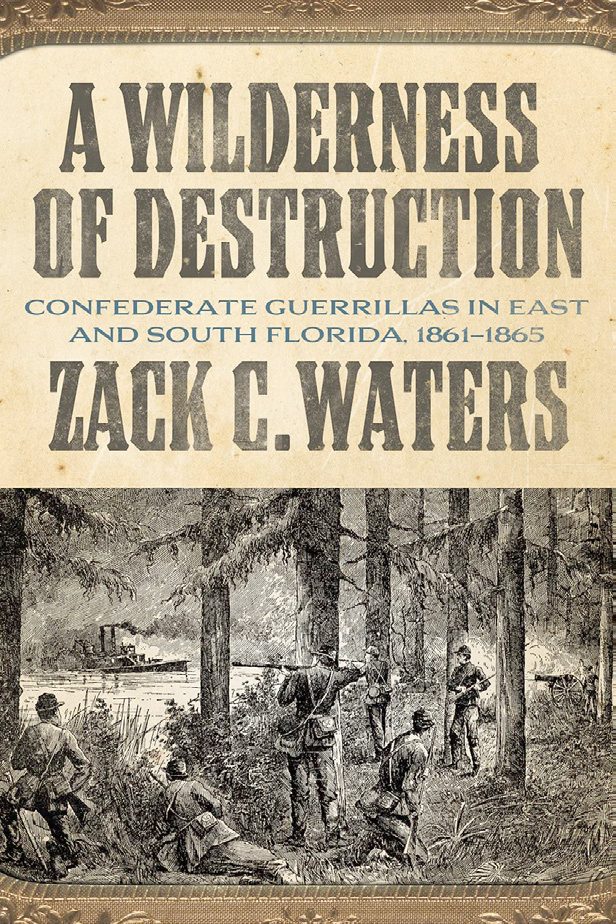
A Wilderness of Destruction: Confederate Guerrillas in East and South Florida, 1861–1865. By Zack C. Waters. Illustrated, bibliography, index, Mercer University Press, 2023, 259 pp., hardcover, $39.00.
As the Civil War entered its second year, the Confederate hierarchy in Richmond placed Florida on the back burner of critical areas to protect. As a result, Gov. John Milton organized guerrilla units (irregulars) to keep Union forces confined to coastal cities and simultaneously protect central and south Florida from Union attacks, thus, protecting the vital cow routes to the famished Confederate armies in Tennessee, Virginia, Georgia, and South Carolina. Additionally, these guerrillas would serve as the only protection against Union depredations towards secessionists in North Florida and the Gulf Coast.
In order to accomplish these objectives, the guerrillas utilized hit-and-run tactics, sabotage, torpedoes, raids, support from locals, intimate knowledge of the terrain, and attack tactics using small, detached groups to thwart superior Union numbers and keep Union troops bottled up on the coast. By disrupting Union communications, attacking Federal shipping, particularly on the St. Johns River, destroying millions of dollars in military property, and capturing Union soldiers who ventured outside their coastal forts, these irregular forces could neutralize much of the North’s superiority in numbers and resources. Nevertheless, the Confederacy could not prevent the fall of Amelia Island, Jacksonville, Fort Clinch, Fernandina, or St. Augustine. They were all in Union hands by May 1862. However, the South was not without victories as they prevailed at New Smyrna, Olustee, Tampa, and numerous small engagements.
The North had its own problems trying to control Florida. Union authorities believed most Floridians were Union sympathizers (an exaggeration). They had only marginal success in recruiting slaves into the army, and as they withdrew from interior towns, Union sympathizers were left unprotected and harassed. Likewise, they could never cut off the herds of cattle going North to feed Lee and Bragg’s armies. In fact, the last herd arrived in Petersburg as Lee was surrendering. Florida never stopped being the essential beef supplier for Confederate armies.
Zack Waters has done an excellent job of researching newspapers, military records, and soldiers’ accounts to craft a history of East and South Florida, an area sorely neglected by many historians who concentrate on major engagements. This book is very readable and brings to life little-known skirmishes and skirmishers like John J. Dickinson, Abner McCormick, Winston Stephens, and W.E. Chambers. Any Civil War historian would benefit from adding this title to his bookshelf.
Dr. Wayne L. Wolf is Professor Emeritus at South Suburban College and past president of the Lincoln-Davis Civil War Roundtable. He is the author of numerous books and articles on the Civil War.
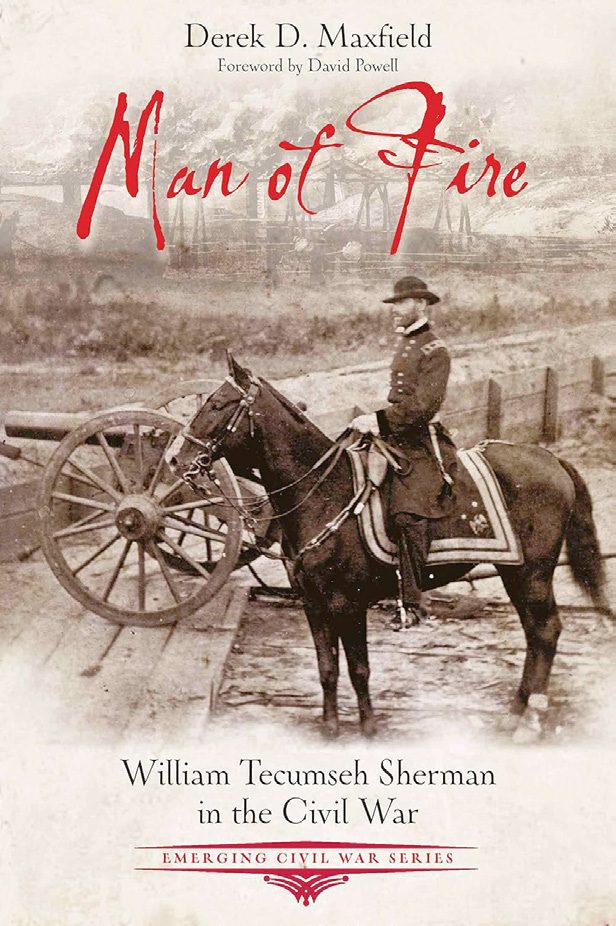
A 132 years after his death, Gen. W.T. Sherman remains one of the most controversial and polarizing figures in American history. To some, he is a military genius whose scorched earth policy helped win the Civil War for the Union. To others, he is a merciless tyrant whose policies caused undue suffering to innocent children and adults. In recent years, he has come under fire for his policies and views on both Native Americans and African Americans.
There is little doubt what Derek D. Maxfield, a history professor at Genesee Community College thinks about Sherman. From the introduction, it is very clear that the author has a strong pro- Sherman bias, and it shows throughout the book. Sherman’s triumphs are highlighted, while his faults are minimized or glossed over. Oddly, the general’s two biggest triumphs, the March to the Sea and the Carolina’s Campaign get less attention than some of his achievements early in the war. Like most Sherman biographies, the general’s postwar life is not as well documented as the rest of his life.
The writing comes across as lazy. A large percentage of the text consists of nothing but quotes by other historians without any endnotes or footnotes. There is no bibliography, only a list of six biographies of Sherman, with the general’s own Memoirs conspicuously absent from the list.
The research also feels sloppy. The author says that Wade Hampton was in charge of the Confederate defenses at Columbia, S.C., when it was Gen. P.T.G. Beauregard, and Generals Matthew Butler and Joseph Wheeler actually led the fighting around the city.
The book is filled with photographs, at least one on every page. Unfortunately, not all of them are related to the text and in some cases are not really germane to the book. It often feels like pictures were added in to “pad” the book.
The book ends with a review of Sherman’s Memoirs by an English professor, an essay by a Sherman reenactor, as well as a list of places to visit.
Sherman is easily one of the most written-about figures, not only of the Civil War but also of American history. However, this book adds nothing to the scholarship that has already been done.
January 2024
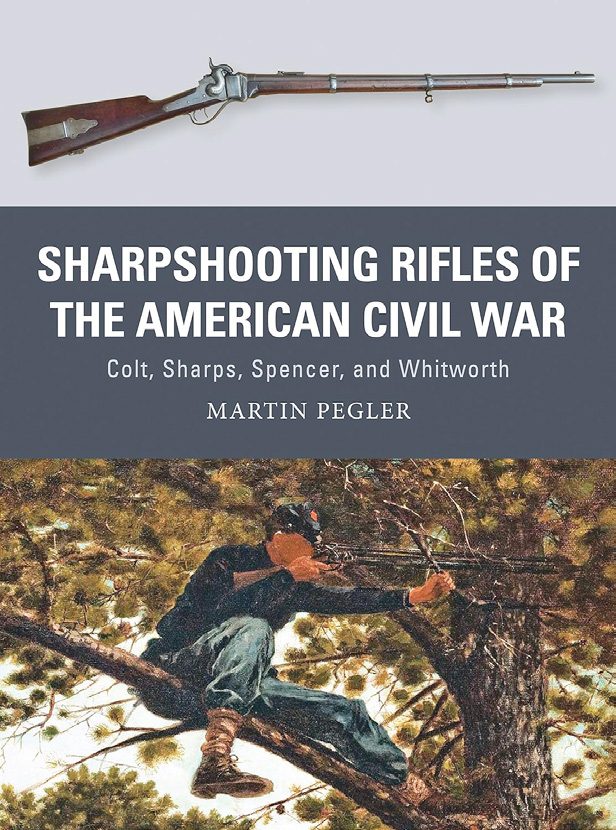
Sharpshooting Rifles of the American Civil War: Colt, Sharps, Spencer, and Whitworth. By Martin Pegler. Illustrated, bibliography, index, 80 pp., Osprey Publishing Company, ospreypublishing.com, 2017, softcover, $23.
Martin Pegler does a commendable job of providing historians with a primer for understanding the sharpshooter’s role in the Civil War, the equipment they used, improvements demanded by battlefield necessity, and the effect sharpshooter units had on a battle’s outcome.
Three main types of weapons were used by sharpshooters during the war. Heavy target rifles were employed for static, long-range sharpshooting; Sharps rifles were standard for both sharpshooting and defense; and the Spencer and Henry magazine rifles were the sharpshooter’s choice for short-range use against infantry assaults. Yet, no one single caliber, model, or rifle was used exclusively by sharpshooters in either army. Thus, ammunition supply became a logistical nightmare and field repair became a nearly impossible task. The attempts to standardize both rifles and ammunition faced a tortuous path of bureaucratic wrangling and individual preference.
Each prominent rifle mentioned had its own characteristics. For
Want to Advertise in Civil War News?
example, the Whitworth rifle was the most expensive to produce, limiting its production. The Springfield Model 1861, of which one million were produced, had a caplock mechanism that was cheaper to produce and could be manufactured by mass production methods. The Colt Model 1855 revolving rifle had a tendency to chain fire, the Sharps could propel a bullet at 1,400 ft/ sec., and the Spencer was the first breechloading cartridge rifle adopted to military service. Each of these models was used by sharpshooters during the war, and the advantages and disadvantages of each helped shape the future technological improvements.
During the war a sharpshooter performed two critical functions, picket duty and skirmishing. Their success against enemy artillery was particularly evident at Antietam, Malvern Hill, Spotsylvania, and Bristoe Station. Their countersniping also took a heavy toll on officers, e.g., Generals Reynolds, Sedgwick, and Vincent were felled by sharpshooters. In all 61 officers over the rank of major died as a result of sharpshooters, dramatically altering several battle outcomes.
The author does a fine job of interspersing primary source accounts of individual sharpshooters to create a very readable and intriguing primer for the Civil War historian to become more familiar with the weaponry of the Civil War and how its uses and improvements foreshadowed the development of modern weapons and tactics. This book is thus recommended for all Civil War buffs to better acquaint them with the vital role played by sharpshooters.
Dr. Wayne L. Wolf is Professor Emeritus at South Suburban College and the author of numerous books and articles on the Civil War including They Saw the Elephant, The Last Civil War Scout and Two Years Before the Paddlewheel. He is an ardent researcher on the life of the common soldier.
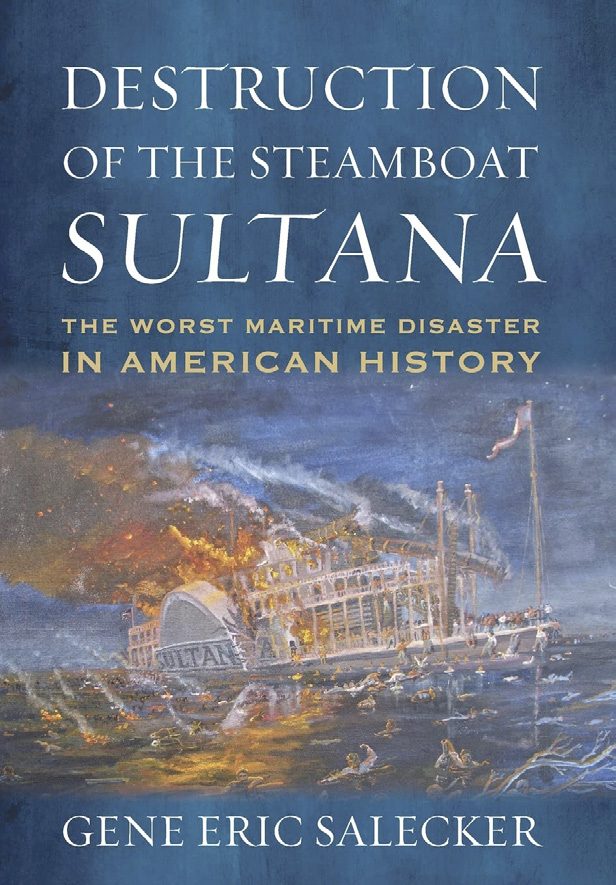
Destruction of the Steamboat Sultana: The Worst Maritime Disaster in American History. By Gene Eric Salecker. Illustrations, maps, index. Naval Institute Press, 2022, https://www.usni.org/press/books/destructionsteamboat-sultana. 528 pp. Hardcover. $39.95 Reviewed by Stephen Davis
As maritime disasters go, the sinkings of the British liners Titanic and Lusitania are more famous. The former took down 1,500 passengers in 1912; a U-boat torpedo killed 1,200 aboard the latter three years later.
But in American history, the Sultana disaster, with its death toll of nearly 1,200, is the worst. Two weeks after Lee’s surrender, the Mississippi steamboat bearing newly freed U.S. POWs blew its boilers early on April 27, 1865. Hundreds of men were killed in the explosion, or were scalded to death. More died from drowning in the turbulent river. (There was just one lifeboat aboard.)
The Sultana story has been told before, as in Jerry Potter’s The Sultana Tragedy (1992). Gene Salecker, author of the new study, has previously written about it in Disaster on the Mississippi: The Sultana Explosion, April 27, 1865 (Naval Institute Press, 1996). Salecker has thus been studying the Sultana for decades, and here brings forth even more research in what will be the definitive history of the shipwreck.
Sultana was a 260-foot twinpaddlewheeled steamboat (not steamship; she had a flat bottom), launched at Cincinnati early in 1863. Owners contracted with the U.S. government to haul troops and freight up and down the Mississippi, New Orleans-Cairo. As the war was ending in the spring of 1865, concerns among her crew of 85 developed over the safety of her leaky boilers. But little was done in the rush to cash in on government work.
For the Sultana, that meant carrying U.S. soldiers recently freed from Rebel prisons, from Vicksburg upriver to Cairo. Some 1,900 officers and men were crammed onboard at Vicksburg on April 24 amid shipmen’s worries that there were too many (troop boats were paid on a per capita basis). Salecker spent three years studying Sultana numbers, and concludes that of 2,130 troops, passengers and crew onboard, 961 survived and 1,169 lost their lives. Rescue efforts were retarded by the scarcity of small boats along the shore banks; Union authorities had destroyed them to reduce guerrilla activity. But steamboats moored at Memphis set out and rescued many people. Some bodies floating downriver were recovered and are buried in Memphis’ Elmwood Cemetery.
Salecker makes clear that greedy captains were shirking their duty. Sultana was so crowded that if the passengers all rushed to one side to see a passing vessel, the ship was in danger of careening. Notably, Capt. James Mason of the Sultana bribed the Assistant Quartermaster at Vicksburg, Capt. Reuben Hatch, to overload the Sultana with men. “It was… greed and corruption that led to those deaths,” the author boldly asserts. “Hatch…was up to his eyeballs in schemes.”
For the watchful, there were other dire omens. A ship’s steward resigned days before, worried Sultana’s about the boilers. Indeed, there was much to worry about: “poor-quality iron, dirty water, and poor design,” in the author’s words. Boilers made of unsuitable metal turned brittle
Loyal Legion of the Confederacy CSA National Defense Medals & other banned internet items
when repeatedly overheated and cooled. Steamboats pumped dirty river water into their boilers, which eventually clogged with mud. Badly built boilers were hard to clean of all this accumulating sediment.
A section of thirty photographs includes pictures of passengers (e.g., “Pvt. Daniel Myers, Company G, 115th Ohio Infantry, perished”), as well as a haunting one showing Sultana grossly overcrowded with men; the ship would blow up twenty-four hours later.
Drawing on previous works on the disaster, and copious accounts in the Memphis Argus and other newspapers, Salecker provides plenty of quoted recollections that give his book its first-person immediacy. He has amassed a personal collection of letters from which he draws such poignant statements as that of Tennessee cavalry private Samuel Pickens: “I must Con fess tha to the best of mi noledg brother William is A mong the lost. I hav not hurd of him Sens the explosion took plase an I hav no hop of ever hering of him eney more.”
Salecker ends his narrative relating what happened to the Sultana survivors and to the hulk itself (covered in sand, three miles inland and today under cultivation). Clive Cussler knows the site, but there’s no monument or even marker there. “Instead,” the author concludes, “it will remain an undisturbed buried memorial to those who died on the Mississippi River so many years ago.”
Stephen Davis, of Cumming, GA, has been writing on the war for decades. His latest work is an edition of Georgian Eliza “Fanny” Andrews’ memoir (Mercer, 2023).
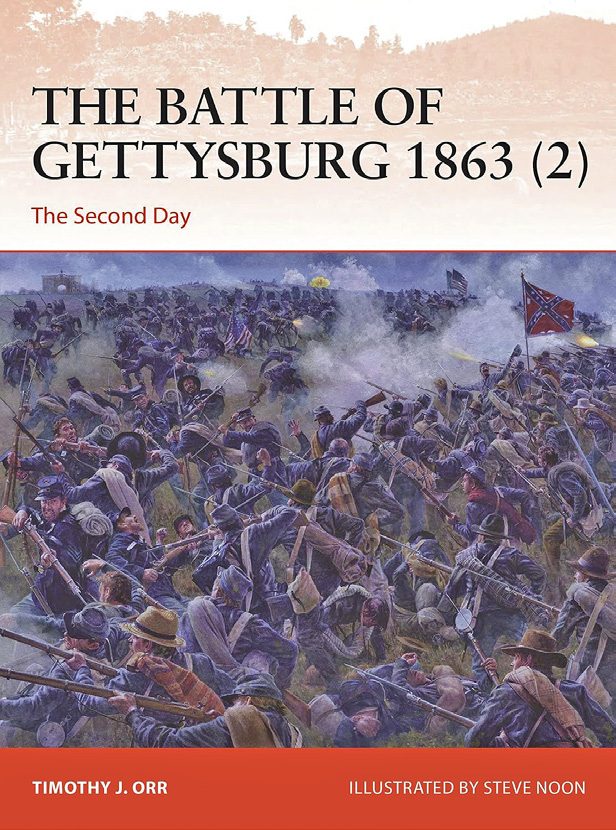
At the end of Day One at Gettysburg, the Army of Northern Virginia held the field, had driven the Army of the Potomac’s left flank back over half a mile, and had captured 5,000 prisoners. Robert E. Lee had every reason to believe he could be successful. But reality intervened. By Day Two, reinforcements had arrived, allowing General Meade to insert them at strategic threatened locations.
Five attempts by Confederate forces to strike a killing blow were attempted this day and all failed. Timely reinforcements altered the outcome of these attacks and changed the flow of the battle. The names of Plum Run Valley, the Wheat Field, Rose Woods, and Houck’s Ridge would forever be remembered as killing fields where over 6,000 dead and wounded fell. In the end, the rebel lines receded, the tide of battle turned, and the final assault by Gen. Ambrose Wright failed to penetrate the Union center.
Cemetery Hill could not be taken and held by Confederate forces; the Union artillery was not routed, and this combination probably doomed General Pickett’s charge the following day. Both armies had suffered terribly on Day Two. Union casualties totaled 11,630 men while Confederate losses were at least 7,000. July 2, became the bloodiest day of the Gettysburg campaign. General Meade’s army had been reinforced by 38,000 new troops over the night of Day One. This, combined with the late arrival of Gen. Jeb Stuart, the timely alert by General Warren of the value of Little Round Top, the disobeying of orders by General Sickles, the heroics of Colonel Chamberlain, and the death of several general officers on both sides were major factors shaping Day Two’s action. By the end of the day, Union forces held commanding positions and the Army of Northern Virginia’s assaults had sapped the strength of the Army of Northern Virginia.
While volumes have been written about the Battle of Gettysburg, and this volume does not add any new theories or discoveries, it does provide a comprehensive and wellarticulated summary of this crucial battle’s second day. It is lavishly illustrated with excellent accompanying maps and a complete chart of the order of battle. The author injects a number of anecdotes about individual soldiers and officers to add a human touch to the tragedy of this battle. For a wellresearched overview of Day Two at Gettysburg, this book does a fine job and is recommended.
Dr. Wayne L. Wolf is Professor Emeritus at South Suburban College and has taught Civil War courses at eight other colleges. He has authored several Civil War books and articles including Civil War Letters, Heroes and Rogues of the Civil War, Surgeons, Scoundrels and Soldiers of the Civil War and Two Years Before the Paddlewheel. He frequently lectures on the roundtable circuit and extensively researches the role of the common soldier.
The Bullets Flew Like Hell: Cutler’s Brigade at Gettysburg. From McPherson’s Ridge to Culp’s Hill. By James L. McLean Jr. Illustrated, maps, index, bibliography, appendices, Savas Beatie, www.savasbeatie.com, 2023, 220 pp., hardbound, $32.95.
This is the third revised and expanded edition of McLean’s study of Cutler’s Brigades at Gettysburg. It thoroughly analyses the heroic deeds and sacrifices of the 76th, 95th, and 147th New York Regiments as well as the 14th Brooklyn, 56th Pennsylvania, and 7th Indiana, after they arrived at a crucial moment to relieve Gen. John Buford’s cavalry. Their heroic efforts delayed the Confederate offensive long enough for additional Army of the Potomac
Promoters of Quality Shows for Shooters, Collectors, Civil War and Militaria Enthusiasts Chickamauga (Dalton) Chickamauga (Dalton) Civil War Show Civil War Show
February 3 & 4, 2024
infantry units to arrive.
This revised edition also describes the origins of each regiment under Lysander Cutler, the brutal marching conditions on the way to Gettysburg, how they attacked piecemeal, and how their vulnerability in doing so cost them over 1,000 casualties. New primary research and topographical data clarified the position of Cutler’s troops during all three days of the battle. Additional information also details Colonel Cutler’s early career as a teacher, militia leader, wool mill owner, and community leader who served as a selectman, railroad director, state senator, and Tuft’s College trustee. When war broke out, this 53-year-old Unionist assumed leadership of the 6th Wisconsin and proceeded to mold them into an effective fighting unit.
His successes in the field eventually saw him promoted to brigadier general and acclaimed by his superiors and the press. His wounding at Brawner’s Farm slowed him down for a short while, but neither lameness nor partial paralysis in his leg prevented “Old Gray Beard” from leading his brigade north to their destiny at Gettysburg.
Upon their arrival in Gettysburg after a grueling march characterized by rain, sweltering heat, and mud, General Reynolds assigned Cutler the task of stabilizing the position and taking possession of favorable terrain west of town, which was being vacated by Federal cavalry. During the execution of this mission, his units suffered severe losses, including the 76th New York, which lost 160 officers and men. During the first morning at Gettysburg, Cutler’s losses totaled 1,002 men out of 2,090 engaged with the 7th Indiana suffering a staggering 60% casualty rate. James McLean uses extensive primary source material to place Cutler’s regiments in their proper historical location and critically important role in the Union’s success at Gettysburg, a role he believes other historians have neglected.
For example, he points out the 6th Wisconsin alone did not arrive first to relieve Buford. Yet, the 6th Wisconsin, in today’s vernacular, won the media war. This revised edition also includes recently uncovered primary source letters by Hershel Pierce, Edgar D. Haviland, and Pierre Thompson which add poignant memories of individual soldiers to the official battle reports. Anyone desiring a detailed, historically researched, and readable account of Lysander Cutler’s brigades at Gettysburg, and their invaluable contribution to Union success would do well to add this book to their library.
Dr. Wayne L. Wolf is Professor Emeritus at South Suburban College and the author of numerous books and articles on the Civil War, including Capture at Missionary Ridge, Home Guard Hotheads and Heroes of the Civil War, and The Last Confederate Scout. He is a frequent speaker on the lecture circuit.
This concise volume details the weaponry used by Civil War cavalrymen, both North and South. The vast variety of rifles, swords, carbines, sabers, and pistols are lavishly illustrated emphasizing how troops were armed with whatever was available. They utilized weapons purchased by Union and Confederate authorities, scavenged from the battlefield, imported from abroad, or brought from home. Throughout the war, improvisation was the rule with improvements and modifications to existing weaponry constantly being patented. By the end of the war, breech-loading and metalcased cartridges had become standard for weapon design.
The most prominent breechloaders were the .52 caliber Spencer, the Henry, Sharps, Burnside, Smith, Starr, and Gallagher. Each had advantages and disadvantages that the author highlights along with the numbers produced and, in many cases, the cavalry units using them and the engagements they were used in. For the Confederacy, with a manufacturing capacity far less than the North, imported weapons
Publishers/Authors Send your book(s) for review to:
Mount Pleasant, SC 29466 January 2024
from Britain, France, Belgium, Austria, and Germany became crucial. Hence, the Enfield rifles. Austrian caplocks, Terry carbines, and French Vieillard carbines were frequently equipment of the Rebel cavalryman. While these imports supplied the bulk of Confederate arms, locally manufactured Navy .36 caliber revolvers, Model 1851 Colts, and locally produced weapons by Griswold & Gunnison as well as Leech & Rigdon were used. Many cavalry units clung to their use of swords, particularly during cavalry charges. These were manufactured by Ames Manufacturing Mansfield and Lamb, Roby Company, Emerson and Silver, and Solingen.
The use of swords declined with the advent of the far more lethal breech-loading weapons. The progression was particularly striking for Southern cavalry as they went from single-shot pistols and sabers to breech-loading carbines, revolvers from shotguns and large blade knives. What weaponry was used by both the Union and Confederacy largely depended on the terrain where the fighting would take place and which weapons were most effective in these situations. This brief volume does a commendable job, through precise descriptions and photographs, of delineating all the weaponry type employed by Northern cavalry during the Civil War. For those interested in a beginning primer on cavalry weaponry and equipment, this small volume is an excellent starting point and is recommended.
Dr. Wayne L. Wolf is Professor Emeritus at South Suburban College and the author of over 20 books on the Civil War and numerous Homeguard, Heroes of the Civil War, Two Years Before the Paddlewheel, and The Scout. He is a frequent lecturer and researcher on the Civil War speaker’s circuit.
War Between the States
OVER 40 YEARS EXPERIENCE
Last Confederate War Between The States specializes in Civil War autographs, bonds, books, currency, documents, newspapers, postal envelopes, stamps, patriotic covers, portraits and historical art, photography, presidential related material, soldier letters, G.A.R. & U.C.V. items, relics, and much other rare ephemera and historical memorabilia.
War Between The States is one of America’s premier sources for Civil War memorabilia with a superb reputation for authenticity, customer service, and excellent quality material.
Certified Member of: International Society of Appraisers Appraisers Association of America Senior Accredited Appraiser (ASA)
The Artilleryman is a quarterly magazine for collectors, competition shooters and those interested in ordnance from the Revolutionary War to World War II, primarily focusing on cannon, implements, projectiles and related artifacts from the American Civil War.
This full color magazine features articles on cannon safety, artillery history, projectiles, fuses, places to visit, book reviews, competition events, and so much more. The annual quarterly subscription price is just $37.95.