July 2023
Soon “he grew more than usually loquacious. The truth is,” Douglas noticed, “the General was incipiently tight.”
How Jackson got his nickname is a familiar story, but there are slight differences in the various accounts by “eyewitnesses.” Here’s Douglas’ take on General Barnard Bee’s famous words: “Look! There is Jackson’s brigade standing behind you like a stone wall!” (emphasis added). That same rock-solid style was evident
a year later on the same battlefield of Manassas. Under heavy attack by Pope, Jackson received a courier from Longstreet, whose divisions were marching to his aid and who asked if he needed reinforcements. “Tell General Longstreet,” Jack replied, “that I am obliged to him but I don’t need them now; if he gets hard pressed I’ll send him reinforcements.”
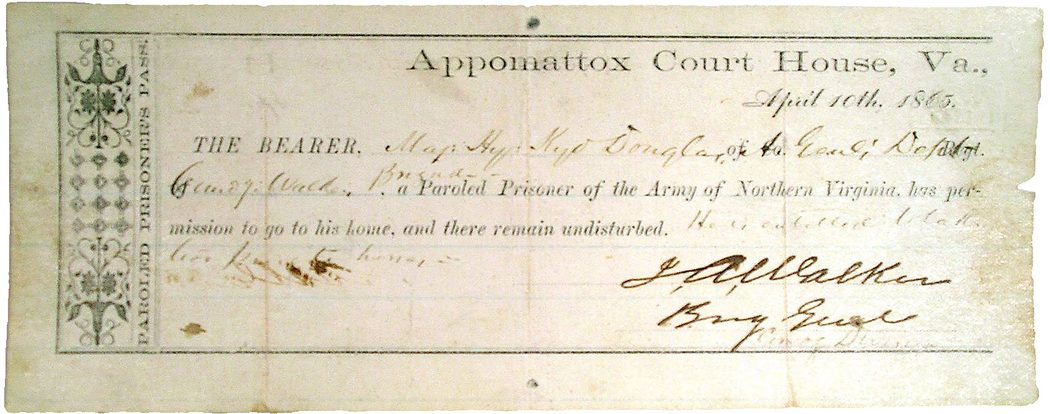
What makes I Rode with Stonewall so valuable is that Douglas based it closely on a wartime diary he kept. Shortly after Jackson’s death Captain Douglas visited General Lee and heard him explain why he could not visit Stonewall as he lay ill at Guinea Station or later in state at the Capitol. “Those people over the river are again showing signs of movement and I cannot leave my Headquarters,” the general declared. Douglas was precise. “I have given these remarks of General Lee as spoken,” he writes, “for I wrote them out in my diary and they are verbatim according to my fresh recollection.” Douglas also refers to the wartime letters he sent his parents at their home near the Potomac. He quotes from a card he wrote to his father: “Sept. 15. ’62—Dear Father: Harper’s Ferry has surrendered. Nobody hurt on our side. H. K. D.” Then he wryly adds, “To be with Jackson was to take lessons in brevity.”
“Old Jack” stories are here in abundance, including old chestnuts about raising his right hand while riding and about sucking that lemon. There’s the one about Jim, Jackson’s servant, who often observed him in prayer. But when Jim saw him kneeling at night, “then I begin to cook rations and pack up for there will be hell to pay in the morning.” There are new ones, too, as when a kind Virginia lady stitched a straw hat and sent it to the General.
Its effect was like malicious magic, and under its transformation our General, never an Apollo, became a caricature. He looked into a mirror to see himself; one glance was enough and he did not “stand and gaze.” He handed it to Jim to put away carefully, and Jim took it with mock gravity and carried it off daintily. The General never asked for it again and it disappeared.
Despite his keen eye for detail, Douglas refrains from explaining Stonewall’s battles. Regarding Groveton, for instance, he shrugs, “this work is not serious for that.” (The memoirist learned modesty very well from his mentor.)
Douglas’ keen eye took in others as well. After he lost his leg, Dick Ewell “was never the same old ironsides again.” As a division commander, Powell Hill earned a reputation as “quick, bold, skillful and tenacious.” But “it cannot be said he added to it when he commanded a corps,” as our memoirist gently puts it. Douglas was more effusive when writing about Jeb Stuart. “America never produced Stuart’s equal as a cavalry commander,” he trills. “I am not forgetful of Nathan Bedford Forrest, and Philip Sheridan, and Wade Hampton, and others, but there was but one Jeb Stuart.”
I often say that having a lifelong Civil War passion keeps us enthusiasts young. Reading
“I Thank
Eliza Frances Andrews (1840–1931)
the Lord I
War-Time Journal of a Georgia Girl
Am Not a
Yankee...”
have won several prizes, including the Fletcher received a strong education and was
a successful writer and educator. Her surely ranks among the most observant and intelligent wartime memoirs by a Edited with commentary by Stephen Davis, I Thank the Lord I Am Not a Yankeeincludes selections of her wartime and postwar journals which are most expressive of her Confederate
patriotism and Southern pride.
Stephen Davisis author of ten books on the Civil War, most of which treat the Atlanta Campaign. His two recent volumes on Confederate General John Bell Hood
Pratt Award of the New York CWRT.
Henry Kyd Douglas’ recollections of Stonewall Jackson rendered me absolutely juvenescent.
Stephen Davis of Cumming, GA, as been contributing his monthly “Critic’s Corner” column to Civil War News for several years. He is the author of George N. Barnard: Photographer of the Atlanta Campaign (Historical Publications). His two-volume study of General John B. Hood has recently been published by Mercer University Press.
Ted Savas has termed Steve’s What the Yankees Did to Us: Sherman’s Bombardment and Wrecking of Atlanta (2012) as “by far the most well-researched, thorough, and detailed account ever written about the ‘wrecking’ of Atlanta.”