June 2023
traveled to Montgomery and let Dick Taylor in on the plan. (Taylor didn’t like it either.)3
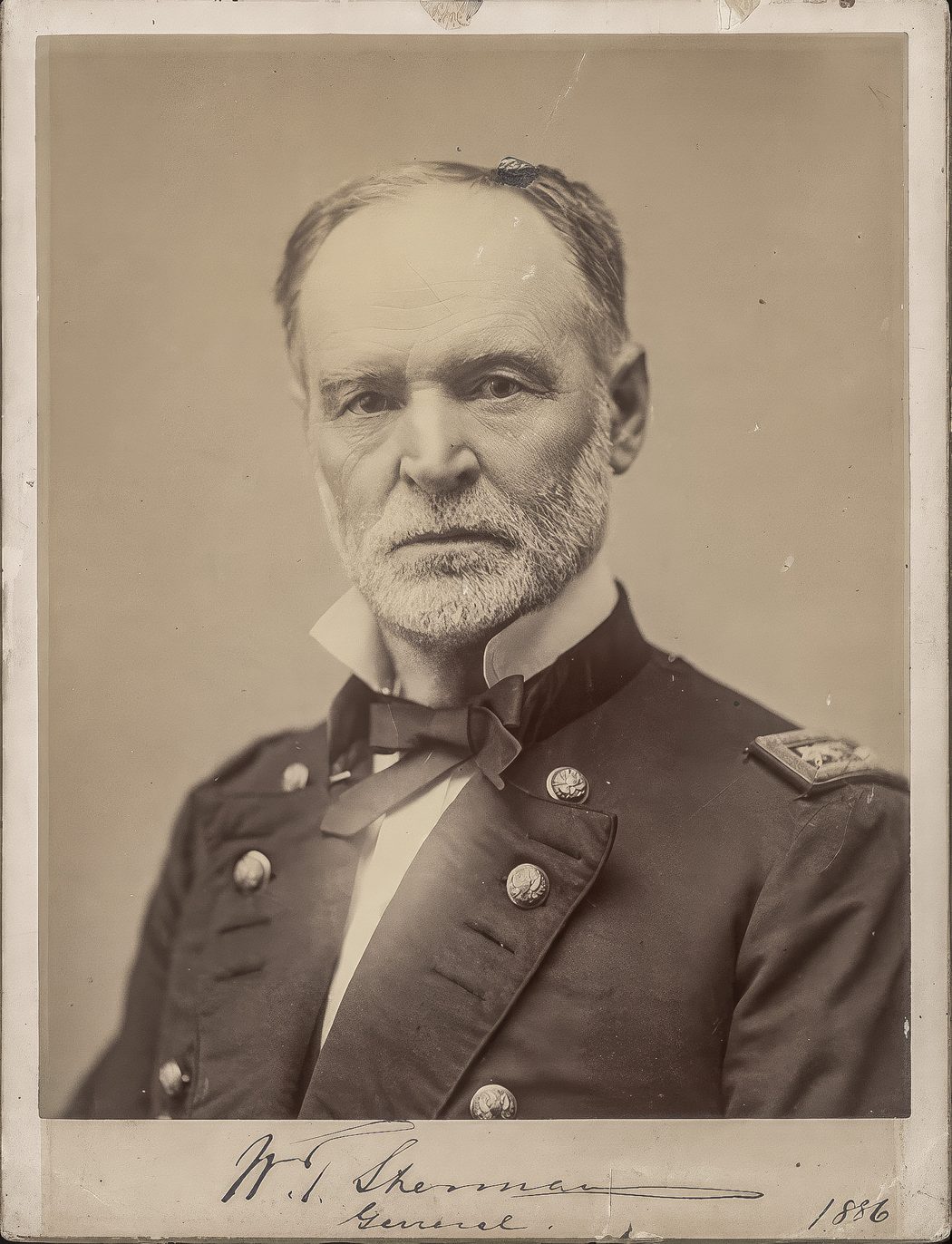
Hood got his army marching north on September 29. Sherman picked up quickly on the Rebels’ move and warned Federal garrison commanders at Rome and Allatoona. Sherman himself followed with several infantry corps. Because Hood’s troops had cut the telegraph, Sherman’s signalmen had to wig-wag the commander at Allatoona, Brig. Gen John M. Corse: “General Sherman says hold fast. We are coming.”
…except that he wasn’t. When, on October 5, Confederate Maj. Gen. Samuel G. French’s division, 3,200 strong, attacked Corse’s garrison of 2,000, they were repulsed in a 3 1/2-hour fight.4
Sherman was at Kennesaw Mountain, fourteen miles away.5
As Sherman’s biographer John Marszalek writes, the general “supposedly signaled ‘Hold the fort! For I am coming’” (italics added). He notes also that Sherman never recalled sending such a message, though conceding, “he probably said something like that.6
Somehow the story got to a Northern hymn writer, Philip Bliss (1838–1876), who was a contemporary of fellow hymnwriter Ira Sankey and a friend of Chicago preacher D. L Moody. In 1870 he composed “Hold the Fort” with this chorus: “Hold the fort, for I am coming,/Jesus signals still,/ Wave the answer back to heaven,--/By thy grace, we will.”
So by the composer’s magical hand, William T. Sherman metaphorically becomes, well, Jesus. Cump, ever the egotist, would be smiling. In 1887 he joked that even though he couldn’t remember saying “hold the fort,” he conceded, “It makes little difference and we had better allow Moody and Sanky’s hymn of ‘Hold the Fort, for I am Coming’ to stand uncontradicted.”7
Sherman even jumbled the famous hymn’s composer. It was Philip Bliss, not Sankey and Moody, who musically enshrined the conqueror of Atlanta.
Music, though, can get you in trouble. I remember, a few decades ago, a Democratic presidential candidate coming to Georgia. At a campaign rally, his band director blundered
online at
by playing a tune he thought would play well with the local constituency: “While We Were Marching Through Georgia.” White Southerners took offense: we remembered this was an air centered on Sherman’s infamous march through our state.
The bandleader was so informed, and the tune was dropped from the group’s repertoire.
Endnotes 1. Lloyd Lewis, Sherman:
3. Ibid., 44-47, 68-69. 4. Brad
5. John York: Harcourt, Brace & World, 1932), 635-37.
Into Davis, Tennessee and Failure: John Bell Hood (Macon: Mercer University Press, 2020), 30.
The Butkovich, Battle of Allatoona Pass (Charleston: History Press, 2014), 95-132 passim.
F. Marszalek, Sherman: A Soldier’s Passion for Order (New York: Free Press, 1993),
Stephen Davis of Atlanta has been a Civil Warrior since the fourth grade. At Margaret Mitchell Elementary, in school auditorium hung the oil painting of Vivien Leigh as the imperious Scarlett O’Hara that Selznick commissioned for his famous film.
Some years back, when visiting Sherman’s homeplace Lancaster, Ohio, his host (Dave
“I Thank
Eliza Frances Andrews (1840–1931)
the Lord I
War-Time Journal of a Georgia Girl
Am Not a
Yankee...”
have won several prizes, including the Fletcher the
received a strong education and was
a successful writer and educator. Her surely ranks among the most observant and intelligent wartime memoirs by a Edited with commentary by Stephen Davis, I Thank the Lord I Am Not a Yankeeincludes selections of her wartime and postwar journals which are most expressive of her Confederate
patriotism and Southern pride. Stephen Davisis author of ten books on the Civil War, most of which treat the Atlanta Campaign. His two recent volumes on Confederate General John Bell Hood
Pratt Award of the New York CWRT.
Roth of Blue & Gray) introduced Steve as visiting from the city that Sherman burned. The horrified docent stammered, “Should I call the police?”
Note: “Cump,” by the way, was Sherman’s nickname from boyhood. In the first edition of Historical Times Illustrated Encyclopedia of the Civil War (1986), the biographical entry for Sherman contains this slip: “Sherman, called ‘Chump’ by his friends....”
The typo has been corrected, but we Southerners delight in the miscue.