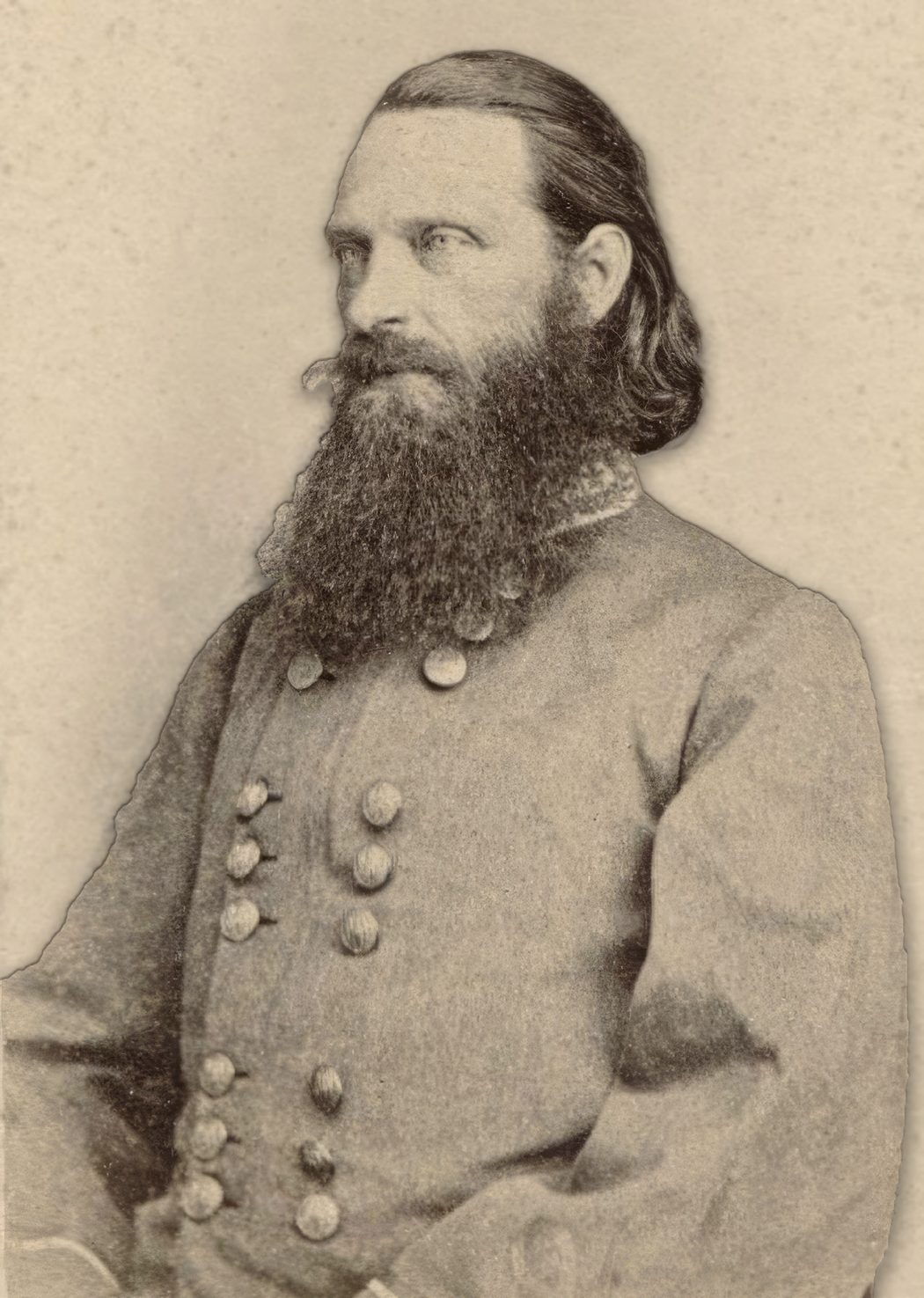
When Ranse Wright’s Brigade Breached the Yankee Line at Gettysburg
Lo Armistead is famous for leading his brigade to the stone wall on Cemetery Ridge in the third day of Gettysburg. Lesserknown is the charge the day before, when Ambrose Ransom Wright’s Georgia brigade struck, and temporarily held, the same point.1
Born in 1826 at Louisville, Georgia (the former state capital), Wright went to local schools before studying law. A few weeks after Sumter he joined an Augusta company. In early May 1861 he was elected colonel of the 3rd Georgia.
In a skirmish in eastern North Carolina Colonel Wright is credited with having singlehandedly captured five Yankees. After whipping the enemy in another Carolina battle Wright
“I Thank
Eliza Frances Andrews (1840–1931) received a strong education and was
the Lord I
a successful writer and educator. Her War-Time Journal of a Georgia Girl
Am Not a
surely ranks among the most observant
Yankee...”
and intelligent wartime memoirs by a
Edited with commentary by Stephen Davis, I Thank the Lord I Am Not a Yankeeincludes selections of her wartime and postwar journals which are most expressive of her Confederate
patriotism and Southern pride.
Stephen Davisis author of ten books on the Civil War, most of which treat the Atlanta Campaign. His two recent volumes
on Confederate General John Bell Hood have won several prizes, including the Fletcher Pratt Award of the New York CWRT.
was promoted to brigadier general in early June 1862, which led to brigade command in Virginia.
A veteran of Malvern Hill, Second Manassas and Sharpsburg, he was wounded in the latter battle, commanding his troops from a litter.
Seven months’ medical furlough ensued. During this period thirty-two officers in the 3rd Georgia (Wright’s old regiment) signed a letter requesting the regiment’s transfer to another brigade. General Wright, they claimed, was in the habit of displaying a “harsh discourteous temperament.” Their appeal went nowhere.2
Wright returned just in time for Chancellorsville, where he fought as part of Maj. Gen. Richard Anderson’s division. The brigade was with Lee’s army marching into Pennsylvania. When it came time for Wright’s troops to go into the fight on July 2, the commanding general was ill and in hospital. Leading the men— the 3rd, 22nd and 48th Georgia, plus the 2nd Georgia Battalion— was Col. William Gibson.3
In the Confederate army, brigades were named after their commander, and the name stuck even in their leaders’ absence. Because of this, writers mistakenly assume a commander’s presence. Glenn Tucker, for instance, in his High Tide at Gettysburg, states that “Wright…stood with his brigade on the crest of Cemetery Ridge,” when the general was actually
a few miles to the rear. Though General Wright filed a report for the Pennsylvania campaign, he acknowledges that “I was compelled by severe indisposition to leave my command” during the battle.4
Lee’s battle plan for July 2 called for a huge infantry assault beginning on the Confederate right (Longstreet’s Corps) that would continue in echelon by division, moving to the left. The attack got off to a delayed start about 4 p.m. When it came time for Anderson’s Division to pitch in, it was late in the afternoon, but with still quite enough daylight on that long summer’s day.5
The Confederates were aiming for the center of the enemy line (including the famous copse of trees), held by Win Hancock’s II Corps. After hearing the signal to move forward, the Georgians pushed across the Emmitsburg Road, to the east of which were positioned the Federal troops. “In this advance, I was compelled to pass for more than a mile across an open plain, intersected by numerous post and rail fences, and swept by the enemy’s artillery,” the general recalled.
Wright’s Brigade “surged up the slope of Cemetery Ridge like a tide rolling up a beach,” writes Harry Pfanz, historian of Gettysburg’s second day.6 The Southerners struck the enemy position, “and drove him in great confusion upon his second line,” Wright declared. The Confederates even captured three guns which the Federals left behind.
Having gained the Emmitsburg turnpike, we again charged upon the enemy, heavily posted behind a stone fence which ran along the abrupt slope of the heights some 150 yards in rear of the pike.
Here the enemy made considerable resistance to our farther progress, but was finally forced to retire by the impetuous charge of my command.
We were now within less than 100 yards of the crest of the heights, which were lined with artillery, supported by a strong body of infantry, under protection of a stone fence. My men, by a welldirected fire, soon drove the cannoneers from their guns, and, leaping over the fence, charged up to the top of the crest, and drove the enemy’s infantry into a rocky gorge on the eastern slope of the heights, and
some 80 or 100 yards in rear of the enemy’s batteries.
“We were now complete masters of the field,” Wright declared in his after-action report with such exaggeration that George R. Stewart, author of the microhistory of Pickett’s Charge, has written that Wright’s report (“complete masters of the field”) “is the most inaccurate and exaggerated of any that it has been my need to study.”7
But as so often happened, his troops’ penetration went unsupported. William Perry’s brigade advanced on the right, but not far enough to assist Wright’s line-breach. Same thing with Carnot Posey’s brigade to the left. General Wright was not very complimentary: “Unfortunately, just as we had carried the enemy’s last and strongest position, it was discovered that the brigade on our right had not only not advanced across the turnpike, but had actually given way, and was rapidly falling back to the rear, while on our left we were entirely unprotected, the brigade ordered to our support having failed to advance.” William Mahone’s brigade, in reserve, also rendered no help.8
Wright was not afraid to speak his mind. His superior, General Anderson, remarked that Ranse needed “a little more coolness.” That quality was not on display,
Carte-de-Visite of General Ambrose Ransom Wright. Inscription on front: Augusta Gen. A. R. Wright. Inscription on back: Ga Lf. 19. From the Collections of the Confederate Memorial Literary Society. though, when he wrote his wife Caroline after the battle. He even picked at other officers involved in the Confederate charge of July 3, in which Wright’s Brigade did not actively participate (standing only in possible support). “On the left, Pettigrew’s line wavers— all is lost,” he claimed, “it falls back—it runs. Some of the officers attempt to rally their men…But one thought seems to actuate them all, and that is to gain a safe place far in the rear.”9
Somehow thegeneral’s letter made its way into the pages of the Augusta Constitutionalist, leading Anderson to place Wright under arrest. In the court-martial trial held in late August, Wright conducted his own defense and won acquittal.10
Perhaps the general needed a break; Wright ran for a seat in the Georgia State Senate and won in September 1863. After the legislature adjourned, he returned to the army, but illness kept him out of action for most of the next year.
An Atlanta newspaper once commented that Ranse Wright was “considered vain, and ambitious of acquiring popularity.” Not only that, but as someone said, he was “too self-willed and combative, often raising unnecessary antagonisms.” Despite these faults, Wright won promotion to major general on Nov. 30, 1864. He was stationed at Savannah
May 2023
when Sherman took the city; he retreated with Hardee’s troops into South Carolina. He ended up surrendering with Joe Johnston.11
But it is Wright’s breach of the Union center on July 2, 1863 that is the centerpiece of his war record. Dr. Freeman asserts that “Wright’s advance was superb,” and thought so much of it that he quoted at length from Ranse’s letter to Caroline, which he obtained through the courtesy of the general’s grandson.
At length, indeed. Freeman took the unusual step of transcribing it into two full pages of Lee’s Lieutenants, noting that the general penned it just five days after the battle, on July 7. If it works for Douglas Southall Freeman, it works for us; so here it is:
As soon as we emerged from the woods and came into the open fields, the enemy poured a most terrific fire of shells into our ranks. We rushed down the hillside and reaching the valley, we found it was broken by a series of small ridges and hollows, running parallel with the enemy’s line on
This is the most common 12-pounder canister used during the Civil War. It was intended to be fired from a 12-pounder smoothbore cannon such as the Model 1857 Napoleon. The standard 12-pounder cast iron canister balls ranged from 1.46 to 1.49 inches in diameter with a mean weight of .43 pound (6.88 ounces) each. Twenty-seven cast iron canister balls were stacked in four layers, packed in sawdust, with the top center ball omitted so the iron top plate would fit properly. The 12-pounder canister had an initial muzzle velocity of 1,262 feet per second with a 2 pound service charge when fired from a 12-pounder field gun. The non-excavated canister on the left is courtesy The Atlanta History Center, Thomas S. Dickey Sr. Civil War Collection; the canister on the right is reassembled from battlefield recoveries.
first of these depressions or hollows, our line paused for breath. Then we rushed over the next ridge into the succeeding hollow, and thus we worked our way across that terrible field for more than a mile, under the most furious fire of artillery I had ever seen. When we reached the base of the range upon which the enemy was posted, they opened upon us with their infantry, and raked our whole line with grape and canister from more than twenty guns.
We were now within a few hundred yards of the enemy’s guns, and had up to this time suffered but little loss, the small ridge I have spoken of protecting our men from the enemy’s fire, except as we would pass on their tops which we always did in a run, thus exposing ourselves very little to the enemy’s fire. But we were in a hot place, and looking to my left through the smoke, I perceived that neither Posey nor Mahone had advanced, and that my left was wholly unprotected. I immediately dispatched a courier to General Anderson informing him of the fact, who answered that both Posey and Mahone had been ordered
12-Pounder Canister
Top plate
in and that he would reiterate the order. That I must go on. Before my courier returned, Perry’s Brigade on my right gave way, and shamefully ran to the rear.
My Brigade had now climbed up the side of the mountain nearly to the enemy’s guns, and being left with support either on the right or left, enabled the enemy to concentrate heavy fire upon my small command, but my brave men passed rapidly and steadily on, until we approached within fifty or sixty yards of the enemy’s batteries, when we encountered a heavy body of infantry posted behind a stone wall. The side of the mountain was so precipitous here that my men could with difficulty climb it, but we strove on, and reaching the stone fence, drove the Yankee infantry from behind it, and then taking cover from the fence we soon shot all the gunners of the enemy’s artillery, and rushing over the fence seized their guns. We had now accomplished our task. We had stormed the enemy’s strong position, had driven off his infantry, had captured all his guns in our front, except a few which he succeeded in carrying off, and had up
to this minute suffered but comparatively little loss.
Just after taking the enemy’s batteries we perceived a heavy column of Yankee Infantry on our right flank. They had taken advantage of the gap left in our line by the falling back of Perry’s Brigade, and had filed around a piece of timber on our right, and had gotten into the gap left by Perry’s Brigade and were rapidly getting into our rear. Posey had not advanced on our left, and a strong body of the enemy was advancing down the sides of the mountain to gain our left flank and rear. Thus we were perfectly isolated from any portion of our Army a mile in its advance. And although we had gained the enemy’s works and captured his guns, we were about to be sacrificed to the bad management and cowardly conduct of others. For a moment I thought all was lost, and that my gallant little band would all be inevitably killed or captured. Colonel Hall of the Twenty-second had been killed, Colonel Gibson of the Forty-eighth seriously wounded, and while at the enemy’s gun with his hands on the horses, Major Ross of the Second Georgia Battalion had just been shot down. Nearly all my company officers had been killed or wounded. Everything looked gloomy in the extreme, but the men remained firm and cool to the last. The enemy had now gotten completely in our rear, and were advancing upon us over the very ground we had passed in attacking them. A large force concentrated in our front and artillery brought into position and opened upon us. Then a prayer was said.
We must face about and cut our way out of the network of bristling bayonets, which stretched around us on every side. With cheers and good order we turned our faces to the enemy in our rear, and abandoning our captured guns we rushed upon the flanking column of the enemy and literally cut our way out, and fell back about one-half the distance we had gone over, and then reformed our line. But alas, very few of the brave spirits who so recently had passed over
that line buoyant in spirit and confident of success, now answered to the order that calmly sang out upon the air, “Fall in, Wright’s Brigade, and here we’ll stand again.”12
“Wright fell back because Posey had not covered his left flank or Perry his right,” Freeman concludes. But the Georgians’ plucky breach of the Yankee line is more than a footnote in the stories of how Lee hoped to win a great victory in Pennsylvania— and nearly did among those fields of Gettysburg!
Notes High Tide at 1. Glenn Tucker, Gettysburg: The Campaign in Pennsylvania (Indianapolis: Bobbs-
Merrill Company, 1958), 286-87.
2. Keith P. Bohannon, “Ambrose Ransom Wright” in William C. Davis, ed., The Confederate General, 6 vols. (Harrisburg: National
Historical Society, 1991), vol. 6, 161. 3. Ibid., vol. 6, 161.
4. Tucker, High Tide, 287; Wright report, Sept. 28, 1863, OR, vol. 27,
5. Noah Andre Trudeau, Gettysburg: A Testing of Courage (New York:
HarperCollins, 2002), 389.
6. Harry W. Pfanz, Gettysburg: The Second Day (Chapel Hill: University
of North Carolina Press, 1987), 387. 7. Wright report, 623; George R. Pickett’s Charge: A Stewart, Microhistory of the Final Attack at Gettysburg, July 3, 1863 (Dayton OH: Press of Morningside Bookshop,
8. Wright report,623-24; Douglas Southall Freeman, Lee’s Lieutenants: A Study in Command, 3 vols. (New York: Charles Scribner’s Sons, 1942-
9. Bohannon, “Wright,” 161, 163; Gen. Wright to Mrs. Wright, July 7, quoted in Freeman, Lee’s Lieutenants, vol. 3,
10. Bohannon, “Wright,” 161.
11. Bohannon, “Wright,” 163.
12. Freeman, Lee’s Lieutenants, vol. 3,
Stephen Davis resides with his sweet wife Billie and loudmouthed cat Cha Cha near Cumming, Georgia. On a good day of retirement there he sees more cows than cars. Some years back he traveled across the South, Mr. Bojangles-like, visiting historic cemeteries and photographing the burial places of Confederate generals. Ranse Wright, for instance, is buried in Augusta, Ga.; decades ago Steve visited him in Magnolia Cemetery, where there are interred six other Confederate generals, including Porter Alexander. Steve wrote about Alexander in The Artilleryman last Fall.