November 2023
reports from “Southern sources” denied that Lee had surrendered and asserted that “Grant had lost in battle and by desertion 100,000 men.” In this trying time it was “the duty of every man to stand firm at his post and true to his colors.”
Soon after, in the first days of May, Forrest met with the governor of Mississippi, Charles Clark, and the former governor of Tennessee, Isham Harris. They urged him not to quit, but to take his command to the Trans- Mississippi and join Gen. E. Kirby Smith’s force. By this time, however, Forrest had made up his
mind: further resistance would be fruitless; surrender was the only reasonable course; he said “no” to Clark and Harris.
What had determined Forrest’s decision? He certainly could see the futility of resistance and envision the further harm guerilla warfare would inflict on a region and a population already ruined by four years of war. If these facts were not already apparent, a message sent by Maj. Gen. George Thomas on May 2 made the situation even clearer. Thomas dispatched a subordinate with this order: “Send, under a flag of truce, a summons to Source: Scott, Robert Nicholson., Lazelle, Henry Martyn., Davis, George Breckenridge., Perry, Leslie J., Kirkley, Joseph William., Ainsworth, Fred Crayton., Moodey, John Sheldon. The War of the Rebellion: v. 1-53 [serial no. 1-111] United States: U.S. Government Printing Office, 1897, page 573. Forrest to surrender upon the terms given by General Grant to Generals Lee and Johnston. Inform him…of the rumors which have reached you, and that you are prepared for him, and if he attempts such a reckless and bloodthirsty adventure he will be treated thereafter as an outlaw, and the States of Mississippi and Alabama will be so destroyed that they will not recover for fifty years.” As for future prosecution, the prospect was uncertain. However, the terms of Taylor’s surrender provided for parole and stated that parolees would not be disturbed as long as they observed their parole and obeyed the law. These terms gave at least some assurance.
Thomas’s warning, however, was probably not necessary. On April 30 Taylor had informed Forrest of the truce signed with Canby and ordered that “no movements or changes from dispositions of troops” be made. Forrest complied with this order, and on May 3 advised Thomas.
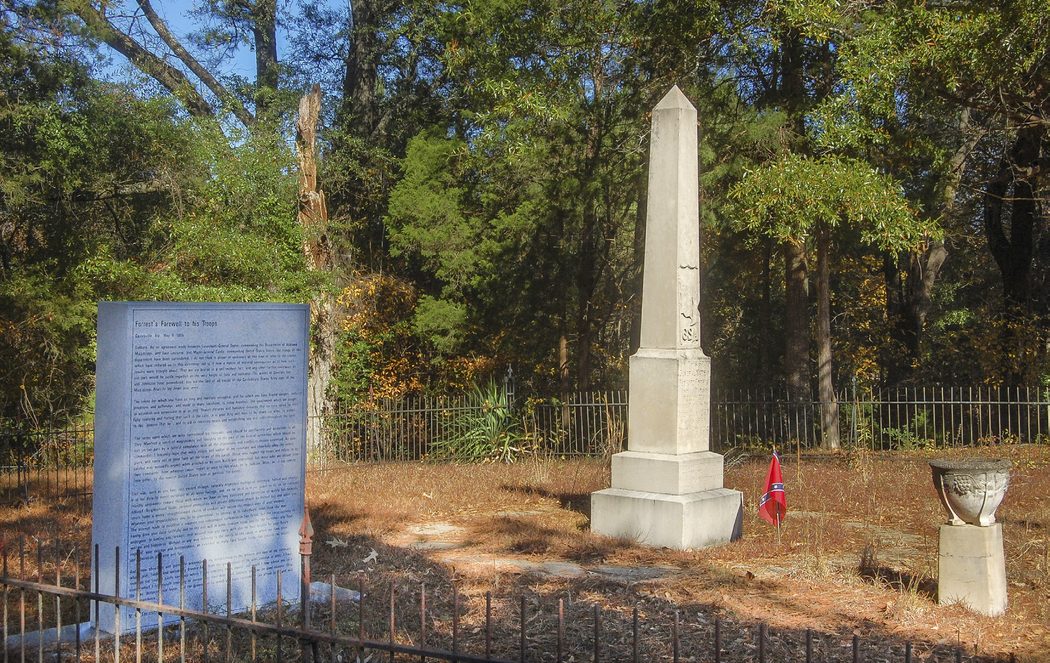
On May 9 a Federal general journeyed to Forrest’s headquarters to issue paroles under the terms of the surrender signed by Taylor and Canby the day before. That same day Forrest issued his farewell message to his men. The message pointed to an undeniable reality. “That we are beaten is a self-evident fact,” the cavalry leader wrote, “and any other further resistance on our part would justly be regarded as the very height of folly and rashness.”
Forrest characterized surrender terms as “favorable,” and said they “should satisfactory and acceptable to all.” He recognized the “spirit of magnanimity and liberality on the part of the Federal authorities,” which, he added “should be met on our part by a faithful compliance with all the stipulations and conditions therein expressed.” He also warned that any men failing to accept the parole offered “may assuredly expect when arrested to be sent North and imprisoned.”
In April many had reasonable fears that the fighting would devolve into a brutal guerilla war. These fears were not realized. The events of early May ended the fighting east of the Mississippi. Next month’s column examine events further west.
GEORGIA’S CONFEDERATE MONUMENTS In Honor of a Fallen Nation Gould B. Hagler, Jr.
This unique work contains a complete photographic record of Georgia’s memorials to the Confederacy, a full transcription of the words engraved upon them, and carefully-researched information about the monuments and the organizations which built them. These works of art and their eloquent nation’s profound grief, praise the soldiers’ bravery and patriotism, and pay homage to the cause for which they fought.
David Silkenat, Raising the White Flag: How Surrender Defined the American Civil War, 2019 Richard Taylor, Destruction and Reconstruction: Personal Experiences in the Late War, 1879 Wills, The Brian Steel Confederacy’s Greatest Cavalryman: Nathan Bedford Forrest, 1992 M.A. DeWolfe Howe, Home Letters of General Sherman, 1909 Official Records, Ser. 1, Vols. 47 and 49.
![Source: Scott, Robert Nicholson., Lazelle, Henry Martyn., Davis, George Breckenridge., Perry, Leslie J., Kirkley, Joseph William., Ainsworth, Fred Crayton., Moodey, John Sheldon. The War of the Rebellion: v. 1-53 [serial no. 1-111] United States: U.S. Government Printing Office, 1897, page 573.](/civil-war-news-archives/articles/2023/gould-hagler-2023-11/img/01.jpg)