Chapultepec Castle, a formidable obstacle three miles southwest of Mexico City. The castle stood on a hill about 200 feet above the plain and guarded the narrow causeways which were the only routes into the capital from the south and west. On the 12th and early on the 13th Scott’s artillery bombarded the position. At 8:30 a.m. American infantry attacked.
At Chapultepec, more than at any other battle in the war, Thomas
GEORGIA’S CONFEDERATE MONUMENTS In Honor of a Fallen Nation Gould B. Hagler, Jr.
This unique work contains a complete photographic record of Georgia’s memorials to the Confederacy, a full transcription of the words engraved upon them, and carefully-researched information about the monuments and the organizations which built them. These works of art and their eloquent nation’s profound grief, praise the soldiers’ bravery and patriotism, and pay homage to the cause for which they fought.
Jackson displayed the soldierly attributes of bravery under fire, leadership, initiative, discipline, and relentless determination. Jackson, now a first lieutenant, commanded two six pounders in a force of infantry and artillery placed at the far left of the American line. Advancing along a causeway on the fortress’s north side, the troops met heavy fire, artillery and musketry, coming from a redoubt on the causeway
and from the castle above.
Immediately, one of Jackson’s two six-pounders was damaged. All 12 horses were killed or disabled. Artillerymen scattered to seek what little protection they could find. Jackson stood in the roadway and rallied the men. First the undamaged gun, then the other, were put into position and returned fire. Infantry soon overran the Mexican redoubt.
Jackson improvised, cobbling together some limbers to pull his guns along the causeway. Jackson’s men and others “whose ardor had exceeded their orders” pursued the enemy to the gates of the city. Meanwhile the castle itself had fallen. The battle was won. Mexican forces evacuated the city and the Americans entered unopposed on the 14th.
After the city fell there was a truce that lasted until the Treaty of Guadalupe Hidalgo was signed. In the intervening months and beyond, the army occupied a peaceful city. It was pleasant duty. Jackson used the time profitably. He continued his study of Spanish, sticking with it until he became fluent. He read histories of Mexico in both English and Spanish. He also read Shakespeare, presumably in the original English. He dined with prominent Mexican families and met some of their charming daughters. Jackson was involved in two matters of honor, but not as one of the duelists. His journey of faith, begun under the influence of Capt. Francis Taylor, continued. He developed an unlikely friendship with an archbishop and explored Catholicism. As we all know, however, he ultimately decided on Presbyterianism.
In the military sphere, he served as his company’s quartermaster and commissary officer and was promoted to the rank of brevet major. He observed the conditions in military hospitals and was distressed by what he saw. He noted “the several sharp rivalries that erupted on the command level relative to battle plans and conduct.”
In June 1848 Jackson left Mexico City with the 1st Artillery. In July he reached New Orleans, the same port from which he had sailed nearly two years earlier. In this war before the War, Thomas Jackson, like many other young officers, developed his skills and learned valuable lessons on the military craft. These lessons would be applied, in the larger and more sanguinary conflict, as he fought against many of the officers who had been his compatriots in Mexico. Many others, of course, would be Jackson’s comrades-in-arms in this later war, including Capt. Lee, with whom he had a close and famous association.
*Whether this was the Texas coast or the Mexican coast was one of the important issues over which the war was being fought. Mexico did not recognize Texas’s claim to the territory south of the Neuces River. Anyway, when Taylor, Jackson and company arrived it was occupied by U.S. troops, not by forces of the region’s other claimants.
July 2023
FRANKLIN, TN—Civil War battlefield preservation advocacy group, Franklin’s Charge, recently honored James Lighthizer, former president of the American Battlefield Trust (ABT), with an appreciation dinner at historic Leiper’s Fork outside Franklin, Tenn. Lighthizer led the ABT, formerly known as the Civil War Preservation Trust, from 1999 until he stepped down in 2020. He still serves on the organization’s board.
Franklin’s Charge has worked with ABT since the early 2000’s in saving or reclaiming at least fifteen battlefield properties. This work included removing numerous structures built on the grounds since the 1864 Battle of Franklin. Lighthizer is widely acknowledged as having challenged FC into action when he visited in 2003 and told them, “You have to get organized and get political.” The first major accomplishment was purchasing a golf course planned for development into a residential mixed-use project. Over those 110 acres hundreds of Confederates lost their lives attacking entrenched Federals. The local group, with help from the City of Franklin and assistance from the ABT, was successful in purchasing the property which is now fully interpreted as part of the Franklin Battlefield. The site is now known as the Eastern Flank Battlefield.
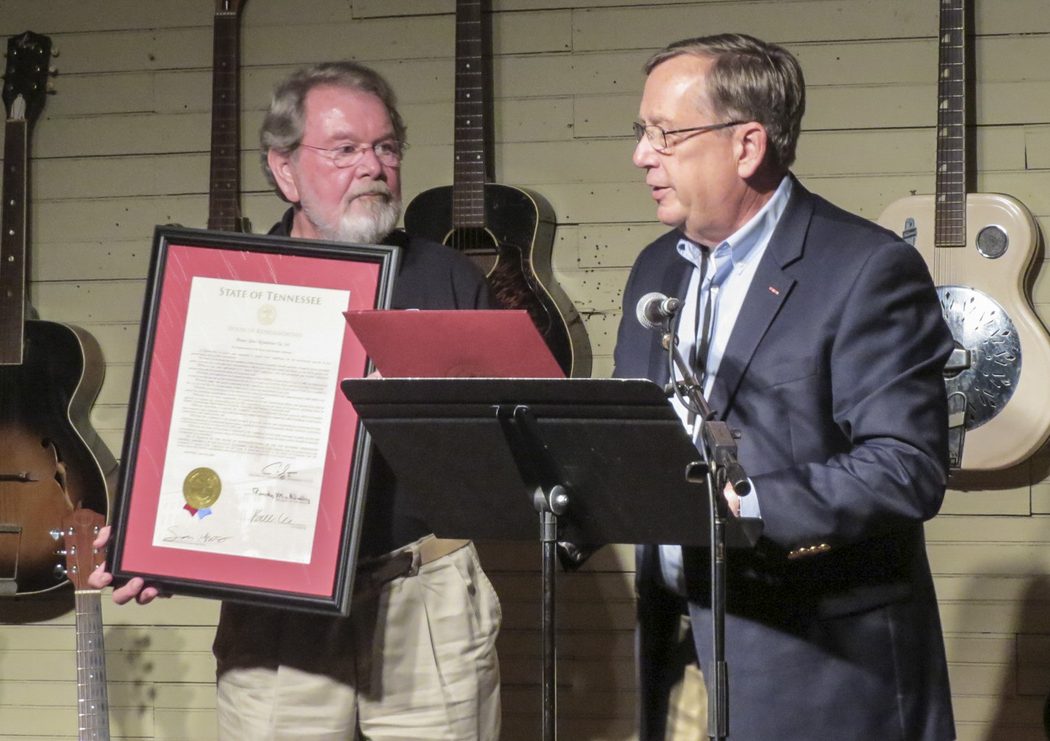
One of the Franklin’s Charge founders and longtime board member, Mary Pearce, noted, Jim was a “supportive teacher who saw we needed help if any battleground would be saved.” Many Franklin’s Charge former and current board members, ABT officials, and Franklin city leaders were in attendance as Lighthizer was recognized with a Tennessee Legislative Proclamation noting his contributions.
The honor was presented by Tennessee State Representative Sam Whitson and retired representative Steve McDaniel, who also worked closely with the ABT in establishing Parker’s Crossroads Battlefield in West Tennessee. Another Franklin’s Charge founder, Julian Bibb,
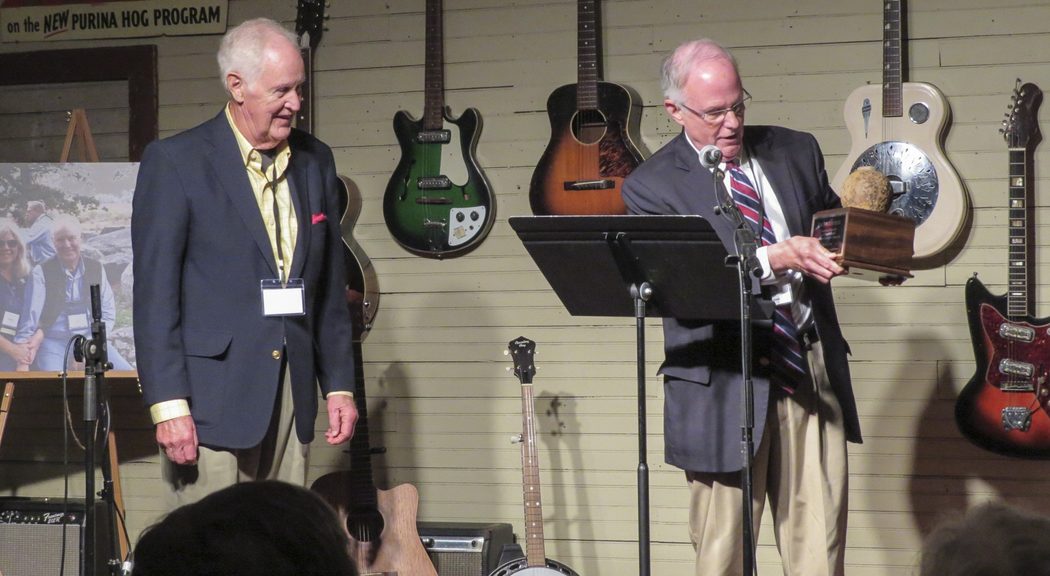
who continues working with the ABT on Franklin Battlefield projects, presented Lighthizer with a 12-pounder cannon ball recovered in the Franklin area. Bibb noted no preservation work has ever happened in the manner it has occurred in Franklin. Noting its importance, Lighthizer said in his remarks, “to be good citizens we have to know our history, the good and the bad. That is why battlefield preservation has been and will continue to be critical for our understanding of who we are.” He added that an “informed citizenry is critical” to our republican form of government and what has been done in Franklin is a “miracle.”
Pearce noted, “we are no longer
a battlefield known for pizza
restaurants, a golf course, and a lost part of our history.” Bibb shared other benefits of historic preservation work. “We have gone from 4,000 tourists a year to over 200,000 who come to see our battle sites, and there is more to come.”
Franklin’s Charge is a § 501(c)(3) Tennessee nonprofit corporation organized in 2005 dedicated to preserving America’s threatened Civil War battlefields in Williamson County, Tennessee. In addition, Franklin’s Charge has actively worked to educate the public about the 1864 Schofield-Hood campaigns, the 1864 Battle of Franklin, the 1863 Battle of Thompson’s Station, the Union earthworks in Triune, and other Civil War events in Middle Tennessee. Further, Franklin’s Charge has been an active participant in heritage tourism, American Civil War history programs, and preservation efforts.
Former Tennessee State Representative Steve McDaniel (left) and Representative Sam Whitson read Tennessee Franklin’s Charge brought proclamation honoring Jim Lighthizer. together all preservation groups operating in Williamson County. Its membership consists of representatives of the African- American Heritage Society, the Carter House Association, the Civil War Preservation Trust, the Franklin-Williamson County Chamber of Commerce, the Harpeth River Watershed Association, the Heritage Foundation of Franklin and Williamson County, Historic Carnton, Inc., the Land Trust for Tennessee, Inc., Save the Franklin Battlefield Association, the Tennessee Civil War Preservation Association, the Tennessee National Civil War Heritage Area, the Tennessee Preservation Trust, and the Williamson County Convention and Visitors Bureau.