November 2023
division in the III Corps, fell dead in the area over which Pender’s men attacked. Berry, who had risen in rank from colonel to major general without formal military training, was apparently shot by one of Pender’s sharpshooters while on horseback delivering orders, work normally reserved for staff officers. He died minutes after his removal to the Chancellor House.
Berry’s men respected the tenacity of Pender’s men. Pvt. Daniel Macomber, 1st Massachusetts, wrote soon after the battle that the Confederates “come up in close column, close to our entrenchments... our whole line poured the shot into them. You could see them drop all around but as soon as one man fell another stepped into his place. They fight like the Devil there is no rubbing that out.”
As they went forward, the 13th North Carolina, on the far left of the brigade did not receive the artillery fire that the rest of the brigade did and continued to advance with Edward Thomas’s Georgia brigade on Pender’s left. In doing so, they encountered Hays’ Brigade at close range. The 13th North Carolina’s Lt. Edward Smith was so near the Federals that “being fired upon by one of the enemy, [Smith] rushed
forward, and killed him with his sword.”
Pender credits Lt. John Ireland for capturing Brig. Hays and his staff, while Lt. Williams gives the honors to privates Alexander “Sandy” Andrews and Daniel Weeden. As Williams recalled it, the two Tarheels grabbed Hays’ horse by the bridle and told him to surrender. Hays replied that if they did not release his horse, he’d kill them. One Confederates then told Hays, “D—n you, dismount or I’ll kill you.” Hays complied. In another dramatic episode reported by Pender, Corp. Monroe Robinson, Company A, 13th North Carolina, “chased a color-bearer so closely that he tore off the colors, and threw down the staff, which was secured.”
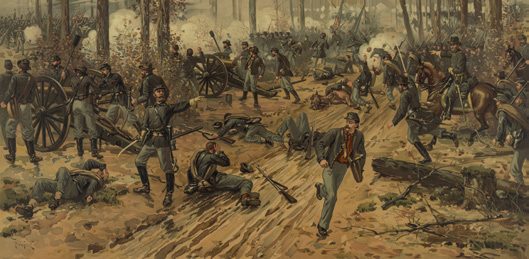
To make the scene even more hellish than it already was, Lt. T.D. Lattimore of the 34th North Carolina remembered that “During the fight the woods caught on fire from the explosion of hostile shells. The scene was sickening—the dead and wounded on both sides were burnt to a crisp. Numbers were so charred that their comrades could not recognize and identify them.”
In his official report Pender claimed that “my brigade fought May 3 with unsurpassed courage and determination. I never knew them [to] act universally so well. I noticed no skulking, and they never showed any hesitation in following their colors.” The casualties suffered by the field officers in the brigade testify to Pender’s praise. As previously mentioned, Colonel Scales of the 13th North Carolina received a disabling thigh wound. Also wounded badly were Col. John S. McElroy and Lt. Col. William A. Stowe of the 16th North Carolina. Lt. Col. Christopher Cole and Maj. Laban Odell of the 22nd North Carolina were both killed. In addition, Maj. Murdock McRae McLauchlin, 38th North Carolina, was also severely wounded.
Pender included a table breaking down his brigade’s losses by regiment in his report of the battle. He reported 45 officers and 706 men either killed, wounded, or missing. The emotionless numbers of course shadow the fact that of those 751 soldiers, 116 would not live to see the May 3 sunset; some
Publishers/Authors Send your book(s) for review to: Mount Pleasant, SC 29466
The Artilleryman is a quarterly magazine founded in 1979 for enthusiasts who collect and shoot
cannon and mortars primarily from the Revolutionary War, Civil War to World War II.
of the 567 wounded would later die from effects of their wounds, others would never fight another battle and go home missing limbs; and probably at least some of 68 missing soldiers would forever go unidentified, thus not allowing their families to learn their fates and gain closure.
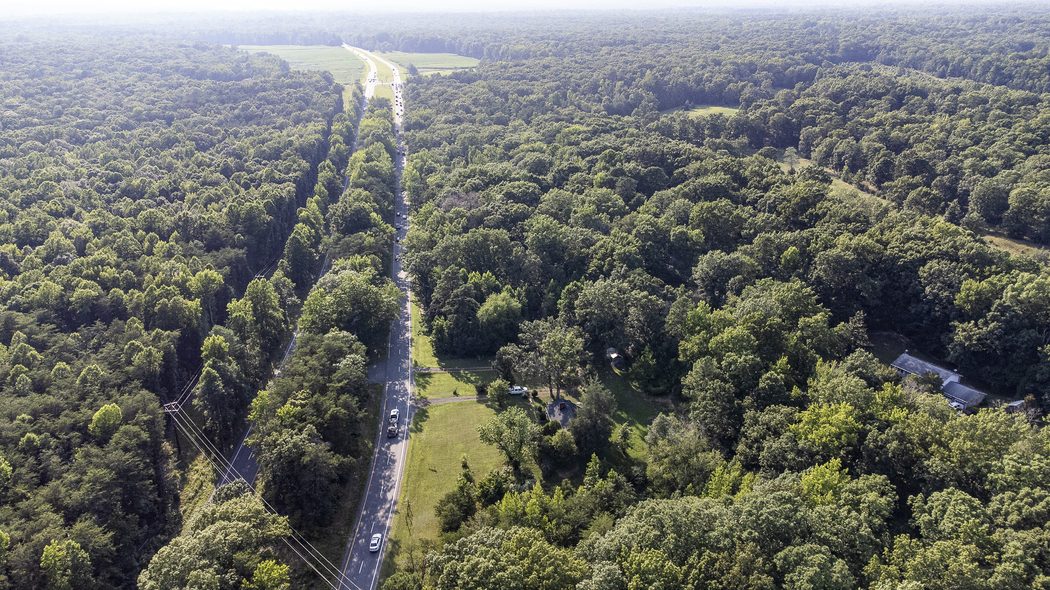
CVBT has helped save over 320 acres at Chancellorsville.
A college graduate and teacher before the war, Confederate Lieutenant Colonel William Peters was severely tested regarding his personal morals and those of his men at Chambersburg, Penn., the morning of July 30, 1864, when he refused an order to burn homes of townspeople gathered in the square or on their doorsteps.
Peters commanded the Twenty- First Virginia Cavalry, one of the first units to enter the town as part of a raid headed by Brigadier General John McCausland. The raiders were cavalry attached to Lieutenant General Jubal Early’s expedition sent behind Union lines into Maryland to disrupt communications, ease pressure on the main Confederate army fighting in Virginia, and forage for horses, food, and military
equipment in enemy territory.
The order to burn the town resulted from a refusal to pay a $100,000 ransom in gold or $500,000 in cash. Townspeople said they didn’t have the money, and if they had it, they would not pay it. With that, McCausland told Peters to begin the burning. Peters asked to see the written order. After reading it, he refused to take part in burning homes of innocent women, children, and the elderly who were left in town when most people fled the Confederate raiders.
The Confederate colonel thought of another order issued by General Robert E. Lee near Chambersburg in June 1863. In it, Lee reminded his troops “We cannot take vengeance for the wrongs our people have suffered without lowering ourselves in the eyes of all,” Lee wrote. His order prohibited unnecessary or wanton injury to private property.
Remembering Lee’s words, many Chambersburg residents refused to believe the town would be burned, whether they gave the money or not. They also recalled that Major General Jeb Stuart had allowed his cavalrymen to burn only buildings belonging to the Federal government during his raid in October 1862.
Peters was ordered to take his command and withdraw to the town’s outskirts, where he was arrested in anticipation of a court martial. The Confederates burned 400 structures and ruined a 10-square block of downtown Chambersburg, including the county courthouse. More than 3,000 were left homeless. Most buildings and homes were sacked of food and clothing. There were no deaths among the townspeople, but three of the raiders lost their lives.
The Southerners were angry about the burning and looting in Lexington, troops under the command of Major General David Hunter in June 1864. Vacant barracks at Virginia Military Institute were burned with looting confined to Lexington’s houses. Their anger would be matched by that of Union cavalrymen who caught up with the Rebels near Moorefield, West Virginia, a week after burning Chambersburg.
Written reports and interviews indicated that many Confederates, reportedly McCausland, left Chambersburg in an inebriated, gleeful state after finding alcoholic spirits in homes and businesses. Peters was restored to duty by Brigadier General Bradley T. Johnson, commander during the return to Virginia while McCausland was absent.
The Confederates hurried to Hancock, where they demanded provisions before crossing the Potomac River at Cumberland into West Virginia. They set up a defensive line with the South Branch of the Potomac at their backs near Moorefield, W.V. The Twenty-First Virginia, again led by Peters, was at the forefront of the defense.
Although Brigadier Averill’s Division of the Union Army of West Virginia slammed into
outnumbered, General Second