November 2023
size caps and loose powder). Nor did he realize that afterwards... by the time he had done his duty faithfully and well with the arms the government had put in his hands there would be little opportunity or need, even if his personal ambition still held out, to fall back on his personal arsenal...The troops of 1861-62 took out hundreds of revolvers only to lose them, give them
away or throw them away; and as many regiments were forbidden by their colonels to wear them, a large number were sent back North. Revolvers were probably cheaper in Virginia in those years than in any other state in the Union.”
This passage partially answers for us what some soldiers may have done with their revolvers if they were not allowed to carry or use them (“send them back North”). The number of surviving specimens suggests that at least some were shipped home with other unneeded private possessions or war souvenirs. However, another possibility is confirmed by Sam Watkins in the passages he records about the arduous journey with Stonewall Jackson marching in the Allegheny mountains near Warm Springs, Va., in late 1861 and early 1862:
“No sooner would we arrive at a place that seemed to be the top than another view of a higher, and yet higher mountain would rise before us. From the foot to the top of the mountain the soldiers lined the road, broken down and exhausted. First one blanket was thrown away, and then another; now and then a good pair of pants, old boots and shoes, Sunday hats, pistols and Bowie knives strewed the road. Old bottles and jugs and various and sundry articles were lying pell-mell everywhere.”
Based on this account, some pistols were obviously discarded as excess baggage. Let me hasten to add that because a handgun survived the war does not necessarily mean that it was carried throughout the entire term of enlistment by a soldier, taken on campaign, or used during battles. Some contradictory period evidence from diaries suggests that not all soldiers discarded or shipped their revolvers home. Some soldiers were still buying revolvers for themselves late in the war. L. Elmer Hackett was “on the moov” towards Atlanta and wrote as an entry in his diary for July 13, 1864:
“I traded my watch for A rolver [revolver] to day. There was between 1 and 2 hundred rebs marched to the rear to day. I got a letter from home.”
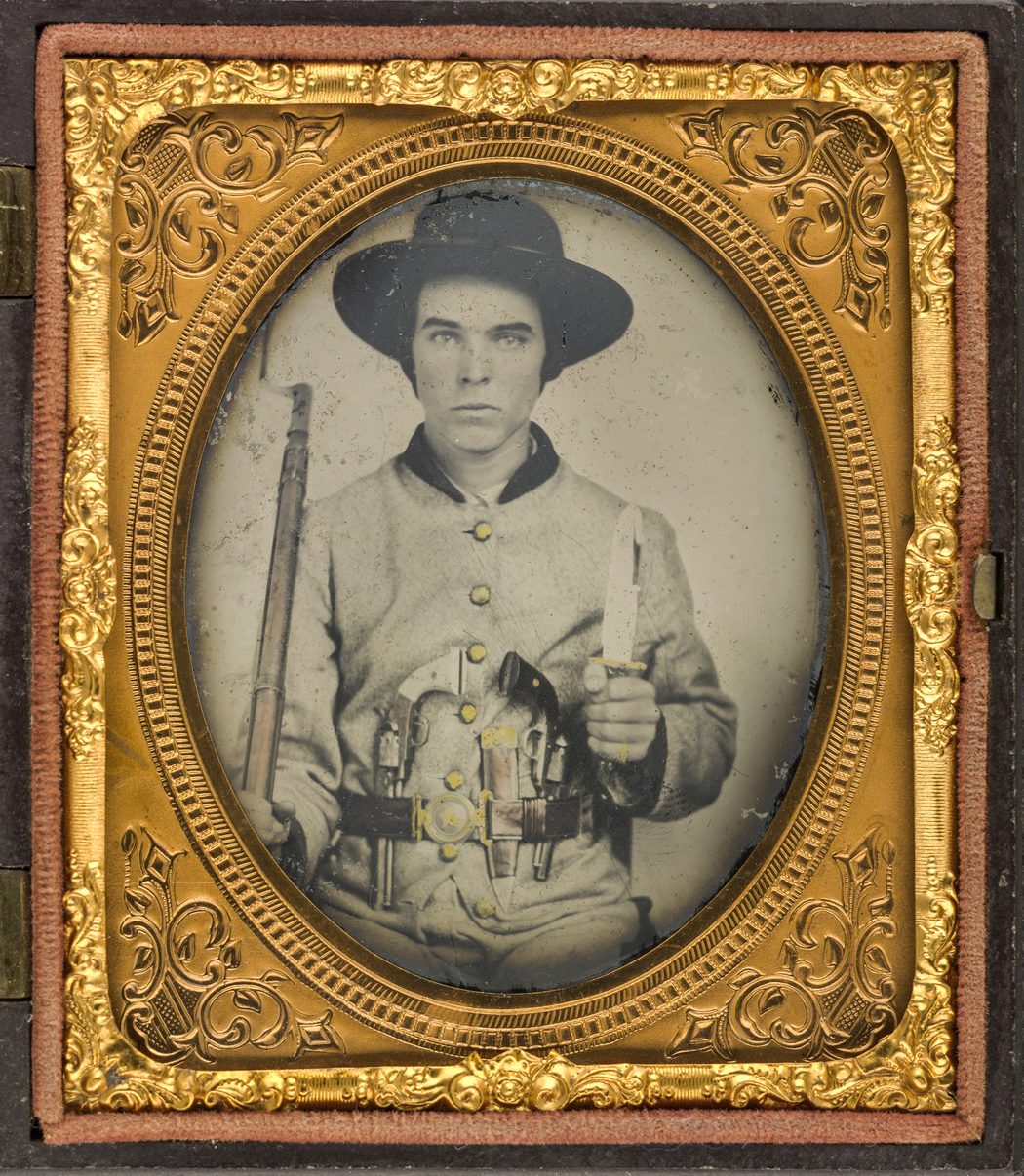
Private Hackett wrote of the revolver purchase as matter-offactly as he recorded his letters from home or a $1 purchase of toback [tobacco] a few days later. This suggests soldiers were bartering goods, and handguns were among those items. If pistols were retained, were they carried tucked in the belt as demonstrated in so many period photos? It would not take great imagination to accept that even those who retained their handguns probably secured them in a knapsack or some other place besides tucked in the waist belt. Speaking as one who has seen a few revolvers (loaded with blanks) at battle enactments tucked in waist belts; the thought has occurred to me that in the
event of an accidental discharge a painful and embarrassing injury to the lower midsection would result, one that would be hard to explain when you got home. Being an experienced and pragmatic group of men, veteran Civil War soldiers may have considered tucking the revolver someplace besides their waist belt while on the march for this and other equally good reasons. If so, period accounts are largely silent on the matter.
It is reasonably clear from period accounts that there were privately purchased, nonregulation revolvers carried, if not frequently used, by infantry on both sides. The practice was less widespread among more experienced soldiers especially on the march, but carrying a pistol was not unknown among veterans either if we can trust period accounts.
Craig L. Barry was born in Charlottesville, Va. He holds his BA and Masters degrees from UNC (Charlotte). Craig served The Watchdog Civil War Quarterly as Associate Editor and Editor from 2003–2017. The Watchdog published books and columns on 19th-century material. He is the author of several books including The Civil War Musket: A Handbook for Historical Accuracy (2006, 2011), The Unfinished Fight: Essays on Confederate Material Culture Vol. I and II (2012, 2013). He has also published four books in the Suppliers to the Confederacy series on English Arms & Accoutrements, Quartermaster stores and other European imports.