August 2023
Farragut, Winfield Scott, John Gibbon, Edmund Davis, and William R Terrill. Nevertheless, when Thomas stayed in the Union Army his true loyalties were questioned and he was always regarded with some degree of suspicion. These concerns obviously proved baseless once the actual fighting got started.
After the Battle of First Manassas, all of Thomas’s assignments were in the Western Theater. In January 1862 he defeated Crittenden and Zollicofer at Mill Springs in Eastern Kentucky. Though not a huge victory, it was an early Union success that turned Confederate forces back into Tennessee. Arriving after the fighting ended at Shiloh, Thomas successfully led forces at the Siege of Corinth. After Perryville, he was passed over for command in favor of Rosecrans. Although resentful, Thomas successfully held the center of Rosecrans forces at Stones River famously remarking “this army does not retreat.”
Perhaps his greatest moment came at Chickamauga in September 1863. Thomas once again held a desperate position against General Bragg’s onslaught while the Union line on his right collapsed. Thomas rallied broken and scattered units together on Horseshoe Ridge to prevent a significant Union defeat from becoming a hopeless rout while Rosecrans retreated to Chattanooga. After the battle he became widely known by a new nickname: ”The Rock of Chickamauga,” for his determination to hold that vital position against continued attacks.
After Chickamauga, Rosecrans was fired and Thomas appointed to command the Army of the Cumberland during the Battles for Chattanooga in November 1863. Missionary Ridge was a stunning Union victory highlighted by Thomas’s troops taking Lookout Mountain on the right and then storming the Confederate line on Missionary Ridge the next day. Assistant Secretary of War Charles A. Dana, an eyewitness, called the assault “one of the greatest miracles in military history....as awful as a visible interposition of God.”
Grant for his part, perhaps relying on old grudges from many years past considered George Thomas a defensive general who was slow to attack. Author Bruce Catton noted that Thomas ”comes down in history...as the great defensive fighter, the man who could never be driven away but who was not much on the offensive. That may be a correct appraisal. Yet it may
also be worth making note that just twice in all the war was a major Confederate army driven away from a prepared position in complete rout—at Chattanooga and at Nashville. Each time the blow that finally routed it was launched by (George) Thomas.”
While strangely unappreciated in his time, George Thomas was always well prepared, and is now highly regarded among military historians for understanding the role of logistical support in achieving success on the battlefield.
Craig L. Barry was born in Charlottesville, Va. He holds his BA and Masters degrees from UNC (Charlotte). Craig served The Watchdog Civil War Quarterly as Associate Editor and Editor from 2003–2017. The Watchdog published books and columns on 19th-century material and donated all funds from publications to battlefield preservation. He is the author of several books including The Civil War Musket: A Handbook for Historical Accuracy (2006, 2011), The Unfinished Fight: Essays on Confederate Material Culture Vol. I and II (2012, 2013). He has also published four books in the Suppliers to the Confederacy series on English Arms & Accoutrements, Quartermaster stores and other European imports
“The Men Fell on All Sides”: Kershaw’s Brigade at Fredericksburg
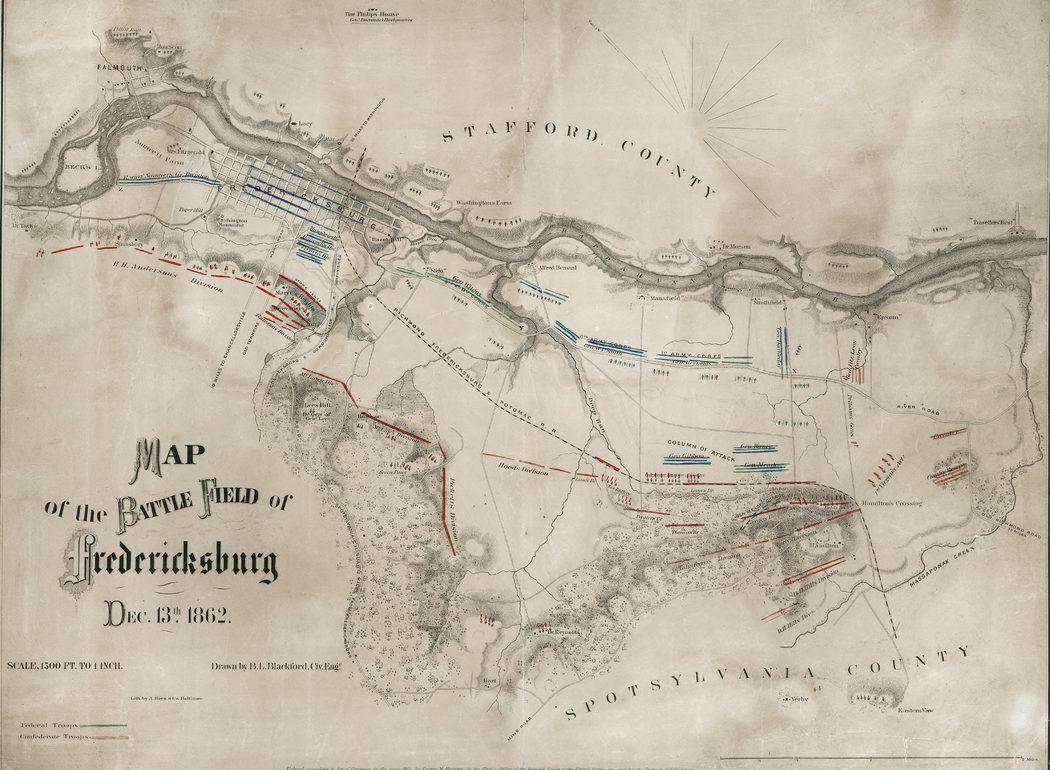
At Fredericksburg, South Carolinians battled on both ends of the Confederate line. While Brig. Gen. Maxy Gregg’s South Carolina regiments endured a brief Federal breakthrough at Prospect Hill and lost Gen. Gregg to a mortal wound, Brig. Gen. Joseph Kershaw’s Palmetto State regiments fought on the opposite end of the long defensive line at Marye’s Heights.
and Mexican War veteran who served in the South Carolina secession convention, started the war as colonel of the 2nd South Carolina Infantry. He received a promotion to brigadier general in February 1862. At the time of Fredericksburg, most of Kershaw’s brigade were experienced fighters, some having participated in actions as early as First Manassas. The brigade comprised the 2nd, 3rd, 7th, and 8th South Carolina Infantry regiments. The 15th South Carolina Infantry and the 3rd South Carolina Battalion joined the brigade in mid- November 1862.
Just before the Battle of Fredericksburg, Kershaw’s Brigade occupied a position in the center of Gen. Lafayette McLaws’ Division. Kershaw’s line stretched from just south of “Braehead,” the Howison family house on Howison Hill, to Hazel Run and the nearby unfinished railroad bed. On December 11 and 12, the newly joined 15th South Carolina served as the brigade’s pickets, helping monitor Federal activity around the lower pontoon bridge crossing. The regiment returned to their position in line
Joseph Kershaw began the war as the colonel of the 2nd South Carolina Infantry. Maj. Gen. Kershaw was taken prisoner at the Battle of Sailor’s Creek on April 6, 1865. (Public domain) “after a night of such intense cold as to cause the death of one man and disable, temporarily, others.” Kershaw noted the brigade’s other regiments worked “strengthening our defenses nightly without any incident requiring notice until Saturday, the 13th.”
About 1 p.m. December 13, Kershaw received orders from McLaws to send two regiments to Marye’s Heights to bolster Brig. Gen. Thomas R.R. Cobb’s brigade in the Sunken Road. Kershaw immediately sent the 2nd and 8th South Carolina; his other regiments were soon ordered to follow. The 3rd South Carolina Battalion was assigned to guard the Howison Mill location along Hazel Run to protect “a gap in the [unfinished] railroad embankment, and prevent its passage by the enemy.”
Just after putting his brigade in motion, Kershaw learned from McLaws that Cobb was mortally wounded, and Kershaw was to “take command.” He arrived at the Stephens House at the Sunken Road about the same time the 2nd and 8th South Carolina appeared. Those two regiments took position in the Sunken Road.
Writing to his wife several days after the battle to let her know that he was all right, the 2nd South Carolina’s 1st Sgt. Alexander McNeill noted, “Our Brigade occupied a conspicuous place in the engagement, and for the honor of Carolina, I am glad to say that her sons fought as valiantly as ever men did.” McNeill’s company had seven wounded. “I am at a loss to know how we came off so well, and I can but render thanks to an all wise and ever mercifull God for his kind protection in the hour of danger,” he penned. In total, the 2nd South Carolina lost six killed and 56 wounded in the fighting.
In his official report, Capt. E.T. Stackhouse of the 8th South Carolina commented that after they occupied the Sunken Road, he received permission from Kershaw to “form my command in four ranks.” Such depth probably helped keep the Federals at a distance. In fact,
![Battle of Mission [i.e., Missionary] Ridge, Nov. 25th, 1863, presented by McCormick Harvesting Machine Company. (Library of Congress)](/civil-war-news-archives/articles/2023/craig-barry-2023-08/img/01.jpg)