February 2023
At age 15 Crosby left for New York City, which at that time meant Manhattan, to attend the New York Institute for the Blind. She used her gift of memory to absorb the lectures she attended. She joined the faculty there at age 23 and taught history and rhetoric classes. Crosby devoted many of her Civil Warera poems and songs to the abolition of slavery. Her satirical “Song to Jeff Davis” deemed the Confederate president worthy of death by decapitation. She was so staunchly pro-Union that after the Civil War began, she often wore a small U.S. flag pinned to her bodice. Once a Southern lady visiting a restaurant in New York found this display offensive and snapped, “Take that dirty rag away from here.” Crosby, blind and middle-aged though she was, challenged the woman to “… repeat that remark at your own risk!”
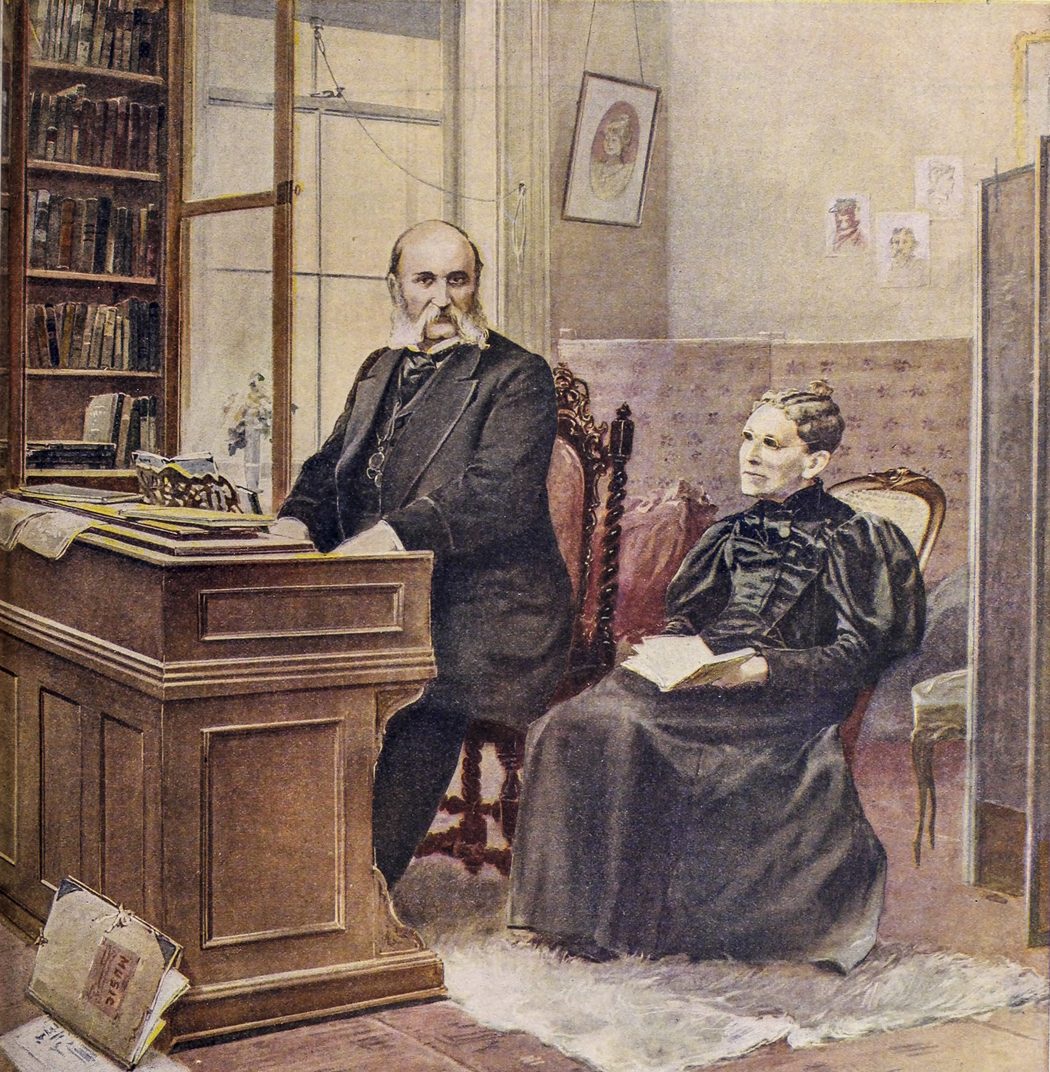
During the Civil War years in New York, Crosby’s already remarkable life took a sudden turn after composer William Bradbury gave her a hymn-writing test. He asked her to put her Christianthemed poetry to some of his melodies. She came up with lyrics that Bradbury considered much better than work of his other collaborators. Her first
Fanny J. Crosby, The Blind Poet, and Ira D. Sankey, Composing A New Hymn. The Christian Herald and Signs Of Our Times. March 25, 1896.
effort, “We Are Going,” (1863) was published in his next hymnal. She later worked with Howard Doane, Ira Sankey, Robert Lowry, and other prominent hymn composers. Fanny Crosby was in great demand as a lecturer and preacher. Although completely blind, wherever she traveled and performed, she insisted on going alone.
While she received a stipend of a few dollars for each hymn published, she and her husband, a former student, lived in simple circumstances near the Bowery district. The Bowery, originally a respectable entertainment center in Manhattan’s southern tip, had degenerated by the time of the Civil War into an area of lowbrow concert venues, gambling halls, beer gardens, and flophouses. It was also home to the infamous Nativist gang “the Bowery Boys,” who took an active part in the mayhem during the New York Draft Riots of mid-1863.
Rather than improve her standard of living even for safety’s sake, Crosby opted to donate any funds in excess of her modest living expenses to local rescue missions. On the evening of Feb. 11, 1915, when she was almost 95, Crosby dictated a letter to cheer a bereaved friend, including a poem which she recalled perfectly. She died
“The best little book on Barnard”
later that night. Hymnist Elisa Edmunds Hewitt, who wrote “Will There Be Any Stars in My Crown,” provided the memorial poem: Away to the country of sunshine and song Our songbird has taken her flight And she who has sung in the darkness so long Now sings in the beautiful light.
Craig L. Barry was born in Charlottesville, Va. He holds his BA and Masters degrees from UNC (Charlotte). Craig served The Watchdog Civil War Quarterly as Associate Editor and Editor from 2003–2017. The Watchdog published books and columns on 19th-century material and donated all funds from publications to battlefield preservation. He is the author of several books including The Civil War Musket: A Handbook for Historical Accuracy (2006, 2011), The Unfinished Fight: Essays on Confederate Material Culture Vol. I and II (2012, 2013). He has also published four books in the Suppliers to the Confederacy series on English Arms & Accoutrements, Quartermaster stores and other European imports.
CHARLESTON IN THE WAR
The American Civil War was the first war in which both sides widely used entrenchments, repeating rifles, ironclad warships, and telegraphed communications. It was also the first American War to be extensively photographed. Mathew Brady, Alexander Gardner and Timothy O’Sullivan are famous for having made iconic photographs in the Civil War’s eastern theater. George N. Barnard deserves to be ranked in this top tier for his photographic work in the war’s western theater. A civilian photographer hired by Gen. William T. Sherman’s chief engineer to take pictures of fortifications around Atlanta, Barnard took several hundred of them in and around the city in the fall of 1864. His most famous is the site of Union Maj. Gen. James B. McPherson’s death in the battle of Atlanta, July 22, 1864. Thus far, no comprehensive, definitive listing has been made of the photographer’s work. For this book we have chosen a hundred images we deem “significant.”