Introducing the Rebel Yell to Pennsylvania
‘If We Are Striking For Pennsylvania:” The Army of Northern Virginia and the Army of the Potomac March to Gettysburg, Volume 2, June 22- 30, 1863. By Scott L. Mingus Sr., and Eric Wittenberg. Illustrated, Appendices, Bibliography, Index, 444 pp., 2023, Savas Beatie, www.savasbeatie.com, hardcover, $34.95.
In Volume Two, the authors cover the period June 22-30, 1863, when both Confederate and Union troops converged on Gettysburg. Using extensive primary material from the Official Records, newspaper accounts, letters, and diaries, they combine the military, political, social, and economic forces that impacted both Union and Confederate strategy in Gen. Robert E. Lee’s push into Pennsylvania. Gen. Hooker had begun to move his troops north to discern the objectives, strength, and location of the Army of Northern Virginia. Simultaneously, the initial thrust north of the Mason-Dixon Line was executed by Gen. Albert Jenkins’ cavalry and led to the occupation of Greencastle and then Chambersburg as General Ewell moved north. The lack of certainty as to General Lee’s objectives left politicians, as well as Generals Hooker and Halleck, guessing, reassigning troops as needed, and hoping to prevent a Confederate assault on Baltimore or Washington. Panic was the name of the game in Adams County.
Each chapter, beginning with June 22, chronicles troop positioning: division, brigade, and regiment, and the response of the local citizenry to the presence of either Rebel or Union troops. As each chapter details troop maneuvering, the reader can follow in the footsteps of the combatants, through Chambersburg, Carlisle, Shippensburg, Greencastle, Harrisburg, and countless smaller towns. The voices of terrified citizens are vividly recalled as they fled their homes, lost or hid their worldly possessions, and wondered if they would survive the coming ordeal. Invading troops, both Union and Confederate, foraged extensively through each town and farm, confiscating livestock, Negroes, grain, and personal possessions townsfolk had spent a lifetime accumulating. Rain, muddy roads, long marches, and exhaustion characterized the soldier’s ordeal and added to their misery. People of Pennsylvania were experiencing the same trauma that had been foisted on the South for two years.
As with Volume One, Scott Mingus and Eric Wittenberg do an excellent job of incorporating primary material to make the panic of these nine days come alive. The book is historically accurate, very readable, comprehensive, and hard to put down. Without a thorough understanding of the days leading up to the Battle of Gettysburg, including the effects of the last minute promotion of Gen. Meade, the absence of Gen. Stuart, and the feelings and emotions of local residents and competing troops, the whole story of Gettysburg would not be complete. Both Volumes One and Two should be added to every historian’s bookshelf.
One vital attribute of this volume is how soldiers and civilians are viewed in human terms, a long overdue aspect of the opposing armies and civilians impacted by the fighting. This volume is recommended highly for its coverage of the human side of the campaign as well as its military aspects.
Dr. Wayne L. Wolf is Professor Emeritus at South Suburban College and the author of numerous Civil War books and articles including Civil War Letters, The Last Confederate Scout and the four volume Heroes and Rogues of the Civil War.
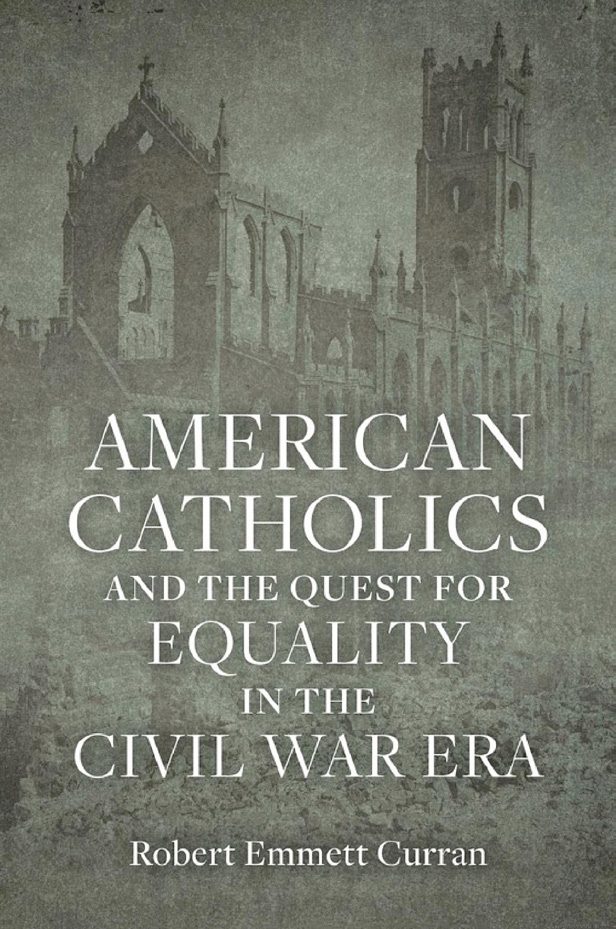
The role of religion in the American Civil War is a subject that never gets old. Robert Emmett Curran, history professor emeritus at Georgetown University, has written about American Catholic history and now offers a new look at how the Roman church existed during the Civil War.
The author starts his discussion during the Mexican War. In the 1840s, about one third of the United States Army was made up of Catholics, most of them Irish. When the Mexican War broke out the army, under orders from President James K. Polk, sought out Catholic chaplains for the first time. From there the book jumps to the secession crisis, to the Civil War itself, and reconstruction.
When the author is focused on what the book’s title suggests, he presents a good overview of the status of Catholics in that time period, although a good percentage is merely anecdotal accounts. However, there is a lot that could have been included.
For example, there is no mention of the Catholic Church’s policy on slavery and the slave trade. Only once, and then in passing, does he mention Bishop John England of Charleston, S.C., arguably the most influential antebellum southern Catholic clergyman, whose views influenced a generation of Catholic priests and bishops in the deep South.
For the part of the war years, he all but puts the main topic of the book aside and instead presents a basic overview of Civil War battles and campaigns that is on par with any basic primer on the War. While there would have been nothing wrong with using that as background material, combat and campaigns are front and center for at least half the book and really add nothing to the main subject. In fact, the book would have been better without it.
He ends the book with a needless epilogue that is bound to offend many readers as he accuses Catholics of being “particularly susceptible to the lure of demagogues” and blasting them for supporting Sen. Joe McCarthy and former President Donald Trump. In the case of the latter, he calls their support
Send your book(s) for review to: 3022 South Morgans Point Road, Suite 222 Mount Pleasant, SC 29466
The Artilleryman is a quarterly magazine founded in 1979 for enthusiasts who collect and shoot
cannon and mortars primarily from the Revolutionary War, Civil War to World War II.
a “shame.” In this reviewer’s opinion, it is the job of a historian to present as honest and balanced view of the past as possible, even if it means putting aside their own personal biases. In this case, Curran failed, and probably lost a lot of Catholic readers who might have otherwise read this book.
In the end, this is a very disappointing, heavily bloated, book that is not worth the money being asked for it.
Tom Elmore is South Carolina State Historian for the Ancient Order of Hibernians in America, An Irish-Catholic fraternal organization, and has written and lectured on Irish-American History.
December 2023
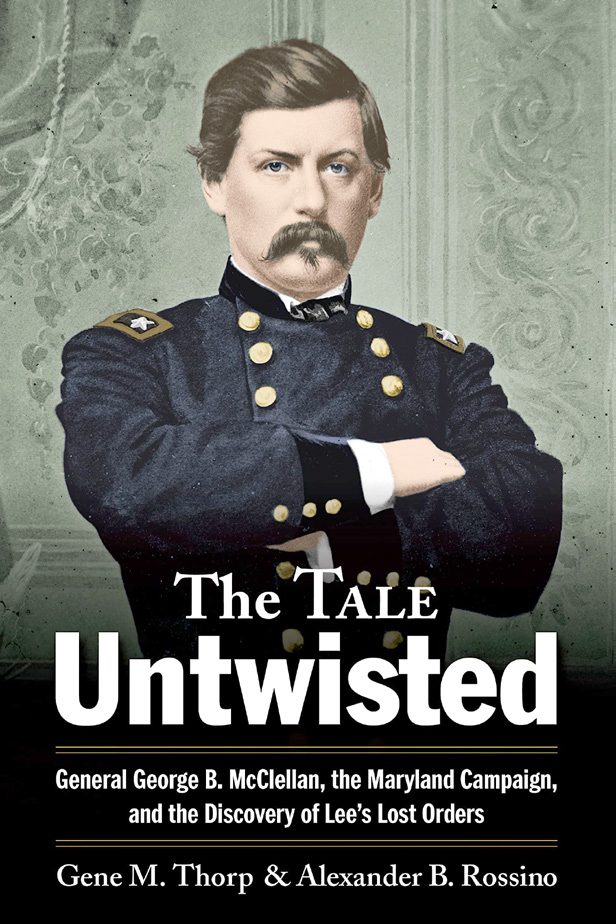
The Tale Untwisted: George B. McClellan, the Maryland Campaign, and the Discovery of Lee’s Lost Orders. By Gene M. Thorp and Alexander B. Rossino. Savas Beatie, https://www.savasbeatie.com, 2023. 171 pages, appendices, bibliography, index. Paper $18.95.
Historians of the American Civil War have long studied the 1862 Maryland Campaign. Indeed, a near-constant stream of articles and books have been written describing, analyzing, and evaluating various aspects of the campaign and its participants for over a century and a half. After such an extended period, certain elements of the tale have been considered nearly sacrosanct in the mythology of America’s Iliad. One element concerns the story of Confederate General Robert E. Lee’s lost orders and Union Major General George B. McClellan’s reaction to finding them.
According to the longtold story, while in pursuit of the Rebel Army of Northern Virginia, elements of the Union Army of the Potomac reached Frederick, Maryland, on September 13. There, Corporal Barton Mitchell of the 27th Indiana Infantry discovered a copy of Special Order 191, the detailed campaign plans of Lee’s army wrapped around three cigars. The order revealed that Lee had dispersed his army into five parts, thus making each subject to defeat in detail. Once the orders worked their way to McClellan, he telegraphed President Lincoln around noon, boasting how he would defeat Lee and send trophies. Nevertheless, McClellan waited 18 hours before deciding to take advantage of this intelligence, and this delay squandered the opportunity to destroy the Army of Northern Virginia.
Many notable historians have subscribed to and perpetuated this established version of events.
For example, see Stephen W. Sears, Landscape Turned Red: The Battle of Antietam, Houghton Mifflin, 1983 (p. 113); James M. McPherson, Crossroads of Freedom: Antietam, The Battle That Changed the Course of the Civil War, Oxford University Press, 2002 (pp. 108-09); Joseph T. Glatthaar, General Lee’s Army: From Victory to Collapse, Free Press, 2008 (p. 168); Ethan S. Rafuse, McClellan’s War: The Failure of Moderation in the Struggle for the Union, Indiana University Press, 2005 (pp. 291-93).
Gene M. Thorp and Alexander B. Rossino in The Tale Untwisted challenge virtually every aspect of the traditional story. The authors initially began examining the Antietam Campaign for separate projects and eventually combined their research. Their book is an expanded version of an essay published as part of Savas Beatie’s Civil War Spotlight (online) series in 2019.
So, how does one go about changing history and challenging noted scholars? Interestingly enough, all it takes are the basic skills taught to any undergraduate history student. Read the relevant secondary sources, then consult the primary sources. The authors carefully examined official reports, correspondence, letters, diary entries, telegrams, signal dispatches, newspaper articles, and unit histories (especially pertaining to September 13), and then placed them in chronological order and plotted them on maps. The result is a highly detailed account of McClellan and his army in their pursuit of Lee, especially on the fateful autumn day when the Federals discovered Lee’s order.
The book follows a logical step-by-step repudiation of the conventional wisdom surrounding McClellan’s handling of the campaign prior to the Battle of Antietam. The first chapter sets the stage, while chapter two explores what McClellan actually knew as he followed Lee into Maryland. The authors correctly point out that while past historians have been overly critical of McClellan for apparently moving too slowly, it was a sound decision. The general was uncertain about the position of the Army of Northern Virginia, the strength of that army, or what Lee’s ultimate intentions were.
Chapters three and four are the heart of the book. Here, the authors dissect in detail the timeline of the finding of Lee’s lost order. Moreover, like a good detective story, the timeline is critical to understanding the events. The lost order was not discovered on the morning of the thirteenth but around noon. This information challenges Stephen Sears’s account on which many future scholars based their own interpretations. McClellan did not receive Special Order 191 until 2 p.m. In the meantime, his forces were not idle. Advanced elements continuously moved westward and drove back the Rebel rear guard.
The authors contend the lost order did not unduly excite McClellan as traditionally reported; it merely confirmed his belief that the Army of the Potomac was going in the right direction and that he now had the opportunity to catch Lee’s army divided. Between 3 p.m. and 6 p.m., McClellan continued to direct his men to the west. Around 6 p.m., he informed his senior lieutenants how his plans related to the discovery of the lost order. Essentially, other than a force sent to relieve Harpers Ferry, the Army of the Potomac was to move through the mountain passes and engage Lee’s scattered force beyond them. He does not exchange telegraphs with the General-in-Chief Henry Halleck until later in the evening; he does not contact Lincoln until around 11 p.m. After midnight, he goes to sleep and is up within a few hours to continue the pursuit.
The authors present a convincing case for their timeline and course of events. They have highlighted errors in the War Department’s dating of telegrams received, and they have even produced evidence that only two cigars, not three, were wrapped up in the lost order.
The authors continued evaluating McClellan’s performance in chapter five as they demonstrate that neither McClellan nor his generals were at fault for the Confederate capture of Harpers Ferry. Indeed, Thorp and Rossino make a convincing case that the Union commander simply surrendered too easily and too soon, before
Want To Advertise In Civil War News?
McClellan’s relief force could arrive. The authors view Halleck’s dogged pursuit to lay the blame on McClellan as a selfserving attempt to prevent any blame from being laid at his own feet. In sum, McClellan again behaved properly, and he did not dawdle. The book concludes with an overall positive assessment of McClellan.
Moreover, three excellent appendices are included: one provides an overview of the Union telegraphic communications during this point in the campaign; the second looks at the strength of the Union Army of the Potomac during the campaign, the last is a copy of Lee’s Special Order No.191. The book has a detailed and excellent bibliography and index and is thoroughly footnoted.
So, what have the authors provided? A lot. First, they corroborate and enhance the research of Joseph L. Harsh in his Taken at the Flood: Robert E. Lee and Confederate Strategy in the Maryland Campaign of 1862: Robert E. Lee and Confederate Strategy in the Maryland Campaign of 1862 (Kent State, 2000). We know beyond a doubt that McClellan did not waste 18 hours after receiving Lee’s lost order. Indeed, the Federal army, except for periods of rest, was moving all day on the thirteenth. The authors’ in-depth research also demonstrates the importance of continuing exploration of the military aspects of the Civil War. While most professional historians have convinced themselves that the military story is done and eschewed, it is almost exclusively in favor of social and cultural subjects; this work alone proves that is not the case.
This slender volume joins several recent works focused on the objective interpretation of Civil War generals, including Stephen M. Hood, John Bell Hood: The Rise, Fall, and Resurrection of a Confederate General (Savas Beatie, 2013); Earl J. Hess, Braxton Bragg: The Most Hated Man of the Confederacy (University of
North Carolina Press, 2016); Stephen Davis, Texas Brigadier to the Fall of Atlanta: John Bell Hood (Mercer, 2019) and Into Tennessee and Failure: John Bell Hood (Mercer, 2020); and Richard McMurry’s The Civil Wars of General Joseph E. Johnston: Confederate States Army – Volume I: Virginia and Mississippi, 1861–1863 (Savas Beatie, 2023). The work also joins and complements new scholarship on the Maryland Campaign. For examples, see D. Scott Hartwig’s two-volume To Antietam Creek: The Maryland Campaign of September 1862 (Johns Hopkins University Press, 2012); and I Dread the Thought of the Place: The Battle of Antietam and the End of the Maryland Campaign (Johns Hopkins University Press, 2020).
This book is an excellent mustread for Civil War scholars and the reading public in general. It would also be useful for graduate students in history since it clearly demonstrates the importance of always going back to the primary sources as a way of making sure long-established “facts” are actually facts and not interpretations. My only criticism is that the authors were terribly harsh with Stephen Sears, accusing him of fabricating evidence. While it has become evident that Sears made errors, the mockery of his scholarship morphed into a visceral and unwarranted personal attack. The Sears commentary aside, the authors have presented a nice work that is to be recommended.
John D. Fowler, Ph.D., is the author of several books and articles on the Civil War Era. He is the author of Breaking the Heartland: The Civil War in Georgia. He is currently a Professor of History at Dalton State College.John D. Fowler, Ph.D., is the author of several books and articles on the Civil War Era. He is the author of Breaking the Heartland: The Civil War in Georgia. He is currently a Professor of History at Dalton State College.
Hood’s Defeat Near Fox’s Gap: Prelude to Emancipation. By Curtis L. Older. Illustrated. Bibliography, index, endnotes, Casemate Publishing, https://www.casematepublishers.com, 2023, 210 pp., hardbound, $34.95.
Curtis Older, in collaboration with local historian Ted Ellis, has compiled an exhaustive geographical and topographical study of the Battle of South Mountain. Their research has altered the previous placement of Gen. John B. Hood’s troops near Fox’s Gap, reprised the role of Gen. Hood’s two brigades in the Maryland campaign, and forced a reexamination of troop alignments and participation in this opening salvo of the Battle of Antietam.
The Battle of South Mountain began at 9 a.m. on September 11, 1862. The fighting around Fox’s Gap provided the Union (particularly the IX and I Corps under Gen. George McClellan) with a path to flank Turner’s Gap from the rear. If successful, Union forces could have gotten between Confederate Gens. Thomas Jackson and James Longstreet, allowing Gen. McClellan to attack each force separately.
Previous published major works on the Battle of Fox’s Gap, e.g., Ezra Carmen, John Priest,
Loyal Legion of the Confederacy CSA National Defense Medals & other banned internet items
and D. Scott Hartwig, according to Older’s research, misplaced Hood’s two brigades during his final assault of the battle during the late afternoon of September 14. Hood had advanced south from Old National Road towards Old Sharpsburg Road and suffered a decisive defeat one-half mile west of Fox’s Gap. This solidified the Union victory at Fox’s Gap, compelled Gen. Robert E. Lee to issue his first-ever retreat order, and weakened Confederate forces for the upcoming Battle of Antietam. Older’s research also contradicted the assertion that Hood’s two brigades retook Miller’s Field along Wood Road and recaptured Mountain Crest at Fox’s Gap. Likewise, maps that show Gen. G.T. Anderson’s Brigade far down the east slope of East Ridge are inaccurate. Also, there is little doubt that Hood always intended to attack the Union’s left flank. However, with fewer than 2,000 men available due to the exhausted condition of his troops, Hood had little chance to regain any lost ground near Wise’s Cabin, Miller’s Field, or Ridge Road. His final repulse was at Cox’s Intersection, and this effectively ended the Battle of Fox’s Gap.
Curtis Older provides ample primary source material, including soldier’s letters, afteraction reports, official records, and topographical data to correct the record on the placement and participation of Gen. Hood’s forces at Fox’s Gap. Those historians eager to examine the prelude to the Battle of Antietam in minute detail will find this study instructive. Several repetitive phrases could have been redacted to promote the flow of material but are otherwise historically sound and well documented.
Dr. Wayne L. Wolf is Professor Emeritus at South Suburban College and the author of numerous books and articles on the Civil War, He is past president of the Lincoln-David Civil War Roundtable.
Funny Thing About the Civil War: The Humor of an American Tragedy. By Thomas F. Curran. Notes, index, 222 pp. McFarland & Co., 2023. Softbound. $39.95.
Reviewed by Brian Matthew Jordan
This book catalogs the remarkable number of literary and creative works that have approached the Civil War with wit. Employing a capacious definition of humor, veteran author Thomas F. Curran surveys an ambitious array of texts, from poetry and prose to slapstick and short stories, from “mockumentaries” and memoirs to the now famous and frequently anthologized Jourdon Anderson letter.
Curran’s book is divided into three parts. In Part I, the author considers how writers deployed humor and satire during the war. “Writers did not always plunge their satirical sword at the enemy,” Curran reminds, “often aiming their wit, as well as their criticism, at their own leaders.” In wartime newspaper columns and popular periodicals, “crackerbox philosophers” like Petroleum V. Nasby and Orpheus C. Kerr lampooned shoddy contractors, office seekers, and Copperhead Democrats. Meanwhile, a veteran of the Pennsylvania Reserve Division who lost his leg at Antietam put pen to paper on John Smith’s Funny Adventure on a Crutch, or the Remarkable Peregrinations of a One-Legged Soldier after the War. This soldier turned author was hardly alone in tackling one of “the grittiest and most unpleasant aspect of the war with humor.”
Part II turns to the immediate postwar decades when memoirs and published accounts of the conflict became a veritable cottage industry. At least some veterans seeking to heal the physical and psychological wounds of war believed laughter was an effective remedy. Wisconsin volunteer George Peck, for example, satirized the immodesty of many Civil War memoirists with his tellingly titled book, How Private Geo W. Peck Put Down the Rebellion. Many others spiced recollections, battle accounts, and bits of autobiography with a sardonic wit. Perhaps most famously, Mark Twain’s “The Private History of a Campaign That Failed” mused over the war’s rank absurdities.
In the book’s final part, Curran shifts his gaze to the twentieth century. He considers a wide range of both print and visual media, from the satirist H.L. Mencken’s “The Calamity of Appomattox,” a tart exercise in counterfactual thinking, to a dystopian fantasy published in 2018. Impressively, Curran’s inventory captures many lesser-known works, such as the historian Thomas Connelly’s intriguing, pseudonymously published parody of the Civil War centennial, Will Success Spoil Jeff Davis?
A lengthy section surveys the many filmic representations of the war. The slapstick comedy of Buster Keaton’s The General proved perhaps the height of Civil War humor on the silver screen, though “mockumentaries” and zombie films such as C.S.A. and Abraham Lincoln: Vampire Hunter, have proliferated at the turn of the twenty-first century.
Throughout the book, Curran maintains a commentate tone. The author punctuates the narrative with his own asides, injecting his own “tongue-in-cheek” humor into the main text. Scholars will no doubt wish that Curran had advanced an overarching thesis, or that he had done more to situate his findings within the historiography of Civil War memory. This reviewer suspects even more humorous anecdotes could be wrung from the records of GAR campfires and the pages of the National Tribune, yet historians will mine with profit the many long-forgotten sources that Curran brings to light.
Brian Matthew Jordan is associate professor and chair of the history department at Sam Houston State University. His Marching Home was a finalist for the Pulitzer Prize.
Without Concealment, Without Compromise. The Courageous Lives of Black Civil War Surgeons. By Jill L. Newmark. Illustrated, Notes, Bibliography, Index, Southern Illinois University Press, http://www.siupress.com, 2023, 283 pp., softcover, $29.95.
This book is a bibliography of the 14 black doctors who served the Union during the Civil War. They formed a small group among the 12,000 doctors who served in the Union Army and Navy. However, their contributions were significant firsts in caring for black soldiers, contraband families, escaped slaves, and freedmen. Whether they ministered near battlefields or in the Contraband Hospital (Freedman’s Hospitals), their service saved lives and encouraged the advancement of civil rights. Each of the book’s twelve chapters highlights these pioneer black surgeons’ life, education, struggles, and trendsetting accomplishments.
Chapter One was devoted to Alexander T. Augusta, one of the few black surgeons in uniform, and how he changed how black people envisioned themselves and redefined conventional notions of authority. Chapter 2 documented William Peter Powell’s service as the surgeon in charge of the Contraband camp in Washington D.C., his improvements to its sanitary facilities, and his request for perimeter fencing to protect patients and staff.
The next three chapters focus on the achievements of Anderson R. Abbott, who possibly accompanied Mrs. Keckly to the Peterson House the night Lincoln was shot, William P. Powell, who served as Asst. Surgeon at the
Contraband Hospital, and John V.S. DeGrasse, the only black surgeon to serve in the field with his regiment (35th USCT). The next set of chapters highlighted John H. Rapier Jr., who was born in Jamaica but served the Union with devotion, Richard Henry Greene, the only Union naval doctor in the Civil War and the first black graduate of Yale, and Willis R. Revels, an AME minister, and surgeon for the 28th Indiana Regiment USCT.
The final chapters are devoted to Benjamin A. Boseman Jr., who later served as Postmaster of Charleston and in the South Carolina House of Representatives, Charles B. Purvis, the first black doctor to treat a president (Garfield), Cornelius V. Creed, and William B. Ellis, the first black graduates of an Ivy League college, Alpheus W. Tucker who served at the Freedman’s Hospital, Joseph Harris, who ministered to the sick at Balfour Hospital, and Charles H. Taylor who served at Lincoln General Hospital.
These men became healers of soldiers, sailors, contrabands, and free men after overcoming racially prevalent impediments of antebellum America. Nevertheless, each achieved their success through hard work, educational excellence, and a desire to serve humanity.
This book provides a thorough biographical sketch of these fourteen black surgeons. It is wellresearched, replete with primary source data, and profusely annotated. At times, it appears that many accomplishments of these surgeons were denigrated through racism, an overused excuse that permeates this book and gives these men less than their fair share of acclaim for their accomplishments. Nevertheless, for a primer on the contributions of black medical pioneers, it is a worthy addition to the bookshelves of those interested in African-American contributions to the war.
Dr. Wayne L. Wolf is Professor Emeritus at South Suburban College and Past President of the Lincoln-Davis Civil War Roundtable. He has authored over twenty books and articles on the Civil War, including The Last Confederate Scout, Two Years Before the Paddlewheel, Soldiers, Sailors, and Scoundrels of the Civil War, and They Saw the Elephant. He frequently lectures to Civil War groups and school events.
Toward A More Perfect Union: The Civil War Letters of Frederic and Elizabeth Lockley. Edited by Charles E. Rankin. 25 photographs, three maps, three appendixes, notes, index, 472 pp., University of Nebraska Press, www.nebraskapress.unl.edu, hardbound, $45.00.
Published letter collections written by Civil War soldiers to their families and friends back home exist in the hundreds if not thousands. It was easy for a man’s wife to preserve his letters for posterity whereas on the other hand, soldiers in the field usually had little means to safeguard letters sent from the home front. All of which makes Toward A More Perfect Union something of a rarity; a splendid two-way correspondence of 162 letters between one-time English immigrant Frederic Lockley and his young wife Elizabeth, selected by editor Charles E. Rankin from the 405 letters in the Frederic E. Lockley Collection at the Huntington Library, San Marino, California. Adding to their uniqueness is the fact that Lockley was an educated man; he was eloquent and a published author as well. Elizabeth was also quite articulate and expressive and remained sympathetic to her husband’s toils throughout the war.
Bored and frustrated with his life as a traveling book salesman, thirty-seven-year-old Lockley enlisted into the 113th New York Infantry in August 1862. The regiment was soon reorganized as the Seventh New York Heavy Artillery. Perhaps not surprisingly, nineteen-year-old Elizabeth was not pleased with his decision, considering her responsibilities in caring for Frederic’s three young children from a prior marriage. Considering the handsome enlistment bounties then being offered coupled with Lockley’s job dissatisfaction, Rankin rightly suggests Lockley’s motives may have been pecuniary every bit as much as patriotic.
There is little surprise then that parenting and children form a constant and reciprocal theme throughout their correspondence. Such family updates offered a powerful and important connection for the soldier so that he could maintain a semblance of sanity in the face of war’s horrors.
Lockley was a staunch Unionist, a man who strove for intellectual attainment, and one who fully subscribed to the era’s definitions of proper manliness. Given his English upbringing, that meant striving to maintain a “stiff upper lip.” He admired others who did the same and, therefore, like scores of Union soldiers, his letters correspondingly reveal a warrior’s respect for the Confederate rank and file. “A Johnny we can respect - and regard as a brother soldier,” he informed his wife. As may be expected, he likewise loathed Union deserters, “big bounty men,” and those home front civilians who did not give full support toward the war.
Of course, Lockley also provides ample military commentary. Even better is that much of it provides Civil War students with a window into underrepresented topics within the literature. His first twenty months of duty were relatively
Civil War Artillery Book 392 page, full-color book, Civil War Artillery Projectiles – The Half Shell Book.
$89.95 + $10 media mail for the standard edition.
easy. Lockley spent most of that time as a clerk performing garrison duty in Washington, D.C.’s defenses. Once the 1864 Overland Campaign’s massive casualties became apparent, many Washington garrison heavy artillery regiments, including Lockley’s, were sent into Virginia.
Fortunately for the Lockley’s, Frederic survived the Petersburg carnage. In late February 1865, Lockley and 100 of his regimental comrades were sent to Annapolis to watch over Union parolees. Two weeks later they were reassigned to Baltimore’s Fort McHenry to guard yet-to-bereleased Confederate prisoners, all of which Lockley described as “a divine interposition.” His eye for detail offers an uncommon glimpse into the often rowdy life of Union parolees. Lockley remained in Maryland for the remainder of the war and then mustered out in June 1865.
Rankin provides an excellent and lengthy prologue that amply sets the stage for these insightful letters to and from the home front. Twenty-five photographs of Lockley, his family, and war sketches further enhance the text. His chapter introductions and editorial annotations provide the proper context for this 450page volume that is an excellent addition to eastern theater primary sources.
Paul Taylor is an award-winning author of eight books pertaining to the Civil War era. His next book is titled “Tis Not Our War”: Avoiding Military Service in the Civil War North and will be published by Stackpole Books in Spring 2024.
The Artilleryman is a quarterly magazine for collectors, competition shooters and those interested in ordnance from the Revolutionary War to World War II, primarily focusing on cannon, implements, projectiles and related artifacts from the American Civil War.
This full color magazine features articles on cannon safety, artillery history, projectiles, fuses, places to visit, book reviews, competition events, and so much more. The annual quarterly subscription price is just $37.95.