U.S. Grant’s Mailman: Messenger of Joy
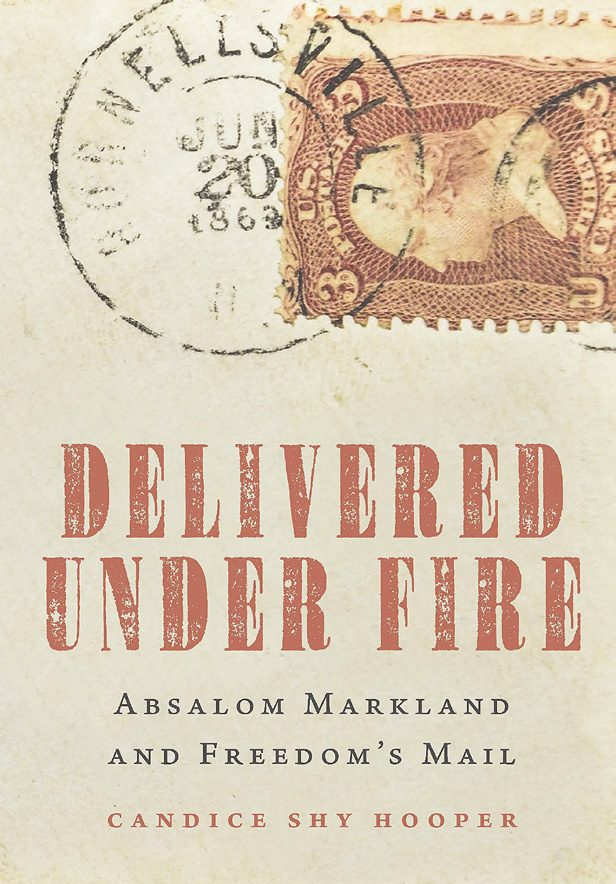
Delivered Under Fire: Absalom Markland and Freedom’s Mail. By Candice Shy Hooper. Illustrated, Notes, Bibliography, Index, University of Nebraska Press, www.nebraskapress.unl.edu, 2023, 317 pp., hardcover, $36.95.
Reviewed by Wayne L. Wolf
Candace Shy Hooper penned a thoroughly researched biography of Absalom Hanks Markland, the boyhood friend of Ulysses S. Grant, who became an unsung Civil War hero. While bearing the honorary title of Colonel, bestowed by Gen. Grant, he used his position as postal agent to keep the mails flowing during the Civil War to the endless thanks of the soldier in the field.
His early life as a schoolteacher, lawyer, steamboat man, newspaper reporter, clerk, and political activist illustrated not only his diverse interests but paled in comparison to the job that would define his life, Grant’s mailman. During the Civil War, he was with General Grant from Fort Henry to City Point and with General Sherman in Savannah and on his march through the Carolinas. During those four years he created the most efficient military mail system ever devised. His efforts kept soldiers and their families connected, passed important messages to generals, took confidential messages from President Lincoln to his commanders, and provided safety for funds shipped home to destitute loved ones. In addition to these functions, he supervised the creation of home mail delivery in 1863, the creation of the Postal Money Order system, and the use of railroads, ships, carriages, and even wagons to see the mail delivered to the troops. By November 1862 he was handling upwards of 180,000 soldier’s letters a day.
Yet, his influence was felt beyond his success with the mails. He helped Horace Greeley disseminate newspapers to all soldiers in the field supporting Lincoln’s reelection campaign. He assisted President Grant in obtaining the executive powers needed to combat the KKK during Reconstruction. He acted as an advocate for those seeking pensions after the war and for freed slaves seeking Civil Rights. He corresponded with numerous military leaders after the war to correct errors that appeared in newspapers, articles, and books. He defended his friend General Grant in his royalty battle with Adam Badeau, and while deaf at the end of his life, used his pen to set the war record straight. He was one of the few civilians with an insider’s view of the military during the war.
This book is well researched, historically sound, and very readable. It is a welcome addition to an area of the Civil War usually relegated to a footnote in military biographies. It should be a welcome addition to every historian’s bookshelf and is highly recommended.
Dr. Wayne L. Wolf is Professor Emeritus at South Suburban Collee and the author of numerous Civil War books and articles including Two Years Before the Paddlewheel, Heroes and Rogues of the Civil War, and The Last Confederate Scout, He is a frequent lecturer at Civil War roundtables and researches the lives of the common soldier for publications.
Fascinating and Exciting Regimental History
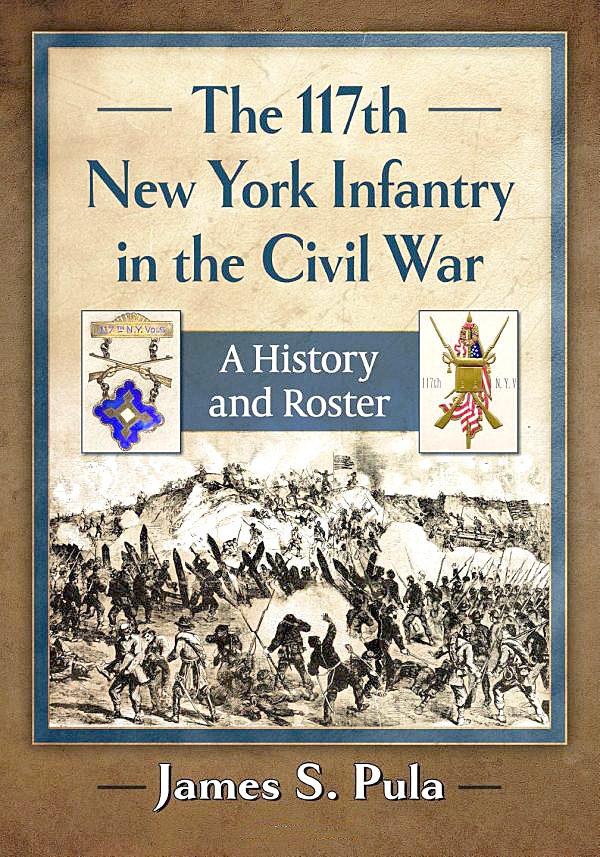
The 117th New York Infantry in the Civil War: A History and Roster. By James S. Pula. Photos, maps, notes, indices, bibliography, index. 336 pp., 2023. McFarland & Company, Inc. www.mcfarlandpub.com. Paperback. $49.95.
Reviewed by Robert L. Durham
With the exception of the Petersburg Siege, the 117th New York did not take part in any major campaigns or battles. This is fortunate, for the 117th took part in many little-known actions, and the details James S. Pula discovered and reveals on these battles is outstanding. Pula’s bibliography is large, especially in primary sources. He has found an amazing number of first-person accounts in diaries and letters.
The 117th New York, also called the 4th Oneida because
Promoters of Quality Shows for Shooters, Collectors, Civil War and Militaria Enthusiasts Middle TN (Franklin) Middle TN (Franklin) Civil War Show Civil War Show
December 2 & 3, 2023
they were the fourth regiment raised in Oneida, served first in the forts surrounding Washington, DC. There, they heard the guns at the Battle of Second Bull Run and saw the defeated Union regiments returning to the capital. Fearing they were missing out on the war, they served in the Washington defenses for eight months, before finally being ordered to Virginia. Instead of taking part in the Gettysburg Campaign though, they spent the end of June and beginning of July 1863 making a demonstration against Richmond to keep troops occupied there so they could not join General Robert E. Lee’s Army of Northern Virginia in their Northern invasion..
Next, the 117th Infantry sailed to Morris Island, SC, where they took part in unsuccessful Federal attempts to capture Charleston. In April 1864, they boarded ship again, returning to Virginia in time to take part in General Ulysses S. Grant’s Overland Campaign. Assigned to General Benjamin Butler’s Army of the James, they took part in the Bermuda Campaign. From June to September 1864, the 117th took part in the dreadful trench warfare of the Siege of Petersburg. There, they experienced the enervating, continuous boredom and danger, never able to relax, each man not knowing when he might be picked off by a Rebel sharpshooter. September 29, 1864, they assaulted Confederate fortifications at Chaffin’s Farm, followed by an attack on Fort Gilmer.
December 1864 found the 4th Oneida aboard ship to take part in the assault on Fort Fisher, NC. The capture of Fort Fisher would mean the fall of Wilmington, NC. As the last port on the East Coast open to blockade runners, it was a major source of supply for Lee’s army. Grant needed the port closed. The First Battle of Fort Fisher, in December 1864, resulted in a failure. The outcome of the Second Battle of Fort Fisher, in January 1865, was a hard-fought, bloody success. The battle, although little known and written about, was one of the most violent of the Civil War, ending in a tough hand-to-hand contest. Pula’s description of the Union assault is masterful. His telling, with the incorporation of eyewitness accounts of participants on both sides, cannot be excelled.
I highly recommend The 117th New York Infantry, one of my favorite regimental histories, and I have read many. The regiment experienced aspects of the Civil War not usually studied, and James S. Pula delivers a virtuoso telling of those littleknown campaigns and battles. In his writing, Pula seamlessly incorporated eye-witness descriptions into his narrative.
Robert L. Durham is retired from the Defense Logistics Agency and is a freelance writer who has had many articles published in numerous historical publications. A life-long history buff, he recently went back to college for a history degree.
July 2023
July 22: The Civil War Battle of Atlanta, by Earl J. Hess, University Press of Kansas, kansaspress.ku.edu, 2023. Hardcover, $44.95.
Reviewed by Stephen Davis
“One of the most remarkable flank movements attempted by any army during the Civil War.”
“Hood’s greatest effort to stop Sherman.”
“Some of the most dogged and costly combat of the entire war.”
“One of the most interesting battles in American history.”
In this new work, Earl Hess is full of superlatives for the bloody battle fought east of Atlanta by the forces of Hood and Sherman on July 22, 1864. After that, he delivers a first-rate tactical history of one of the three big engagements of July 20-28, when Hood tried unsuccessfully to drive the Yankees away. The other two battles, Peachtree Creek and Ezra Church, bear distinctive names. For this one, first termed “Atlanta” by Grenville Dodge, I rather like Albert Castel’s suggestion of “the battle of Bald Hill,” although the name has yet to stick.
Students of the Atlanta Campaign will want to know how Hess’ book compares to Gary Ecelbarger’s The Day Dixie Died: The Battle of Atlanta (2010). Actually, the real question is why the prolific Dr. Hess should write
another similar book so soon after the last one. He declares his as more thoroughly researched, “tracking down every bit of information.” If that’s true, I can’t imagine the need for any other book on this fight.
After his failed attack at Peachtree Creek July 20, Hood saw another opportunity when Maj. Gen. James B. McPherson’s Army of the Tennessee approached Atlanta from the east without cavalry guarding his left. Hardee’s Corps marched all night to launch a flank attack early on the 22nd. The Confederates struck around noon, but by then a worried McPherson had taken steps to protect his line. The Southerners, surprised to find enemy infantry positioned and ready, nevertheless made initial gains, capturing guns, prisoners, and killing General McPherson himself. Despite repeated Confederate assaults, and a secondary attack by Frank Cheatham’s Corps about 3 p.m., the Army of the Tennessee held onto its key position, a “bald hill” at the south end of the Federal line. When the Bald Hill came under attack from different directions, Federals had to jump from one side to the other over their parapet; they came to call it “Hardee’s Tactics.”
The Southerners withdrew by dark, and Hood lost another big battle. Casualties were 3,722 U.S. (15% of 25,000 engaged); Confederates lost 5,549 (18% of 30,000). Interestingly, though Hess occasionally disagrees with Ecelbarger on some details, he repeatedly cites his calculation of casualties.
With the narrative set, one looks for an author’s particular flavorings. Hood “had been promoted well above his competence level” (the famous Peter Principle). Sherman brought on the battle, and indirectly caused the death of his friend Mac, because he “was too obsessed with wrecking railroads”; sending Kenner Garrard off railroad-raiding exposed McPherson’s left flank and invited the Rebel attack. Hood’s battle plan, calling for Hardee’s all-night march, was unrealistic.
Despite Hess’ enormous research, there are instances when he frankly confesses “we know very little of their movements.” At the same time, he misses some sources. One of them is the letter of Lt. Robert M. Gill, 41st Mississippi, that Bell Wiley edited for CWTI back in April 1964. Gill wrote his wife that “I never enjoyed a thing better in my life. We had the pleasure of shooting at Yankees as they ran without being shot at much.” Gill was part of the Confederate assault that broke the Yankee line at the Troup Hurt house.
Hess includes lots of colorful vignettes, such as the fistfight between Union generals Sweeny and Dodge, though he left out some colorful dialogue, as when Sweeny called his superior officer an “inefficient son of a bitch.” In the cavalry fight at Decatur, he misses the writing of Mary Gay, who was an eyewitness.
Hal Jesperson’s lucid maps, conveniently set within the text, once again add much value. A not-to-be-overlooked treat is that Dr. Hess routinely writes the captions for his complementary illustrations, which are wellplaced alongside the narrative. The effect is to further strengthen this fine battle-book from the University Press of Kansas.
The author concludes with a chapter on the battle’s commemoration in the Cyclorama, the big painting produced by German artists in Milwaukee in 1886. Ironically, Hess considers the “new” Cyclorama at the Atlanta History Center, with its downplaying of the battle’s historical narrative, as part of current “efforts to take down or remove Lost Cause symbols.” But as many of us say, you take down the symbols, you erase the history.
We’ve still got books, though. And Earl Hess is writing a lot of good ones.
With ten Civil War books to his credit, Stephen Davis of Cumming, Ga., is trying to catch up with the prolific Dr. Hess. But he probably won’t.
After Steve bought Hess’ biography of Braxton Bragg (2016), his cat urinated on the book—justifying, he supposes, Hess’ claim that Bragg was “the most hated man in the Confederacy.”
Lionel Jobert and the American Civil War: An Atlantic Identity in the Making. By Stephen D. Bosworth. Illustrated, bibliography, index, notes, 189 pp., State University of New York Press, 2021, hardcover.
Steven Bosworth has penned a definitive biography of Lionel Jobert d. Epineuil, Colonel of the 53rd New York Volunteer Regiment. Born in France, his life began on the sea, rising to the rank of a ship captain au long cours for the French Merchant Marine. From there to leading a Naval School in Haiti, he arrived in New York with his mistress, Mrs. Lloyd. Always looking to achieve a position where he could live the life of a gentleman, engage in leisure, and be admired for his legacy as a count, he sought out a position that would cement his position in society.
Thus, at the outset of the Civil War, he managed to get appointed as Colonel of the 53rd New York Volunteer Regiment, recruited French officers and all nationalities of privates, and outfitted them as d’Epineuil’s Zouaves.
After training on Long Island, his regiment, already plagued by desertions, infighting, and resentment at all French officers, left aboard the barge John Tucks. This boat was a filthy, crowded, vermin infested ship that was to transport the regiment to assist General Burnside in his seizure of Roanoke Island. However, the
Want to Advertise in Civil War News?
John Tucks could not cross the sand bar to Cape Hatteras into Pamlico Sound and was ordered to return to Fort Monroe. Here General John Wool ordered the ship to Annapolis. After spending a month at Fort Madison drilling and parading, an inspection report found the 53rd disorganized, demoralized, and incompetently managed. This sealed the doom of Jobert’s regiment. General George McClellanordered the regiment disbanded on March 1, 1862, ending Jobert’s quest for fame.
Jobert tried unsuccessfully for the next two years to be appointed to a different military command. Failing in this, he took a job in the Treasury Department but shortly after headed to Philadelphia to establish himself as a patent solicitor. After five years and in debt, a condition that characterized him most of his life, he left for England, never to return.
Here he used his theatrical talents to try and cement his image as a cultured gentleman, married the daughter of a prominent family, and tried to live the life he always dreamed of-as a bon vivant, man-about-town. He died suddenly in 1881 never achieving the fame or position his ambition desperately craved.
Stephen Bosworth does a commendable, deeply researched job compiling this biography of Jobert. For Civil War historians, the service of the 53rd New York Volunteer Regiment comprised ninety days of doing nothing to prosecute the war. For those who desire to read about a failed regiment, characterized by internal dissension, desertion, jealousy, and idleness, this is a book to read. For general readers of history, it encompasses a small, select audience.
Dr. Wayne L. Wolf is Professor Emeritus at South Suburban College and the author of numerous Civil War books and articles including Two Years Before the Paddlewheel, The Last Civil War Scout and Soldiers, Sailors and Scoundrels of the Civil War. He is past president of the Lincoln-Davis Civil War Roundtable.
Mary Lincoln Demystified: Frequently Asked Questions about Abraham’s Wife. Donna D. McCreary. 366 pp., 2022. Southern Illinois University Press, $26.95 (Paper) Reviewed by Sal Cilella
In 1972, physician and surgeon with a specialty in psychiatry, Doctor David Reuben published his ground breaking and eyeopening book entitled Everything You Always Wanted to Know About Sex: But Were Afraid to Ask. It has been followed by imitators with titles such as Everything You Always Wanted To Know About Acting (But Were Afraid To Ask, Dear) [2013]; Everything You Always Wanted to Know about God (But Were Afraid to Ask): The Jesus Edition (2009); and Everything You Always Wanted to Know About Birds …But Were Afraid to Ask (2005). You get the idea.
Now comes Donna McCreary Mary Lincoln with her Demystified: Frequently Asked Questions about Abraham’s Wife. It’s a mind-boggling potpourri of important facts and trivia from a woman who has portrayed Mary Lincoln as an interpreter for twenty years. She is an author, lecturer, and performer and this book is a culmination her myriad experiences and talents. Her many enthusiastic audiences prompted her to put pen to paper and lay out in pristine detail everything she could discover about the wife of the 16th president.
McCreary’s knowledge of Mary Lincoln is encyclopedic and deep. The question of Mary’s sanity is covered extensively, encompassing an entire chapter. As sad as her night of horror April 14, 1865 was, the ordeal with her perceived mental issues was equally tragic. She couldn’t understand why her surviving son Robert would label her a lunatic and have her committed to an institution. Was she insane? McCreary comes down on the side of “perhaps” and “perhaps not.” Critics and authors have speculated that Mary suffered from everything from PTSD to syphilis. (138)
Nothing is left untouched, Mary’s attitudes toward African Americans and slavery are dealt with as are her relationships with her family, what became of the Lincoln family afterward; her love interests before Abraham; her extravagance; her temperament; and her personality. The first five chapters are biographical with chapter five dealing exclusively with the assassination. McCreary fields such questions as who took Mary to the Peterson House; where were Tad and Robert at the time of the assassination; and eventually what Secretary of War Stanton really said. She maintains that whatever he said “Now he belongs to the Ages” or “Now he belongs to the angels,” Stanton’s comment “demonstrates the great admiration and respect that Stanton felt for Lincoln.” (106) The author presents a wellbalanced view of Mary Lincoln, her foibles, her moods, her joys and her sorrows. Mary wrote of that night and McCreary points out that although the evening was a political and historical earthquake, “For Mary, it was about the changes in her family, the destruction of her life. She lost her comforter, her lover, her husband, her all.” (110)
One of the “burning questions” often asked by Lincoln scholars and Civil War trivia masters is: Did Lincoln really say that “One ‘d’ was good enough for God, but not for the Todds?” It doesn’t appear that McCreary chose to wade into this historical debate. Perhaps she was comfortable with Stephen Berry’s extensive research revealed in the quote in his House of Abraham: Lincoln and the Todds, a Family Divided by War. Berry maintains that the original line probably came from governor David Tod of Ohio and Lincoln appropriated it and used it when the occasion presented itself. According to Berry, “the gag has existed for as long as there have been Todds and Tods.” (197).
This is not a book for that big lounge chair in your study as a winter fire warms you as you curl up with it and that glass of brandy. But it is one you need to have at the ready to answer all the questions you always wondered about Mary Lincoln, the Todds, and the Lincolns. Admirably, when McCreary doesn’t know the answer, she doesn’t guess but offers the pros and cons of the issue. She has constructed the work so that the reader can dip into the text at any point. It’s probably the best and only accessible resource on Mary Lincoln.
After 43 years in the museum field, Cilella devotes his time collecting American prints and maps and writing. His most recent books are Upton’s Regulars: A History of the 121st New York Volunteers in the Civil War (U. Press Kansas, 2009). His two-volume Correspondence of Major General Emory Upton, (U. of Tennessee Press, 2017), received the 2017–2018 American Civil War Museum’s Founders Award for outstanding editing of primary source materials. Upton’s love letters 1868-70, (Till Death Do Us Part) was published in 2020 by the Oklahoma University Press. His current book, the memoirs of Dewitt Clinton Beckwith of Upton’s Regulars (McFarland Press) was published May 2023.
Slavery, Freedom, and
Reform in the Midst of War
Navigating Liberty: Black Refugees and Antislavery Reformers in the Civil War South. By John Cimprich. 1 halftone, 2 maps, notes, index, 248 pp., Louisiana State University Press, www.lsupress.org, $45.00.
Throughout the Civil War’s four years, slaves across the South who escaped into Unionheld territory invariably began the slow process of learning what freedom really meant. In particular, they had to understand how to integrate themselves into a white-dominated, military-led society that often seemed to care little for their social or physical welfare. Yet at the same time, hundreds of northern antislavery reformers, both white and free blacks—trekked southward to assist these destitute and illiterate refugees in making that muddy transition from slavery to freedom. Those activists often consisted of unmarried yet
“I Thank
Eliza Frances Andrews (1840–1931) received a strong education and was
the Lord I
a successful writer and educator. Her War-Time Journal of a Georgia Girl
Am Not a
surely ranks among the most observant
Yankee...”
and intelligent wartime memoirs by a Edited with commentary by Stephen Davis, I Thank the Lord I Am Not a Yankeeincludes selections of her wartime and postwar journals which are most expressive of her Confederate
patriotism and Southern pride.
Stephen Davisis author of ten books on the Civil War, most of which treat the Atlanta Campaign. His two recent volumes
on Confederate General John Bell Hood have won several prizes, including the Fletcher Pratt Award of the New York CWRT.
educated women who, as the author points out, considered this type of moral work as a more fulfilling calling than staying home and performing domestic work for kinfolk. Regardless of the reformer’s gender, the work was often hard, dirty, and occurred from dawn to well past dusk. One woman wrote of delivering food to the needy by “trudging through the mud as no other white woman of my status would do.” Nonetheless, the assistance they offered and its eventual acceptance became a give and take process that was far more complex and quarrelsome than readers may have previously thought.
The Christian values, homefront practices, and racial stereotypes the reformers brought with them generated some initial internal discord over strategy. Paternalists argued that the reformers needed to maintain tight guidance and control over blacks due to the latter’s degraded condition. Laissez-fare proponents argued for offering self-help and choices to the escaped though with minimal intervention from whites. A third group, the egalitarians, advocated for immediate equal rights for blacks. Northern free African- Americans certainly fell into this last camp though very few whites did initially.
The three differing perspectives certainly clashed with the needs and desires of their black audience. As slaves, black men and women were forced to adopt a cautious and wary attitude in their dealings with whites. Now as freed people, they often resented the reformers’ authoritarian
attitudes or racial preconceptions. The result was that on occasion freed people chose to reject any educational or vocational aid offerings, instead seeking greater autonomy over their movements and actions. The famous African- American missionary, Sojourner Truth, for example, on occasion considered her fellow blacks to be disgracefully dependent on white charity. The fact that a war was still raging generated opportunity and change yet often resulted in stubborn challenges and imperfect results.
Cimprich sets his work within the war’s 1861-65 timeframe while geographically, it primarily focuses on federally occupied territory within the Confederacy where slavery was still present. He points out that in the war’s early years of 1861-62, relatively few blacks sought freedom within the four loyal slave-holding Border States, as most federal garrisons there refused to welcome them. Those who escaped into federal lines elsewhere, along with the reformers on hand to assist them, faced immediate challenges regarding how best to provide necessities such as food, clothing, housing, and medical care. As the war wore on, the reformers continuously sought to instill their values and beliefs into the freedmen, many of which they believed would require significant elements of paternalistic supervision. For their part, blacks accepted those ideas they found meaningful though they also clung tenaciously to customs, thinking, and traditions found within their own culture. Clashes between the two groups sometimes resulted.
In this engrossing study, the author skillfully analyzes the sometimes rocky relationship between northern reformers and the enslaved people of the South who escaped to freedom. In modern jargon, the two groups often appeared to be “frenemies,” each relying upon yet pushing the other for their own desired ends. Cimprich’s thorough work adds a fresh analysis to black selfemancipation, slavery’s end, and the long journey to racial equality within the United States.
Paul Taylor is an award-winning author of eight books pertaining to the Civil War era. His current manuscript is titled “Tis Not Our War:” Avoiding Military Service in the Civil War North and is currently under publisher review.
A Nation So Conceived – Abraham Lincoln and the Paradox of Democratic Sovereignty, by Michael P. Zuckert. 2023, University Press of Kansa, Lawrence KS. 397 pp. $34.95.
Reviewed by Charles H. Bogart
This is truly a book for today. The political players of today have different names from those in this book, but the underlying story told is of events that took place over 150 years ago which still resonate within the United States. It is interesting that with all the books printed over the years on Lincoln, the politician, that there is still more to learn about this man. The author points out that throughout his political career, Lincoln feared that “this government by the people and for the people” might perish from this earth.
Throughout Lincoln’s adult life, the United States stumbled from one political crisis to another. Each of these crises, when stripped down to their basic fundamental cause, revolved around the question of slavery. It was the topic of slavery and its impact upon the United States that shaped Lincoln. In telling the story of Lincoln’s political growth, the author looks at the intellectual development of the man from 1845 through 1865, by chronologically examining speeches Lincoln gave during this time period. It is a shame that no recording exists of these speeches for, while the printed words resonate when read, it would be interesting to understand how Lincoln verbally delivered his speeches. The words of Franklin D. Roosevelt calling for war against Japan are stirring when read, as is Martin Luther King’s speech “I Have a Dream,” but they are both so much more powerful when heard spoken.
The book opens with an examination of the words and phrases contained in Lincoln’s 1838 speech to the Springfield Young Men’s Lyceum “On the Perpetuation of Our Political Institutions.” This is followed by a discussion of Lincoln’s 1842 address to the Washingtonian Temperance Society in which he said he hoped that one day, “there shall be neither a slave nor a drunkard on the earth.” Next, the author examines Congressman Lincoln’s reactions to the War with Mexico. Here, Lincoln’s beliefs in Manifest Destiny collide with the specter of the spread of slavery. I remember in my college history class being told that Texas had the option of dividing itself into five states. No one mentioned that this ability was a subterfuge to increase the number of slave states if necessary. Lincoln would close out his one-year term in Congress by offering a bill to end slavery in Washington, D.C.
The author now moves on to reflect upon two eulogies offered by Lincoln. The first in 1850 for President Zachary Taylor and the second in 1852 for Senator Henry Clay. Both show the thought process of Lincoln as he reflects on the lives of these men in relationship to the citizens of the United States. The reflections are followed by a dissection of Lincoln’s 1854 “Faith of Our Fathers” address given at Peoria, Ill. This address was a rebuttal of Stephen Douglas’ speech in defense of the Nebraska Act. Lincoln saw the Nebraska Act as an overturning of a fundamental national understanding concerning control over the spread of slavery.
The year 1857 is seen by the author as a pivotal year in Lincoln’s political development. That is the year the Dred Scott Decision was rendered by the U.S. Supreme Court, which undid the national understandings that had allowed the “House Divided” to survive by drawing a line between where slavery was allowed and not allowed. Next, the author moves to the Lincoln- Douglas Debates concerning slavery under the concept of popular sovereignty as expressed in the Kansas-Nebraska Act. I found one of the author’s comments concerning these debates very interesting. Lincoln, in his debate speeches, “mapped out a path toward all-slave, but is remarkably quiet about a path to all-free.”
Next, the author critiques Lincoln’s July 4, 1861, response to the Confederacy’s belief that secession was allowed under the Constitution. Lincoln’s thought process in issuing his rebuttal is a crash course in United States history that reads, once you joined the Union you are thereafter for good or bad a part of it. This section is followed by three excellent essays that delve into 1) The suppression of Habeas Corpus; 2) The Emancipation Proclamation; and 3) The Gettysburg Address. These essays are thoughtful looks at what Lincoln saw as the bedrock upon which the relationship between those governed and those elected to govern was built.
Finally, the author scrutinizes Lincoln’s Second Inaugural Address. I am not sure that all readers will agree 100 percent with the author’s assertions concerning Lincoln’s thought process in laying out this speech. However, the author rightly points out that this speech is a pivotal point in plotting the direction the United States would from that day onward follow.
The reviewer, after reading this book, believes that too much emphasis can never be placed on Lincoln’s House Divided speech. As one reads over Lincoln’s speeches, one is struck with how often he expresses a fear about the spread of slavery, not only as it existed, but in its potential to encompass a larger and larger community of human beings. Just
what did “all men created equal” mean if one man could enslave another man?
This book is a hard read. I found myself reading a chapter and then putting the book down to contemplate what I had just read, not only within the time period Lincoln uttered his speech, but its applications to today’s society. Much of today’s political and social rhetoric centers around human equality as it did in Lincoln’s lifetime. I believe one of the most telling comments the author makes is that more than 150 years after Lincoln gave his campaign and Presidential inaugural addresses, they are still read and studied, unlike the campaign speeches and inaugural addresses of the Presidents who have followed him.
Charles H. Bogart has a BA from Thomas More University and an MCP from Ohio State University. He is employed as a tour guide at the Fort Boone Civil War Battle Site in Frankfort, Ky., serves as President of the Frankfort Civil War Roundtable, and is a board member of the Kentucky Civil War Roundtable. He has written several books and articles on military and naval history.
The Artilleryman is a quarterly magazine for collectors, competition shooters and those interested in ordnance from the Revolutionary War to World War II, primarily focusing on cannon, implements, projectiles and related artifacts from the American Civil War.
This full color magazine features articles on cannon safety, artillery history, projectiles, fuses, places to visit, book reviews, competition events, and so much more. The annual quarterly subscription price is just $37.95.