Reviewed by Salvatore Cilella
It undoubtedly all started with Jubal Early and his founding of the “Lost Cause” myth, then was moved along seamlessly by the Daughters of the Confederacy, and probably culminated in the Civil War Centennial “Celebration”/ “Commemoration” in 1961– 1965. I write of the notion of two, principled, monolithic armies, “Billy Yank” and “Johnny Reb” (ably aided by Bell Irvin Wiley) facing off against each other in solidarity as brothers in arms. The Centennial only fueled the monolithic myth.
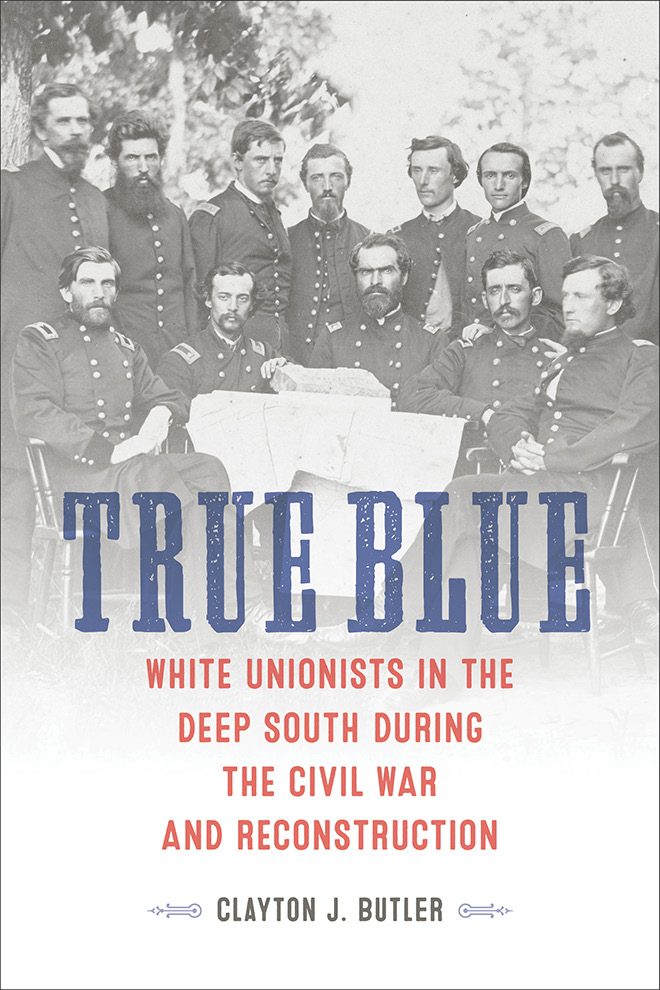
Thankfully, recent Civil War scholarship has persuasively pushed back against the grain and offered solid and nuanced insights into the realities of the conflict, both north and south. In his new book, True Blue: White Unionists in the Deep South During the Civil War and Reconstruction, Clayton J. Butler has admirably exposed the myth of Confederate solidarity. As the title indicates, Butler follows the Confederate Tories well into Reconstruction. The difference is that much more has been written about Unionism in the border states and the upper south. Butler takes on Unionism in the deep South. He devotes one chapter apiece to monitor the First Louisiana Cavalry, The First Alabama Cavalry, Bradford’s Battalion and the Massacre at Fort Pillow (1864), and one each to Presidential reconstruction during 1865-67 and Congressional Reconstruction from 1867–1877. In a tightly constructed argument and narrative, Butler lays bare how members of each “Tory” regiment fared during the war and their fates after the war. Although Confederate Tories were a minority, the story of those in the deep South has never been told or appreciated as well.
The First Louisiana Cavalry was formed in 1861, primarily of foreign born or northern born New Orleans immigrants. They were rejected as traitors to the Confederate government primarily because of their non-American origins. Nearly 50% were foreign born, Cuba, Mexico, Spain, Portugal, Germany, France, and several other European countries were represented in the regiment. (p. 42). Until the arrival of Benjamin Butler’s command, the regiment was hunted by Confederates spurred on by the government’s conscription act of 1862. To the men of the 1st Louisiana, staying with the Union made more sense than the alternative. They viewed the new government as illegitimate and in conflict with the constitution and Union.
The 1st Alabama however, was made up of white, native-born Alabamians who formed the unit during late 1862. In this case Confederate forces no longer had the rationale they were fighting against foreign born fighters but “neighbors.” Confederate General Samuel Ferguson attacked the regiment under Colonel George Spencer and later remarked how strange it was: “In the very center of the Confederacy” were “men wearing the enemy’s uniform, killed—as some were—within a half mile of their own houses.” (67).
Although they were roundly beaten, the First Alabama Cavalry suffered much less than Major William Bradford’s 13th Tennessee Cavalry or “Bradford’s Battalion” at Fort Pillow. Although the narrative of the Massacre at the fort has focused correctly on the slaughter of U.S. Colored Troops, 277 of the 585 white Unionists were killed and 202 taken prisoner. (104) As the author points out, it is not his intention to minimize the losses of the USCT, but to balance the historical record. He attributes Nathan Bedford Forrest’s vicious assault on both troops to “perceived race betrayal.” (105)
What’s most remarkable in Butler’s last two chapters is his documentation of the complete reversal of white Unionists during Presidential Reconstruction and its follow-on, Congressional Reconstruction. Always in the minority, the “tory” regiments reveled in the Union victory, but quickly succumbed to the “lost cause” onslaught, joining their defeated Confederate neighbors to win the peace for the South. From the start, white Unionists were first and foremost, for the Union, but racial animosity trumped loyalty as emancipation was not part of the original bargain. In the new president, Andrew Johnson, a white loyalist from Tennessee, they saw a chance to return to the old days, the status quo, antebellum; the feeling was mutual. The Lincoln administration, and later Johnson’s, viewed Southern Unionists as foundational to eventual reconciliation and reconstruction. It was not to be.
First Louisiana Cavalry founder James Madison Wells was a prime example of southern Unionism’s tortured history. Wells owned 95 slaves and saw secession as a slippery slope to emancipation. After the war, President Johnson installed him as Louisiana’s reconstruction governor. He survived 2 turbulent years until the Military Governor of the Gulf District, Philip Sheridan, removed him for incompetence in 1867. (141)
Locally, the social, economic, racial, and political realities pushed Unionists back into the “redemption” fold. As Butler so eloquently points out, “faced with a choice between freedmen and former rebels,” they “could either ally themselves to the revanchist regime, leave their homes, or resign themselves to silence and political impotence.” (129). Most capitulated to the reality on the ground.
This powerful book is a much-needed balance to our understanding of the nuances and intricacies of both regions of the country between 1861 and 1877. Butler has combined meticulous research, clear expository writing, and authoritative documentation to present a lucid explanation of a period in American History that demands more understanding.
Port Hudson The Most Significant Battlefield Photographs of the Civil War by Lawrence Lee Hewitt. Photos, figures, notes, index, bibliography, 180 pp. University of Tennessee Press, Knoxville, utpress.org, 2021. ISBN 978-1- 6219-0483-0. Hardcover, $49.95. Reviewed by Lawrence E. Babits
Hewitt began his research into both Port Hudson and the photographic record of a Civil War siege in 1978. His research was initially conducted in his role as Port Hudson State Historic Site’s manager and then it became his doctoral dissertation topic. The book took a long time because he was initially serving two masters, the state site and his dissertation. After finishing the academic work, he continued researching Port Hudson and, more importantly, began looking seriously at its photographic record. Although they were related, the job did not always coincide with the research; over thirty years meant that there was time for reflection and other images to surface, often in sizeable number from previously unknown collections.
The research effort can be seen in the bibliography ranging from regimental histories and
Salvatore Cilella is the retired CEO of the Atlanta History Center. He is the author of Upton’s Regulars, (Univ. of Kansas Press, 2009). He has edited The Selected Correspondence of General Emory Upton, 2 Volumes. (Univ. of Tennessee Press, 2017). A recipient of the 2019 Founder’s Award, American Civil War Museum. He has edited “Till Death do us Part,” the love letters of Emory and Emily Upton documenting their brief and tragic two-year marriage (University of Oklahoma Press, 2020) and the Memoirs of Dewitt Clinton Beckwith, of Upton’s Regulars, (McFarland Publications) due out Spring 2023.
the Official Records, through national archives holdings of the Corps of Engineers, census data, and photographic history. “Photography theory” relates to how a photograph is evaluated. There are several aspects to this interpretive approach including how the photograph was physically produced and artist’s portrayal of the subject in terms of what he wanted to convey. Another aspect is the subject matter, time of photo, location, and direction of the camera view. Anyone familiar with Frassanito’s work has seen how well the approach can work. Hewitt provided an outstanding observation on using material culture, including photography, to help tell history what happened when he pointed out that “Photographs taken at the time and artifacts recovered from the battlefield proved more accurate sources about the struggle there than eyewitness accounts and walking the ground.” His research into camera angles, times (both calendrical and daily hours), and the landscape clarified a great deal about what happened at Port Hudson. This is especially important because post-siege alterations and changes wrought by the Mississippi River left a very different environment to the future.
The 173 photographs are presented in chronological according to work periods of the men who created this record of a Civil War siege longer than the one conducted at Vicksburg, just up the Mississippi River. Hewitt organized six chapters around the work of three teams, McPherson and Oliver (June 14-July 9,1863), McPherson and Chronicle
January 2023
(July 9-18, 1863), Brooks and Blauvelt (Jan.-April 1864; and three individuals, Smillie (1864- 1865), Fossett (1864-1865), and Ward (circa 1900). Only McPherson and Oliver worked during the siege itself and the team is credited with taking the only photo of a Confederate surrender. The individual photos are explained, related to siege events, and to each other as part of a chapter’s discussion of its photographers.
The issue of who owns an image was also covered. Hewitt pointed out that several institutions hold photos of great importance to Port Hudson’s history. Some wanted to be paid for using images they own but the cost was too great to include them, especially when fine print seems to reveal compensation for each reproduction or reprinting in a text. While institutions may own the photograph, they most emphatically do not own the history it recorded. That belongs to the people, both past and present, and by denying its exploration, the institutions are showing something of an elitist view.
One distraction was noted. With all the cannon photographed, and potential information that might be derived from them, it was puzzling that Hewitt constantly referred to cannon by the term “pound.” He cannot have thought these massive metal objects weighed 12 or 32 pounds; the proper term is pounder. That said, the large number of artillery pieces shown in the photos allows additional research into individual guns as historical topics themselves. [see Artilleryman vol 42(2):48-60, (Spring 2022) and vol 41(4):4- 17, (Fall 2020)]
This book might be seen by some old line historians as simply a coffee table book. Nothing could be farther from the truth. It is a serious historical study that sheds new light on the siege and provides a new starting point for looking at how the photographic record can be utilized for many disparate research projects. It can serve as a reference point for anyone studying the Mississippi River operations before, during, and after 1863. It serves as a western theater version of Frassanito’s groundbreaking Gettysburg study.
This is recommended highly.
Larry Babits earned degrees at Maryland and Brown leading to a career teaching archaeology and military history at Washington and Lee, Armstrong State, and East Carolina.
Robert C. Conner, the author of General Gordon Granger: The Savior of Chickamauga and the Man Behind Juneteenth, is a former journalist, and it shows. His experience crafting pieces for the New York Associated Press gives him the expertise to offer readers the biography of a complicated man. General Gordon Granger is one of the “B List” Union generals who make the history of the Civil War such a compelling field of study. However, some, including Ulysses S. Grant, might have considered him “C List” at best. Granger had a difficult personality.
A West Point graduate and career army officer, his first experiences in combat came during the Mexican-American War. His regular rise through the ranks came despite his reputation as a rude, profane, and irritable officer. Granger’s fame, despite his issues, came at the Battle of Chickamauga. On September 30, 1863, his Reserve Corps saved the U.S. Army of the Cumberland from nearly certain destruction. Without orders, General Granger sent two brigades forward to help Major General George H. Thomas on Snodgrass Hill, where
Publishers/Authors Send your book(s) for review to:
Charleston, SC 29412
the C.S.A. Army of Tennessee was gaining control. Asked by Thomas if he could counterattack a Confederate force on the Union flank, Granger replied, “My men are fresh and they are just the fellows for that work. They are raw troops and don’t know any better than to charge up there.” (98) Granger’s action brought fresh ammunition and ready fighters, throwing them into Longstreet’s troops. He kept the attack going until dark, allowing the exhausted Federals to retreat in good order.
As glorious as his military career had been to this point, his odd behavior and irascible, sometimes threatening temperament finally ended his promotions. Both Grant and Sherman had become annoyed with him early on for such “dereliction of duty” as finding a battery that looked as if it needed some help and staying there to site guns, etc. Granger’s decision to go to Thomas’s aid did not make up for the fact that he had defied orders. It had happened too often, and General Granger was sent to join Admiral Farragut. Granger led the XIII Corps’ land operations against the Confederate forts in Mobile, Alabama.
When the war ended, Granger was given command of the District of Texas. On June 19, 1865, in the city of Galveston, General Granger read his own General Order No. 3 to the people of Texas. He informed them that, in accordance with a Proclamation from the President of the United States, all slaves were free. This was news to Texas, and the now-free people held joyous demonstrations. These celebrations were the origin of Juneteenth, commemorating the abolition of slavery in the former Confederate state of Texas. The chapter “Juneteenth” (174-189) is one of the most compelling in the entire book. For anyone who is not clear on the concept of the holiday, Conner explains the circumstances surrounding the proclamation and the public reaction to it, both in Texas and the rest of the United States.
Author Robert C. Conner expertly weaves together the various personality traits that made General Gordon Granger such a perplexing man. Sometimes he was a brilliant general, but sometimes he flew off the handle at minor infractions and threatened maximum punishments, rescinding them the following day. He was outspoken, blunt, and critical of the mistakes of others. It seems as if Granger had two sides to his personality. He courted Louise Garland, who later married James “Pete” Longstreet, and Ellen Marcy, who became the wife of George McClellan. It was a love match when he finally married Maria Letcher in 1869.
As Civil War history continues to evolve, fascinating books like General Gordon Granger: The Savior of Chickamauga and the Man Behind “Juneteenth” will help readers understand that all-important
“B-List” of commanders, soldiers, spies, politicians, and civilians who made the midnineteenth century so absorbing and so relevant today.
Meg Groeling received her master’s degree in military history, with a Civil War emphasis, in 2016, from American Public University. Savas Beatie published her first book, The Aftermath of Battle: The Burial of the Civil War Dead, in the fall of 2015, and she has written First Fallen: The Life of Colonel Elmer Ellsworth, which Savas Beatie will also publish. In addition, she is a regular contributor to the blog Emerging Civil War. She and her husband live with three cats in a 1927 California bungalow covered with roses on the outside and books on the inside.