One Grand and Imposing Monument
In 1890, just over a quarter century after two great battles were fought in northwest Georgia and adjacent areas of Tennessee, the United States Congress created the Chickamauga and Chattanooga National Military Park. This park is the oldest, and with more than 9,000 acres the largest, of the 17 Civil War battlefield sites preserved by the national government.
The park was dedicated in a huge three-day ceremony held on September 18-20, 1895. On the 19th and 20th, 40,000 to 50,000 people attended the services dedicating the Chickamauga and Chattanooga portions of the battlefield.
The national government established the military park but the monuments that were to populate the battlefield were projects undertaken by the 28 states whose sons fought on and near this preserved land. On September 18 a throng of 10,000 attended the unveilings of monuments already completed by eight Northern states.
The May 1896 report of the ceremonies compiled for Congress noted that plans for
GEORGIA’S CONFEDERATE MONUMENTS In Honor of a Fallen Nation Gould B. Hagler, Jr.
This unique work contains a complete photographic record of Georgia’s memorials to the Confederacy, a full transcription of the words engraved upon them, and carefully-researched information about the monuments and the organizations which built them. These works of art and their eloquent nation’s profound grief, praise the soldiers’ bravery and patriotism, and pay homage to the cause for which they fought.
other states’ memorials were in the works, including plans underway in Georgia. The state’s General Assembly had made “a liberal appropriation for marking the positions of her various troops.” The Georgia State Memorial Board had been created in 1894. The $25,000 appropriated in 1895 was to be used by this board to create memorials at Chickamauga.
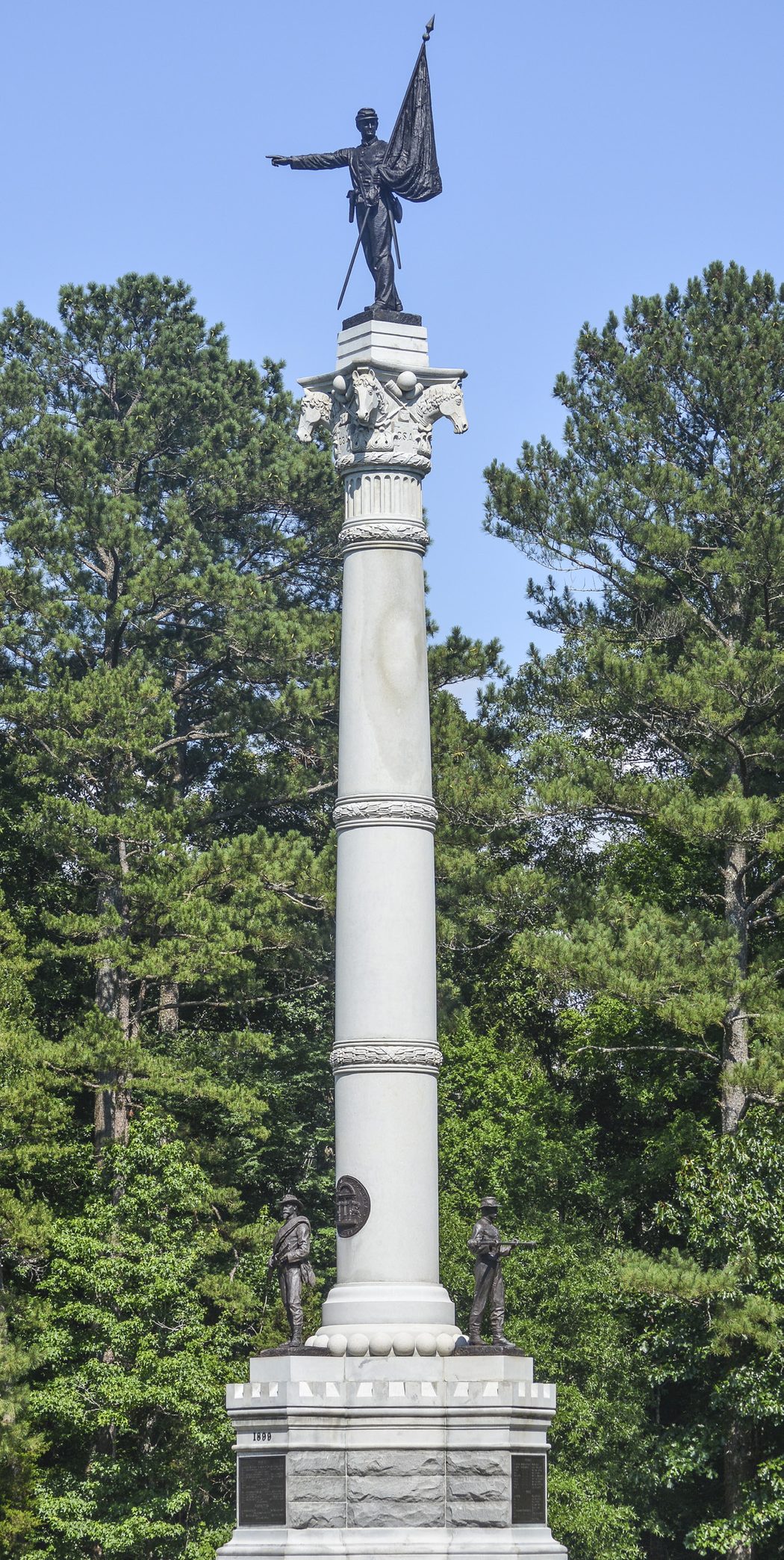
The five-man board got to work and decided to devote the bulk of the appropriation, up to $20,000, to “erect one grand and imposing monument” near the center of the park. The remaining funds were earmarked for smaller monuments marking the battlefield locations on where Georgia units had fought.
The board promptly sought bids for the design and construction of the grand monument. The Muldoon Monument Company of Louisville, Ky., submitted the winning design. Venable Brothers of Atlanta won the contract to build the structure, performing the granite work itself and contracting with the Gorham Manufacturing Co. of Providence, R.I., to make and place in position all the bronze work, four statues and four tablets. Gorham was to be paid $7,200 for its part of the job.
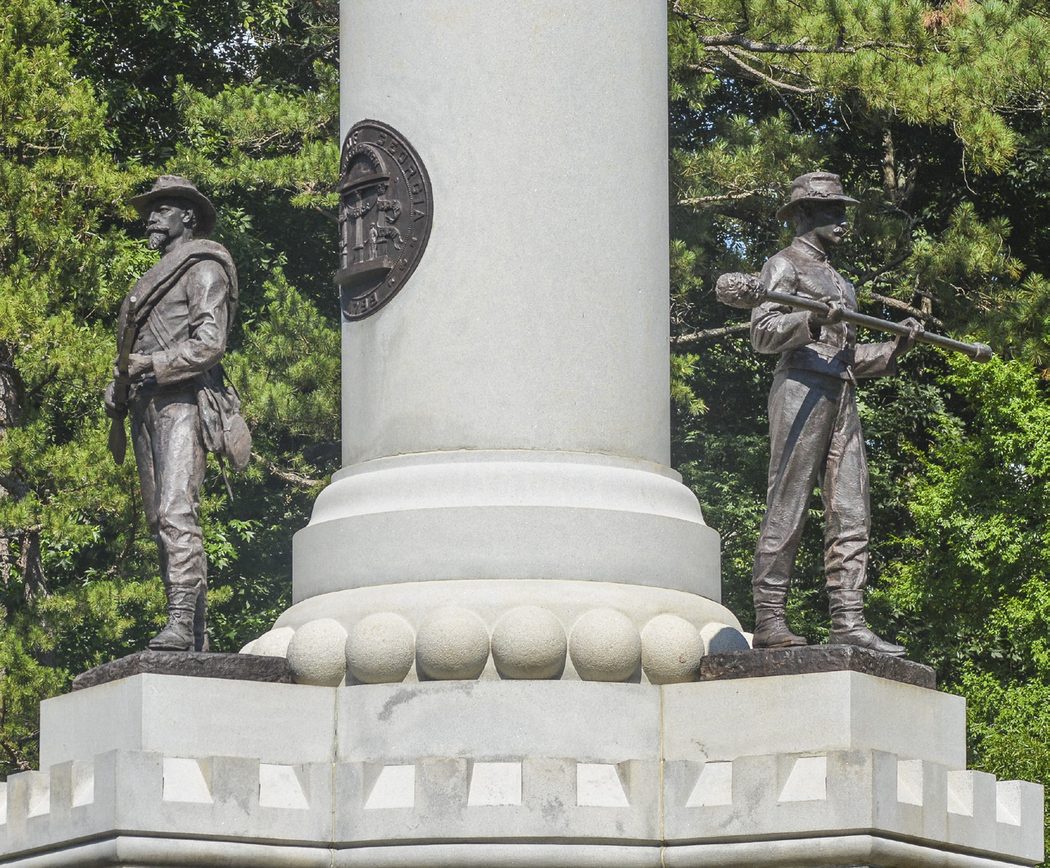
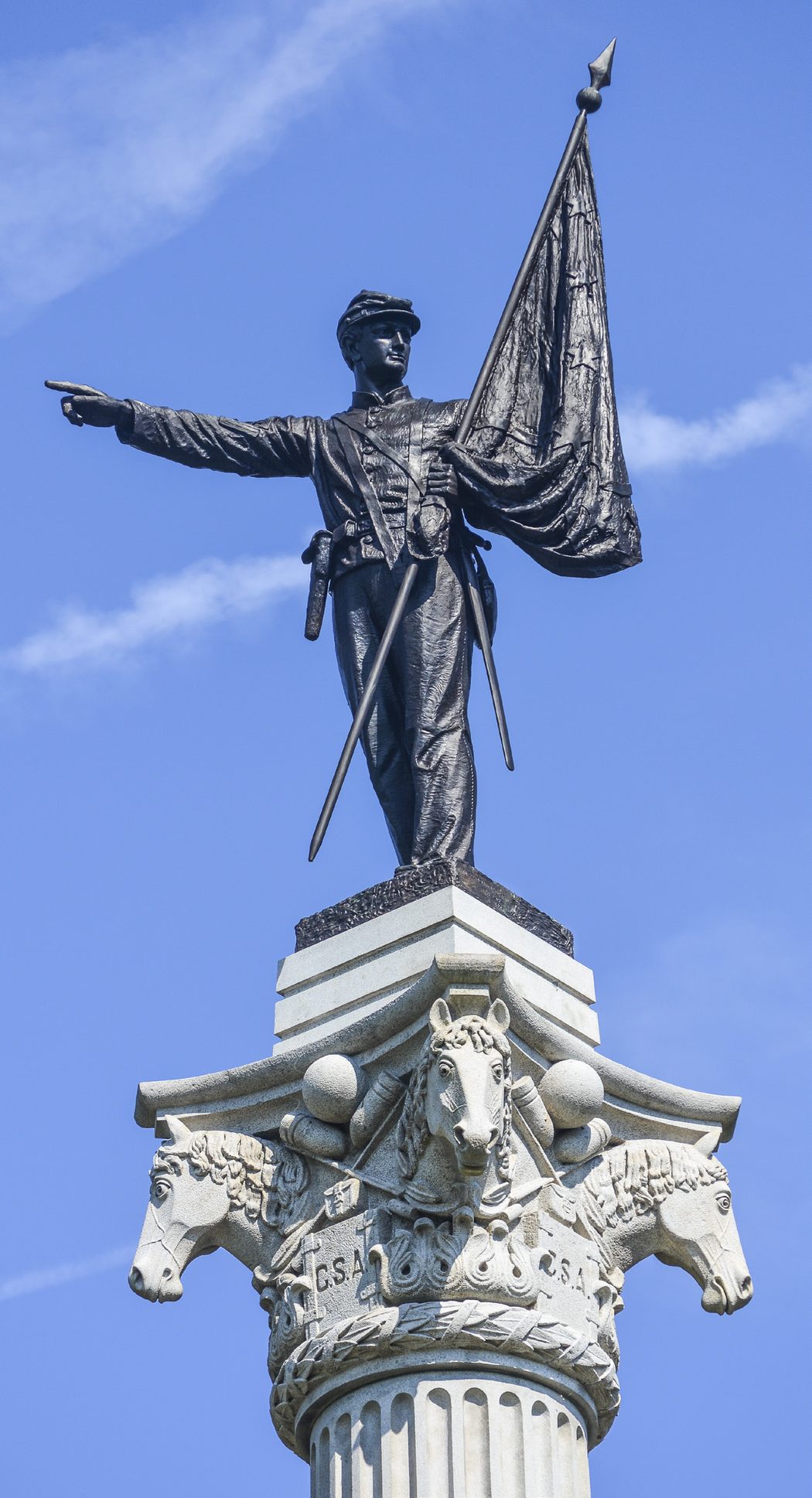
The design called for a substantial granite base, 19 ½ feet high, from which a round granite column would reach skyward another 37 ½ feet. Upon the base would stand three bronze statues, 6 ¾ feet tall, representing an infantryman, an artilleryman, and a cavalryman. A bronze color-bearer, 15 feet in height, would stand on the capstone surmounting the column. The
monument’s height from the ground to the tip of the colorbearer’s flag staff would be 86 feet.
A proviso in the 1895 appropriation act stated that “the material used in the work shall, as far as practicable, be a product of Georgia.” The bulk of the material used was blue granite from which the base and shaft were formed, quarried in Oglethorpe County.
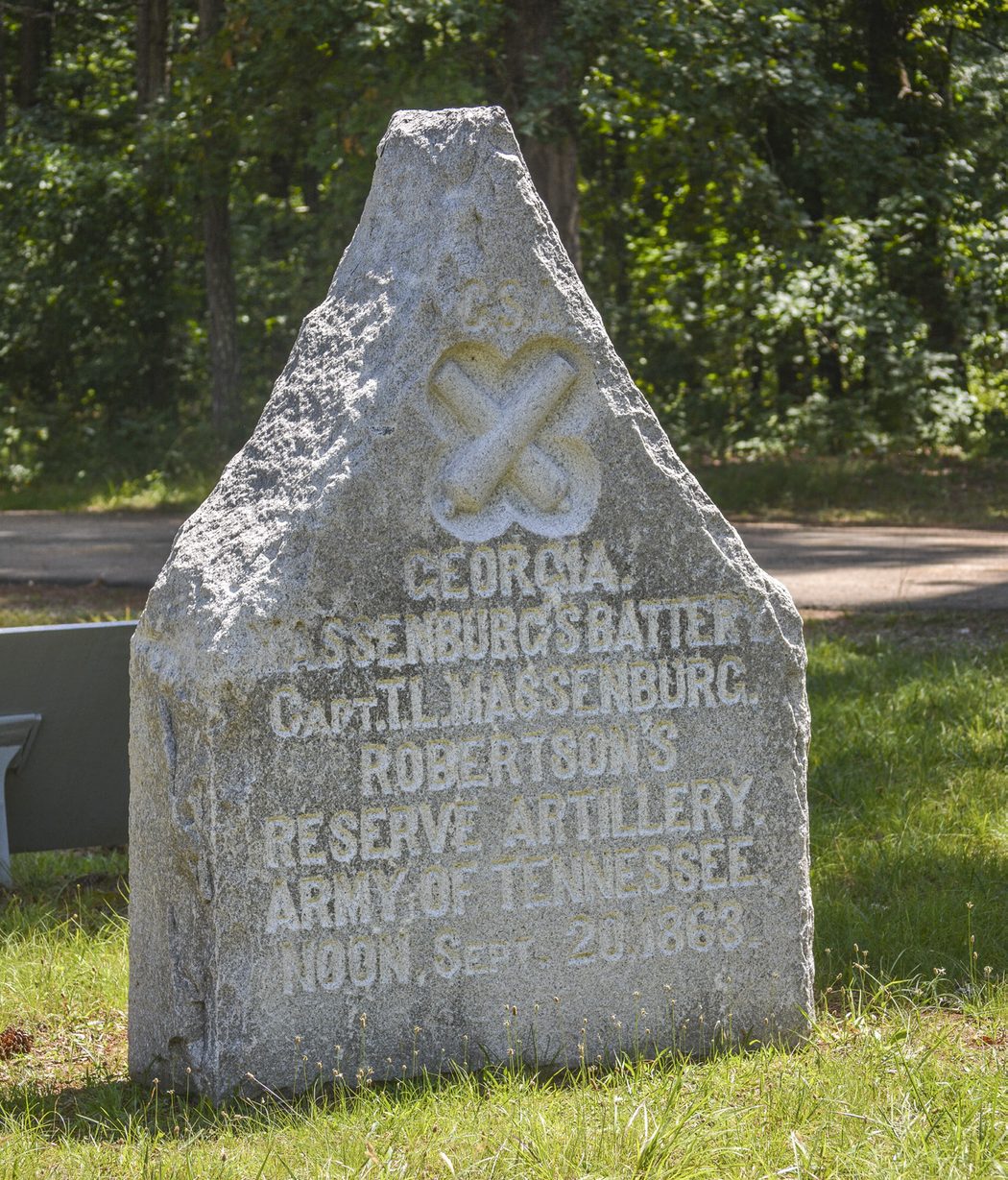
In addition to the granite work on the grand monument, Venable Bros. was to fabricate 40 to 60 smaller granite “battle markers or monuments,” at a cost of $75 each.
That’s today. Let’s go back to the late 19th century. Venable and Gorham started work sometime in 1897, or perhaps in late 1896. The State Memorial Board reported to the governor (then William Y. Atkinson) in December 1897 that “considerable progress had been made” and that the work so far completed was “done according to the plans and specifications.”
The work continued and was completed in time for the dedication scheduled for May 4, 1899. Like the memorial itself, the dedication was monumental in scope.
According to a report in the May 5 Atlanta Constitution, the occasion was witnessed by a crowd of several thousand. From
October 2022
their lodgings in Chattanooga, they arrived at the Chickamauga station after a short and festive train ride, on which they enjoyed a “jolly time renewing old acquaintances and making new ones.” Many were shuttled the last mile to the monument site by local farmers who took advantage of the busy day to turn their wagons into taxi cabs. The many VIPs rated a more formal escort. The arrival of Gov. Allen D. Candler and other dignitaries were greeted by a cheering crowd and “a lively march” played by a Chattanooga band.
Of the 53 members in the governor’s immediate party listed in the paper, nearly all the men bore military rank, ranging from lieutenant to colonel, plus one general, James Longstreet, accompanied by Mrs. Longstreet. Three of the five members of the State Memorial Board were present, Gordon Lee, James Boynton and William Everett,
the chairman. John McIntosh Kell and Joseph Cumming were absent.
The stands were full and “several hundred people were standing up in the hot sun all round the stand.” Others found more comfortable accommodations on the grass and in the shade.
Chairman Everett opened the ceremonies by introducing the chancellor of the University of Georgia, who offered a “fervent and patriotic prayer.” After more music and a brief summary of the board’s word, the monument was unveiled by Miss Myrtle Everett, daughter of William Everett.
Then the serious speechmaking began. The dignitaries, the crowd standing in the sun and the people sitting in the nearby shade were treated to three hours of lofty oratory.
Governor Candler spoke, followed by Gen. Henry Van Ness Boynton, U.S.A., the chairman of the commission responsible for the creation of the park. The “Orator of the Day” was Maj. J.C.C. Black, an Augusta attorney who had served in the command of Gen. John Hunt Morgan. All three orations struck the same chords, chords familiar to the 1899 audience and to anyone today who has examined Civil War memorials and read of their dedication ceremonies.
For speakers on the winning side, in this case Gen. Boynton, there is magnanimity and generosity in victory. Homage is paid to the brave men against whom the victors fought.
Speakers representing the vanquished, Candler and Black at Chickamauga, display dignity in defeat and, like the victors, offer high praise for the adversary. There is no admission that their cause was not just, but rather a graceful acceptance of the outcome, and promised loyalty to the restored Union.
For both sides, there are prayers of thanksgiving for the blessings of peace and a successful reconciliation.
General Boynton spoke of “the valor of all soldiers who fought here from the north and from the south.” He spoke of the lesson taught by the memorial, that the once-divided nation could come together in “a reconciliation so perfect as to have brought both sections together to fight shoulder to shoulder under the one flag of our restored and indissoluble union.” Many Southern men, including four former Confederate generals, had worn the uniform of the United States in the previous year’s war against Spain.
Governor Candler stressed the sections’ common heritage. The combatants were all patriotic Americans, all “scions of Anglo- Saxon stock,” brave and dutiful men in whom all Americans should take pride. Candler saw the hand of “inscrutable providence” at work, a divine plan “protecting and more firmly cementing together the many parts of the great country with which God has blessed us.”
Major Black, in his long address, also struck a religious tone, saying of the fallen Confederates that “no purer libation was ever poured upon Liberty’s altar than the blood they shed.” The survivors “fought like true soldiers and, when overcome, like true men accepted defeat without apology, though without reserve.”
Black bluntly defended the rightness of the Southern cause. “Georgia declares that her sons who here fought were not traitors!” However, what was done was done, and this soldier
Georgia State Memorial Board
The act of the legislature creating this commission provided that the governor should appoint four members and that the fifth would be the state’s adjutant general serving ex officio.
Governor William Y. Atkinson appointed Gordon Lee, William S. Everett, Joseph B. Cumming and James S. Boynton. John McIntosh Kell was Georgia’s adjutant general and was therefore the fifth member of the board.
Gordon Lee was from Chickamauga, born there four years before the famous battle. His father, James Lee, and his maternal grandfather, James Gordon, were partners in Lee and Gordon’s Mill, located on Chickamauga Creek just one mile from today’s battlefield park. Gordon Lee was engaged in business and agriculture and served in Congress from 1905 until shortly before his death in 1927.
William Everett was born in 1839 in New York and moved to Atlanta as a young man. He volunteered for the Confederate army, while two of his brothers back home fought for the Union. At Chickamauga Lt. Everett commanded Co. E, 9th Georgia Artillery Battalion. After the war Everett prospered as a wholesale merchant. He died in 1904 in a carriage accident near his place of business in Atlanta.
Joseph Cumming, born in 1836, was an attorney in Augusta. During the Civil War Cumming served in staff positions for several Confederate generals, John K. Jackson, William J. Hardee, William H.T. Walker, John Bell Hood, and very late in the war, Joseph E. Johnston. At the Battle of Chickamauga, he was the adjutant general on Walker’s staff. Cumming was active in veterans’ affairs and was a regular speaker at monument dedications and other occasions. He died in 1922.
James Boynton, born in 1833, was an attorney in Henry County from 1852 until the start of the war, when he volunteered as a private in the 30th Georgia Infantry. He rose to the rank of colonel and led the regiment in the Battle of Chickamauga. After the war Boynton settled in Griffin, practiced law and entered politics. As president of the State Senate in 1883, he briefly assumed the office of governor when Alexander Hamilton Stephens died in office. Boynton died in 1902.
John McIntosh Kell was born in 1823 in Darien on the Georgia coast. He served in the United States Navy as a midshipman in the United States Navy, but was dismissed from the service in 1849 when he refused to obey an order he considered to be illegal. Kell was soon reinstated, and served until his resignation in 1861, four days after Georgia seceded. At his court-martial in 1849 Kell was defended by Lt. Raphael Semmes, with whom he later served on the CSS Sumter and the CSS Alabama. He was appointed the state’s adjutant general by Gov. John B. Gordon in 1886 and held that office until his death in 1900.
knew that peace was better than war. “The earth has drunk enough of the blood of her sons,” he said. He took comfort in the “assurance that the union of these states will never again be disrupted by sectional war. We rejoice today in a country reunited, and forever.”
At the conclusion of Maj. Black’s speech, and before the ceremonies were brought to a close by a final musical number, from the crowd arose “calls for Longstreet, and the venerable Georgian who played so important a part in the bloody events that made Chickamauga famous, was compelled to rise and bow his acknowledgments. As he did so he was given three hearty cheers.”
Georgia’s “grand and imposing monument” stands in Poe Field, on the east side of LaFayette Road a short distance south of the park’s visitors’ center. The fine work of art remains in pristine condition more than 123 years after its dedication. The most recent restorative work was done a decade ago, when all the stone surfaces were washed, the bronze cleaned and waxed, the failed joints repointed, and the original concrete apron replaced.
The color-bearer is looking to the northwest, so if you want a good picture with some sun on the young soldier’s face, pick a mid-summer day and be there in the afternoon.
My thanks to Park Historian Jim Ogden, who arranged for me to review the park’s file on the Georgia monument and provided much additional information. Jim is a fount of information on all aspects of the battles fought at Chickamauga and Chattanooga. I encourage anyone who has an opportunity to participate in one or more of his superb tours. Visit this website https://www.nps.gov/chch/getinvolved/donate. htm to see the various ways you can support the Chickamauga and Chattanooga National Military Park.
Gould Hagler is a retired lobbyist living in Dunwoody, Ga. He is a past president of the Atlanta Civil War Round Table and the author of Georgia’s Confederate Monuments: In Honor of a Fallen Nation, published by Mercer University Press in 2014. Hagler speaks frequently on this topic and others related to different aspects of the Civil War and has been a regular contributor to CWN since 2016. He can be reached at gould.hagler@gmail.com.