“It is amazing what people can collect.”
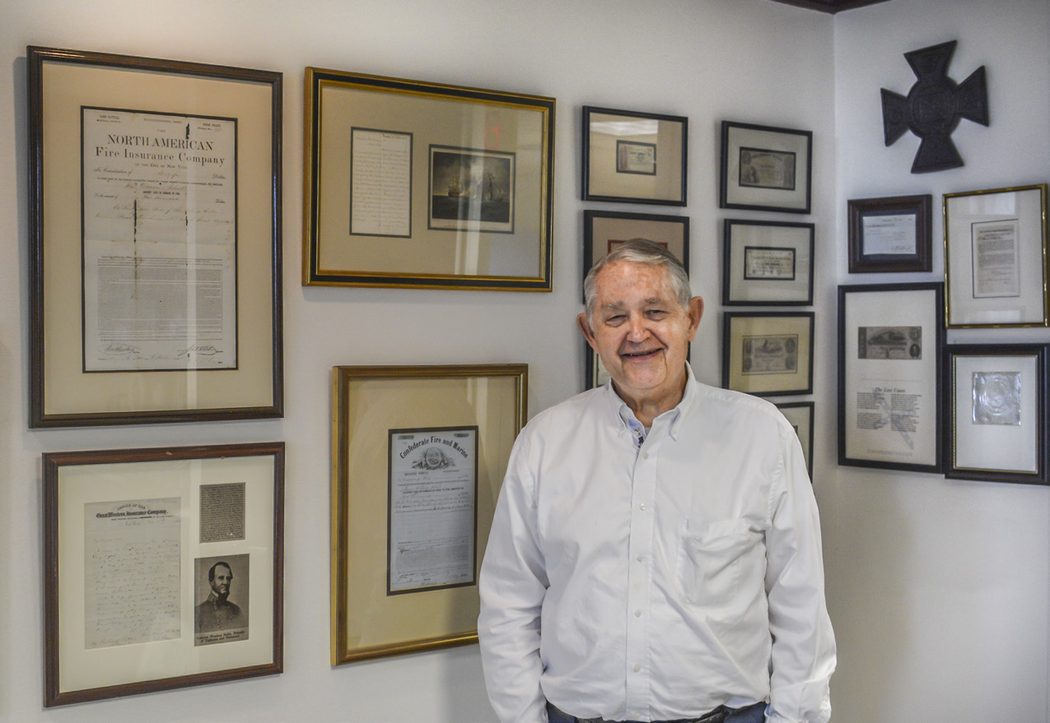
The walls in Scott Thompson’s office are decorated an assemblage of Civil War memorabilia, scores of items that Scott has acquired since he started his collection in the1980s. A visitor giving the framed pieces a brief perusal will see the faces of some famous generals, note some documents that obviously belong to an earlier time, and admire some renderings of battle scenes on land and sea. A more careful examination will reveal that the collection has an unusual theme connected to the industry in which this avid collector has labored for many years. Scott is the president of the American Southern Insurance Company. Nearly all the items relate, in one way or another, to insurance.
Scott is a native of West Virginia and has lived in Atlanta since the 1950s. After high school he furthered his education at Yale and at the Harvard Business School, then served in the Navy, where he was a Supply Corps Officer in the Philippines. Scott worked four years at C&S Bank, then 47 years ago he moved to the company which he has headed for the past 15. If you count another way, Scott’s tenure is more
GEORGIA’S CONFEDERATE MONUMENTS In Honor of a Fallen Nation Gould B. Hagler, Jr.
This unique work contains a complete photographic record of Georgia’s memorials to the Confederacy, a full transcription of the words engraved upon them, and carefully-researched information about the monuments and the organizations which built them. These works of art and their eloquent nation’s profound grief, praise the soldiers’ bravery and patriotism, and pay homage to the cause for which they fought.
protracted. “It is really longer than 47. When I was 16, I was the fill-in janitor for the company,” he said. American Southern is a “small specialty company,” Scott explained, focusing on motor trucking and commercial auto insurance. “About 80% of our business has got wheels on it.”
Scott developed an interest in the Civil War many years ago. He viewed ads in Civil War magazines, looked at dealers’ catalogs, and visited a few shows. He began to “pick up some stuff.” The stuff grew into the fine collection that now adorns his office and spills over into some other areas in American Southern’s headquarters.
Scott is aware of only one other person who focuses on Civil War items with an insurance angle. There is not a huge supply of such material but neither are there many collectors driving up demand. “So it doesn’t get terribly expensive,” Scott explained.
In addition to insuring all the things with wheels, American Southern also has a program to insure collectibles. “It is amazing what people can collect,” Scott said. Indeed.
As we began the tour, Scott showed me a letter signed by Maj. Gen. G.W. Smith in 1868, framed along with the general’s picture and a brief synopsis of
his career. “Smith ran the Army of Northern Virginia for about a day,” Scott chuckled. Smith took over when Gen. Joseph Johnston was wounded at Seven Pines. Pres. Jefferson Davis put Robert E. Lee in command the very next day. The insurance connection? Smith returned to his native Kentucky after the war and served as the Commonwealth’s insurance commissioner until 1876.
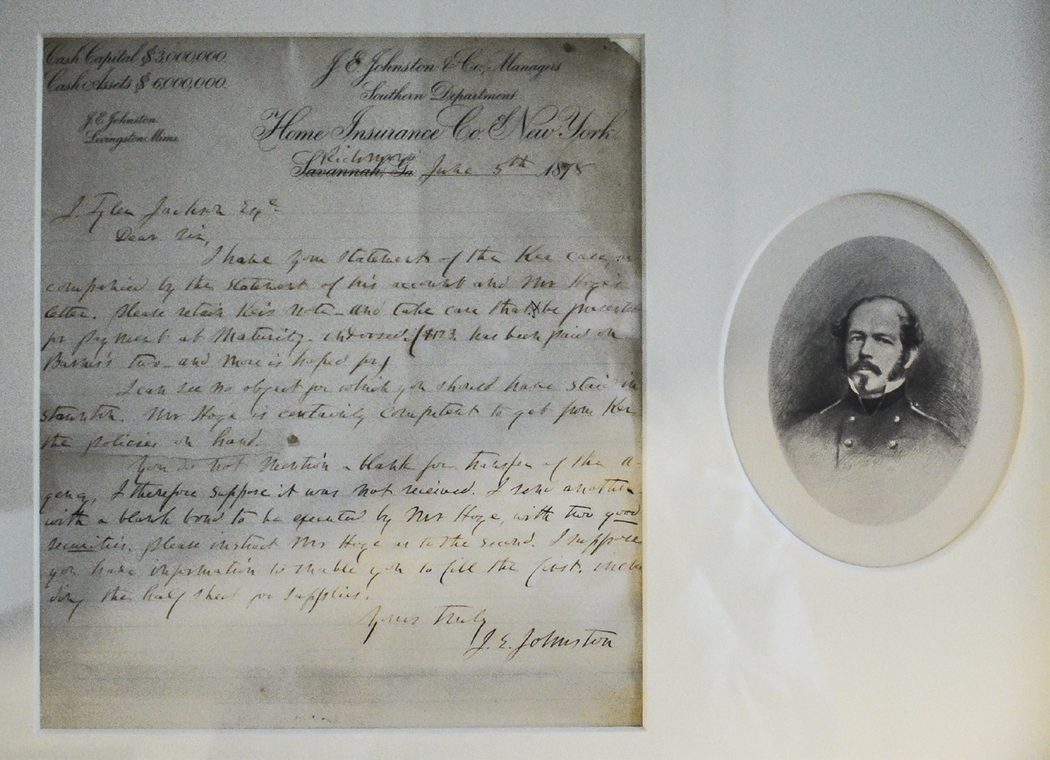
Of course, Gen. Johnston has an honored place in the collection as well. Near Smith’s letter is a framed picture of Johnston with a letter signed by him in 1878. The letterhead reads “J.E. Johnston & Co., Managers, Home Insurance Company of New York, Southern Department.” Scott said that the former general was “trying to get a claim settled.”
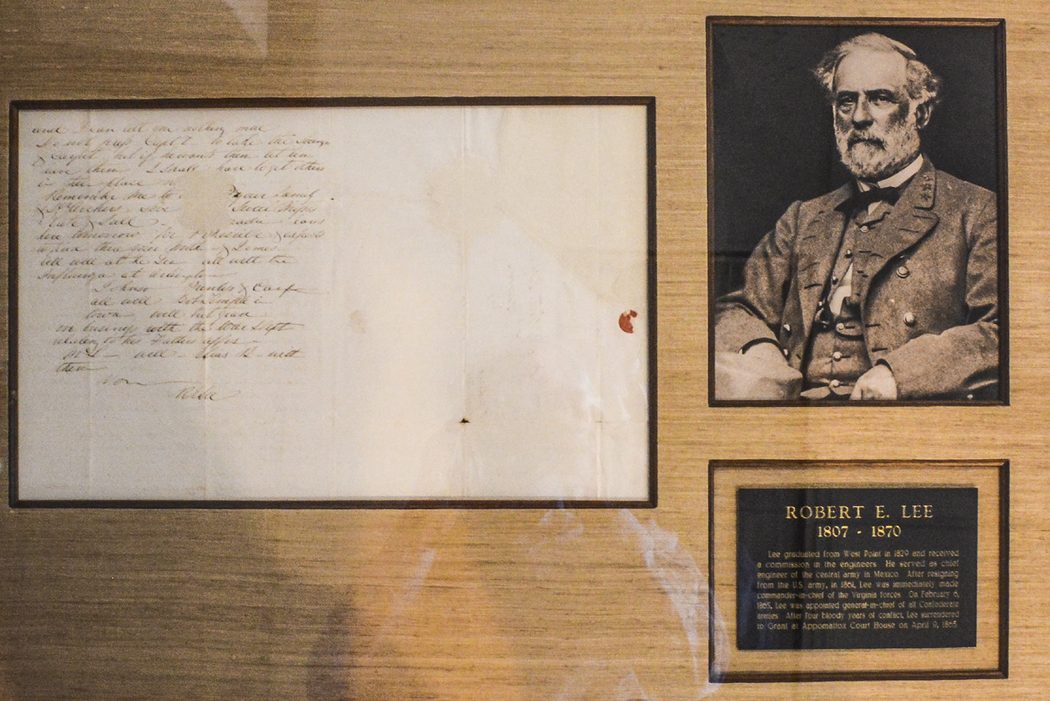
These items relate to the first two commanders of the Army of Northern Virginia. Scott’s wall also has a place for the third. A letter signed “R.E. Lee” is set in a large frame with a photograph of Lee, one of the famous series taken in Richmond by Mathew Brady seven days after Appomattox. Lee wrote this letter well before the war. “One with a war date is worth a whole lot more; if it said ‘Robert E. Lee, Commanding,’ it would be worth five times as much,” Scott said.
Do Lee’s photo and letter fit with the insurance theme? In a way, yes. In 1865 Lee was offered a lucrative position with an insurance company. The offer was for the use of his name, as he would be only the titular head and would have no other duties. He declined, saying “I cannot consent to receive pay for services I do not render.” Scott has this letter with Lee’s autograph, but in 1885 a man seeking something signed by Lee was not so fortunate.
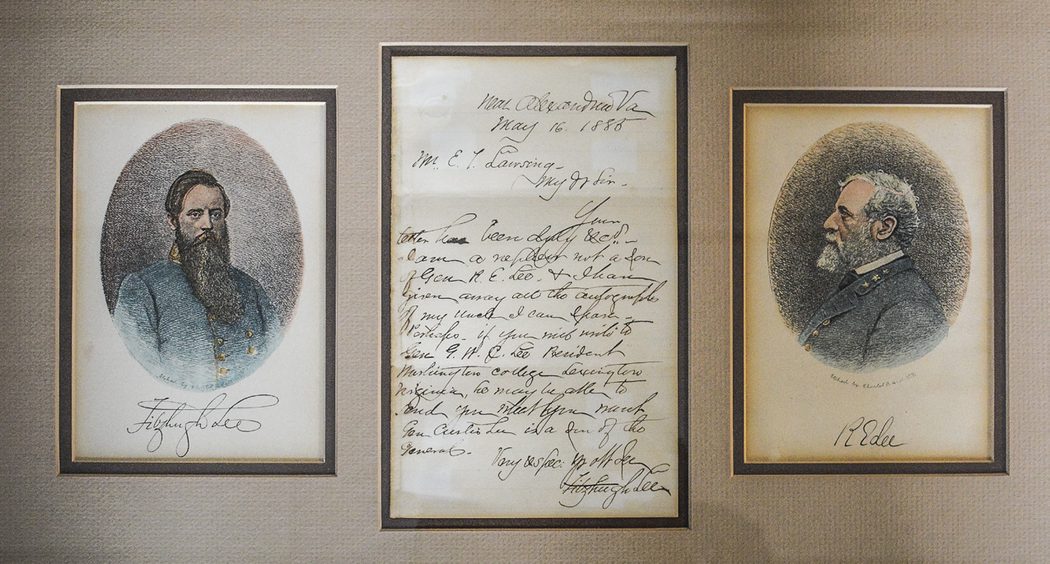
The collection contains a letter written by Maj. Gen. Fitzhugh Lee to a Mr. Lansing. This gentleman had written to this General Lee seeking an autograph of the more famous Confederate general. Fitz first set the record straight: he was R.E. Lee’s nephew, not
August 2022
his son, as Mr. Lansing thought. Furthermore, he wrote, he had no more autographs to give away. He referred Mr. Lansing to R.E. Lee’s son, Gen. G.W.C. Lee, then president of Washington College, who, Fitz wrote, might be able to help. Whether he did we don’t know, but at least Mr. Lansing got Fitz’s autograph; now Scott Thompson has it.
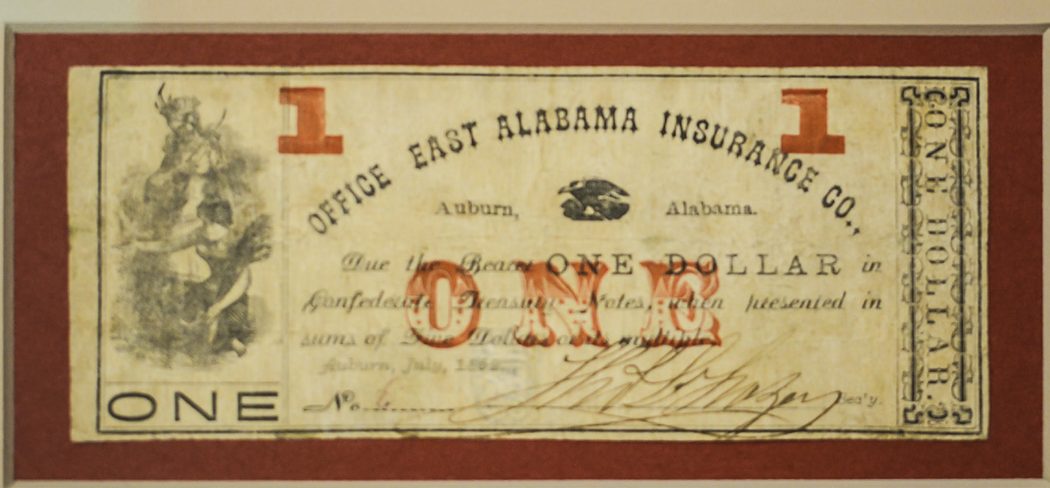
Next came the money. “Back in the good old days insurance companies could issue money,” Scott said. On his wall are several notes issued by insurance companies during the period, mostly in Confederate dollars. One fine specimen was issued by the East Alabama Insurance Co. in July 1862. The note states that the bearer is due “one dollar in Confederate Treasury Notes, when presented in sums of five dollars or its multiples.” Uberrima fides, as they say in the insurance biz. Scott also displays a government-issued note, for 50 cents, issued in 1864.
Another notable find is a letter written to policy holders by the Charlotte Mutual Fire Insurance Company. Scott explained that this company was an assessable mutual.
“Back in the day a mutual insurance company could have an assessable feature, which means if they got into trouble they could make you pay more premium.” On April 1, 1863, Charlotte Mutual sent a letter telling policy holders that they had to pay an additional 10 percent, or else. If a policy holder didn’t pay he would soon get another letter cancelling his policy.
Fire insurance policies have a war exclusion, so if the Federals had torched the Queen City there would be no coverage at all. Scott’s collection also contains a document from another fire insurance company. In Atlanta, the Confederate Fire and Marine Insurance Company issued a policy in September 1862 to a Mr. John Bull, whose premium of $30 secured a policy that would pay up to $2,000 for loss or damage by fire; unless, of course, the fire was caused by an invading army.
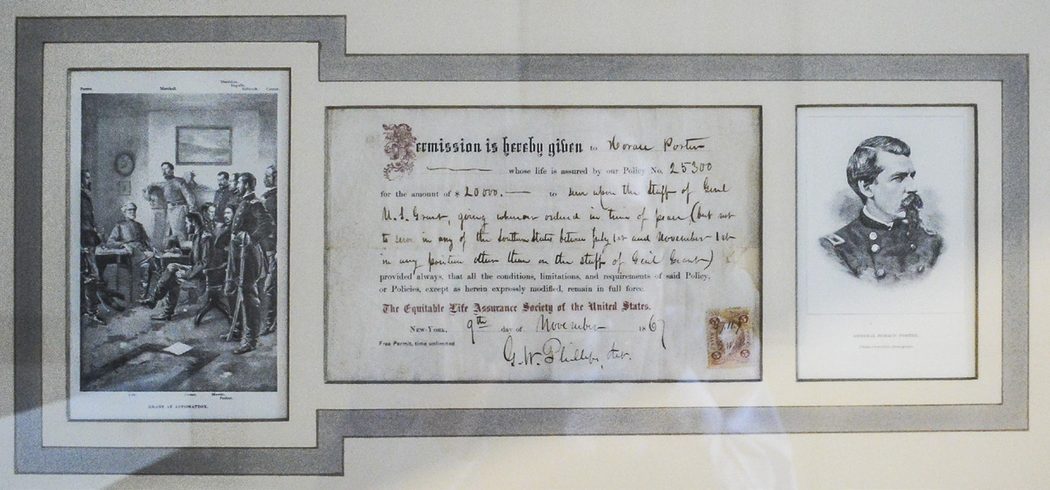
Another interesting item in the collection is an 1867 letter from the Equitable Life Insurance Society of the United States to Brig. Gen. Horace Porter, a member of Gen. Grant’s staff. The letter authorized Porter to travel to the Southern states, provided he was there pursuant to Grant’s orders. Scott speculates that the policy had a territorial exclusion and Gen. Porter wanted to make sure the former Confederate states were not encompassed by the exclusion.
on sea as well as land. Scott’s collection contains some relics of that part of the conflict. In keeping with his insurance theme, Scott displays a letter written in 1862 by one Richard Nichols to a William Hathaway. Hathaway had apparently inquired about obtaining insurance. “I can obtain the war risk here, but I do not believe that any risk can attach to the Virginia after she has crossed the line,” the letter states. The whaler Virginia sailed from New Bedford on August 26. She was captured and burned by the CSS Alabama in the North Atlantic 20 days after she set sail. This whaler was one of the first captures scored by the Alabama after she was commissioned on August 24.
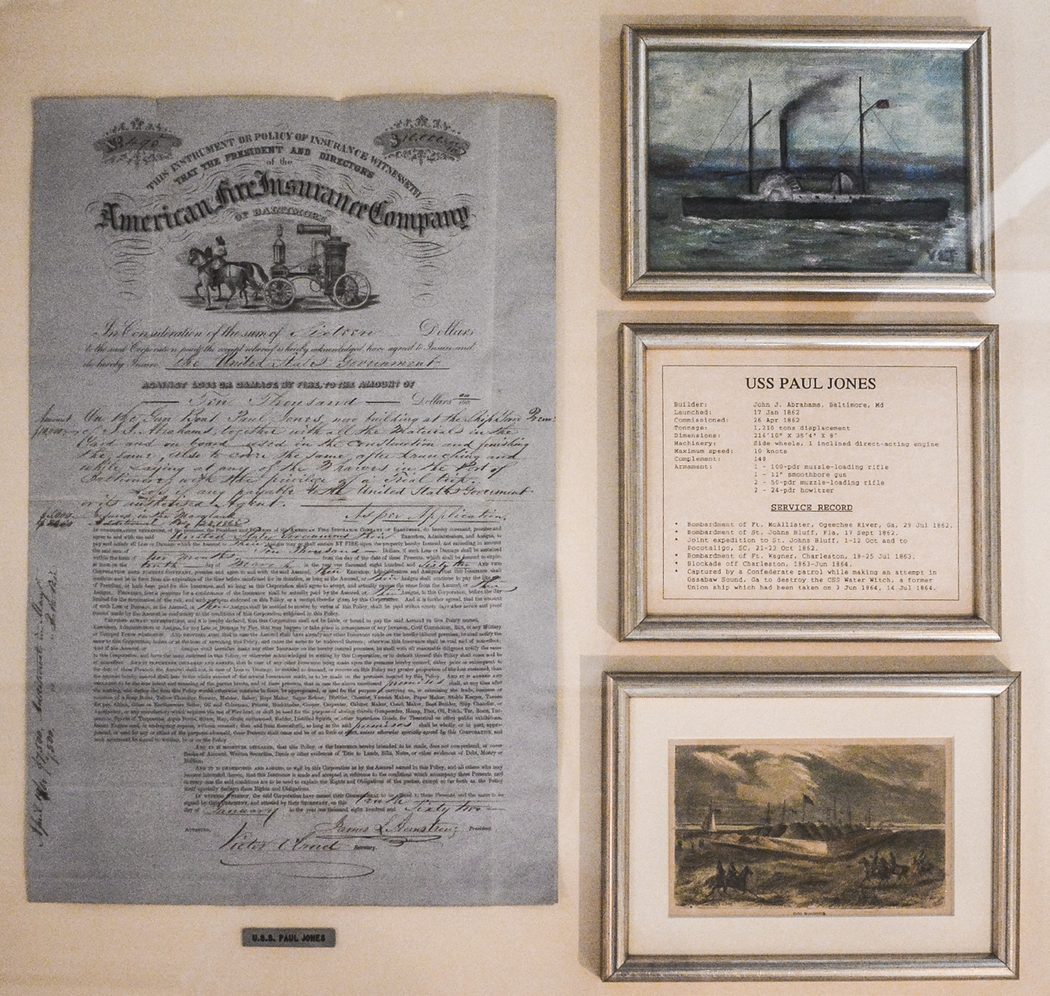
Another piece of Civil War nautical history is a policy written on the USS Paul Jones. The policy covered the ship while it was under construction in Baltimore in 1862. The Paul Jones was commissioned in July of that year and served in the South Atlantic Blockading Squadron.
The insurance field was a popular choice of postwar careers for many Confederates. Scott speculated on the reasons. “Insurance was a fairly easy way to leverage on name recognition.” Plus, insurance is “something you can get into without a whole lot of money,” which would be the situation of many former Confederates. Maj. Gen. George Pickett was an insurance agent after the war, in Norfolk, Scott thinks. “I have never been able to find anything with his signature on it.” For a time, Maj. Gen. John B. Gordon was head of a life insurance company. Scott’s collection contains a policy issued in 1869 by the Southern Life Insurance Company bearing the signature of this Georgian who commanded Lee’s Second Corps from October 1864 until the surrender at Appomattox. The insurance company went under, and Gordon went on to other things: governor of Georgia, U.S. Senator, and commander of the United Confederate Veterans.
Other Confederate generals got into the insurance game,
and so did their commander-inchief. “Jefferson Davis after the war worked for a life insurance company for a brief period of time,” Scott said. Scott once had an opportunity to get a signature of Davis on a life insurance policy but somebody else bought it before he could.
When Scott retires, he, like many other people, will have to decide what to do with all the things in his office. I asked him to name some favorite items he will keep if he finds himself short of space. He mentioned the letters written by Robert E. Lee and Joseph E. Johnston, and the document related to the USS Paul Jones, which was a very meaningful gift. However, it was clear he doesn’t really want to part with any items, a sentiment that any collector will certainly understand.