July 2022
spoke up, as did senators and representatives from other states. Atlanta’s mayor said that Sherman’s son would be welcome in his city but advised against appearing with his military escort. The acting mayor of Savannah made the press with an intemperate remark about hanging Father Sherman.
Regular people joined the chorus, sometimes with facetious comments and lame jokes about torches and fire insurance; numerous newspapers continued to fan the flames.
Although the comments varied in tone and volume, all had the same basic points: the military escort was improper and unnecessary. This private citizen had no right to use the army
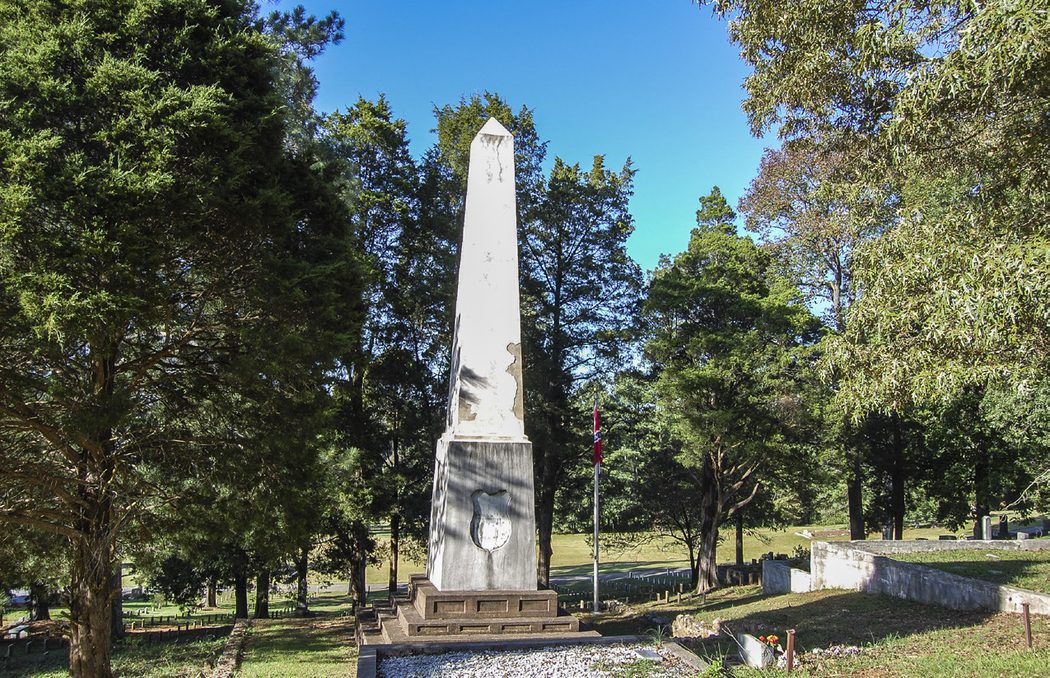
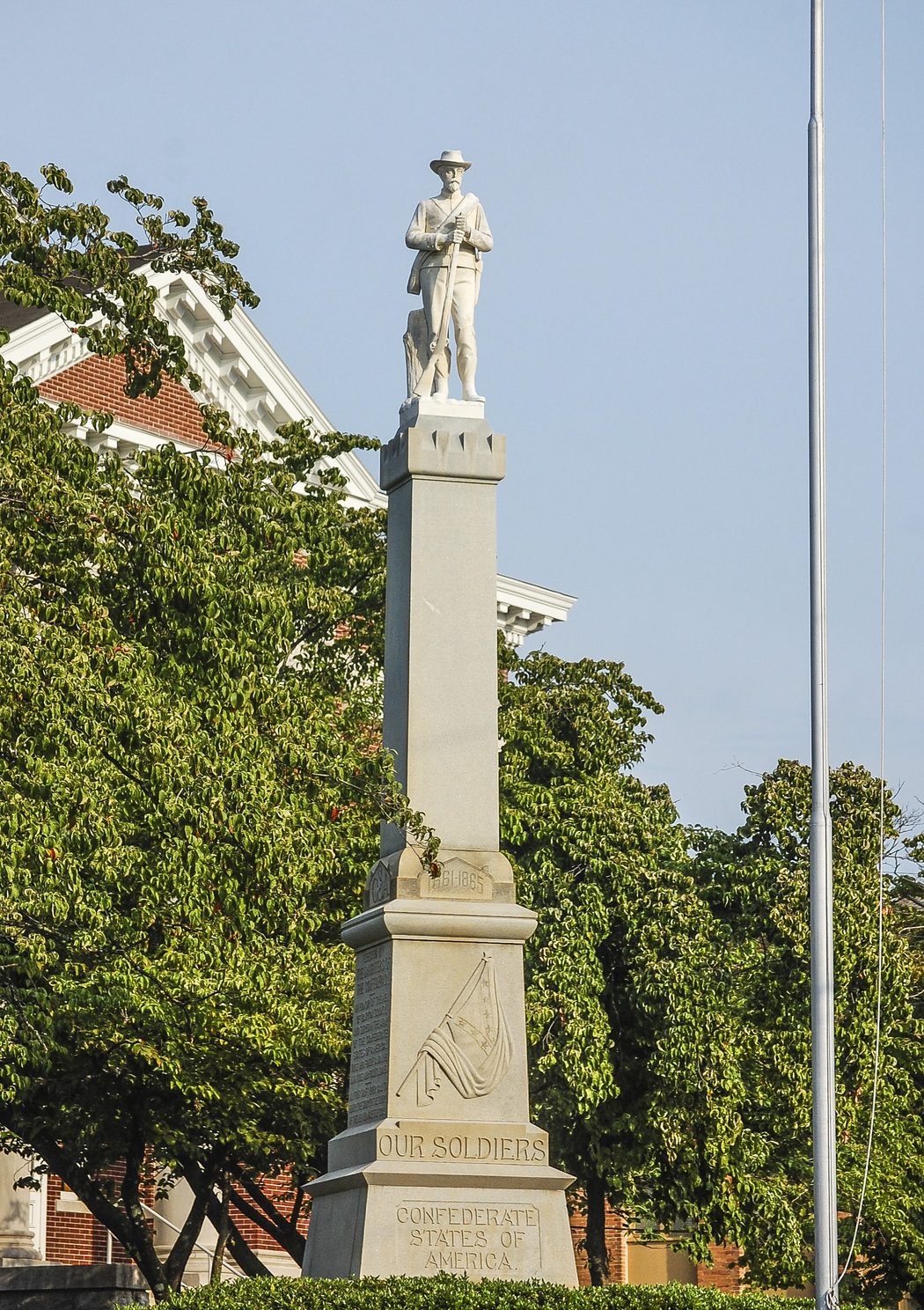
Father Sherman’s excursion ended in Cartersville. This Confederate monument was built two years after his visit. (All photos by Gould Hagler)
for his own purposes and had no need of protection from his fellow citizens.
Following a sit down with the president, the army chief of staff sent an order to the commander of the Department of the Gulf in Atlanta. Word was sent to Col. George Chase at Fort Oglethorpe: recall the cavalry.
However, the cavalry was hard to find. The small force (two officers, eight enlisted men, and one Jesuit) was riding through and camping in the countryside, or “lost in the woods,” according Atlanta Constitution to the on May 3. After leaving Fort Oglethorpe on April 30 the party spent the night in Dalton. They moved on to Resaca, where they spent some time on the battlefield, then passed through Calhoun. In Cassville they halted to make some notes on the action that had occurred there.
In several places along the way the cavalrymen and their guest encountered local people, including Confederate veterans, and spent time in conversation with them. All the meetings were cordial and apparently no one they met had seen the news that was so upsetting to so many people.
On May 2, after Cassville, Father Sherman and the cavalrymen reached Cartersville, just 7 miles to the south. There they caught up with the news and the order for the cavalry to turn back.
In the words of historian E. Merton Coulter, “Father Sherman was astounded, aggrieved, and deeply hurt – and angered as far as became a priest.” On May 3 Father Sherman and the soldiers mounted up and headed north. In contrast to the pleasant outbound trek, the march back to Fort Oglethorpe would be an ordeal for the clergyman, nearly 50 years old and unused to riding such a distance.
Father Sherman and his “escort” camped that night near Calhoun. On the 4th they made camp just short of their destination, which they reached the morning of Saturday May 5. The exhausted Jesuit was taken in by Col. and Mrs. Chase, who allowed no one to see him. A reporter from the Times was present when the party arrived, and wrote that “in five minutes the priest had disappeared.” He was told that Father Sherman “did not wish to be disturbed by reporters or anybody else.” The persistent journalist tried by telephone and spoke to Mrs. Chase. She was adamant, and “would not allow the colonel’s guest to be disturbed.”
Mrs. Chase answered the reporter’s questions and informed him of some facts, important facts, that had been missing from all the press coverage during the week. Quoted in the May 5 Times, Mrs. Chase said: “The socalled trip over the ‘March to the Sea’ was arranged well before the invitation was given Father Sherman. You know, we have a practice march at Fort Oglethorpe every week.” According to Mrs. Chase, the invitation had been issued the previous December by Gen. Thomas Barry the Assistant Chief of Staff of the Army.
If Father Sherman knew the source of the report from Springfield he did not say, nor did he comment otherwise on the press coverage. He spoke positively of the welcome he received from the Georgians he had met on his abbreviated trip. According to Coulter, Father Sherman felt “bitter against the authorities in Washington.” While he did not mention Roosevelt, this bitterness may indicate that the president did first suggest and arrange for the invitation, or at least was aware that such an invitation could have been issued. Perhaps Father Sherman resented the fact that Roosevelt responded to the controversy not by immediately setting the record straight but by recalling the cavalry.
The exhausted priest rested on Sunday at the Chases’ home. On Monday he left Chattanooga by train, bound for California, to officiate at the wedding of his cousin William Ewing.
The reporter from the Times had spoken to Col. Chase, as well as Mrs. Chase, on the day the party returned to Fort Oglethorpe. The colonel said that “it was intended that nothing would ever be given to the public about Father Sherman’s march over Georgia battlefields.” Nothing about the march would have appeared in the press, said the colonel, “If first news had not been received here from Springfield.”
“I should have kept the matter a secret,” Col. Chase said, but of course that was beyond his power after the dispatch had been sent to the Chattanooga Daily Times on April 27. Father Sherman did not speak to the press, but surely his sentiment was precisely the same as the colonel’s.
I am indebted to Cheryl Mason- Mercer of Colorado Springs, Colo., whom I heard speak on this little-known episode in 2020. Ms. Mason-Mercer directed me to the article upon which this column is based, “Father Sherman’s ‘March to the Sea,’” by E. Merton Coulter, published
GEORGIA’S CONFEDERATE MONUMENTS In Honor of a Fallen Nation Gould B. Hagler, Jr.
This unique work contains a complete photographic record of Georgia’s memorials to the Confederacy, a full transcription of the words engraved upon them, and carefully-researched information about the monuments and the organizations which built them. These works of art and their eloquent nation’s profound grief, praise the soldiers’ bravery and patriotism, and pay homage to the cause for which they fought.
in The Georgia Review, Winter 1956. The article is available in booklet form in the Fulton County Public Library’s Special Collections.
Gould Hagler is a retired lobbyist living in Dunwoody, Ga. He is a past president of the Atlanta Civil War Round Table and the author of Georgia’s Confederate Monuments: In Honor of a Fallen Nation, published by Mercer University Press in 2014. Hagler speaks frequently on this topic and others related to different aspects of the Civil War and has been a regular contributor to CWN since 2016. He can be reached at gould.hagler@gmail.com.
online at
160 pages of the best selection of historical reenactment items from Medieval era to Civil War era. Includes over 60 pages on our famous tents and a 4-color section.
Battles and Leaders of the Civil War
Douglas Southall Freeman deemed it one of “the basic reference works” on the war.1 Ralph Newman and E. B. Long included it the same way in their “Basic Civil War Library.”2 The very first issue of Civil War History (March 1955) ran Newman’s “For Collectors Only”; of course it was listed there, too.3 In an article, “Battle of the Books” for CWTI in February 1970, James I. Robertson remarked that so many Civil War books were coming out that the next one would be titled “Lincoln’s Wife’s Doctor’s Dog”—but amid the bibliographic bustle he was careful to mention it.4 More recently (1995), Gary Gallagher listed it among 100 essential titles.5 Bibliographer David J. Eicher included it in “Finding the Civil War in Books” for North & South (April 1998).6 He based a list of 125 titles on his The Civil War in Books: An Analytical Bibliography (1997), in which it is #743 of 1,099 works cited.7
We’re speaking, of course, about Battles and Leaders of the CivilWar, the four-volume work thatranks as probably the most important compilation of writings by major Civil War figures, both Union and Confederate. First published in 1888, the series was reissued in a single-volume Century War Book: People’s Pictorial Edition in 1894.8 Three subsequent editions have appeared, including that published in 1956 by Thomas Yoseloff.9
The “Battles and Leaders” series was conceived by Clarence Clough Buel, assistant editor for Century magazine. In early 1883 Buel thought of pairing an article on John Brown’s raid at Harpers Ferry written by a Virginian, with a “Comment by a Radical Abolitionist.” The pieces, published that June, aroused considerable interest. Soon Buel outlined a more ambitious project using the same format: a series of eight or ten articles on decisive battles of the Civil War, written by generals who had commanded the opposing armies. Buel proposed his idea to the associate editor, Robert Underwood Johnson. Both Johnson and the Century editor-in-chief, Richard Watson Gilder, liked the plan. Gilder put Johnson in charge of it, with Buel assisting.
The most important task, the lining up of contributors, was begun in the spring of 1884. In the early days of “general catching” (Gilder’s phrase), the editors met with setbacks. Ulysses S. Grant, the first officer to be contacted, declined to write because his biographer, Adam Badeau, had said it all. William T. Sherman said the proposed series would fail. G. T. Beauregard said he was too busy. Some officers refused because they would have to criticize their dead comrades; others held back because of the living (Johnson termed this dilemma “Scylla and Charybdis”). But the editors worked their prospects energetically. They persuaded Beauregard by using as intermediary his friend George Washington Cable, whose fiction Gilder had published. Grant, attracted by the editors’ promise of $500 per article, consented after his banking house had failed, and he in turn helped convince Sherman to write an essay. Eventually Joseph E. Johnston, David D. Porter, James Longstreet and many other important military leaders agreed to help.10
Despite their array of contributors, the editors regretted the refusal of some notables to cooperate. Johnson could not persuade generals Winfield S. Hancock, Nathaniel P. Banks, Simon B. Buckner, or Benjamin F. Butler to participate in the series. Philip H. Sheridan wanted to save his commentary for a book; Jubal A. Early claimed that he opposed writing history for money. Neither Robert E. Lee’s son, George Washington Custis Lee, nor Lee’s chief of staff, Col. Charles Marshall, could be induced to contribute a piece on the great Virginian.
With these exceptions, though, most of the war’s major figures participated, and the series progressed. From the start, the editors emphasized an interesting, colorful format. Johnson admonished his contributors to avoid the style of official reports and tell of their battles as they would an after-dinner chat, preferably with personal incidents and even secrets. But many contributors submitted articles that were too long and sometimes so colorless that they were returned or discreetly set aside. General Grant, considered the biggest “catch,” was one such case. Having received his article on Shiloh in early July, Johnson was dismayed to find the general’s writing too much like an official report. On his next visit, Johnson induced Grant to talk offhand about the battle, then informed him that this was the style which the editors were seeking. “He seemed astonished at this,” Johnson recalled, but the general eagerly applied himself to revision. Before long he had completed a more lively piece, as well as three others on different battles.11
Plentiful illustrations by such staff artists as Walton Taber and Allen C. Redwood (himself a Confederate veteran) would accompany the articles. To balance the generals’ factual narratives, lighter pieces were also commissioned. In December 1885, for instance, there appeared a witty piece by Mark Twain, “The Private History of a Campaign That Failed,” relating in a highly imaginative way the celebrated author’s brief stint in the Confederate service. At the same time, the editors planned to continue their policy of publishing Southern fiction by Joel Chandler Harris and others, long a trademark of Scribner’s-Century, as another counterweight to the war series. “I’ve just been blubbering over [Harris’] “Free Joe,” wrote Gilder. “How well it goes with the war articles!”
With plans set, the editors chose a title for the series. After considering “Men and Events,” Buel proposed “Leaders and Battles.” Gilder liked the dramatic emphasis on fighting, as opposed to political events in the war, and approved Buel’s suggestion in August 1884. By the time the war series was announced in October 1884, the title had become Battles and Leaders of the Civil War. The next month’s issue carried Beauregard’s piece on First Manassas. Thereafter each issue of the magazine carried a least one or two articles by famous officers.
Public response was immediately favorable. A year later, in November 1885, circulation figures for Century peaked at 225,000, up from 127,000 the year before. Letters from readers poured in such quantity that the editors created a special column, “Memoranda of the Civil War,” to print some of them. Unsolicited manuscripts and illustrations also came in, and generals heretofore reluctant to contribute now readily agreed.
On the strength of this good showing Battles and Leaders of the Civil War, which had originally been forecast to run for a year, was extended. The unexpected abundance of manuscripts resulted in a hefty pile of unpublished work even after the final piece in Battles and Leaders appeared in November 1887. To use the remaining materials and to capitalize on the success of the magazine series, Johnson and Buel planned an elaborate