Spotsylvania’s Laurel Hill Battlefield
After two days of brutal but ultimately indecisive fighting at the Battle of the Wilderness (May 5-6, 1864), Ulysses S. Grant decided to move the Army of the Potomac around the Army of Northern Virginia’s right flank and drive for Spotsylvania Court House. This route provided the Federals the most efficient road to leave the Wilderness, maneuver into the open, maintain contact with supply lines, and potentially threaten Richmond. While United States cavalrymen battled Confederate horsemen to open Brock Road on May 7 at Todd’s Tavern (a property that CVBT is currently campaigning to save), Federal infantry began moving toward Spotsylvania Court House. Leading the way was the Army of the Potomac’s V Corps, commanded by Gouverneur K. Warren. Unbeknownst to Warren, brigades from the Army of Northern Virginia’s First Corps, now under Richard Herron Anderson, due to James Longstreet’s wounding on May 6, arrived in the Spotsylvania area just before Warren’s men.
After the V Corps pushed back Fitzhugh Lee’s Confederate cavalry, thus freeing the road
south of Todd’s Tavern, early on May 8, they soon began encountering more Rebel cavalry and Anderson’s rapidly arriving infantry, who were directed into defensive positions just northwest of the court house by J.E.B. Stuart.
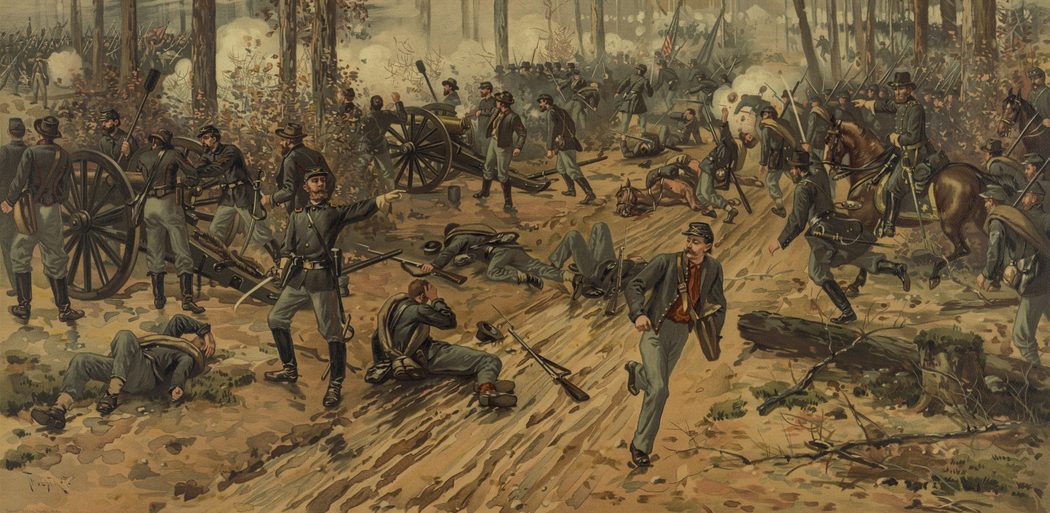
This first round of two and a half weeks of fighting at Spotsylvania Court House became known as Laurel Hill. While the fighting occurred largely on the Spindle Farm, some early wounded received aid behind Union lines at Laurel Hill, the Couse family home. The house name became confused with the battle’s true location, and the moniker Laurel Hill stuck. This engagement was only a prelude to more desperate slugfests that erupted on May 10, 12, and 18, which would make Spotsylvania one of the most fiercely fought battles of the Civil War. However, Laurel Hill’s tactical importance in denying the Federals easy access to Spotsylvania Court House should not be overlooked.
Researching Laurel Hill fighting uncovered a couple of “common folks,” a soldier and a civilian, who had their lives drastically altered by this often-neglected phase of the Spotsylvania fighting. Sgt. Charles Hunter, and Kate Couse, each experienced Laurel Hill from different viewpoints, but learning about their battlefield trials offers a different perspective, one sometimes missed when looking at actions primarily through the Official Records.
Charles Hunter was a typical citizen soldier. Hailing from Philadelphia, he enlisted in what would become the 88th Pennsylvania Infantry in August 1861, as a twenty-year-old. As was common of Civil War soldiers, Hunter endured periods of illness, and saw his fair share of combat during his service, but he continued writing home. On the morning of May 8, 1864, Hunter and the 88th, as part of Richard Coulter’s Brigade, John Robinson’s Division, V Corps, were among the soldiers who arrived on the scene and entered the fray against John Henagan’s South Carolinians and Benjamin Humphreys’ Mississippians at Laurel Hill.
Pvt. John D. Vautier, who later became the regimental historian of the 88th Pennsylvania, wrote: “The brigade [Col. Coulter’s], supporting some other troops, marched straight across the field, receiving the enemy’s fire when about half way over.” Since the Confederates had arrived first and thrown up improvised works, “they were comparatively safe, while the Union battalions were raked by a severe artillery and musketry fire.” The results were as expected: “the plain being strewn with the disabled, while many of the slightly wounded made their way to the rear,” Vautier explained. Among the injured was Sgt. Charles Hunter, who received a painful gunshot wound to the groin.
Evacuated from the field and transported first to Aquia Landing, and then by boat to the Mansion House hospital in Alexandria, Hunter finally received treatment. A physician, writing to Hunter’s father explained that the bullet went all the way through, causing a painful wound. Hunter spent about seven months in Alexandria recovering. He returned to the 88th at Petersburg in December 1864, received a promotion to lieutenant, and then resigned in June 1865 before the regiment mustered out.
June 2022
Originally from New Jersey, the Couse family had settled in Spotsylvania County around 1840. When sectionalism tore the country in two, their continued commitment to the United States set them apart from most of their neighbors. By the spring of 1864, only three Couse sisters, Kate, Ann, and Sarah, still lived at their home northwest of the Spindle Farm. When the scene of battle shifted from the Wilderness to Spotsylvania Court House, the Couse sisters and their home were overrun with soldiers from both sides.
Kate Couse recorded some of the tumultuous happenings she experienced in the days before and after the fighting at Laurel Hill. On May 7, in a diary-style letter, Kate wrote, “Calmer this morning, we are choked with smoke—from camp fires—and woods fires.” Much of the fuel came from the Couse Farm’s fence rails. She continued that, “the place is alive with waggons moving, the field in front of the house is full of waggons moving to and fro.” As mentioned earlier, their home was used as a hospital for wounded soldiers so Kate and her sisters must have seen terrible things they would never forget. One can almost hear the sadness in her voice when she wrote, “This war, this war.”
After the Civil War, Kate’s brother, Peter Couse, applied for compensation for damages to their Spotsylvania farm. Due largely to their unwavering loyalty, they received payment. However, while financial reimbursement certainly helped repair and rebuild, it did not erase the anxiety and sights of suffering she and her sisters endured.
Whether in the army carrying a rifle, or on the home place holding a family together, Civil War battlefields intruded on common people’s lives, leaving an uncommonly profound impact.
Coming Soon: Beyond the Battle
A Gettysburg Experience Like Never Before
ADAMS COUNTY, Penn.— Imagine millions of rare Gettysburg artifacts, letters, diaries, photographs, records, battlefield relics, and souvenirs, all at dire risk of destruction. This is the reality for the Adams County Historical Society (ACHS), a nonprofit headquartered in a weathered Victorian house on the edge of Gettysburg. There is no climate control, nor is there fire protection; a stunning reality for “Gettysburg’s Historical Society.”
The ACHS collection, amassed over a dozen decades since the organization was founded in 1888, is a treasure trove of rare materials. To name just a few: a rifle owned by civilian hero John Burns; an original program from the Gettysburg Address, the first Gettysburg town lot map drawn on animal hide in 1785, and personal items that belonged to notable Americans including Francis Scott Key, Thaddeus Stevens, and the Eisenhowers; all of whom had a connection to Gettysburg’s storied past.
A gem of the Society’s holdings is its civilian accounts of the Battle of Gettysburg and Lincoln’s November 1863 visit. Over 300 in number, they provide a fascinating and often underappreciated dimension of the Gettysburg story. Imagine what it was like for ordinary citizens who witnessed dramatic, and often traumatic, events during the battle. Some were active participants, dropping everything to care for the wounded, bury the dead, and rebuild a shattered community. Their stories matter.
In 2020, ACHS launched a capital campaign to fund construction of a new Gettysburg home. Adams County’s Commissioners donated land and $1 million to get the project moving. The initial goal of $5 million would have allowed ACHS to build a large storage facility with room for a few exhibits and public programming space, but when ACHS staff and volunteers began talking about the project, Gettysburg enthusiasts from around the country responded. Gifts poured in and the initial fundraising goal was surpassed. The excitement and enthusiasm allowed ACHS to dream bigger. As of this month, May 2022, the Society has brought in over $8.5 million with a goal of raising at least $2 million more to complete the project.
There is a lot to be excited about. With help from national figures such as Ken Burns, author Jeff Shaara, and filmmaker Jake Boritt, the ACHS team is bringing an experience to Gettysburg like nothing ever imagined. The history center, located north of town, is already under construction; it will include an artifact-packed museum, a research library and archives, and a spacious event center.
Gettysburg The museum, Beyond the Battle, will be a must-see for Civil War buffs from around the country. Starting with the early history of Gettysburg and surroundings, the exhibits take a deep dive into the stories of local families during the battle. The feature gallery is an immersive room where visitors will enter a home caught between the Union and Confederate lines. Here, you’ll feel floors shake, hear shells burst overhead, and listen as one family grapples with life-or-death decisions from a dark cellar below.
This is just one moment in a museum full of stories and artifacts you’ve never seen or heard before. They are stunning, representing a side of Gettysburg
that helps us better understand the significance of the battle and its impact on real people in a small American community. These are the same scenes playing out today in other parts of the world, where innocent civilians, especially children, encounter the horrors of war every day. Beyond the Battle will help visitors understand that it happened here, too.
In addition to the museum, ACHS hopes you will take advantage of its frequent program offerings featuring some of Gettysburg’s top historians: Tim Smith, Sue Boardman, and William A. Frassanito, to name just a few. All three are playing key roles in the development of the new history center.
ACHS will formally open to the public in 2023, ahead of the summer tourist season.
Who Was “Clio”?
The study of Civil War journalism has come a long way in the last few decades. That’s especially true regarding Confederate newspapers.
Fifty years ago, the go-to source was J. Cutler Andrews, The South Reports the Civil War (Princeton University Press, 1970). Since then, we’ve had studies of prominent editors and reporters, such as Knights of the Quill: Confederate Correspondents and their Civil War Reporting, a collection of twenty-nine articles edited by Patricia G. McNeely, Debra Reddin van Tuyll and Henry H. Schulte (Purdue University Press, 2010). In his essays on Partisans of the Southern Press: Editorial Spokesmen of the Nineteenth Century (University Press of Kentucky, 1994) Carl R. Osthaus includes one on John M. Daniel, the acerbic editor of the Richmond Examiner. Upstaging this is now Peter Bridges’ book, Pen of Fire: John Moncure Daniel (Kent State University Press, 2002).
There are also studies of individual Southern newspapers during the war. Barbara Ellis’ The Moving Appeal: Mr. McClanahan, Mrs. Dill, and the Civil War’s Great Newspaper Run (Mercer University Press, 2003) deserves mention if only for its ponderous size (677 pages). Ford Risley of Penn State advances the scholarship with Dear Courier: The Civil War Correspondence of Editor Melvin Dwinell (University of Tennessee Press, 2018). Professor Risley’s work focuses on the Rome (Georgia) Courier during the war. Bill Hendrick and I hope to make a similar contribution with The Atlanta Daily Intelligencer Covers the Civil War, which is due out this summer from the University of Tennessee Press.
Dear Courier reprints a number of Dwinell’s articles in the newspaper. So does Writing & Fighting the Confederate War: The Letters of Peter Wellington Alexander Confederate War Correspondent, edited by William B. Styple (Belle Grove Publishing, 2002). Along with Felix G. De Fontaine, Peter Alexander, writing as “P.W.A.” for the Savannah Republican, is considered one of the preeminent reporters for Confederate newspapers.
(Incidentally, one thing we’ve noticed is that historians speak Confederate of newspapers, not Federal ones. Partly this is a temporal device, referring to the four-year period of Southern nationhood. But it is also a reflection of the nationalistic fervor one sees in almost all papers operating in Confederateheld territory.1)
Despite all this commendable scholarship, “the whole topic of the Civil War-era press deserves much more study,” George C. Rable wrote as recently as 2015 in Damn Yankees! Demonization & Defiance in the Confederate South (Louisiana State University Press). Incidentally, when Dr. Rable spoke to the Atlanta Civil War Round Table a few years ago on his book, he quoted the
The Atlanta Daily Intelligencer Covers the Civil War Stephen Davis and Bill Hendrick
Confederate soldier who declared in January1862, “I have no more idea that the Yankees will whip us than that a chicken can teach Latin.”
…which brings us back, in a roundabout way, to our lead question: who was Clio?
Well, aside from being the Greek Muse of History, “Clio” was the pen name of a reporter whose writing appeared the Atlanta Daily Intelligencer from November 1862 to June1864— more than 150 articles in all, most sent as letters from Richmond.
It was the style back then for veteran reporters to cloak their identities in colorful noms de plume. Dr. Andrews lists a lot of them: for the Richmond Dispatch, Peter Alexander took the name of “Sallust.” (Many field correspondents wrote for multiple papers and took different names for themselves; Sallust [86-35 B.C.] was a Roman historian.) Another example: Dr. George W. Bagby was the Charleston Mercury’s prolific reporter in Richmond, “Hermes.”
For a long time, the identity of another reporter for the Mobile Advertiser & Register, “Shadow,” was unknown. Andrews devoted a whole Appendix to the problem, and guessed that “Shadow” was Henry Watterson, who after the war famously edited the Louisville Courier- Journal. (There’s an avenue in the city named after him.) More recently, Barbara Ellis and Stephen Dick have confirmed Watterson as “Shadow” by using a computerized word content analysis that compared “Shadow’s” wartime writings postbellum with Watterson’s articles in the Louisville paper.2
But we still don’t know the identity of “Clio.” Andrews doesn’t even list him in his index, though he was able to identify Richard Hawes as “Vidi” for the Atlanta Intelligencer.3 (Vidi is Latin for “I see.”)
Was “Clio” an Atlantan? Perhaps. In his letter from Richmond dated Nov. 12, 1862, he wrote of the recent death of Confederate Brig. Gen. Allison Nelson, “formerly Mayor of our city,” Nelson served briefly as Atlanta’s mayor in 1855.We also think that“Clio” was an established man of letters. In introducing him, Intelligencer editor John Steele referred to “Clio” as “one of the most distinguished Southern writers.”
“Clio” reported on everything he heard about: a skirmish at Culpeper Court House, prospects for Confederate recognition by England, the state of the Yankee army (“an unwieldy, half disciplined and unmanageable body”). He commented that dueling between gentlemen was passing out of fashion. He engaged in spiteful denunciation of speculators, people driven by “a reckless, insatiable avarice,” such as hotel keepers who had the temerity to demand three dollars a day: “if the government does not speedily intervene to put down extortion with a strong hand…I do not know what will become of us.”4
Because “Clio’s” handwritten articles reached the Intelligencer office by mail, they were usually several days behind the paper’s telegraphic dispatches, sent from Richmond, that John Steele relied upon for news of the war in Virginia. More than once did the editor throw up his hands at these postal delays: “How is this? Surely there must be some neglect somewhere!”
“Clio,” of course, could only relate what he had heard, and pass it on with comment. Burnside and the Army of the Potomac, he wrote on December 5, “has taken to ditching on the other side of the Rappahannock in the mud, and does not venture across for falling on a Lee shore with a Stone wall in the rear.”5
“Clio” sometimes scooped the telegraph. When he wrote from Richmond in May 4, 1863, that “General Jackson, by ascending the Rappahannock, succeeded in getting into the rear of the enemy,” he gave readers of the Intelligencer (printed on May 9) their first information about Stonewall’s flank attack at Chancellorsville.