August 2022
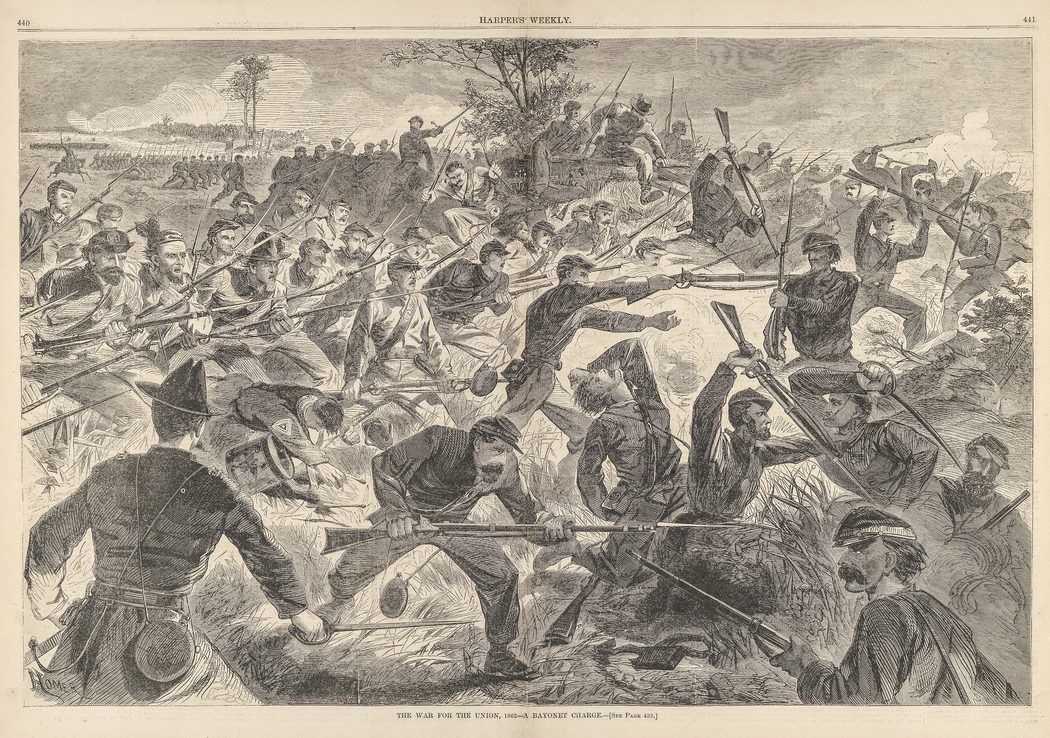
saved the Army of the Potomac by ordering that famous bayonet charge at Gettysburg. He noted in his report the following:
“My ammunition was soon exhausted. My men were firing
their last shot and getting ready to “club” their muskets. It was imperative to strike before we were struck by this overwhelming force in a hand-to-hand fight, which we could not probably have withstood or survived. At that crisis, I ordered the bayonet. The word was enough. It ran like fire along the line, from man to man, and rose into a shout, with which they sprang forward upon the enemy, now not 30 yards away. The effect was surprising; many of the enemy’s first line threw down their arms and surrendered. … we made an extended ‘right wheel,’ before which the enemy’s second line broke and fell back, fighting from tree to tree, many being captured, until we had swept the valley and cleared the front of nearly our entire brigade.”
The day of the bayonet was far from over. One must also consider the well-documented effect on morale of a phalanx of gleaming bayonets advancing steadily on defenders. The British Army command for fixing bayonets features a movement where the blade is held overhead for an instant, to communicate the threat which it represents. It was especially effective to control civil unrest as well, often dissipating a crowd of rioters without firing a shot. Rather than concluding that the bayonet was obsolete by the time of the Civil War, it is fairer to say that the tactic of charging an entrenched position with bayonets alone should have ended with the Civil War; yet it did not. Because of its usefulness in hand-to-hand fighting no matter how infrequent or impractical, the bayonet remained a valuable part of the infantry soldier’s equipment well into the twentieth century.
Craig L. Barry was born in Charlottesville, Va. He holds his BA and Masters degrees from UNC (Charlotte). Craig served The Watchdog Civil War Quarterly as Associate Editor and Editor from 2003–2017. The Watchdog published books and columns on 19th-century material and donated all funds from publications to battlefield preservation. He is the author of several books including The Civil War Musket:
A Handbook for Historical Accuracy (2006, 2011), The Unfinished Fight: Essays on Confederate Material Culture Vol. I and II (2012, 2013). He has also published four books in the Suppliers to the Confederacy series on English Arms & Accoutrements, Q u a r t e r m a s t e r stores and other European imports.