December 2022
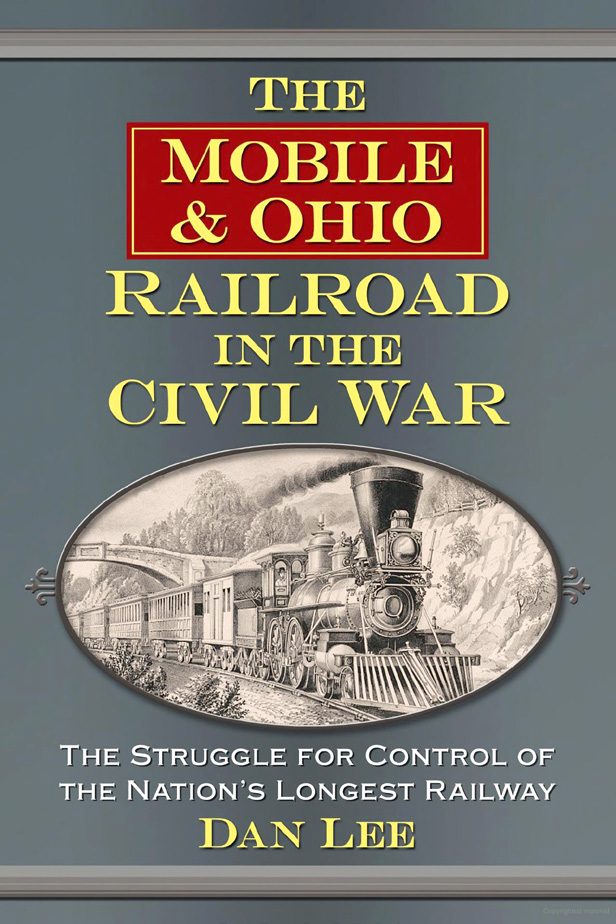
When the Mobile and Ohio Railroad was completed, it ran from Columbus, Ky., in the north to Mobile, Ala., on the Gulf coast. The connection, however, was short-lived; the final spike on the line was hammered in on April 22, 1861. Soon warring armies were operating along the M&O, each side using the rails within its lines to supply its own troops and wrecking the rails beyond to hamper the foe.
Dan Lee’s new book tells the story of the M&O during the Civil War, providing much interesting detail about the operation of the railroad amidst the stress and trauma of war. The reader meets the president of the company, Milton Brown, and his chief engineer, L.J. Fleming, two gentlemen who labored to keep the line running for the benefit of both their stockholders and the Confederacy.
To tell the story of the road and the struggle, Lee relies on the
records of the Norfolk Southern Corporation, the Official Records, a website on Confederate railroads run by David L. Bright, and many other primary and secondary sources.
The bulk of the book is devoted to narration of the battles fought in the area served by the M&O, from the fighting over Columbus early in the war to the fall of Mobile in April 1865. In between we visit Corinth, Iuka, and Corinth again. We witness Van Dorn’s famous raid on Holly Springs and ride with Forrest on his various adventures. Mississippi’s towns are wrecked and wrecked again. The railroad figures into this narration, of course, but the focus is on the marching, riding, and fighting.
Lee’s battle accounts are quite good, but readers familiar with the war in this theater will find little that is new. Those less familiar with the battles here may have trouble following the action, as the book contains only one map, and this shows nothing but the single rail line and about 20 towns and whistle-stops along the way.
Dan Lee has degrees in history from Murray State and Western Kentucky. In addition to this well-researched and well-written work, Lee has written four others published by McFarland, including a 2011 book on the Louisville & Nashville in the Civil War.
Reviewed by Jonathan A. Noyalas
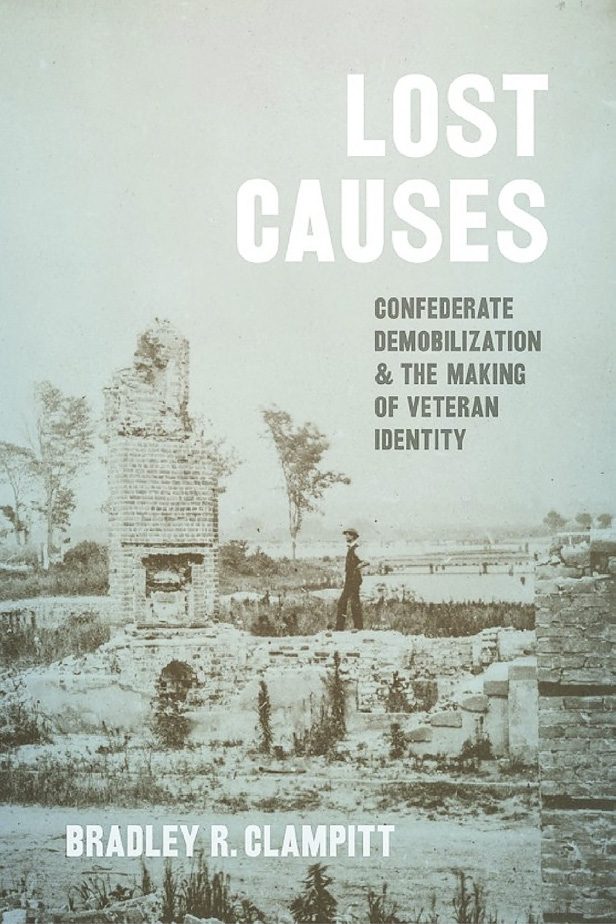
Thirteen years after the Civil War’s end Gilman & Co. published Union veteran Willard Glazier’s Battles for the Union. In the book’s final chapter Glazier offered a succinct narrative of the surrender at Appomattox and what immediately followed. After Generals Ulysses S. Grant and Robert E. Lee signed the surrender terms, Confederate soldiers laid down their arms, received their paroles, and journeyed home. In Glaizer’s accounting of events, one that has become all too familiar, the surrender brought a clean break with the war and ushered in peace, almost as if a switch had been flipped. Glaizer wrote simply that “the sunlight of peace fell athwart the National horizon.” The linear chain of events and the simplicity with which Glaizer described them has permeated much of the literature on the conflict’s end. Recently, however, a small cadre of historians, most notably Caroline Janney and James Broomall, have begun to intensely study the period following the surrender of Confederate forces and revealed that Confederate veterans confronted an array of difficulties and obstacles en route from the battlefield to home and once they arrived at home. Bradley Clampitt’s study makes a fine addition to this burgeoning body of scholarship.
Clampitt, a professor at East Central University, largely aims to achieve three objectives with this finely crafted and impressively researched study. First, Clampitt sets out to provide a nuanced account of the varied experiences of veterans as Confederate armies demobilized. Second, the author examines how those experiences helped shaped the ideology of the Lost Cause. Finally, Clampitt utilizes this study, based on a sample of 1,100 primary sources, to test the reliability of the claims Confederate veterans made decades after the conflict in reminiscences and regimental histories against what they recorded in the moment about surrender and journeys home in diaries and letters. “Rather than dismiss postwar sources as worthless or hopelessly flawed,” Clampitt suggests these sources, like all historical documents, are worthy of scrutiny, deserve fair analysis, and possess value.
After cogently outlining the array of emotions Confederate veterans felt at the moment of surrender, how they came to terms with it, and the logistics of demobilization in the book’s opening chapters, the author transitions to a remarkably detailed examination of their journey home. In addition to an analysis of the ways in which veterans procured life’s necessities, including stealing what was needed either from civilians or government warehouses, the author intensely explores the interactions between Confederate veterans and civilians. While the author uncovered numerous examples of civilians who offered assistance to veterans, Clampitt clearly illustrates that not every civilian eagerly lent material comfort to Confederate veterans. In some instances, Clampitt clearly shows that civilians who once supported the Confederacy, particularly those in more rural areas, were “more afraid of Johnny Rebs than vengeful Yankees.”
Clampitt also explores interactions between Confederate veterans and United States soldiers during the journey home. While on many occasions Union troops aided former Confederates making their way back to communities, the author highlights exceptions. Various factors, including some Union veterans’ beliefs that Confederates were traitors and deserved to be hung or Union soldiers who sought revenge for
President Abraham Lincoln’s assassination contributed to the animosity.
Additionally, the author explores challenges that Confederate veterans encountered when they returned home. In many circumstances the elation of reunions with loved ones quickly transformed into anxiety as veterans confronted economic uncertainty and grappled with the conflict’s emotional toll. In some communities, particularly in areas that held pockets of Unionists, former Confederate soldiers were greeted with disdain.
Clampitt’s volume also explores the interactions Confederate veterans had with formerly enslaved people on their homeward journey and upon their arrival home. While Clampitt concludes that many postwar writings which form the nucleus of this book compare favorably to accounts written in the conflict’s immediate wake, the author finds, not unsurprisingly, that veterans’ postwar writings about interactions with African Americans manipulate historic reality. Positive encounters Confederate veterans had with African Americans were spun in later decades to further cement the Lost Cause’s mythology of loyal, happy, and contented enslaved people.
Those seeking a deeper understanding of Confederate demobilization or searching for an analytical exemplar of determining the validity of postwar writings will find Clampitt’s intensively researched, well-written, and clearly argued history quite eye-opening and valuable.
Jonathan A. Noyalas is director of Shenandoah University’s McCormick Civil War Institute in Winchester, Virginia, a professor in Civil War Era Studies at Shenandoah University, and founding editor of Journal of the Shenandoah Valley During the Civil War Era. He is the author or editor of fifteen books including most recently Slavery and Freedom in the Shenandoah Valley during the Civil War Era, published by the University Press of Florida.
Visit our New Website
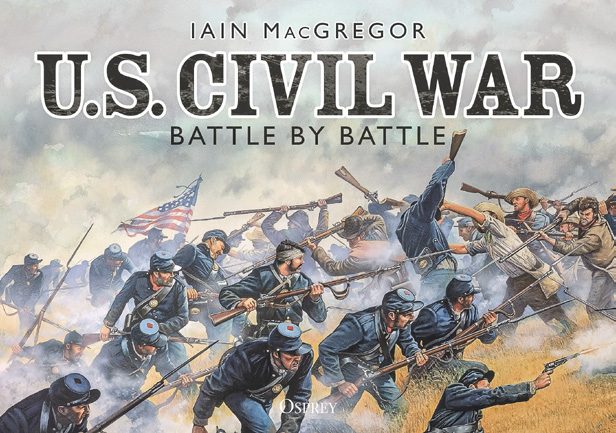
U.S. Civil War Battle By Battle. By Iain MacGregor. Illustrated, Index, Chronology, 128 pp., 2022. Osprey Publishing Ltd., ospreypublishing.com. First published in Great Britain. Also in Ireland and USA. Softcover. $8.46. Available in e-book format, $5.76.
Reviewed by Joan Wenner, J.D.
In this compact 7-1/2 x 5" book, longtime editor with three decades in non-fiction publishing working with a number of distinguished historians, author and publisher Iain MacGregor and his U.K. Osprey Publishing firm and with a talented team of artists, has produced a gem that joins his well-written WWII battles and ship, tank, and plane Spotter’s Guides.
He has tackled 30 leading engagements and detailed infantry, cavalry, artillery, and seaborne units through illustrations and engaging narrative giving “a rather true sense of the scale of the War Between the States.” The text also includes two lesser-known battles in the western theater such as the Battle of Okolona.
For example, for the Battle of Okolona: when Sherman began his Meridian, Mississippi, campaign he had some 7,000 horsemen “led by an unfortunate brigadier named W. Sooy Smith, and these coming down to Corinth to help him, ran into Bedford Forrest and 2,500 Confederates near Okolona and were roundly whipped, and Sherman presently marched his men back to Vicksburg.”
MacGregor accurately notes that when Sherman was ordered to capture the railway hub at Meridian, as well as the state arsenal and prisoner-of-war stockade located there, and then push on to Alabama as far as Mobile if practicable, he had dispatched orders for the 7,000 cavalrymen under the command of Brig. Gen. William Sooy Smith in Memphis to rendezvous with him at Meridian, traveling via Okolona, Miss., and the Mobile and Ohio Railroad coordinating in a series of feints to conceal Sherman’s real target.
Smith’s mysterious delay in departure and with his troops slowly riding “through the muddy roads of the countryside destroying railway lines, telegraph cables, burning crops and barns, and also freeing 1,000 slaves” is detailed. Leaving a frustrated Sherman to reluctantly head back to Vicksburg, “Smith ordered a halt and headed to Okolona. He would soon clash with forward units of Nathan Bedford Forrest’s 2,500 Confederates, “arguably the finest cavalry commander of the Civil War.”
On February 21,1864, a dogged chase by Forrest and a brigade led by his younger brother Jeffrey, slowed Smith’s retreat to Okolona itself. Read the battle’s narrative and learn why “Forrest’s reputation as a brilliant guerrilla leader of horse was now even further established in the minds of Union forces.” A story I once did about Forrest’s capture of a Union gunboat on the Tennessee River was equally brilliant and I believe it was the only instance when a cavalry commander scored a naval victory in the Civil War. Smith escaped five days later to the Tennessee border, was severely reprimanded, and left the military in September 1864.
Okolona had been ‘visited’ more than once. Only a month before Grant marched his army inland from the Mississippi River, occupied Jackson, and then began laying siege to Vicksburg, a Federal cavalry raid led by Benjamin Grierson slashed past Okolona as it swept the length of the state.
This ‘guide book’ also covers the Battle of Glorieta Pass in the far West in late March 1862.
online at
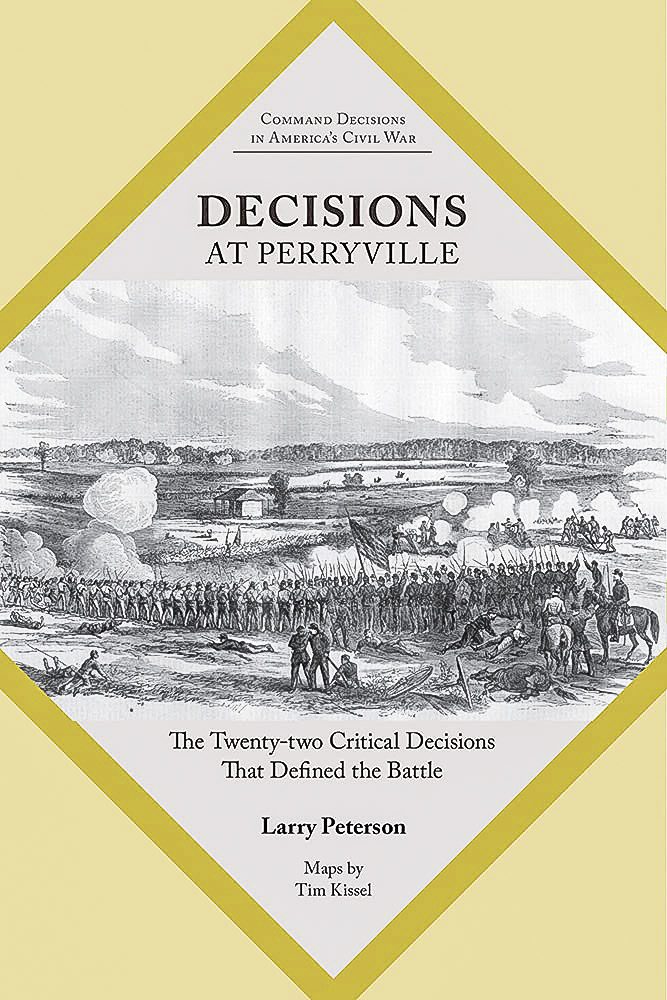
Decisions at Perryville: The Twenty-Two Critical Decisions That Defined the Battle. By Larry Peterson. Photos, notes, maps, index, 215 pp., 2022. University of Tennessee Press, www.utpress.org. $29.95.
Reviewed by Brian Matthew Jordan
This book, the latest entry in the University of Tennessee Press’s “Command Decisions in America’s Civil War” series, aims to analyze the major operational, strategic, logistical, and tactical choices that informed the bloody duel between the armies of Braxton Bragg and Don Carlos Buell at Perryville, Kentucky, on October 8, 1862. Author Larry Peterson is a veteran contributor to the series, having produced earlier volumes on Chattanooga, Atlanta, and, most recently, the 1862 Kentucky Campaign.
As do all previous titles in the series, this book foregrounds the contingent nature of a Civil War engagement. By isolating key episodes and pausing to ponder the full range of options available to the decision makers in the moment, Peterson issues an important reminder that nothing in the past had to turn out the way that it did. Careful analysis yields insight into the character and personality traits of individual commanders. The book recovers the battle of Perryville as a fluid, dynamic event that owed as much to misapprehension as it did to circumstances on the ground.
The introduction and first chapter situate Perryville in the larger operational and strategic context of the war. Peterson argues that the months between June and December 1862 represented the “period when the Confederacy had its best chance to achieve recognition as its own nation” (9). During these crucial months, foreign intervention was still on the table, the Lincoln administration had not yet reached into its deeper reservoirs of manpower, and the war had not yet taken its decisive turn toward emancipation. The Confederates’ Kentucky gambit played out under these circumstances.
In the second chapter, Peterson considers a half dozen decisions made in the days immediately preceding Perryville. On the Federal side, perhaps none was more important than Buell’s choice to replace the murdered Maj. Gen. William Bull Nelson, the commander of his III Corps, with “Acting Maj. Gen.” Charles C. Gilbert. An inexperienced and unimaginative commander, Gilbert “quickly lost the confidence of his men.” Then, during the battle, Gilbert failed to adequately support his embattled I Corps comrades (19).
On the Confederate side of the ledger, Bragg proved unable to distinguish between Buell’s “feint” on Frankfort and the main body of the enemy’s army (33). Bragg fought the battle with quarrelsome subordinates, chief among them Leonidas Polk, but also without any clear sense of his enemy’s true position.
Chapter Three tackles four decisions made the morning of the battle, while Chapter Four treats ten decisions made during the engagement itself. As Peterson parses the decisions that delivered the armies to Perryville, he reminds the reader that an “extreme drought constantly and significantly affected operations” (41). Commanders made decisions about the movements of their parched troops as they searched for potable water. While Bragg’s forces notched a tactical victory, decisively driving the federal lines back at great length, they ultimately conceded a strategic defeat when they withdrew and abandoned Kentucky.
Following a brief consideration of Bragg’s decision to retreat and Buell’s neglect to chase his foe, the author offers some general conclusions. Perryville, he writes, was “a nasty battle” that produced lengthy casualty rolls and proved the “high water mark” of the Confederate war effort in the Bluegrass State (97). Peterson further marvels that Bragg “unknowingly decided to assault” Buell’s main force, while Buell, outnumbering his opponent more than three to one, “postponed his attack out of concern that he was outmanned” (97).
An appendix presents an extended driving tour of the battlefield keyed to the decisions discussed in the main text. The ten-stop tour is punctuated by illuminating excerpts from official reports, as well as recent secondary literature. Peterson likewise appends complete orders of battle for both the Union and Confederate armies.
The author’s keen analysis lends depth and texture to our understanding of an important battle. Amplifying key moments and personalities, Decisions at Perryville nicely complements the fine, narrative battle studies produced by Earl J. Hess, Kenneth W. Noe, and Stuart W. Sanders. That being said, this book needed a copy-editor. Twice, for instance, the author states that Ambrose Burnside commanded the Federal army at Second Manassas. More than once, the author mistakenly writes that the battle took place on “September” 8, rather than October 8. Finally, in the conclusion, Peterson reports that the battle of Stone’s River was fought on January 31. These errors unnecessarily detract from an otherwise engaging text. Nonetheless, students of the war’s military history in general, and battlefield stompers in particular, will find this a useful volume.
Brian Matthew Jordan is Associate Professor of Civil War History and Chairperson of History at Sam Houston State University. He is the author or editor of five books on the Civil War and its era, including Marching Home: Union Veterans and Their Unending Civil War, which was a finalist for the Pulitzer Prize in History.
Timothy Smith, who teaches history at the University of Tennessee at Martin, is a prolific Civil War author whose theater of operations encompasses northern Mississippi and western Tennessee. Two earlier books by Smith on the Vicksburg campaigns covers the later stages of the Vicksburg Campaign story. The Union Assaults at Vicksburg appeared in 2020 and The Siege of Vicksburg in 2021; both were published by the University Press of Kansas, the publisher of the book under review here. Smith’s other works encompass the battles at Forts Henry and Donelson, Shiloh, and Corinth.
Early Struggles for Vicksburg goes back in time to narrate and analyze the first Federal efforts to take the Confederate stronghold during the fall and early winter
of 1862. Grant was newly in command of the Department of the Tennessee, answering to General-in-Chief Henry Halleck in Washington. His adversaries were Confederate Gen. John Pemberton and his subordinates, Generals Earl Van Dorn and Sterling Price.
While Grant moved south along the railroad, Sherman steamed down the Mississippi from Memphis then up the Yazoo River to land near Chickasaw Bayou. From there his task was to take high ground north of the city and, in coordination with Grant’s column, move in for the kill.
It wasn’t to be. Van Dorn, in a stunningly successful cavalry raid, destroyed Grant’s essential supply base at Holly Springs. Meanwhile Gen. Nathan Bedford Forrest was wrecking the supply chain further north in Tennessee. Grant was running out of everything his army needed. He retraced his steps, pulling back beyond the Tallahatchie River, a couple of hundred miles from his objective.
Sherman, completely out of touch with Grant, landed his force at Chickasaw Bayou on Christmas and the day after, unaware of Van Dorn’s Holly Springs raid on December 20. Grant’s retreat allowed Pemberton to shift more men to the Yazoo. A skillful defense by Gen. Stephen Lee and waterlogged terrain that greatly favored the defenders combined to stop Sherman’s assault. After heavy fighting, especially on the 29th, the first days of the New Year found Sherman’s men back on their riverboats heading toward Memphis.
Smith does an excellent job in describing the battlefield action and all other aspects of the campaign. Grant moved south from Tennessee, along his supply line, the Mississippi Central Railroad. Mississippians, pro-Confederate or not, suffered as do any civilians when great armies pass through. Slaves took advantage of the Federals’ presence to emancipate themselves. Grant dealt with bad weather, difficult river crossings, and supply problems. He also worried that Gen. John McClernand might arrive on the scene with his newly formed regiments, muddling up the works and undermining Grant’s authority.
As the outnumbered Confederates retreat, Pemberton is pulled in every direction at once, dealing with shortages of everything, while facing multiple threats in his large Department of Mississippi and East Louisiana. Civilians and soldiers on both sides tell their parts of the story through their letters and diaries.
The author places Grant’s moves, and Pemberton’s reactions, within a larger strategic framework. Jominian doctrine, favored by Halleck, governed Grant’s actions as he advanced along his line of supply. Smith argues that this by-the-book approach proved inadequate and he describes how Grant adapted in subsequent campaigns.
Smith’s book covers a lot of ground and the story is a complex one. Skillful narration, excellent maps, Union and Confederate orders of battle, and a well-done index help the reader keep it all straight. The account of the fighting at Chickasaw Bayou is especially strong.
Early Struggles for Vicksburg is a valuable resource for any reader seeking to understand what happened in late 1862 Mississippi, how it happened, and why it is an important part of the overall story of the Civil War.
Gould Hagler is a retired lobbyist living in Dunwoody, Ga. He is a past president of the Atlanta Civil War Round Table and the author of Georgia’s Confederate Monuments: In Honor of a Fallen Nation, published by Mercer University Press in 2014. Hagler speaks frequently on this topic and others related to different aspects of the Civil War and has been a regular contributor to CWN since 2016. He can be reached at gould.hagler@gmail.com.
Reviewed by Joseph Truglio
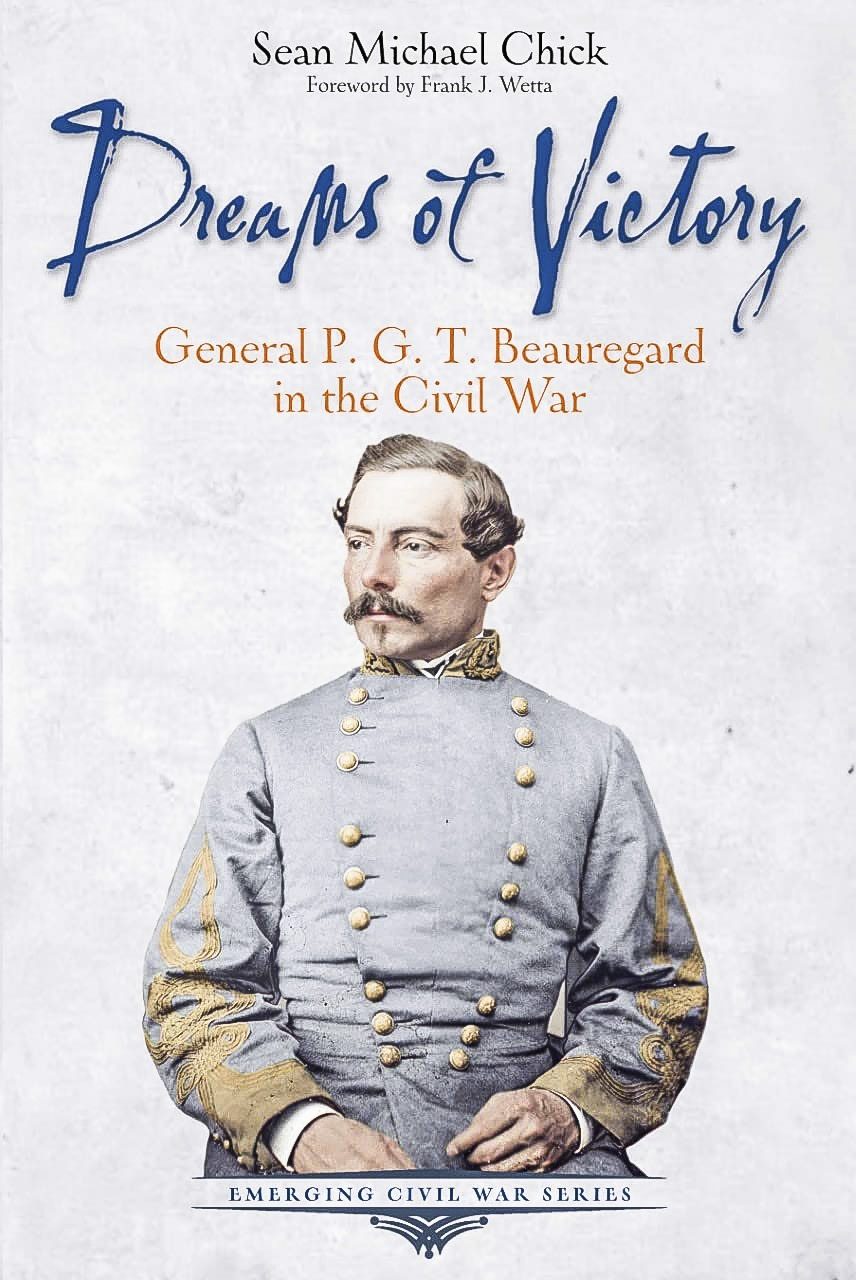
In all my years of studying the Civil War I know little of Beauregard. A “Fop,” the loser of Shiloh, an enemy of Jefferson Davis, and various other short comings. So, when the opportunity arose to read this book, I jumped at the chance.
Beauregard was born in 1818 to an Italian mother and a father of French/Creole heritages. They were a prominent family in New Orleans. He attended West Point, became an engineer of note, rose to be Commandant of the Academy for a day, before resigning when Louisiana seceded. He was in command of troops at First Manassas, and was very successful in orchestrating the Confederate victory.
His prickly personality put him in bad stead with Jefferson Davis. This animosity lasted till Davis’s death. It diminished his career throughout the War. He never got due credit for his actions as a result of this animosity.
Publishers/Authors Send your book(s) for review to:
Charleston, SC 29412
Confederate authorities blamed him for the loss at Shiloh, an unfair assessment. His excellent engineering skills saved Charleston and contributed to the repulse of Grant and Butler at Petersburg. These accomplishments were never recognized nor rewarded. Beauregard wanted field command of an army, but Davis denied him. R.E. Lee recommended him for command of the Army of Tennessee, but Davis gave it to John Bell Hood. This was one of Davis’ biggest mistakes as we all know how that turned out. Davis was a proponent of the ‘crony’ system.
Beauregard does well in the post war era, but because of several decisions and beliefs he went unheralded. He was not a proponent of ‘The Lost Cause,’ believed in equal rights for African Americans, and did not believe in the canonization of Lee. Although he got along with Lee, I believe he was a bit jealous of his fame. Perhaps his biggest mistake was joining the board of the Louisiana Lottery, a thoroughly corrupt enterprise. It made him financially secure but left a bitter taste in the mouths of the Southern people. He never left his beloved New Orleans and died there in February 1893.
This is an excellent biography, filled with information, a short reading list, and notes. In reading it I tried to compare him to a Union general of similar traits. I failed. Beauregard is unique. There has not been a new bio of Beauregard since T. Harry Williams wrote Napoleon in Gray back in 1955. Perhaps Mr. Chick will take up that task in the near future. I certainly hope so.
Joseph Truglio, of Manchester, N.J., is a retired Motion Picture Technician who has a lifelong interest in the Civil War. He is past President of the Phil Kearny CWRT in N.J.