Lieutenant General James Longstreet: Innovative Military Strategist. By F. Gregory Toretta. Illustrated, notes, bibliography, Casemate Publishers, 2022, 241 pp., hardbound, $34.95.
Reviewed by Wayne L. Wolf
Recent scholarship placed General James Longstreet among Civil War generals who tried to fight a modern war. His adaptive thinking took into account the impact of the rifled musket and cannon, the destructive power of the Minie ball, the use of rail transportation to effectively employ interior lines, and his using tactical defensive tactics to counteract the Northern numerical superiority in manpower and equipment. He was analytical, subtle, and deliberate in his calculations and ever concerned with the needless loss of manpower in frontal assaults, manpower that the South could not replace.
This study spans the years 1863- 1864 to focus on how General Longstreet’s tactical maneuvers could have benefitted the Confederate army at Gettysburg, Chickamauga, Knoxville, and the Wilderness. Voluminous excerpts from the writings of Generals Edward Alexander, G. Moxley Sorrel, and James Taylor show Longstreet strategically wanted to conserve precious resources while demoralizing Federal forces, increasing dissatisfaction with the Lincoln administration, and prolonging the war until a negotiated peace could be obtained. Unfortunately, he was frequently ignored by President Jefferson Davis, General Robert E. Lee, and General Braxton Bragg who clung to Napoleonic tactics that ignored contemporary technology. The result was the draining of Southern troops in needless slaughter.
The author speculates that Longstreet was never given credit for all he achieved on the battlefield because he was not a Virginian, had incurred the wrath of President Davis, and aligned himself with the Republican Party after the war. This book is one of several new publications coming to market that attempt to rectify this omission.
This book is historically accurate with voluminous excerpts. These extensive excerpts could be abbreviated to make the same point increasing the book’s readability and giving the author additional space for analysis. The maps that appear in the text are too small to be of any material value for the reader. Aside from these limitations, the book gives a comprehensive analysis of Longstreet’s strategy and is recommended for historians wishing to give credit where credit is due.
Dr. Wayne L. Wolf is Professor Emeritus at South Suburban College and the author of numerous Civil War books and articles including Two Years Before the Paddlewheel, Heroes and Rogues of the Civil War, and the Last Confederate Scout. He is past president of the Lincoln- Davis Civil War Roundtable and frequently gives talks on the common soldier in the Civil War.
Reviewed by Jonathan A. Noyalas
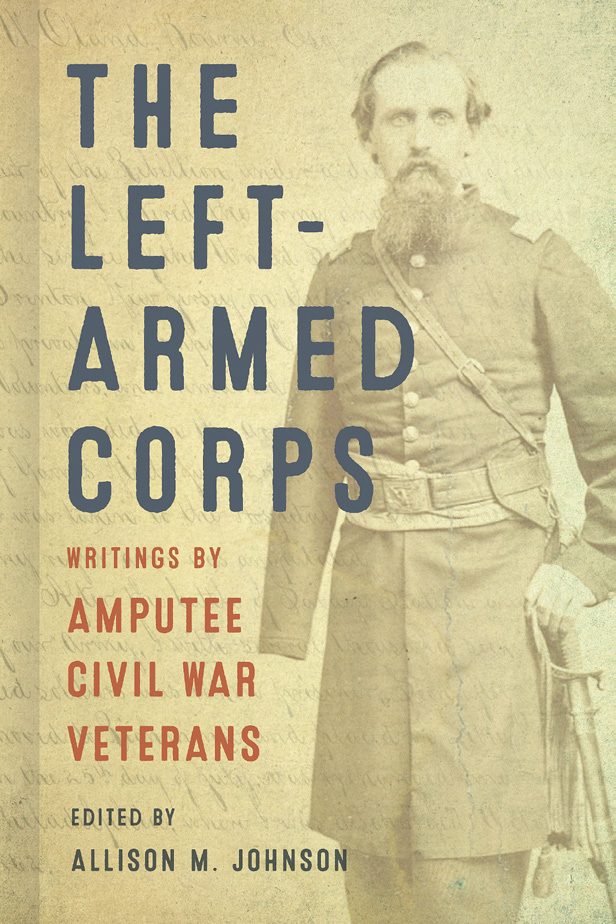
In the summer of 1865 newspapers across the United States announced William Oland Bourne’s penmanship contest for Union veterans who “have lost their right arms, or whose right arm is so disabled that they cannot write with it.” Bourne, a chaplain who worked at New York’s Central Park Hospital during the conflict and published The Soldier’s Friend, believed that these “left-armed soldiers” could only “fit themselves for lucrative and honorable positions” after the conflict if they learned how to effectively use their left hand. The contest promised a financial reward to top entrants, an exhibition, and “publication of a memorial volume” if the exhibition generated enough proceeds. Regrettably, Bourne’s dream of a published volume never materialized. For a century-and-a-half the more than 300 essays Bourne received from the contest in 1865, and a second one two years later, resided in obscurity in the Library of Congress. Fortunately, Allison Johnson, an English professor at San José State University, has rescued these important voices.
While Johnson offers a superb introduction detailing Bourne’s effort, contest rules, provides brief biographies of each entrant, and appropriately annotates each essay, Johnson does not overburden the volume with extraneous material and allows the veterans’ submissions to remain the book’s focal point. Central to many submissions are detailed descriptions of the soldier’s wounding and hospital experiences. For example, Heman Rockwood, a private in the 106th New York Volunteer Infantry wounded at the Third Battle of Winchester, vividly described the “sound of a single shell as it came howling through the air,” his subsequent wound, experiences in a field hospital, and transport to Philadelphia.
Other entrants went beyond basic descriptions of their experience and offered insight into how veterans believed the loss of their right arm served as a visible reminder of their patriotism. William Kipling, an English immigrant who arrived in New York in 1861, served in the 3rd United States Artillery, and was wounded at Battery Wagner in the summer of 1863, expressed pride that he lost his “once dear right hand” in the fight “for the Union.” While many veterans offered patriotic reflections such as Kipling’s, not all did. Sergeant Thomas Perrine, a 140th Pennsylvania Volunteer Infantryman wounded at Chancellorsville, submitted, as did a contingent of other veterans, a poem. Perrine’s “Sinistra Manu Scripta” offers a sorrowful lament about how the loss of his right arm ended the relationship with his girlfriend.
This volume’s importance, however, extends significantly beyond grisly descriptions of wounds, hospital experiences, and reflections on how the loss of a right arm forever altered life’s course. Some essays highlight the important roles African Americans played in aiding Union soldiers. Elisha Wise, a veteran of the 11th Pennsylvania Volunteer Infantry, wrote a detailed description of how an unidentified African American woman and her husband provided him food after he was captured at the Second Battle of Bull Run and aided him to escape his Confederate captors. Wise’s submission, one which I believe is among the most compelling in the volume, also offers insight into the strength of Unionist sentiment in Martinsburg, West Virginia.
Submissions to Bourne’s contest offered some veterans an outlet to express their opinions about various political matters in the conflict’s aftermath. Ezra Dayton Hilts,1st New York Volunteer Light Artillery, who lost his right arm at Williamsburg, Va., explained that he did not support immediate pardons for Confederates after the Civil War’s conclusion and instead wanted them to “first kneel in the dust of humiliation and show by their deeds that they sincerely repent.” Others such as Private Henry Krahl, 13th United States Infantry, wounded at Arkansas Post in 1863, vehemently argued for full citizenship rights for African Americans.
The wide array of experiences, perspectives, and reflections expressed by the veterans in Bourne’s contest make this an important compilation of primary sources. Johnson’s masterfully edited volume is essential for anyone interested in war’s tragic toll on the human body and those seeking a deeper understanding of what Union veterans thought about a wide array of topics including patriotism, politics, pensions, the Union’s restorations, and citizenship.
Jonathan A. Noyalas is director of Shenandoah University’s McCormick Civil War Institute in Winchester, Virginia, a professor in Civil War Era Studies at Shenandoah University, and founding editor of Journal of the Shenandoah Valley During the Civil War Era. He is the author or editor of fifteen books including most recently Slavery and Freedom in the Shenandoah Valley during the Civil War Era, published by the University Press of Florida.
November 2022
Stan Cohen, Following in the Footsteps of Jefferson Davis: Statesman – Soldier – Author – Planter – President. Selected bibliography, 252 pages, Pictorial Histories Publishing Company, Missoula, Mt., www.pictorialhistoriespublishing.com, paperback. $25.00.
Reviewed by Thomas J. Ryan
The author of this publication portrays it as a “pictorial history of Jefferson Davis from his birth, his family, wartime experiences, political life, Secretary of War, his presidency, his capture and imprisonment, and his death
and legacy.” Stan Cohen’s objective is to present to “the reader a comprehensive look at one of American history’s most interesting and productive individuals.” In fact, Cohen has put together a remarkable collection of visual aids to illustrate the life and accomplishments of a man who qualifies as one of the most controversial in U.S. history.
Jefferson Davis, in his nearly 90 years on the world’s stage, proved to be a talented, devoted, and energetic performer in a wide variety of significant roles. In fourteen chapters, this study represents Davis as a cadet, military officer, cabinet member, congressional representative, senator, president, prisoner of war, and elder statesman.
cabinet members and military leaders, pertinent newspaper articles, personal residences in Montgomery, Ala., and Richmond, Va., along with their architectural drawings and interior furnishings. In addition, there are marble busts of key players in the Davis administration, historical statues, and structures that played important roles during Davis’s administration, including St. Paul’s Episcopal Church and the Virginia State Capitol.
Cohen devotes a chapter to Davis’s vice-president, the enigmatic Alexander Stephens, and multiple chapters deal with the Civil War period, as well as Davis’s eventual imprisonment. A separate chapter covers Davis’s time spent in retirement at Beauvoir in Biloxi, Miss.
Throughout this illustrated history of the life and times of Jefferson Davis, the author places the reader at the scene and provides appropriate descriptive narrative. Although this publication is not intended as an analytical history, it does whet the appetite for further knowledge about Jefferson Davis, and those who played important roles in his life.
A selected bibliography provides sources to pursue further the life and times of Jefferson Davis, including William J. Cooper Jr.’s Jefferson Davis, American, and Jefferson Davis, The Man and the Hour by William C. Davis. Other recommendations include Jefferson Davis’s twovolume autobiography titled The Rise and Fall of the Confederate Government, and Varina Howell Davis’s biography of her husband, Jefferson Davis, Ex- President of the Confederate States of America.
In effect, this pictorial history offers an opportunity to observe Jefferson Davis in a variety of roles during his productive, as well as more controversial, years.
Publishers/Authors Send your book(s) for review to:
Charleston, SC 29412
“Following in the Footsteps of Jefferson Davis” is heartily recommended. It serves as a reminder of the reservoir of knowledge still waiting to be discovered.
A Union Indivisible – Secession and the Politics of Slavery in the Border South, by Michael D. Robinson. 2017, Chapel Hill, The University of North Carolina Press. 294 pp., paperback. $19.95.
Reviewed by Charles H. Bogart
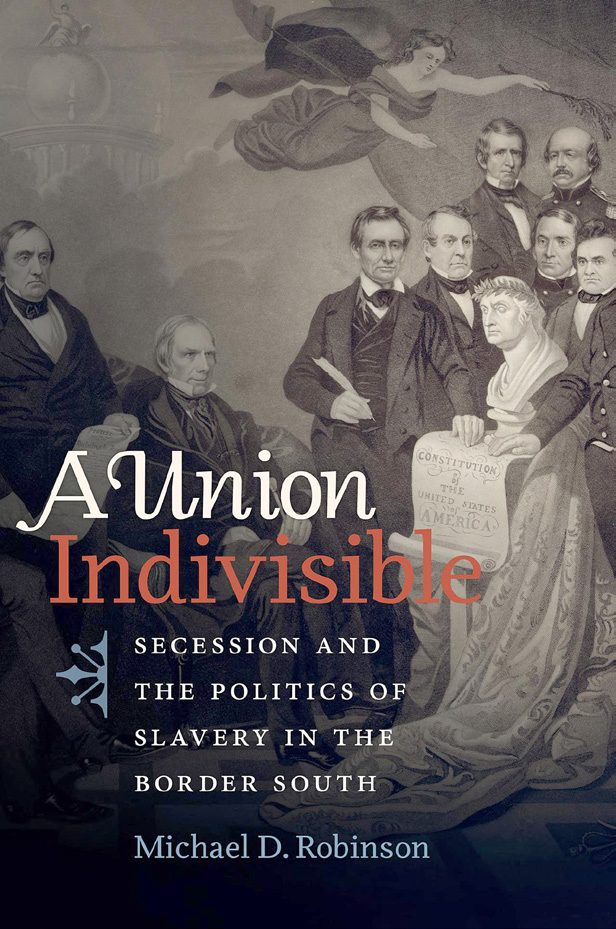
It has often been said that Kentucky left the Union in 1866 to join the Confederacy. Why this came about is laid out in some detail in this book. While the author examines the political and social turmoil that buffered four of the five Border States, Missouri, Kentucky, Maryland, and Delaware during the winter of 1860–1861, much of his focus deals with Kentucky and Senator John J. Crittenden of Frankfort, Kentucky. All four Border States were slave states, that is, slavery was legal within their borders. Two of the three largest slave owning cities were in the border states, Baltimore and Louisville. However, all four states chose to remain in the Union.
The author’s premise is that the Border States saw the existing Federal government as the best guarantee to preserving the institution of slavery. To them, the United States Constitution protected their rights to own slaves and these rights were guaranteed by numerous federal laws that further bolstered the rights of slave owners. Lincoln, they held, might have been elected president on a platform of non-expansion of slavery, but the slave owning states controlled Congress. Therefore, Lincoln and his supporters were powerless to make any significant changes in the laws governing slavery.
The Border State Unionists, however, were divided into two camps, unconditional and conditional. The unconditional Unionists supported any war effort by the Federal government to preserve the Union, while the conditional Unionists fought to preserve the Union as they understood it to exist on the day before Lincoln was elected president. The Kentucky Unionist who served in the U.S. Congress during the Civil War owned more slaves than the Kentucky Secessionist serving in the Confederate Congress.
Front and center in this story were the efforts of Senator John J. Crittenden to preserve the Union. Just as Senator Henry Clay of Kentucky had negotiated compromises that ended various slavery based secession crises during the 1840s and 1850s, Senator Crittenden sought to orchestrate such a compromise during the winter of 1860 and 1861. That he was unable to find a common ground for compromise was due to the fact that the time for compromise had passed. Crittenden, when he was unable to draft a compromise satisfying a majority in Congress, moved for calling a public meeting hosted by the states to find common ground to avoid war. Yet while this move for public meetings generated a lot of positive comments, it also failed to halt the drift to war. With his hope for a compromise settlement in ruins, Crittenden, in July 1861, introduced into Congress a War Resolution Act that did not hint at any change in the Federal slavery policy. Its passage strengthened the Unionist hold in the Border States, but its noble sentiments were soon forgotten as fighting broke out and confiscation of property held by those in rebellion became the policy of the Federal government.
The heart of the book is how the Border States during the 1860/61 secession crisis were pulled in two directions. They are slave owning states with ties to the south. but they also have strong economic, transportation, and social ties with the free states. Emotion and reason pull the Border States’ Conditional Unionist this way and that, as the situation around them constantly changes in a fluid war time environment. The firing on Fort Sumter and Lincoln’s call for volunteers to put down the secession movement are tipping points in turning a Conditional Unionist into a Secessionist or Unconditional Unionist. There will be other tipping points during the course of the war, the issuing of the Emancipation Proclamation and the passage of the 13th Amendment ending slavery were the two greatest tipping points in turning the Conditional Unionist into a Secessionist or Unconditional Unionist. Delaware did not ratify the 13th Amendment until 1902; Kentucky only did so in 1976.
The book ends with twelve tables. These tables need to be studied and reflected upon as they provide a numerical insight into the economic and social makeup of the Border States and show the differences and similarities they shared with their northern and southern neighbors.
This book will stand the test of time and is a must read to understand why the Border States acted the way they did in 1861 and then in 1866. The margin between the Border States remaining in the Union or leaving the Union in 1861 was razor thin.
Charles H. Bogart has a BA from Thomas More University and an MCP from Ohio State University. He is a tour guide at Fort Boone Civil War Battle Site in Frankfort, Ky., served as President of the Frankfort Civil War Roundtable, and is a board member of the Kentucky Civil War Roundtable. He has written several books and articles on Civil War history.
Count the Dead: Coroners, Quants, and the Birth of Death as We Know It. By Robert W. Black, University of North Carolina Press, 140 pp. ISBN-10- 1469667525, softcover $17.95. Reviewed by Meg Groeling
Count the Dead: Coroners, Quants, and the Birth of Death as We Know, by Stephen Berry, may not initially seem like a Civil War book. According to the author, “This is a book about death and data...” but it quickly gets into an easily-understood discussion about the importance of data to state and national politics. From the mortality census of 1850, breakthroughs in disease classification, diagnostics, and vital statistics allowed the government to count the dead and put them back into the workforce as data. By learning when citizens died and from what, government health initiatives doubled Americans’ lifespans from 1850 to 1950. It is one of the significant reasons historians know more soldiers died from disease than from battlefield injuries during the Civil War.
Between 1861–1865, the U. S. military began to develop its now-highly-effective process for notifying families of deaths, returning corpses, and keeping a record of who died while under its care. However, until the dead began to be counted, they did not “count.” As a result, at the beginning of the war, there was no idea that the federal government was responsible for the men who fought, especially after they died. It was not until the end of the war and the National Cemetery movement, combined with families who scoured battlefields and hospitals looking for their loved ones, that the importance of counting the dead was realized and acted upon.
The most critical aspect of counting the dead comes when the dead are identified by name: “... died from the whipping given her by William Tuggle,” is what a coroner in the antebellum South wrote concerning the incident involving Jeny, a slave (xvii). Author Berry suggests that, because there is no statute of limitations on murder, relisting Jeny’s fate as, “In 1786, the enslaved woman Jeny was murdered by William Tuggle.”
The casualty list was the Civil War’s first attempt to identify dead soldiers by name. Printed in hometown newspapers, these were required reading by every family with a soldier in the army. Clara Barton and Dorence Atwater used Atwater’s list of the dead to identify and reinter the dead of Andersonville. The first memorials to fallen soldiers were put up immediately after the war and listed the names of local dead. These memorials included little other ornamentation. The names were honor enough. Readers who have used ancestry. com or FindAGrave to research ancestors will quickly understand (and agree) with author Stephen Berry. Counting the dead is mightily important in any era. His book shows how a metaverse of coroners, court officials, and state and federal authorities, both past and present, developed methods to track and identify patterns of dying. Their work turned the dead into informants, allowing them to speak once again.
Berry’s subject matter may be serious, but his writing style is thoroughly enjoyable. He includes quotes from other books, brief histories of pertinent points, and a clever smattering of poetry among the prose. For example, one chapter concerning the Civil War ends with an excerpt from Herman Melville. It concerns the reading of the casualty list in the local paper: The death-list like a river flows Down the pale sheet,
And there the whelming waters meet.
Counting the Dead: Coroners, Quants, and the Birth of Death as We Know It is relatively short, but its words and images are powerful. Anyone interested in nineteenth-century American cemeteries, monuments, and memory would be well advised to add this book to their collection.
Meg Groeling received her Master’s degree in Military History, with a Civil War emphasis, in 2016, from American Public University. Savas Beatie published her first book, The Aftermath of Battle: The Burial of the Civil War Dead, in the fall of 2015, and she has written First Fallen: The Life of Colonel Elmer Ellsworth, which Savas Beatie will also publish. In addition, she is a regular contributor to the blog Emerging Civil War. She and her husband live with three cats in a 1927 California bungalow covered with roses on the outside and books on the inside.
Sons of East Tennessee: Civil War Veterans Divided and Reconciled. By Jack Brubaker. Photos, notes, bibliography, index, 237 pp., 2022. McFarland & Company, Inc. Publishers. ISBN 978-1-4766-8414-7 $35.00
Reviewed by John D. Fowler
The American Civil War, like most such conflicts, ripped apart a nation and brought untold suffering to its inhabitants. Border States such as Tennessee were especially scarred as their populations were divided over the issues of secession and war. Since its founding in 1796, Tennessee had been a state characterized by sectionalism, as the three “Grand Divisions” of East, Middle, and West struggled for political and economic superiority. At no time was this sectionalism more apparent and more tragic than during the Civil War era. United by politics and economic
Want To Advertise In Civil War News?
self-interest, Middle and West Tennessee overwhelmingly supported secession and alliance with the Confederacy.
The majority of East Tennesseans, however, refused to abandon their allegiance to the old Union, precipitating an intrastate civil war within the national conflict. East Tennessee’s stance involved more than just another chapter in the state’s ongoing sectionalism, however. It also involved a rejection of the Confederate South and its values. This rejection made Tennessee’s eastern counties not only a distinctive section of the state but also a distinctive region within the South.
Jack Brubaker’s Sons of East Tennessee is an engaging look at the fractured nature of East Tennessee during and especially after the Civil War. It is essentially the story of two aging Civil War veterans who meet for the first time while mourning the deaths of their sons at a joint funeral at the Knoxville National Cemetery, one of the nation’s oldest military cemeteries. Reuben Frank Bernard was a brevet colonel of the First U.S. Cavalry, and Dr. William Alexander McCorkle was a major and surgeon of the Second Tennessee Cavalry, CSA. The loss of their sons, Second Lieutenant John Jay Bernard, Fourth U.S. Infantry, and First Lieutenant Henry Leftwich McCorkle, Twenty-First U.S. Infantry, brought the two former enemies together in shared grief. Their boys were both University of Tennessee graduates, and both were killed near each other in Cuba during the Spanish- American War. Contemporary newspaper accounts presented the encounter as an example of the national reconciliation between North and South that was still manifesting itself in the late nineteenth century.
Brubaker’s interesting narrative begins with the reconciliation. Post-war resentment toward the United States and the national government had remained fresh in the South for a generation. National holidays such as Independence Day were still not celebrated in parts of the former Confederacy. Yet, since East Tennessee had largely remained loyal to the Union, it integrated back into the United States quickly, and any ex-Confederates in the region had to integrate as well or face expulsion or worse. Ex-Rebels had to gradually accept defeat and a united nation. Yet, elsewhere in the Volunteer State, it was the ex-Confederates who were in control; integration and reconciliation came slower and more painfully. As the decades passed and passions subsided, however, the state’s veterans, both Union and Confederate, led the way in moving past the bitterness of the war.
The author poignantly describes the Nashville Memorial Day service in 1899 when Knoxville Mayor William Rule spoke about national reconciliation in the Spanish American War. Rule told the audience the story of the two men and how the fathers had buried their sons side by side in Knoxville. The mayor stressed that both sons were Tennessee boys. These young soldiers, sons of officers who had fought on opposite sides during the Civil War, died leading their troops in battle at El Caney, Cuba. They had been buried hastily where they fell on July 1, 1898, but they had been reburied ceremoniously at Knoxville on April 2, 1899. Rule eulogized them, stating: “A few weeks ago two fathers stood before two open graves in the national cemetery at Knoxville, into which were tenderly lowered two caskets, containing the remains of two Tennessee boys,” he said. “Both were lieutenants in the regular army,” he explained. “Both were Tennessee boys, who attended the same Tennessee university, and each had poured out his life’s blood following the same flag on the same battlefield, and now their fathers – one who wore blue, the other who wore gray – mingled their tears over the biers of their precious boys who had sacrificed their young lives on the same altar of patriotism in defense of the same flag and the same country.” “Ah!” Rule continued. “Tell me not, in the presence of such a scene as that, that Americans are not Americans, even though they may have a radically different past…! The time is at hand,” he concluded, “when we are indeed and in truth one people, with a common interest, a common purpose, a common destiny.”
The author uses this story to begin a deeper examination of both families and what the deaths of the two young lieutenants meant to America and its struggle to heal the wounds of a civil war. Brubaker spends time examining the lives of the two fathers before and during the war. Both families settled in Hawkins County prior to the Civil War. Both sacrificed much during the war. Both returned to Hawkins County to rebuild their lives and rear families. Both families had strong ties to the University of Tennessee, where the young lieutenants had graduated. Finally, both families came to represent the healing of the region, the state, and the nation as exemplified by the university memorializing the two lieutenants on several occasions in the early1900s.
The rest of the book contains chapters that place the story of these two families into context. The author discusses East Tennessee during and immediately after the Civil War, as well as the creation of the national cemetery at Knoxville and early memorialization and monument building activities conducted by the region’s Unionists and former Confederates. One chapter focuses on East Tennessee’s reaction to the Spanish-American War as well as an exploration of the battle at El Caney that claimed the lives of the young lieutenants. Other important chapters examine the initial
“The best little book on Barnard”
The American Civil War was the first war in which both sides widely used entrenchments, repeating rifles, ironclad warships, and telegraphed communications. It was also the first American War to be extensively photographed. Mathew Brady, Alexander Gardner and Timothy O’Sullivan are famous for having made iconic photographs in the Civil War’s eastern theater. George N. Barnard deserves to be ranked in this top tier for his photographic work in the war’s western theater. A civilian photographer hired by Gen. William T. Sherman’s chief engineer to take pictures of fortifications around Atlanta, Barnard took several hundred of them in and around the city in the fall of 1864. His most famous is the site of Union Maj. Gen. James B. McPherson’s death in the battle of Atlanta, July 22, 1864. Thus far, no comprehensive, definitive listing has been made of the photographer’s work. For this book we have chosen a hundred images we deem “significant.”
burial and memorial of the two soldiers and their subsequent reburial in Knoxville. Brubaker concludes with an insightful epilogue that ties the memorial in 1899 to the 2015 Tennessee Civil War sesquicentennial. The author noted that while earlier reconciliation efforts between Unionists and Secessionists had left out the plight of African Americans, the 2015 memorialization included a sermon by an African American minister did not. This conclusion eloquently illustrated that while the wounds of Tennessee’s and America’s great national tragedy are in many ways still healing, great progress has been made.
In sum, Sons of East Tennessee is an interesting book that focuses on the effects of war over time. The author does an excellent job of exploring the immediate post-war period and the nation’s struggle to find healing and reconciliation after a bitter and costly civil war. He goes further in attempting to tie that struggle and its legacy to our time and explore where scars still remain. Overall, it is a solidly researched and well-written work that should find a wide audience with Civil War enthusiasts as well as those interested in historical memory.
John D. Fowler, Ph.D., is the author of several books and articles on the Civil War Era. He is the author of Breaking the Heartland: The Civil War in Georgia. He is currently a Professor of History at Dalton State College.