Reviewed by Wayne L. Wolf
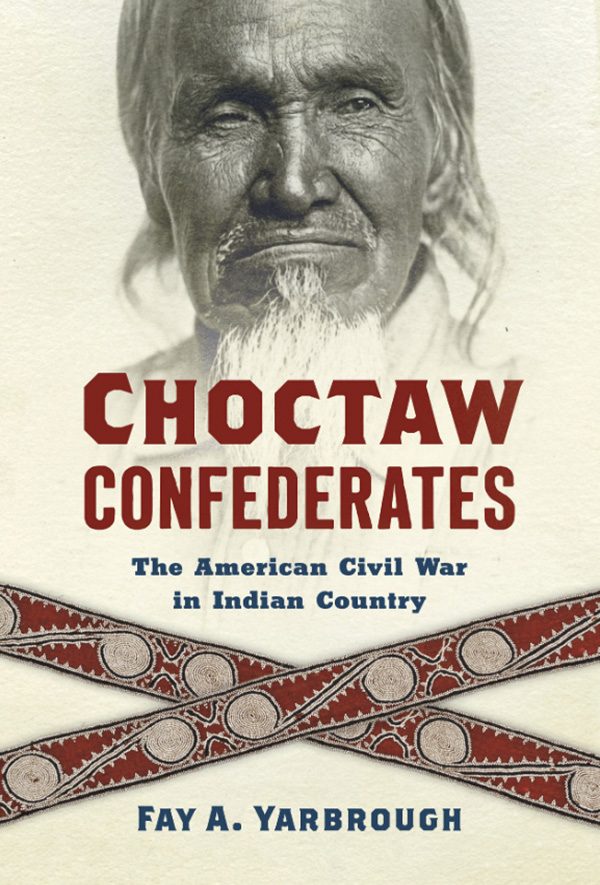
Choctaw Confederates is an attempt to explore motivations behind the enlistment of over 3,000 Choctaws in the First Choctaw and Chickasaw Mounted Rifles and their alignment with the Confederacy. An extensive portion of this book, however, deals with three crucial elements: national sovereignty, states’ rights, and the survival of slavery, and how they affected Choctaw culture. The text traces the Choctaw experience with the U.S. government before the war, the treaties that shaped Choctaw relations with Washington, and the cultural and social attributes of Choctaw society. Essentially, the Choctaw experience before the war was a Southern experience, wherein slavery played an integral part; the Choctaws thus saw their support of the South as crucial to their own survival as a separate, sovereign nation, with slavery preserved.
The author exhaustively details how the Civil War offered Choctaw men an opportunity to recover their identity as warriors, altered gender and property roles, and gave the Choctaw common ground with their Confederate neighbors. Hence, the combination of Choctaw reliance on slavery, geographic proximity, pressure from neighbors in Texas and Arkansas, Southern promises of national sovereignty, and the assumption of annuity payments compelled their alliance with the Confederacy.
In 1861 enlistments for the South ran high, although initial battles, e.g. Round Mountain, Chusto-Talasah and Chustenahlah were basically fought against Creek Indians who initially sought neutrality. Enlistments began to wane by late 1862; as the war dragged on supplies, clothing, arms, food, and victory became scarcer.
Unfortunately, the author gives only passing treatment to combat where Choctaws were engaged. Battles like Honey Springs, Boggy Depot, Perryville, Backbone Mountain, Caving Banks, and Locust Grove receive virtually no treatment. Valuable insight into the Choctaw performance in these encounters, the impact on their communities, and their military significance is never discussed. Rather sociological perspectives, such as a necessity for warriors, marriage customs, and political participation take center stage. A short chapter on Reconstruction and the Choctaw Freedom Bill of 1883 was almost exclusively a discussion regarding the rights of the newly freed slaves.
The author’s first book on Race in the Cherokee Nation could easily have served as the title of this book by substituting the word Choctaw. For the historian who wishes to delve into the sociological and cultural basis of Choctaw society, this book would be helpful; but for any understanding of the contributions of Choctaw Confederates to the war effort there is little to tantalize the military historian.
Wayne L. Wolf is Professor Emeritus at South Suburban College, the author of over thirty Civil War books and articles, and past president of the Lincoln- Davis Civil War Roundtable.
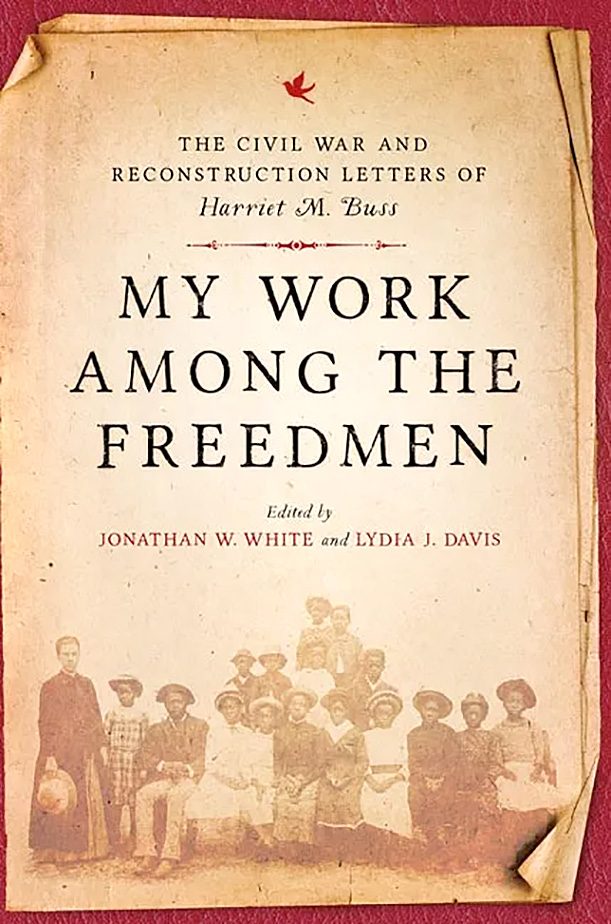
My Work Among the Freedmen: The Civil War and Reconstruction Letters of Harriet M. Buss. Edited by Jonathan W. White and Lydia J. Davis. Photos, notes, index, 244 pp., 2021. University of Virginia Press, www.upress.virginia.edu. $39.50.
Reviewed by Jonathan A. Noyalas
When Harriet Buss passed away on October 10, 1895, a correspondent for The News and Observer in Raleigh, North Carolina, wrote that throughout her distinguished career as an educator Buss “enjoyed the high esteem and friendship of teachers and pupils.” Historians, particularly those who have studied the education of African Americans after the Civil War, have made excellent use of Buss’ correspondence. Now through the efforts of historians Jonathan White, a prolific author and professor at Christopher Newport University, and Lydia Davis, an educator at the Mariners’ Museum in Newport News, Buss’ correspondence ranging from March 1863 to April 1871 is available in this valuable and brilliantly edited collection.
Born in 1826 in Sterling, Massachusetts, Buss, who began her teaching career in 1850 as an assistant teacher at Charlestown Female Seminary in Massachusetts, proved an important figure in the education of formerly enslaved people on the Sea Islands of South Carolina during the Civil War and in Norfolk, Virginia, and Raleigh, North Carolina, in the conflict’s aftermath.
While this significant collection of letters offers much to individuals interested in the education of African Americans during and after our nation’s most tumultuous moment, this superb assemblage offers important insight into the ways teachers who journeyed south formed bonds with each other, coped with the various pressures they confronted, established relationships with their students, and the manner in which formerly enslaved people commemorated emancipation. Additionally, Buss’ letters provide critical insight into figures who played important roles in the establishment, perpetuation, and expansion of educational institutions for African Americans after the conflict. Particularly noteworthy are Buss’ musings about Henry Martin Tupper, a veteran of the 36th Massachusetts Infantry, who established the Raleigh Baptist Institute for the Education of Colored Men for the Ministry after the Civil War’s end. By 1875 this institution evolved into Shaw University, a place near and dear to Buss’ heart as she not only taught there and assisted in raising funds to help sustain it, but upon her death in 1895, gave a portion of her estate for its perpetuation.
Beyond this volume’s usefulness to understanding the education of African Americans during and after the Civil War and the challenges confronted by students and teachers, Buss’ correspondence offers a lens through which one can gain a more cogent understanding of the Civil War era from a woman’s viewpoint. Throughout, Buss peppered her correspondence with thoughts about various military figures she encountered in her work. For instance she found James Montgomery, colonel of the U.S. Second South Carolina Volunteers, a regiment of largely escaped slaves, “quite interesting,” while she possessed “no high opinion” of Union general David Hunter. Additionally, Buss’ letters are filled with opinions about political matters, including criticism of Senator Stephen Douglas and President Ulysses S. Grant, and what she believed should have been the fate of the Confederacy’s leaders. For example, after Buss visited Fortress Monroe and the place Jefferson Davis was held for two years, Buss seethed with anger. She did not believe that Davis and other former Confederate authorities suffered severe enough punishment. “I am afraid a large number of them would go to the gallows if I was to sit as judge and pronounce sentence when they were tried for treason,” Buss explained.
Finally, Buss’ letters offer important insight into the ways in which women utilized the Civil War era to assert themselves and create new opportunities.
Buss’ letters are powerful, insightful, and valuable to anyone desiring a deeper understanding of education’s critical role in aiding African Americans realize emancipation’s promise. As an educator, I find Buss’ letters inspiring. Editors White and Davis are to be commended for producing such a terrific volume that deserves wide readership.
Jonathan A. Noyalas is director of Shenandoah University’s McCormick Civil War Institute in Winchester, Virginia, a professor in Civil War Era Studies at Shenandoah University, and founding editor of Journal of the Shenandoah Valley During the Civil War Era. He is the author or editor of fourteen books. Noyalas’ latest book, Slavery and Freedom in the Shenandoah Valley during the Civil War Era, was published by the University Press of Florida.
June 2022 Maryland Unionist Recollects
His Wartime Experiences
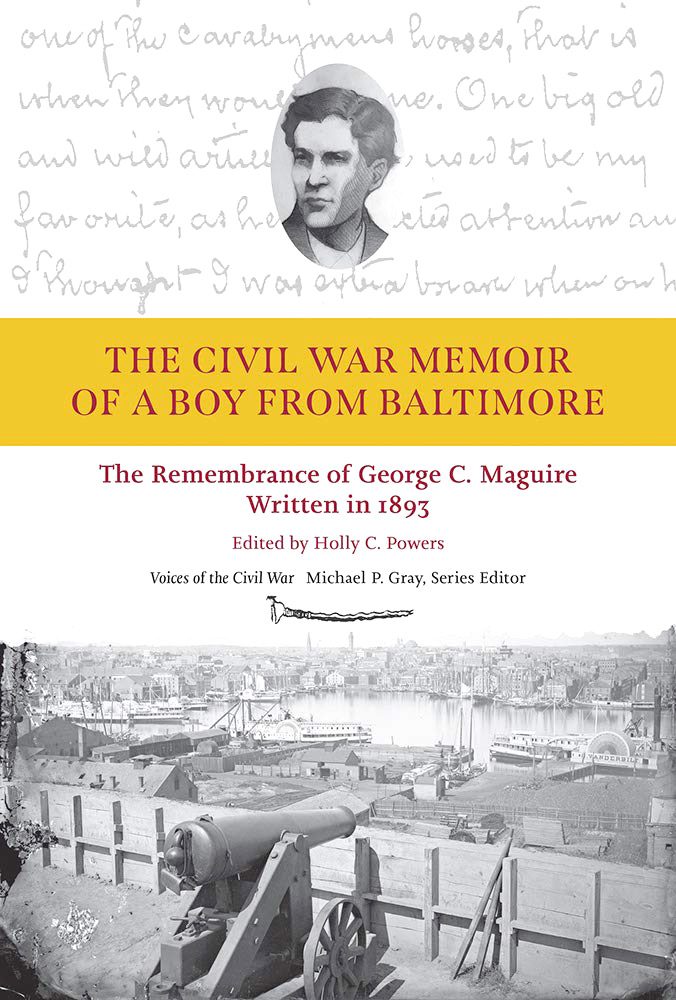
The Civil War Memoir of a Boy from Baltimore: The Remembrance of George C. Maguire, Written in 1893. Edited by Holly I. Powers. Foreword by David Price and Jake Wynn. Photos, notes, index. 106 pp. University of Tennessee Press, 2021. www.utpress.org. $45.
Reviewed by Jonathan W. White
This slim, handsomely illustrated volume is worthy of the attention of Civil War enthusiasts. Writing three decades after the war, George Maguire recollected his experiences as a young teenager during the most tumultuous years in American history. During the presidential election of 1860, he participated in a Republican parade in Baltimore, a decision that led him to be grievously wounded. “Now! Let them have it,” he heard a voice yell. “I saw the men drop. Lanterns were bursted by stones and bricks and while wondering what the trouble was, ‘bang’ my head felt as if a steam car was pushing through it, and something wet was running all over my face and down my neck. I drew my hand over my face, looked at what it collected and saw blood.” Maguire fainted, the first of several times he did so in the memoir.
After joining the 5th Maryland Volunteers, not as an enlisted man, but more as a “mascot,” since he was underage, Maguire soon found himself in Newport News, Virginia, one day after the famous Battle of Hampton Roads in March 1862. “For a week or ten days afterwards the dead would be continually washed up on the beach,” he wrote. “All around this part of Virginia the waters were full of crabs,
June 2022
and every poor sailor that was washed ashore had his face and every other part of his body these crabs could reach eaten off or partly eaten off.” Ever a collector of relics and souvenirs, on one occasion, Maguire attempted to pilfer a flag from the mast of the Cumberland, which still waved above the waterline after the ship had been sunk by the CSS Virginia, but an officer “gave me a lecture and said he was ordered to send me back up that mast and place that Union Jack just where I had got it from.”
In Virginia, Maguire was “horror struck” the first time he saw an amputation, and he ran from the tent and cried for an hour. Soon, however, he found himself assisting medical personnel in their duties. At Antietam he even met Clara Barton on the battlefield. His description of his experiences at Antietam is vivid, at times moving.
From late 1862 to early 1863, Maguire was stationed at Harper’s Ferry, where he assisted his brother-in-law, who had been appointed provost marshal in the town. Today, tourists can visit a recreated provost marshal’s office at the National Park site. Maguire did routine clerical work, such as writing out passes, but he also recorded his experiences searching for spies and contraband materials. The remainder of his war experience was back in Baltimore, where he worked at Hicks U.S. General Hospital. His brief description of this period is richly detailed; he even described the dreams of one patient, and will be of interest to readers curious about medical history of the war.
The Civil War Memoir of a Boy from Baltimore is a quick, excellent read. There are very few published primary accounts by Union soldiers from Maryland. Hopefully more like this one will follow.
Day by Day Through the Civil War in Georgia. By Michael K. Shaffer. Footnotes, bibliography, index, appendices, maps, photographs, illustrations, hardcover. 442 pp., 2022. Mercer University Press, www.mupress.org. $37.
From the title of historian Michael Shaffer’s newest book, one might expect a reference work, akin to E.B. Long’s The Civil War Day by Day. The work is quite different, however, and (to my knowledge) unique. This fine volume is not intended to live on a shelf until you want to look something up; it is to be read all the way through.
To merit inclusion, as Shaffer states in the preface, an entry had to be derived from “a quill scrolling the parchment or a press imprinting type on the day the activity occurred.” These are real primary sources and include messages and orders sent by military and civil officers, diaries, letters, and newspapers. The reader hears from a wide variety of people reporting on a wide variety of events.
On one page a newspaper editor reports on a battle and presents an optimistic view of his army’s prospects. Further down, a general orders troops transferred from one hard pressed place to another. Following that, the reader sees a testy message sent by Georgia’s governor to the Confederate Secretary of War. Then a soldier writes a letter to his wife and diarist traveling through the state describes conditions in places visited by Sherman’s troops.
The book begins on November 21, 1860, when Gov. Joseph Brown called for a convention to consider “the crisis in our national affairs.” From the first day of January, 1862, until May 31, 1865, there is an entry for each and every day of the war. In 1862 and most of 1863, much of the action occurs on the coast, where the Federals imposed a naval blockade, held strong points, threatened Savannah, and raided other cities on and near the coast. Afterwards the focus shifts to Chickamauga, then to the Atlanta Campaign and the March to the Sea. The book concludes with a few key events in the immediate post war days. The final entry is for July 15, 1870, the date Georgia re-joined the Union.
By listening to these diverse voices, the reader follows the course of events from before the war starts until after it ends. This is a narrative history with a different kind of narration, an approach that presents a little of everything: military and naval events; the efforts of the Confederate leaders to manage shortages of manpower and every other necessity; the impact of the war on civilians; an economy stressed by war; the coverage of the war in the press; and, of course, the political goings on.
Almost all sources are used multiple times. As we follow Governor Brown we come to know him rather well, and understand how he became a thorn in President Davis’s side. Diarist Fanny Andrews pops up frequently to report on her experiences and to share her observations, as does another diarist, Sam Richards. These, and all the other contributors, are woven into a highly readable account of the war fought in this one state.
The author devotes most of the
Publishers/Authors Send your book(s) for review to:
Charleston, SC 29412
book to what happened inside Georgia, with limited coverage of battles in other places in which Georgians fought and which, of course, left an impact at home.
All readers will be grateful for the plentiful notes which are placed where they belong, at the bottom of every page, informing the reader about the sources and pointing him to where he can go for more information. Appendices include the texts of Georgia’s Declaration of Secession, Alexander Hamilton Stephens’s Cornerstone Speech, the state’s 1861 Constitution, proclamations issued by Governor Brown and General Johnston, and Sherman’s Special Order 15.
Shaffer’s approach has no space for in depth treatment of any one thing, but we get a taste of everything. The reader floats along in the stream of history, catching a glimpse of everything along the way, not stopping, but knowing that, aided by the footnotes and bibliography, he can go back anytime and linger at any point along the stream and learn more.
Gould Hagler is a retired lobbyist living in Dunwoody, Ga. He is a past president of the Atlanta Civil War Round Table and the author of Georgia’s Confederate Monuments: In Honor of a Fallen Nation, published by Mercer University Press in 2014. Hagler speaks frequently on this topic and others related to different aspects of the Civil War and has been a regular contributor to CWN since 2016. He can be reached at gould.hagler@gmail.com.
Writings of a Rebel Colonel: The Civil War Diary and Letters of Samuel Walkup, 48th North Carolina Infantry. Edited by Kemp Burpeau. Map, photos, notes, bibliography, index. 231 pp. McFarland, 2021. www.mcfarlandbooks.com/. $39.95.
Samuel Walkup’s Civil War letters and diary offer an intriguing Confederate perspective on the Civil War. A prominent lawyer, planter, and politician from the Old North State, Walkup led the 48th North Carolina Infantry through some of the most important battles of the eastern theater. His writing captured pivotal and interesting moments. Following the Battle of Sharpsburg, for example, he described a conversation with several Yankees, “who began to discuss the tiresomeness of the war and argue for the Union.” Walkup cut them off, saying, “That was not a subject we could hold discussion, however glad we would be for the war to end.”
Walkup’s description of Fredericksburg in December 1862 is intense. He described commanding his men as the “balls and bombs are flying thick and heavy over us.” During the fight, Walkup “went from right to center looking after and cheering the boys and was wounded in the right hip, a flesh wound not very serious.” Meanwhile, he described wave after wave of Union attacks; “Their very number made their courage more awful. They came up by acres and our boys fired into the dense masses without fear of missing and with a fair prospect of cutting down two at a time.”
The 48th missed Gettysburg,
and Walkup received false intelligence about the battle. On July 4, 1863, he wrote: “It is a glorious Fourth to me. I am a happy man. Glorious news from the army from York Pass to New Orleans, Louisiana to battle Gettysburg.” He would soon learn the truth, concluding that Gen. George G. Meade was “after” Lee “like a pack of wolves elated with victory, enraged by invasion, prompted by hate and national pride.” The “reported successes,” Walkup wrote, “were fabricated by dispatchers” that had “perhaps” been sent “to deceive us.”
When Walkup’s wife urged him, “Resign and come home,” he replied that he would not be able to make enough money on the home front. His letters nevertheless describe a deep affection for his wife, including occasional reference to dreams about her.
For the last year or so of the war, Walkup regularly kept a tally of deserters, and his diary offers insights into Confederate military justice. The accounts of the siege of Petersburg are gripping, and his observations were keen. On May 29, 1864, he wrote, “Desolation marks the track of an army like some fiery blast consuming everything and leaves the rich and poor in one common ruin.” A few days later he explained, “I dig my own hole for safety, and it is much needed. Thank God that it is no worse.” On June 6 he added, “A constant hammering of rifle keep [sic] up a monotonous music of death and funeral elegy during the whole morning, and death dealing Minie balls rattle rudely over and around us.” Perhaps capturing his frustration, he wrote on June 21, “Old Lee makes himself an undignified paternal fussypuff for his petted and spoiled darlings.” By February 1865, prospects were “getting more
Walkup’s diary is supplemented by letters to family members and North Carolina’s Governor Zebulon Vance. While the family letters depict Walkup’s devotion to loved ones, the letters to Vance reveal a devotion to his men. In one letter to the governor, he described “the destitute condition” of the regiment. Many were “completely and absolutely barefooted,” their pants were “ragged and out at the seats,” and they desperately needed food, blankets, and medical supplies. “With Lincoln’s [preliminary emancipation] proclamation promising freedom to the slaves, what might the suffering, exhausted, ragged, barefooted, and dying non-slaveholders of the South, who are neglected by their government and whose suffering families at home are exposed to so many evils, begin to conclude?” Walkup warned that the “spirit of disaffection” might “lead to open mutiny.”
These few quotations are intended to give readers a sense of the perspectives and insights offered by Walkup. Readers interested in the military history of the Civil War will find much, much more worthy of their attention in Writings of a Rebel Colonel.
Jonathan W. White is professor of American Studies at Christopher Newport University and the author or editor of 13 books. His most recent are To Address You As My Friend: African Americans’ Letters to Abraham Lincoln (UNC Press, 2021), My Work Among the Freedmen: The Civil War and Reconstruction Letters of Harriet M. Buss (UVA Press, 2021), and A House Built By Slaves: African American Visitors to the Lincoln White House (Rowman and Littlefield, 2022).
Part of the Voices of the Civil War Series, this volume draws upon a plethora of primary sources; letters, diaries, after action reports, and official records, to weave together a narrative of the common soldier’s trials and tribulations in the Army of Tennessee. As such, this book is replete with the horrors of a fratricidal war where thousands of young men marched on frozen roads without shoes, slept in the open air without blankets, marched with wet clothing, fought off lice, parasites, bacterial infections, and disabilities from battle wounds. It was not just the soldiers who suffered; civilians lost their crops, their livestock, their horses, their homes, and not infrequently their lives.
Christopher Thrasher does not leave out the sordid incidents of wives raped, family members tied to fence posts, forced evacuations of families, desertions by soldiers to protect their homes, and an economic disaster that left scars on the South for decades. Neither does he omit the feelings of soldiers about their leaders. How did they view the constant retreats of General Joseph Johnston, the impetuous attacks of General John Bell Hood that decimated the army, or the individual bravery of Generals Cleburne, Granbury, Adams, etc.? What made individual soldiers desert
to protect their families; what motivated others to stay until the bitter end? How did trench warfare, retreats, and inaction breed desertion while aggressive attacks boosted morale? All these questions are answered in the words of the surviving soldiers who saw their friends murdered before their eyes (one shot 47 times at the Battle of Franklin), going days with little or nothing to eat except possibly green corn, seeing their horses die of starvation, giving up their scant rations to help feed the starving families of Atlanta, watching 120 boxcars of ammunition and supplies go up in flames as they abandoned Atlanta, and then being attacked by bushwhackers as they retreated. Further evidence of the hardships faced by the common soldier could also be seen in their need to fashion moccasins out of fresh calf hides for shoes, making coffee out of acorns, going through withdrawal from want of tobacco, and eating fodder intended for their horses. Such were the desperate measures that confronted the Southern soldier in their quest for an independent country. Likewise, for the wives, parents, and children left behind the war meant the loss of loved ones far from home, the demolishing of their homes, fences, barns and means of survival, the diseases brought home by their soldiers, and the years of recovery in a world turned upside down.
Christopher Thrasher’s social history is a welcome addition to the literature on the common soldier; a topic long neglected in favor of biographies of generals and statesmen. His use of primary source material is to be commended for its depth and breadth. If the reader wishes to experience war’s hell for the individual soldier and his loved ones, this book will be a welcome addition to their bookshelf. The writing flows, the prose is riveting, and except for a few grammatical errors that escaped the editor, is historically accurate and thorough. This book is highly recommended.
Wayne L. Wolf is Professor Emeritus at South Suburban College and Past President of the Lincoln-Davis Civil War Roundtable. He is the author of numerous books and articles on the Civil War and frequently writes for Civil War News and history journals.