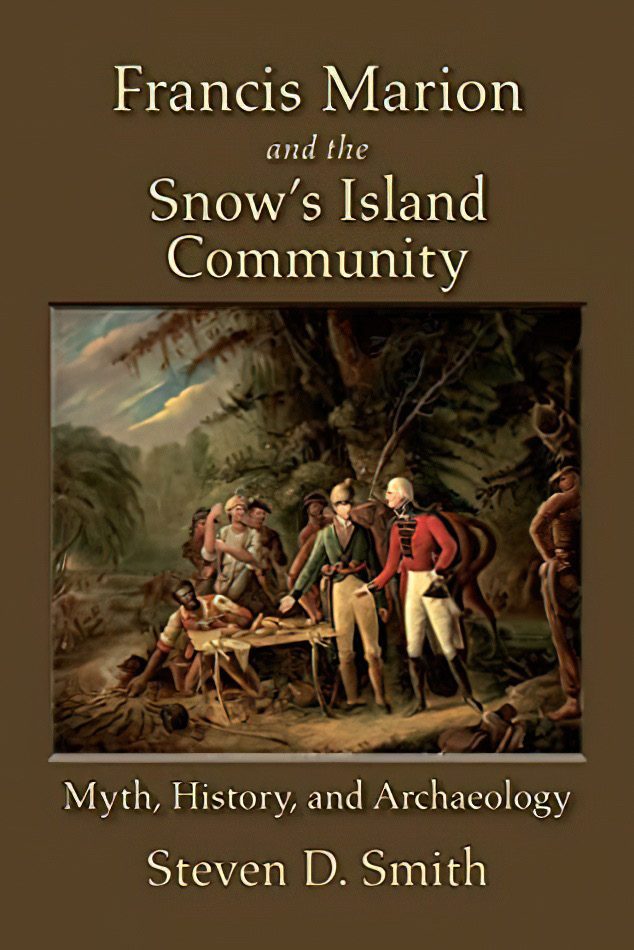
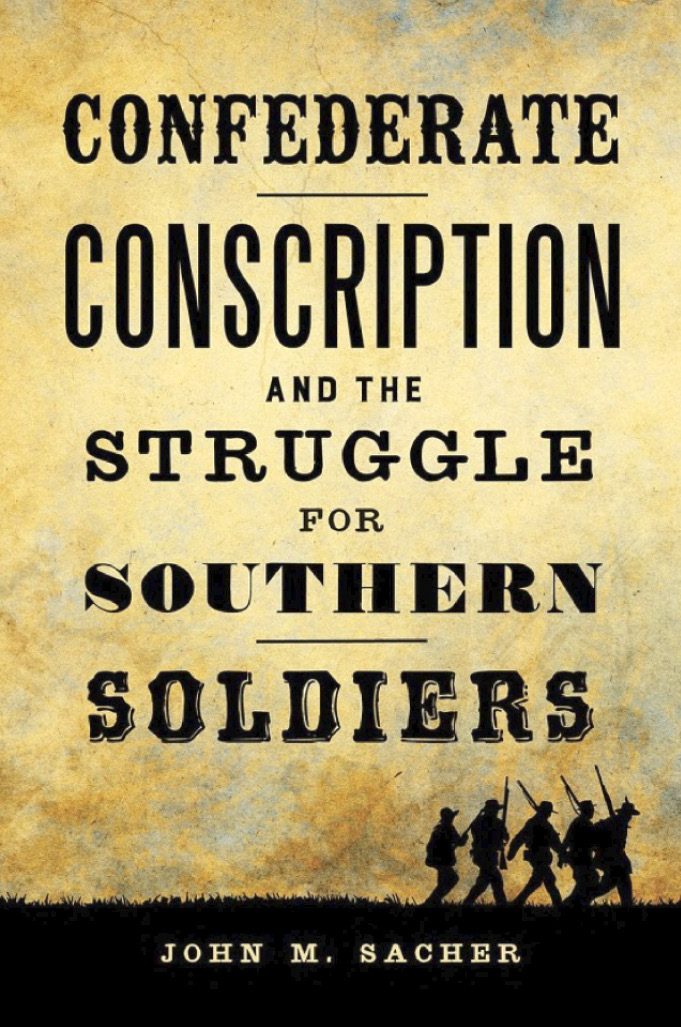
Francis Marion and the Snow’s Island Community- Myth, History, and Archaeology. By Steven D. Smith. Maps, Photos, Illustrations, Endnotes, Bibliography, Index. 320 pages. United Writers Press, www.unitedwritespress.com. $40.00 Reviewed by Tom Elmore
Not unlike Robin Hood’s Sherwood Forest, Snow’s Island, located in the Pee Dee River in Florence County, South Carolina, has attained an almost mythic status as the place from where Brig. Gen. Francis Marion, the most successful partisan leader of the American Revolution, and his men seemingly came out of nowhere to harass the British and then disappear back. This, despite the fact, that it was only used for a few months in the winter of 1780–1781.
Author Dr. Steven D. Smith, a Research Professor at the South Carolina Institute of Archaeology and Anthropology, has spent years in the field examining sites on the island and throughout the region where Marion operated. This book is a not straight narrative of Marion, per se, but an archaeological and historical examination of the area and its people. The author concludes that the region was the perfect place for Marion’s base of operations. It was almost inaccessible, did not have a large population, and those who lived there, mostly farmers and planters, supported the Patriot cause.
He also examines the various myths and legends about Marion and how accurate the first three, and arguably the most influential, biographies of Marion are. Many legends about Marion come from these books and some, such as the famed sweet potato dinner with a British officer, probably never happened. The author also suggests that Marion was never called the “Swamp Fox” in his life time and that the nickname was a romantic invention of his early biographers.
As for Marion actually using Snow’s Island as a base, sadly there is no hard evidence despite years of excavations. However, archaeologists have found numerous sites in the region where Marion and his men may have camped. This leads Smith to believe that Snow’s Island was used in the same manner that someone from Burbank, California might say that they live in Los Angeles or Hollywood.
The one drawback to the book is that parts of it makes for dry reading, as it is filled with terms, descriptions, graphs, statistics, and other jargon that a historian or an archaeologist would understand, but not necessarily the casual reader, even though that documentation is rock solid.
This is by far one of the best books ever written about Marion. Anyone with an interest in the American Revolution should check this book out.
Tom Elmore is a descendant of two American Revolution Whig militiamen and is married to a descendent of Thomas Jefferson and Patrick Henry. He has written extensively on South Carolina’s history.
Reviewed by Wayne L. Wolf
Since 1780 conscription has been controversial. Patriotic Southerners debated whether or not the goal of mobilizing the most men to achieve Southern independence was served by forcing soldiers into the ranks. John Sacher does an excellent job of presenting a balanced view of conscription clearly demonstrating that conscription was not the “most hated” measure that many historians have labeled it. Southerners generally supported the Conscription Act of 1862, yet argued over whether it violated their States’ Rights ideology and whether it included exemptions unfairly favoring the rich and powerful. For the individual soldier, it was not a question of loyalty to the Confederate cause but a decision on what came first, family or country.
Exemptions were sought, or bought, if it meant one’s family would otherwise starve or one’s occupation was necessary to produce necessities to clothe and feed the army. To achieve a balance between the need for manpower and maintaining home front productive capacity, the Conscription Act was modified several times, most notably in
Visit our New Website
1864 and early 1865. Exemptions were changed, details eliminated, and slaves added to those eligible for conscription. All this was an effort to balance the unceasing demand for more soldiers and the need to be fair in the eyes of the home front. The perfect balance was never achieved. While statistics are fragmentary or missing to determine the actual number of men conscripted, exempted, or detailed to the critical occupations on the home front, three factors played into one’s views on conscription. Where one lived, how the war affected their family, and how the government listened to their concerns largely determined one’s willingness to obey the call for conscription.
Adherence to the principles of the Confederacy was seldom in question. Loyalty to the cause remained unshaken throughout the war. John Sacher has done a commendable job of refuting the notion that conscription was the most hated measure passed by the Confederate Congress. It provided essential manpower that enabled the South to sustain itself for four long years, yet it had flaws. The rich and powerful could avoid conscription with substitutes or direct payments, families were negatively impacted by the forced conscription of husbands, fathers, and agricultural producers; occupations deemed critical for supplying the troops became the instant avocation of shirkers.
The author’s research represents the first comprehensive study of conscription in over a hundred years. His research is exhaustive, balanced, and convincing. The book is easily readable, filled with primary sources, and is highly recommended for any serious student of the South’s struggle to supply its armies with manpower to counter the North’s numerical superiority.
Wayne L. Wolf is Professor Emeritus at South Suburban College, past president of the Lincoln-Davis Civil War Roundtable, and the author of numerous Civil War books and articles including Two Years Before the Paddlewheel and The Last Confederate Scout.
April 2022
The Siege of Vicksburg: Climax to the Campaign to Open the Mississippi River, May 23-July 4, 1863, by Timothy B. Smith. Lawrence: University Press of Kansas, https://kansaspress.ku.edu, 2021. 724 pp. $45.00 Reviewed by John D. Fowler
In 1863, the Confederacy suffered three military disasters that sapped Rebel strength and drastically altered the course of the American Civil War. While Lee’s defeat at Gettysburg and the near annihilation of the Rebel Army of Tennessee at Chattanooga delivered hammer blows to the Confederacy, the third disaster, the fall of Vicksburg, has been viewed by some historians as perhaps the most critical. The fall of the Rebel river fortress has been chronicled several times but perhaps never with such painstaking detail as
“The best little book on Barnard”
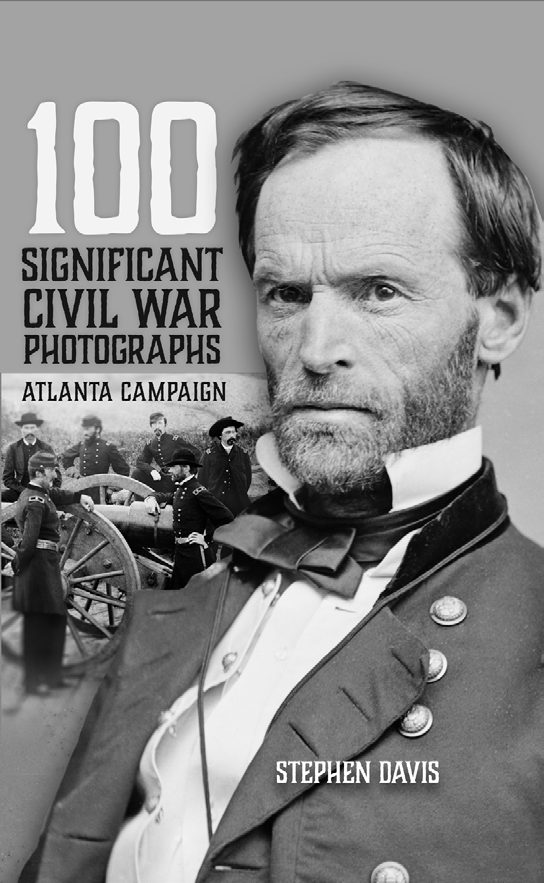
The American Civil War was the first war in which both sides widely used entrenchments, repeating rifles, ironclad warships, and telegraphed communications. It was also the first American War to be extensively photographed. Mathew Brady, Alexander Gardner and Timothy O’Sullivan are famous for having made iconic photographs in the Civil War’s eastern theater. George N. Barnard deserves to be ranked in this top tier for his photographic work in the war’s western theater. A civilian photographer hired by Gen. William T. Sherman’s chief engineer to take pictures of fortifications around Atlanta, Barnard took several hundred of them in and around the city in the fall of 1864. His most famous is the site of Union Maj. Gen. James B. McPherson’s death in the battle of Atlanta, July 22, 1864. Thus far, no comprehensive, definitive listing has been made of the photographer’s work. For this book we have chosen a hundred images we deem “significant.”
found in Tim Smith’s The Siege of Vicksburg.
Smith, a professor at the University of Tennessee (Martin), is a prolific scholar noted for exhaustive research and detailed writing. With more than 500 pages of text covering the events from May 23-July 4, 1863, this volume is no exception. In fact, hardly any aspect of the siege escapes Smith’s notice. This comprehensive account lies in stark contrast to general works on Grant’s campaign against Vicksburg. In general, most authors merely mention the Union advance on the Rebel citadel and the failure of the Union attempts to storm the city’s defenses, and then briefly discuss the siege and the eventual Confederate surrender.
Smith clearly considers the Western Theater the most important of the war and the struggle for Vicksburg the most important military event in the West. Vicksburg, Smith contends, turned out to be the largest and most complex campaign of the war in terms of time, geographic impact, resources, and combat operations (with cavalry raids, pitched battles, naval actions, siege warfare, and skirmishing all part of the long struggle).
Smith launches into the story of the siege following the failure of Grant’s assaults on the Vicksburg works. At this point, Grant realized the topography and Rebel defenses were simply too strong to storm, at least from hundreds of yards away. He would need the skill of his engineers and his army’s raw muscle to inch his entrenchments closer and closer to the Confederate works, where another assault could be launched or mining operations under the Rebel works conducted. In the meantime, the Rebels would be cut off from supplies of food and ammunition.
Smith ably details Grant’s struggles during the siege, from overcoming a shortage of engineers to the even more important struggle to supply his army. Smith also details Grant’s paranoia concerning a possible attempt by Confederate General Joseph E. Johnston to relieve the besieged city, either by crossing the Big Black River to the east or advancing from the area Smith called “the slot” between the Big Black and Yazoo Rivers in the north.
The author also covers the Confederate decisions in equal detail. While Confederate General Pemberton emerges as a competent commander who had few options at his disposal by May 1863, Smith portrays Johnston as a poor commander who refused to make any real movements toward relieving the city. Smith views Johnston as doing just enough to make it look as if he were trying. For example, Johnston finally informed Pemberton that he would attack around July 7th when he knew full well that the latter did not have rations enough for his men at that point. For Smith, Johnston is more concerned with his reputation and not being blamed for what he views as the inevitable fall of Vicksburg, especially since he had ordered Pemberton to evacuate the city prior to the siege.
In addition to the experiences of the general officers, Smith covers the average soldier’s experience in the trenches as well as the Rebel civilian population both inside and outside the river fortress. He even discusses in some detail the Northern visitors and the political machinations Grant faced from the Northern press. He examines the military aspects, the skirmishes, sharpshooting, small engagements around the city, and mining attempts by Federal sappers.
Smith notes that the surrender was not completely the result of the food shortage. Although food stocks were nearly exhausted, the Rebels did have emergency rations when they finally surrendered on July 4. Pemberton’s decision came not from hunger but from the realizations that Johnston would not provide help and the Federals had dug themselves to within easy range for a quick assault. By early July, the Federal lines were close enough for an assault, which Smith believes would have overwhelmed the devastated Rebel works and led to the city’s capture. Simply put, the Rebels were dug out, not starved out.
This book is part of what will ultimately become a five-volume set exploring the Union attempt to capture the Rebel bastion on the Mississippi. The details presented in The Siege of Vicksburg are remarkable given the short span of time covered. As with Smith’s previous trilogy on the Tennessee River (Corinth 1862: Siege, Battle, Occupation (University Press of Kansas, 2012); Shiloh: Conquer or Perish (University Press of Kansas, 2016); and Grant Invades Tennessee: The 1862 Battles for Forts Henry and Donelson (University Press of Kansas, 2021)), he has decided to write the books out of chronological order.
In the Vicksburg series, The Siege of Vicksburg is volume five. The Union Assaults at Vicksburg: Grant Attacks Pemberton, May 17-22, 1863 (University Press of Kansas, 2020) is volume four. What will be volume one is forthcoming and will cover the Union attempts to advance on Vicksburg via the Mississippi Central Railroad and Chickasaw Bayou as well as the Confederate cavalry actions of Nathan Bedford Forrest and Earl Van Dorn. Volume two will cover the campaign from January to April 1863; volume three will examine events from May 1 through May 16, 1863.
This series will augment by three previous works by Smith
that cover various aspects of the Vicksburg Campaign: Champion Hill: Decisive Battle for Vicksburg (Savas Beatie, 2004); The Real Horse Soldiers: Benjamin Grierson’s Epic 1863 Civil War Raid Through Mississippi (Savas Beatie, 2018); and The Decision Was Always My Own: Ulysses S. Grant and the Vicksburg Campaign (Southern Illinois University Press, 2018).
Tim Smith has emerged over the past decade as one of the premier historians of the Civil War’s Western Theater and of Ulysses S. Grant. Now, following in the footsteps of Michael B. Ballard’s Vicksburg: The Campaign that Opened the Mississippi (University of North Carolina Press, 2010) and Ed Bearss’s three-volume study of the campaign, Vicksburg is the Key; Grant Strikes a Fatal Blow; and Unvexed to the Sea (Morningside House, 1985– 1986), Smith promises to bring new insights into the struggle for control of the Mississippi. This volume and the entire series deserve a wide audience as do any works by Smith mentioned here. The author’s attention to detail, keen insights, deep understanding, writing style, and exhaustive research combine to produce remarkable works of scholarship. With dedicated authors such as Smith, the longdeclared exhaustion and decline of Civil War military history is happily far from correct.
John D. Fowler, Ph.D., is the author of several books and articles on the Civil War Era. He is the author of Breaking the Heartland: The Civil War in Georgia. He is currently a Professor of History at Dalton State College.
The Broken Constitution: Lincoln, Slavery, and the Refounding of America. By Noah Feldman. Photos, notes, index. 384 pp. Farrar, Straus, and Giroux, 2021. Macmillan Publishers, http://us.macmillan.com. Hardcover. $30.
Reviewed by Jonathan W. White
In The Broken Constitution, Harvard law professor Noah Feldman argues that Abraham Lincoln “broke” the U.S. Constitution to “cleanse” it of the moral evil of slavery. “Today we conceive of the Constitution as a moral compact—a higher law that embodies an ideal form of government,” writes Feldman. “Yet the original Constitution was not a moral ideal. It was a compromise that preserved slavery.” According to Feldman, Lincoln initially sought to preserve the proslavery “compromise Constitution,” but over time changed his view. Once Lincoln “deemed that the compromise Constitution had been broken by the South,” he “ensured that it would remain broken” and “broke the Constitution as he had previously understood it” to transform the Civil War into a moral war, and the Constitution into a moral document.
Feldman’s thesis is not entirely original. In 1987, for example, Supreme Court justice Thurgood
Publishers/Authors Send your book(s) for review to:
Charleston, SC 29412
Marshall argued, “While the Union survived the civil war, the Constitution did not. In its place arose a new, more promising basis for justice and equality.”
Feldman makes some questionable claims throughout the book, such as Lincoln won the presidential election of 1864 in part “because the Democrat George McClellan was too extreme in his Southern sympathies.” In his letter accepting the Democratic nomination in 1864, McClellan wrote: “But the Union must be preserved at all hazards,” among other statements calling for northern victory. More significantly, Lincoln would not recognize his depiction in this book. To explore one example in depth: In Feldman’s hands, Lincoln’s brilliant Cooper Union Address becomes “strange,” “fairly bland,” ambivalent, “mildly tendentious,” and an “odd performance.” Feldman comes to these conclusions because he appears to miss the overarching structure and purpose of Lincoln’s speech.
In the first section of the speech, the “fairly bland” part, Lincoln used historical evidence to argue the Founding Fathers believed that Congress could regulate slavery in the territories. In the second section, Lincoln urged white Southerners to engage Republicans in civil debate over the slavery issue. Feldman completely ignores this aspect of the second section of the speech. In the third and final section, Lincoln exhorted Republicans to make their case in the public sphere, to compromise with white Southerners where they could, but not to sacrifice their moral principles on the issue of slavery. His ringing conclusion brought the audience to a roar: “Neither let us be slandered from our duty by false accusations against us, nor frightened from it by menaces of destruction to the Government nor of dungeons to ourselves. LET US HAVE FAITH THAT RIGHT MAKES MIGHT, AND IN THAT FAITH, LET US, TO THE END, DARE TO DO OUR DUTY AS WE UNDERSTAND IT.”
Feldman finds Lincoln’s stirring conclusion “logically incoherent.” According to Feldman, “the Constitution of the union, to which Lincoln was expressing loyalty, was not ‘right.’ It was a compromise designed to achieve ‘might,’ based fundamentally on embracing what Lincoln was now openly calling a terrible moral wrong.” But Feldman misses what Lincoln was doing in this speech. Lincoln wanted Republicans to believe that their arguments were morally, and constitutionally, right and that they were winnable in the public sphere. The point of Lincoln’s “bland” history lesson was to give Republicans a basis for making sound arguments. If only white Southerners would listen; they wouldn’t. His faith in the “right” in his peroration was his belief that antislavery constitutional thinking could form a political majority, the “might.” Unlike slavery, which existed because some people had the raw power to impose their will on others, or “might makes right,” Lincoln was contending that strong moral arguments could be more powerful than bad ideas. In essence, he was calling for a robust understanding of “free speech” while simultaneously making an historically grounded constitutional argument about slavery.
People at the time understood the speech’s greatness. On February 28, 1860, a schoolgirl in upstate New York wrote in her diary: “Grandfather asked me to read Abraham Lincoln’s speech aloud which he delivered in Cooper Institute, New York, last evening.... It was a thrilling talk and must have stirred men’s souls.” In like manner, in Lincoln at Cooper Union (2004), Harold Holzer argues that this “tightly argued,” “ingeniously calculated,” and “spellbinding oration” helped Lincoln attain the presidency.
Curiously, Feldman never engages with one of Lincoln’s deepest meditations on the Constitution, a circa 1860–61 fragment in which he argued that “The Union, and the Constitution, are the picture of silver” framed around the Declaration of Independence’s principle of
Visit our New
“Liberty to all,” this, he called an “apple of gold.” Lincoln concluded, “The picture was made, not to conceal, or destroy the apple; but to adorn, and preserve it. The picture was made for the apple—not the apple for the picture.” In other words, Lincoln believed that the Constitution embodied and preserved morally right principles and was worth preserving. The Constitution was not something to be broken. It already was a moral document.
Feldman’s analysis leaves other major questions about the Civil War era unanswered. If one accepts his view that “the compromise Constitution” was essentially proslavery, why did so many young men rush to arms to defend it? An immoral Constitution would not have been sufficient motivation. Readers interested in understanding how preserving the Union had a “moral” dimension could profit from reading Gary Gallagher’s The Union War (2011), Elizabeth Varon’s Armies of Deliverance (2019), or Andrew Lang’s A Contest of Civilizations (2021).
On the question of emancipation, James Oakes offers a far more persuasive explanation in The Crooked Path to Abolition (2021). Oakes traces an antislavery constitutional tradition that developed in the decades between the Revolution and the Civil War. Feldman
I N S I DE E V E RY I S S U E
occasionally recognizes that “the framers’ Constitution embodied both slavery and nonslavery at the same time,” but his emphasis is overwhelmingly on the proslavery interpretation of the Constitution. For Oakes, Lincoln’s wartime policies were the fulfillment of antislavery constitutionalism, not a breaking of the Constitution. As Oakes writes, “In 1861, as slaves began running for freedom to Union lines, President Lincoln and congressional Republicans reacted in ways consistent with their long-standing commitment to the antislavery Constitution.”
Jonathan W. White is associate professor of American Studies at Christopher Newport University and author or editor of 13 books, including A House Built by Slaves: African American Visitors to the Lincoln White House (2022) and To Address You As My Friend: African Americans’ Letters to Abraham Lincoln (2021).
Want To Advertise In
Email us at
Jack Melton’s endeavor, Civil War Artillery Projectiles – The Shell Book, is a remarkable addition to Civil War artillery ammunition literature. For archaeologists and collectors the clearly written text and the excellent photographs provide a wealth of information to properly identify recovered shells and burst fragments. For bomb squad and EOD specialists this book should be on every units’ shelf. The material found these pages will help EOD personnel identify what has been found, whether or not it is dangerous, and how to inert the round without the necessity of destroying an important historic object. This book takes Civil War artillery ammunition studies to a new level.
Adjunct Research Faculty, Colorado Mesa University. Author of Uncovering History: Archaeological Investigations of the Little Bighorn.
Wow. I have been reading a lot of different books on ordnance from this era, but this one takes the cake. Most of the other books drift off in directions that are not helpful with the ordnance specific information I am usually looking for. But this book stays on task and topic from start to finish.
MFS, Graduate A r s o n - E x p l o s i v e s Investigation (AEI), School of Forensic Sciences, Oklahoma State University
Jack Melton’s new book Civil War Artillery Projectiles – The Half Shell Book, promises to be one of the most important volumes on Civil War artillery in recent times. Anyone who has studied the wide variety of Civil War projectiles knows that what is inside is just as important, and maybe more so, than what is outside the shell. In this book, cutaway shells are graphically explained with superb color photographs and notes. They reveal important details and differences in a variety of similar projectiles that tell us U.S. from C.S. and between type variations, in a way that no other approach has ever done. It is supremely helpful in explaining others just how a shell works, whether it is still dangerous or not, and why.
Les Jensen Former Curator Museum of the Confederacy