My paternal grandfather was a brick manufacturer, a practical and down-to-earth occupation for a practical and down-to-earth man. He was also a voracious reader with widely varied interests. The contents of his library ranged from Proust to Douglas Southall Freeman. I took several items from his shelves when he died in 1971. I never managed Proust, but I still have Papa’s copy of Lee’s Lieutenants, which I have read more than once and refer to with some frequency.
The three volumes of Freeman’s work were published between 1942 and 1944 by Charles Scribner’s Sons. Many readers, like my grandfather, read these books about the Confederate War while their sons waged war against Japan and Germany.
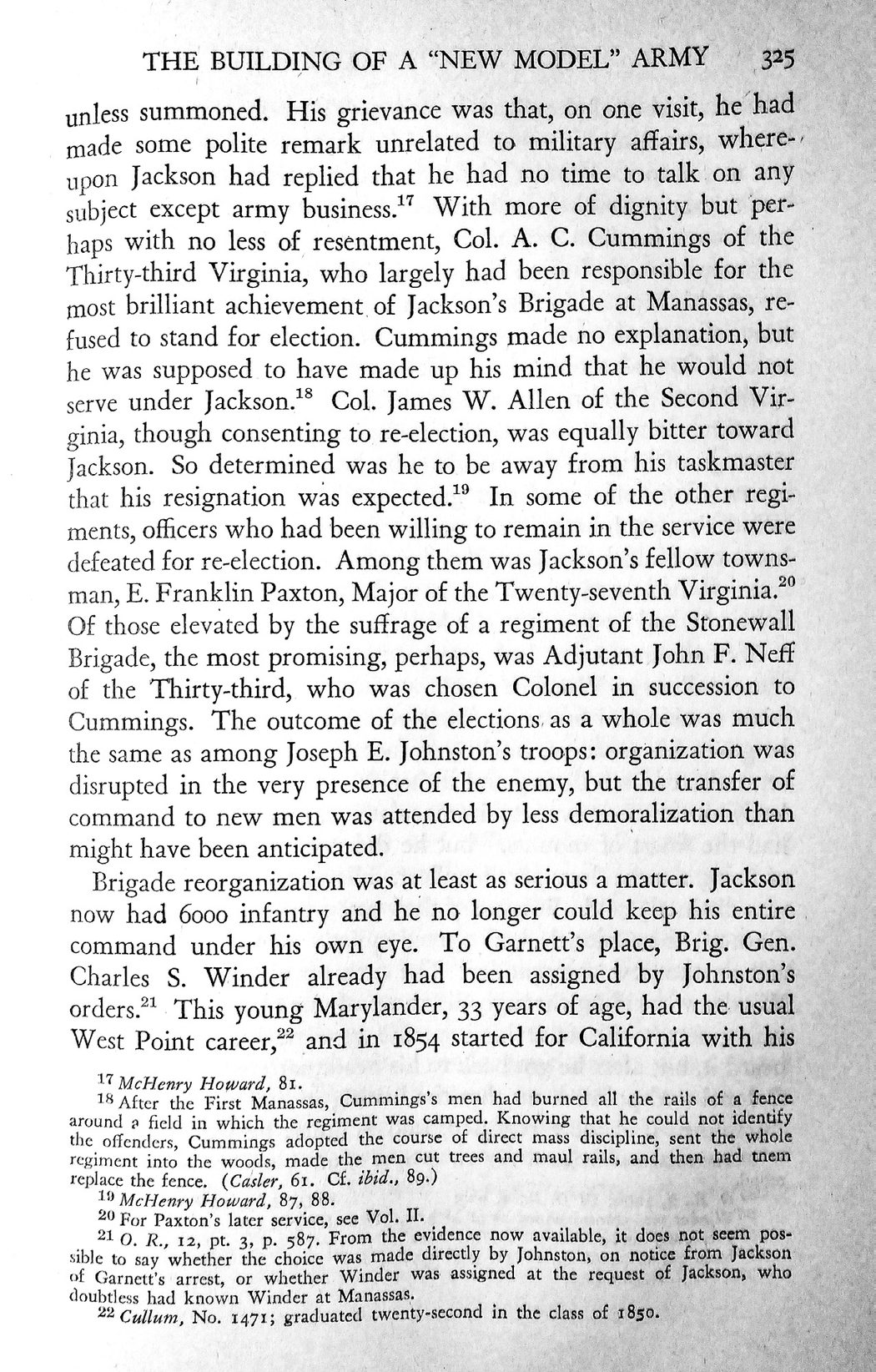
Mr. Freeman and Mr. Scribner’s sons had confidence their readers cared enough about the details of this “Study in Command” to read the notes with care. They knew that readers would be interested in the documentation backing up assertions made about the events of a war fought two generations before. Virtually every page of the three-volume history has multiple footnotes. Each individual datum that requires sourcing comes with its own individual note. The reader can glance down and see precisely what document or documents support the
statement made in the text.
On pages 324 and 325 of Volume I, Freeman tells us about ill-feelings some officers had for Stonewall Jackson because of his brusque manner. One colonel vowed never to go to Jackson’s headquarters because of the general’s attitude. How do we know? Well, this officer, McHenry Howard, said so, in a book he wrote in 1914.
On page 362 there is a reference to a place called Mount Solon. Don’t know where that is? Look down, and in an instant you will know that it is ten miles southwest of Harrisonburg, Va. Freeman tells us that Jackson put aside his old blue uniform on May 5, 1862, and donned regulation C.S.A. attire. Another quick glance advises that Jedidiah Hotchkiss mentioned that in his diary. Let’s put some emphasis on “quick” and “glance” and come back to them later.
Trivia? Maybe, but facts are facts. A bigger fact was Ewell’s decision to stick with Jackson and follow his orders as Jackson planned an attack in the Valley, in spite of the fact that Ewell had conflicting orders from Joseph Johnston. Jackson’s Valley Campaign is not trivia, and the risk Ewell took was a big deal. Two footnotes on page 365 tell us more about this episode and provide references to the OR and an 1866 book by Jackson’s chief of staff.
clude discussion of various issues that would distract if embodied in the text. Readers interested in a particular matter can benefit from these discussions, such as the note on page 369 that provides detail on the makeup and service of Arnold Elzey’s Brigade. If you want to know more you can look at the pages in the OR mentioned in the 12-line note.
First, the quick glance emphasized above. The notes are where they are most useful, at the bottom of the page, not at the back of the book. No flipping pages to find the note; no putting fingers between pages to hold open two places in the book; no repeating the process one page later to check another source.
rate, each datum having its own separate note, as I said before, inserted as it is needed. A typical paragraph will have two or three notes. A greater number is not uncommon. It is not unusual for a single sentence to have two notes. After all, if a sentence has more than one datum that requires sourcing, it needs more than one note, right? Elementary.
GEORGIA’S CONFEDERATE
Many footnotes, of course, in
Two things are important here.
Second, the notes are sepa
Civil War Artillery Book
Civil War Artillery Projectiles – The Half Shell Book. This hardbound book has 392 pages, and is full-color with 850 photographs.
$89.95 + $8 media mail for the standard edition.
MONUMENTS In Honor of a Fallen Nation Gould B. Hagler, Jr.
This unique work contains a complete photographic record of Georgia’s memorials to the Confederacy, a full transcription of the words engraved upon them, and carefully-researched information about the monuments and the organizations which built them. These works of art and their eloquent nation’s profound grief, praise the soldiers’ bravery and patriotism, and pay homage to the cause for which they fought.
A single catch-all note, at the end of a paragraph, is less useful, as the reader must sometimes labor to match a given datum to its source.
I have reviewed 21 books for Civil War News. Thirteen have endnotes and one has notes at the end of each chapter. One has no notes at all and needs none because of the nature of the book. Of the books I have reviewed, only six have footnotes, two of which are the sometimes-problematic end-of-paragraph notes.
Once I heard Gordon Jones, the military historian at the Atlanta History Center, say that when he is king all maps in history books will be oriented the same way, the logical way, the way readers expect, with north at the top. Well, when I am king all history books will have footnotes. Penalties for noncompliance will be severe.