As the American Civil War ground into its third year of combat, the ever conservative Ordnance Department began actively looking for metallic cartridge carbine designs for the U.S. cavalry. The success of the Model 1860 Spencer rifle and carbine had finally softened most of the institutional objections within an Ordnance Department that preferred not to rely upon patent metallic cartridge ammunition that could not be easily produced at the U.S. Ordnance ammunition laboratories. As a result, a number of cartridge carbines were contracted for during the War’s last eighteen months, including the Ball and Palmer carbines, both of which were produced by the same manufacturer. While many new designs were relatively innovative, most were not delivered in time to have any effect on the war and many were never even issued to US troops.
The Ball carbine was designed and patented by Albert Ball of Worcester, Mass. Ball had spent the 1850s working for various Massachusetts based gunmakers, including Lucius Pond. After Ball secured a patent for a breechloading, metallic cartridge carbine (#38,935) on June 23, 1863, the patent rights to produce the carbine, were subsequently purchased by E.G. Lamson of Windsor,m Vt., in order to produce the carbine. Lamson had been a principle of the firm Lamson, Goodnow & Yale (LG&Y) that organized in 1861 to produce rifle muskets on contract for the U.S. government. Lamson, Goodnow & Yale had purchased the majority of the assets of the defunct Robbins & Lawrence Company, also of Windsor, Vt. Robbins & Lawrence held an earlier contract to produce Pattern 1853 Enfield rifle muskets for the British government during the Crimean War so they had all the tooling and machinery necessary to produce that model long arm. L.G.&Y. became one of the three firms, plus Colt and Amoskeag, to produce the “Special Model” U.S. M1861 rifle musket. The gun was a sort of Enfield / Springfield hybrid championed by Samuel Colt, and his primary designer of the period Elisha K. Root. The “Special Model” had many Enfield-style features and was easier to produce on the machinery that LG&Y acquired from Robbins & Lawrence than the standard U.S. M1861 rifle musket. In 1864, Goodnow & Yale left the firm, and Lamson took sole control. At this time Lamson began actively seeking contracts to produce breechloading metallic cartridge carbines for the U.S. military. In addition to purchasing Ball’s patent rights, Lamson also purchased the patent rights to the Palmer bolt-action carbine. Lamson managed to secure contracts to deliver one thousand each of these patent carbines. Although both were originally to be produced in .44 rimfire, the U.S. Ordnance Department changed the specification in mid-stream, requiring the guns to be manufactured in .50 Rim Fire government. The newly adopted .50 rimfire gov’t cartridge was actually the improved 56-50 Spencer and represented an attempt by the Ordnance Department to standardize calibers of self-contained cartridge arms, thus reducing the number of specialized cartridges in service.
Two sample Ball carbines were delivered to the Ordnance Department on Jan. 17, 1865. With Ball now working as Lamson’s superintendent, the company proceeded to manufacture 1,000 Palmer and Ball designs each. None would be delivered before the end of the War. The 1,000 contracted Palmer carbines were all delivered by mid-June 1865, some two months after Gen. Robert E. Lee surrendered. However, the re-tooling to produce the Ball Carbines in the new caliber had thrown a significant wrench into manufacturing efforts resulting in numerous delays. It would be May 1866 before the Ball carbines would be delivered to the Ordnance Department. The end of the Civil War meant there would be no additional U.S. military contracts for his designs, and that orders for martial arms were going to end abruptly. In 1868 Ball left the E.G. Lamson company, and the firearms industry, and went to work for the Sullivan Machinery Company of Claremont, N.H. He lived until 1927, and received one hundred and thirty-five design patents during his lifetime.
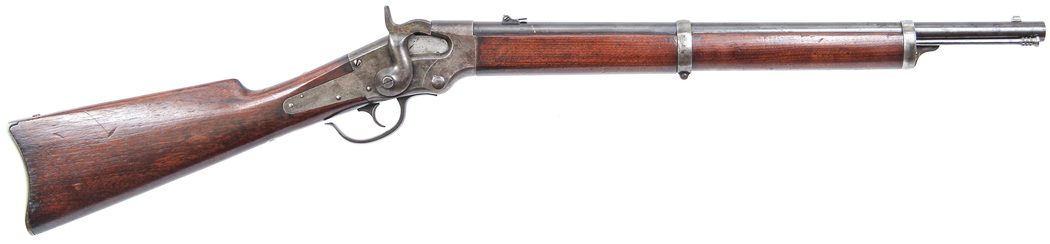
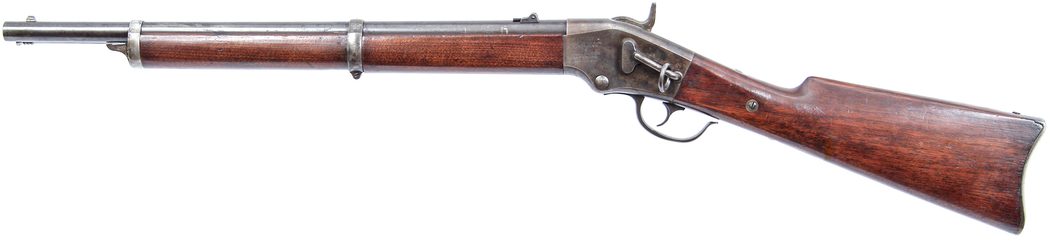
The Ball carbine represented a sort of “improved” Spencer carbine. The Ball design used a tubular magazine, as did the Spencer, but it was mounted under the gun barrel, instead of in the buttstock. The seven-round magazine was loaded by lowering the triggerguard, thus opening the magazine. This allowed insertion of cartridges directly into the magazine tube.
The magazine was tensioned by a long spring that had to be compressed and retained to allow loading. This was accomplished by pulling a long rod that resembled a cleaning rod, out from the carbine’s forend. When the rod was fully extended, the spring was compressed and was captured by a small catch at the end of the forend. Once the magazine was fully loaded, the catch was released, and the spring tensioned the magazine to push the cartridges towards the action.
Much like a Spencer, lowering the triggerguard opened the action, ejected a fired cartridge, and allowed a fresh cartridge to be pushed onto the cartridge lifter. Closing the action chambered the round. As the action could only be opened when the carbine was cocked, it was now ready to fire.
The Ball carbine had a 20.5inch round barrel and a twopiece smooth walnut stock and forend. Like most cavalry carbines of the era, a sling bar and ring were mounted on the left side of the receiver. The barrels were blued; the receivers were color casehardened, as were the triggerguard, hammer, and buttplate. The forend was secured by a barrel band about mid-way between the receiver and muzzle, and by a combination barrel band/end cap near the muzzle that contained the magazine spring catch mechanism. The spring compression rod, which extended below the lower right side of the barrel was left “in the white” and not finished.
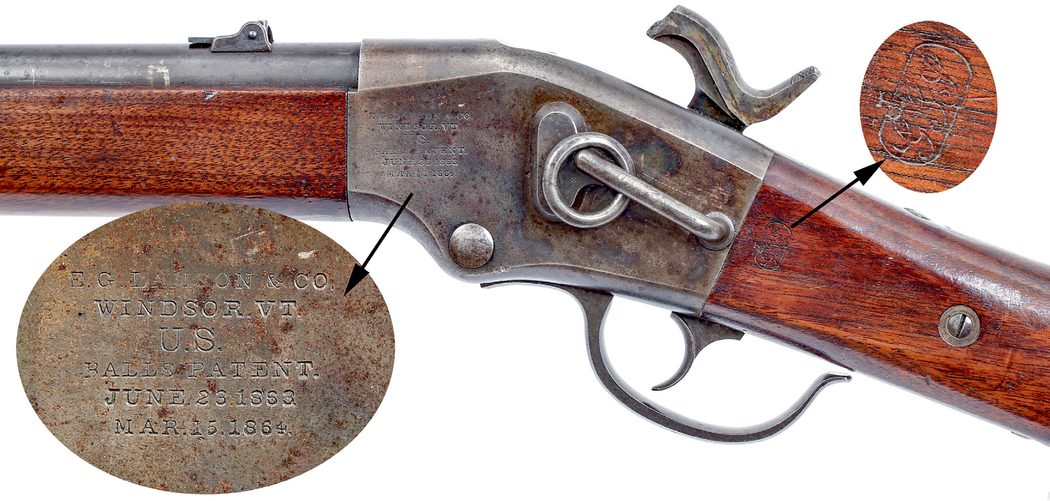
The guns were not serial numbered but were marked on the left side of the receiver in six horizontal lines, reading: E. G. LAMSON & CO / WINDSOR, VT / U.S. / BALL’S PATENT / JUNE 23, 1863 / MAR 25, 1864. The guns were inspected by U.S. arsenal sub-inspector George G. Saunders and his script GGS cartouche was applied to the reverse wrist. Saunders had a career of some fifteen years as a Springfield Arsenal civilian inspector and his marks are found on everything from pre-Civil War 3rd Model Colt dragoon revolvers to post-war Ames saber bayonets for the Springfield- Remington M1870 naval rifles.
The carbines were equipped with an L-shaped aperture leaf
Digital Issues of CWN are available by subscription alone or with print plus CWN archives at
sights as were many of the era’s U.S. carbines. The short leaf was graduated to 100 yards, the pierced aperture in the long leaf was set at 400 yards, and the top of the leaf was sighted to 600 yards.
Despite Ball carbines not seeing any military service, it is quite possible that some of the gun’s features were noted by other designers. The under-barrel tubular magazine enclosed in a wooden forend and loaded from the receiver end rather than the muzzle end may well have inspired Nelson King to improve the Henry rifle design, resulting in what would become the Winchester M1866.
Tim Prince is a full-time dealer in fine & collectible military arms from the Colonial Period through WWII. He operates College Hill Arsenal, a web-based antique arms retail site. A long time collector & researcher, Tim has been
Reverse receiver of the Ball carbine, showing the sling bar and ring with inset details showing the receiver markings and the inspection cartouche of George G. Saunders.
View of the Ball carbine with lever lowered, showing the action open, and the loading access through the receiver to the tubular under barrel magazine.