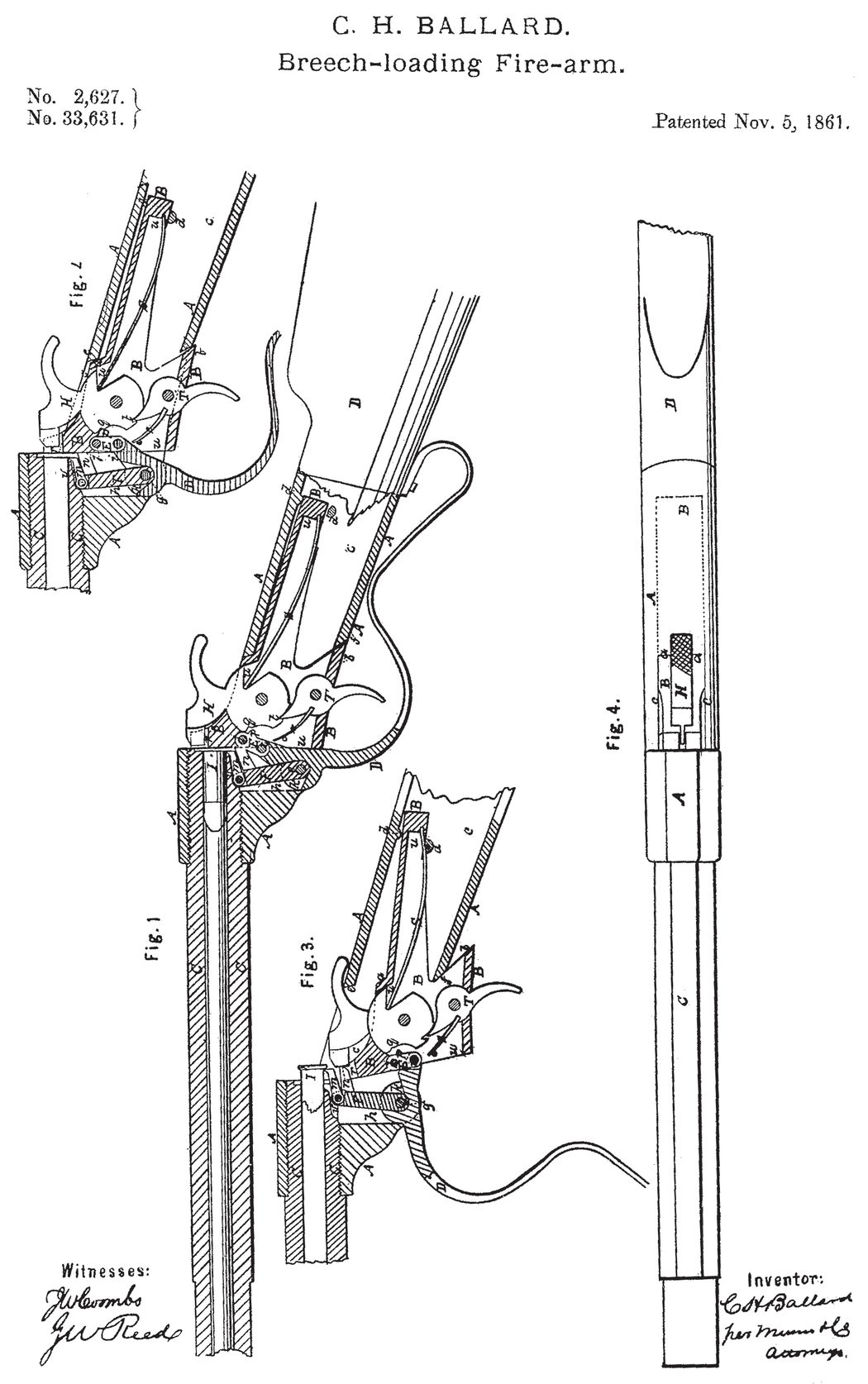
The Ballard Carbine was a breechloading, single shot metallic cartridge firearm invented by Charles H. Ballard of Worcester, Mass. His invention was issued U.S. Patent #33631 in November 1861. Like many budding firearms developers of the day, Ballard was an inventor, not a manufacturer. As a result, he sought a way to market and sell his invention with an eye towards collecting patent royalties, instead of investing in a manufacturing facility to produce his guns. This led to a partnership with the New York sales agents Merwin & Bray, who represented Ballard’s invention, received contracts for his guns, and then subcontracted the gun’s production to other established arms makers. Joseph Merwin, the principle in the company, would go on to be principle in the post-war firms of Merwin, Hulbert & Company and the Evans Rifle Company. During the Civil War period he was a major firearms distributor for firms like Colt and Smith & Wesson, and held the exclusive distribution rights to some innovative designs like Plant revolvers and the Ballard carbine.
With the Civil War well under way in the winter of 1861–1862, Merwin & Bray found a ready market for the well designed, single shot rim fire carbines and rifles covered under Ballard’s patent. They then negotiated the manufacturing contracts with Ball & Williams of Worcester, Mass., and Dwight, Chapin & Co. of Bridgeport, Conn. After the conclusion of the Civil War, Kentucky state ownership marking on the barrel of a Ball & Williams manufactured Ballard rifle, with detail showing patent markings and Merwin & Bray’s agent mark. three other makers manufactured arms under Ballard’s patents as well, but they are not relevant to this discussion. Between 1862 and 1865, Ball & Williams produced some fifteen thousand six hundred “small bore” carbines and rifles under Ballard’s patent. Of this production about five thousand were sporting rifles in a variety of calibers, about four thousand were military rifles in both .44 and .46 rimfire, and the remaining sixty-six hundred guns were military style carbines in .44 rimfire. The majority of the sixty-six hundred carbines were eventually delivered to the State of Kentucky for use by their cavalry. The U.S. Ordnance Department contracted for five thousand carbines in January 1864, but only one thousand five hundred and nine of the guns were delivered, accepted, and marked with Ordnance Department acceptance marks. The Ordnance Department rejected six hundred additional carbines delivered for inspection, and Ball & Williams forfeited the balance of their U.S. government contract to deliver the rest of the guns to the Kentucky, where they were able to sell them at a higher price than the U.S. government offered. Nearly all the remaining carbines produced were sold to Kentucky. Ballard military carbines were issued to, and saw service with, the 3rd, 6th, 8th, 11th, 12th & 13th Kentucky Cavalry (US), as well as the 4th Kentucky Mounted Infantry. The carbines also saw some service with the 2nd Iowa Cavalry and 7th Ohio Cavalry.
An additional five hundred were sold to New York. The majority of the fifteen hundred and nine Ballard carbines accepted by the U.S., roughly twelve hundred of them, were sent to arm the Vermont State Militia following the October 19, 1864, Confederate raid on St. Albans, Vt.
A much rarer martial variant of the Ballard carbine exists. The firm of Dwight, Chapin & Company of Bridgeport, Conn., produced these very scarce guns. In the fall of 1862, Merwin & Bray received a contact from the U.S. Government for one thousand Ballard patent rifles and one thousand Ballard patent carbines. Unlike the arms being produced by Ball & Williams, these guns were manufactured in a larger caliber, 56-56 Ballard. This was the same cartridge, with a different name, as the currently issued 56-56 Spencer cartridge (sometimes called 56-52). Ball & Williams were overloaded with their contracts for .44 and .46 Ballards and could not take on any more orders. As a result, Merwin & Bray contracted with Dwight, Chapin & Company to produce the guns. According to most sources, Dwight, Chapin & Company delivered only one hundred and fifteen of the 56-56 Ballard carbines by September 1863, and the company subsequently failed. At this time, Ball & Williams bought both the finished and unfinished guns and parts at auction then proceeded to try and complete the contract. Most sources note that they managed to assemble an additional one thousand carbines and six hundred and thirty five rifles in
Obverse receiver view of the carbine showing the action open with the lever lowered. Inset shows patent marking detail on the receiver.
Reverse receiver of Ballard #607 showing marking details and the script JM cartouche of arsenal sub-inspector James Mills who also inspected Smith and 2nd Model Maynard carbines. Obverse overall view of a .44 caliber Ball & Williams produced Ballard carbine. Note the octagon to round barrel and the longer rear sight leaf to allow more graduations out to longer distances. All photos by Tim Prince. 56-56 Ballard; most sources note that all but thirty-five rifles ended up being sold to the Kentucky.
The guns finished by Ball & Williams are marked only with the Merwin & Bray and Ballard patent marks, and do not bear any Ball & Williams markings. Additionally, the guns and receivers that originally did have Dwight, Chapin & Co. markings
most references. This suggests that completion, deliveries, or at least the acceptance, of the guns, was not necessarily in numerical order.
The Ballard carbine, in its primary Civil War configuration (aka Model 1864), was a single shot, breech loading, .44 rimfire (.44-33-250) carbine with a 22inch octagon to round barrel. The Dwight, Chapin & Co produced examples were chambered in 56- 56 and had a 20-inch fully round barrel and some references refer
Capital of the Confederacy Capital of the Confederacy Civil War Show (Richmond, Va.) Civil War Show (Richmond, Va.) November 14 & 15, 2020
January 30 & 31, 2021
Collectors, Civil War and Militaria Enthusiasts
Chickamauga (Dalton) Chickamauga (Dalton)
Promoters of Quality Shows for Shooters, Cancelled Cancelled
Civil War Show Civil War Show
to these as “Old Model” Ballards. The military rifle version of the guns usually had a 30-inch barrel, either half-round half-octagon or fully round, and with either a carbine style forend with a single barrel band or a full-length musket type forend with three barrel bands.
All variants used a simple dropping block action actuated by a lever that doubled as a triggerguard. While most cavalry carbines of the era were usually produced with a sling bar and ring,
Collector’s Arms 1700-1945 Militaria Specializing in Civil War-World War II
December 5 & 6, 2020 Military Collectible Military Collectible Gun & Knife Shows Gun & Knife Shows
Middle TN (Franklin) Middle TN (Franklin)
Cancelled Cancelled
most Ballards were manufactured with a pair of sling swivels, one on the single barrel band and one in the toe of the buttstock. Some carbines had a third swivel on the reverse of the buttstock as well.
The guns had a simple manual extractor system to remove the spent cases. Pulling a small, spring-loaded lever located under the gun to the rear, actuated the extractor. The guns were finished with blued barrels, frames, and furniture, with hammers and breech blocks color
casehardened. Bores were rifled with five grooves. Two versions of rear sights are noted; both are L-shaped leaf sights with the .56 caliber version graduated to 100 and 200 yards. Another L-shaped rear sight that had a pierced aperture in the long leaf for the intermediate distance was included on the .44 and .46 caliber Ballard carbines and rifles. For carbines the graduations were 100, 200, and 300 yards and for the rifles 100, 300, and a very optimistic 500 yards.
The U.S. Ordnance Department started to sell off obsolete carbines within months of the end of the Civil War. The first federally purchased Ballard carbines offered for sale were sixty-seven guns in the Allegheny Arsenal inventory. The guns were offered at public auction on January 18, 1866, with a reserve price of $3 each and did not sell. However, more than four hundred Ballards were sold for between .75¢ and $3 each from the St. Louis Arsenal in April 1869. In October 1871, Kentucky sent seventeen hundred and forty-one of their state owned Ballard carbines to the New York Agency, where they were categorized as “100 – New, 996 - Cleaned & Repaired and 645 - Unserviceable.” In October 1882, the firm of Schuyler, Hartley & Graham purchased over sixteen hundred surplus Ballard carbines from the U.S. Government at prices ranging from $1.50 to $4 each. In 1901, there were still some four hundred and ninety-five Ballard .44 carbines in inventory at the New York Agency; in June of that year they were sold to Marcus Hartley & Co. for .86¢ each. Interestingly, Hartley owned a large chain of sporting goods stores and had purchased the Remington Arms Company in 1886. I am indebted to the research of John D. McAulay as it was instrumental in untangling the Ballard story.
Tim Prince is a full-time dealer in fine & collectible military arms from the Colonial Period through WWII. He operates College Hill Arsenal, a web-based antique arms retail site. A long time collector & researcher, Tim has been a contributing author to two major book projects about Civil War era arms including The English Connection and a new book on southern retailer marked and Confederate used shotguns. Tim is also a featured Arms & Militaria appraiser on the PBS Series Antiques Roadshow.