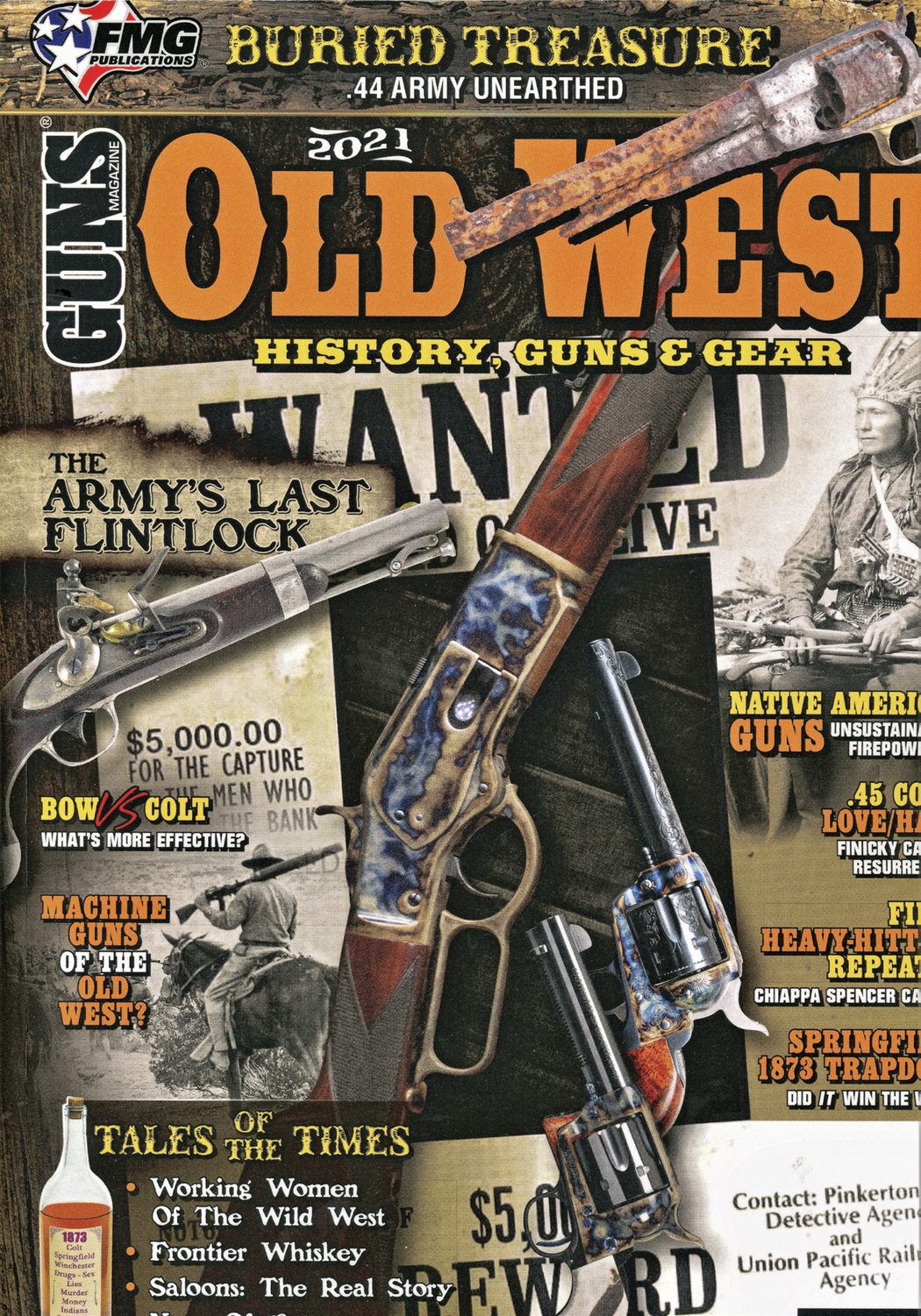
As the editor of GUNS Magazine, sponsor of this abundantly illustrated publication, notes, “Guns tell stories, and those associated with the Wild West surely have thrilling tales to share.” The magazine also noted, much to my satisfaction, that “Unfortunately, much of this mystique was fabricated by scriptwriters from the 1930s through the 1960’s.” It is time to correct this situation, and this publication sets about doing it.
The large number of articles in the Old West Special Edition covers a multitude of subjects, from original arms, ammunition, leather gear, replicas, and restorations. Tom Laemlein’s “Native American Arms: An Unsustainable Fire,” was particularly interesting to me as it gives us a new perspective on Native American acquisition of firearms. Although some were captured, some found, most
“This is the magazine for all things Civil War Navy. From ‘Uncle Sam’s web-feet’ to the ‘grey jacket navy’ raised by Jeff Davis! It is all here thoroughly researched and illustrated by beautiful contemporary navy images.”
actually came into native hands through trade with white folks. It was ever thus, back to colonial days, as I have documented in my book New Jersey: A Military History.
The Civil War makes an appearance in some articles as well and an edition such as this would not be complete without a fascinating tale of buried treasure. Interestingly they are one and the same. Dr. Will Dobbs shares how a Civil War-era revolver was discovered under layers of Mississippi mud. Jeff Houston, an acquaintance of Dobbs and owner of the “Rebel” gun store in Oxford, Miss., was using a backhoe to improve drainage on his property when he noted the unusual shape of a dirt clod he unearthed. When he examined it, Houston found it was a rusty Remington .44 caliber percussion revolver, that he cleaned, conserved, and then put on prominent display in his gun shop.
Dr. Dobbs was curious about how the revolver ended up where it was found and did some local research on the possible
by Joe Bilby
origin of the gun. According to Dobbs, in 1864, an unsuccessful Union cavalry raid in pursuit of General Nathan Bedford Forest ended up in Oxford where some Yankee horse soldiers found a hoard of whiskey and burned some buildings. As they left, heading toward the property owned by Houston today, the cavalrymen encountered a small group of Confederate infantry, who fired a few volleys and retreated. According to Dobbs, the Confederate musketry killed one man on Houston’s property, Lieutenant Theophilus Milhouse, and he concluded that this handgun was probably Milhouse’s revolver.
Whether it was or not remains a mystery. Records of serial numbered weapons and who they were issued to, while not nonexistent, are rare, since they were not required. I have occasionally seen Quarterly Ordnance Reports bearing the serial numbers of, for example, Sharp carbines issued to a regiment, but not individual soldiers. I made a brief check on my usual reference in these cases, Civil War Database, but found no one of that name and rank killed in the Civil War. Of course, spelling errors are common. If anyone discovers otherwise, let me know. At any rate, it makes a good story, and guns tell stories, sometimes with a little assistance.
A more verifiable story in the magazine is Frank Jardim’s article on the Chiappa reproduction Spencer carbine. The weapon differs from the original in that it features minor improvements made over the years of production, including an extractor developed in 1867, none of which are readily visible, making the gun useful in both Civil War reenactments, and Cowboy Action Shooting matches. It is available in three calibers, .45 Colt, .44-40, and a centerfire version of the original .56.50 rimfire round. Prices range from $1,400 to $2,000.
Jardim gives the gun a complete review, which includes loading .56-50 centerfire rounds for his gun. The .45 Colt and .44- 40 ammunition is widely available. If you want to be super authentic with your Spencer, you should choose the .56-50, as it approximates the initial rimfire round. Fortunately, all you need, providing you are a hand loader, is readily available. Cartridge cases are available from Buffalo Arms and Starline Brass; bullet molds and handles come from Lyman. The components are not cheap but if you can afford a Chiappa Spencer, you can probably afford the ammo components.
Jardin used smokeless powder in his Spencer, with a load of 23 grains of Dupont IMR 4227. You can, of course, load black powder, although the Starline cartridge case has smaller interior dimensions, since the brass is modified to be stronger than the original Spencer rimfire
All in all, the Old West Special Edition is an entertaining read; there is even an article on tavern whiskey of the era. Well worth the modest price.
Joseph G. Bilby received his BA and MA degrees in history from Seton Hall University and served as a lieutenant in the 1st Infantry Division in 1966–1967. He is Assistant Curator of the New Jersey National Guard and Militia Museum, a freelance writer and historical consultant and author or editor of 21 books and over 400 articles on N.J. and military history and firearms.
He is also publications editor for the N.J. Civil War 150 Committee and edited the award winning New Jersey Goes to War. His New Jersey: A latest book, Military History, was published by Westholme Publishing in 2017.
He has received an award for contributions to Monmouth County