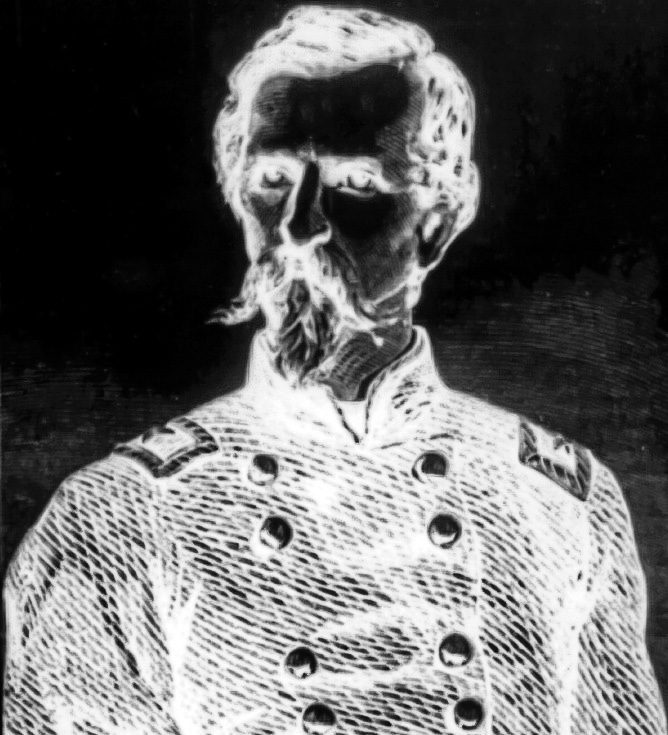
New Jersey sent two brigades to Virginia in 1861. The first was a four regiment militia brigade enlisted for 90-days service; the second the official “First New Jersey Brigade,” was three regiments of men who had enlisted for three years. Both brigades were deployed in the Bull Run Campaign as support troops and not really engaged. Following the Battle of Bull Run, the militiamen went home; the Volunteer Brigade remained in Virginia.
There was a lot of chaos among the Jerseymen after Bull Run, with officers accusing other officers of incompetence and cowardice. On Aug. 7, 1861, the brigade was assigned a new commander, legendary one-armed Jerseyman General Phil Kearny. When the general first encountered his new command, the Jerseymen were joyously pillaging a Virginia peach orchard. Kearny interrupted the festivities and was chastised by a young lieutenant who apparently took him for a local farmer. The general quickly revealed his identity and placed all the brigade’s officers under arrest. Before releasing his prisoners, Kearny established new disciplinary guidelines. His New Jersey citizen soldiers were initially unhappy with their new commander’s regime, but they quickly adjusted when it became clear that, although he made demands on them, he looked out for his men’s welfare.
The brigade was soon reinforced by the Fourth New Jersey Volunteer Infantry and Battery A, New Jersey Light Artillery. Over the winter of 1861–1862, the Jersey Brigade camped at Fairfax Seminary, Va. Kearny was interested in promoting marksmanship and, shortly after taking command, detached two companies from each regiment to create a “light battalion” equipped with highly desirable rifle muskets that Kearny had managed to pry loose from Ordnance Chief James Ripley. He seemed to predicate his choice of companies on his opinion of the capabilities of their commanders.
Captain Henry O. Ryerson, commander of the Second New Jersey’s Company B, was delighted when his company was detailed to the brigade’s “new battalion of sharp shooters.” Ryerson’s men swapped their smoothbore muskets for “the Minnie [sic] musket, rifled so that we may with some propriety be called ‘the Sussex Rifles.’”
Kearny, interested in promoting marksmanship throughout the brigade, organized a competition during the winter, described in a January letter to a Philadelphia newspaper from a Third New Jersey soldier. According to the correspondent, the men of the brigade, comfortable in their winter quarters, with tent topped log structures, plastered with the “sacred soil” of Virginia, and warmed by stoves purchased by the troops, were invited by General Kearny to send the best shot in each regiment to his headquarters on New Year’s Day, 1862, to compete for a prize of “three barrels of ale and a rifle.”
In the Third Regiment it turned out that the best shot (distance and size of target not specified) was a soldier from Company F armed with a smoothbore musket, who edged out two men from Companies B and C armed with rifle muskets, apparently as members of the Light Battalion. Unfortunately, the unnamed marksman did not win the ale and gun. “He was doomed not to win the prize, for in loading his
by Joe Bilby
piece at head-quarters he forgot to cut the buck-shot off the cartridge (which was buck and ball) and although he hit the centre, it was not counted, and the First Regiment got it, with a Sharpes [sic] rifle, with which one of their companies is armed.” There is no record of Sharps rifles in service with the First Regiment, but they left the state with one company armed with Model 1855 rifles with sword bayonets, one of which was probably in the hands of the winner.
The Civil War submarine dubbed the “Intelligent Whale,” was invented by Scoville Merriam of Massachusetts. In November 1863, a group of New Jersey investors led by William Halsted, former commander of the First New Jersey Cavalry, funded construction of the vessel. The Whale had a door in the bottom that could be opened so a diver could leave the submarine to remove obstructions or plant mines. The air pressure in the submarine exceeded the outside water pressure, thus allowing the diver to leave and return without the craft flooding.
The owners hired well known lobbyist Oliver S. “Pet” Halsted, a Newark attorney and relative of William Halsted, to represent them in an effort to sell the
submarine to the navy. It was tested in Long Island Sound in August 1864, successfully submerged and then returned to the surface, but was not prepared to demonstrate its other capabilities. The navy declined to purchase it due to fears regarding its seaworthiness, even after a more comprehensive test reported in the October 1864 issue of Scientific American magazine noted that “…in all respects the vessel worked so completely that its success is undoubted.”
Halsted eventually managed to convince the navy to purchase it in 1866. Transported to the Brooklyn Navy Yard, the Intelligent Whale was unsuccessfully tested there; several years later and ended up as an ornament on the base commander’s lawn. When the Navy Yard closed, the submarine was shipped to the Washington Navy Yard. It remained there until returned to New Jersey in 1999. It currently resides at the National Guard Militia Museum of New Jersey in Sea Girt. It is the only surviving Union Civil War submarine on display today and a major attraction at the museum.
As of this writing (April 2020), the museum is closed to the public during the Coronavirus Pandemic, but plans are in place to move the museum, with the Whale the first artifact going to a new location within the Sea Girt camp; when we reopen, it will be our most prominent artifact once again.