The savage back-and-forth struggle at the north and center ground to a halt by early afternoon. On the right, Confederate numbers were much reduced as troops were stripped away to face emergencies elsewhere; however, the remaining forces here had thwarted several Federal efforts to cross the Antietam and were still holding on. Would the next assault succeed? Would the Federals manage to cross the creek at the lower bridge and nearby fords and move up the slope? Could the Confederates form a force sufficient to block them on the plateau east of the Sharpsburg, or would the attackers break the stalemate and deal a crushing blow to Lee north of the Potomac?
In this final installment on the battle at Sharpsburg, we will hear from some Confederate officers as the Army of Northern Virginia struggles to halt the attack against its right with regiments already on the scene, with worn-down troops at the end of a 17-mile march, and with artillery units cobbled together to brace the weary and thinned-out infantry.
GEORGIA’S CONFEDERATE MONUMENTS In Honor of a Fallen Nation Gould B. Hagler, Jr.
This unique work contains a complete photographic record of Georgia’s memorials to the Confederacy, a full transcription of the words engraved upon them, and carefully-researched information about the monuments and the organizations which built them. These works of art and their eloquent nation’s profound grief, praise the soldiers’ bravery and patriotism, and pay homage to the cause for which they fought.
Brig. Gen. Robert Toombs defended the lower bridge and, for as long as possible, delayed the Federal effort to cross the creek. From the start, Toombs was short-handed. Two of his four regiments were away guarding a wagon train; in the remaining two Toombs counted only about 400 men; a third regiment, borrowed from another brigade, numbered “scarcely 100 muskets,” according to Toombs. These infantrymen, backed by three artillery batteries, stood against a Federal corps under Maj. Gen. Ambrose Burnside.
In his report Toombs described the terrain and its tactical significance. “The ground descended gently to the margin of the river, covered with a narrow strip of woods, affording slight protection to the troops. Its chief strength lay in the fact that, from the nature of the ground on the other side, the enemy were compelled to approach mainly by the road which led up the river for near 300 paces, parallel to my line of battle, and distant therefrom from 50 to 150 feet, thus exposing his flank to a destructive fire the most of that distance.”
The defenders made the most of this advantage. “At between 9 and 10 o’clock the enemy made his first attempt to carry
the bridge by a rapid assault, and was repulsed with great slaughter, and at irregular intervals, up to about 1 o’clock, made four other attempts of the same kind, all of which were gallantly met and successfully repulsed by the Twentieth and Second Georgia.”
“After these repeated disastrous repulses,” Toombs continued, “the enemy, despairing of wresting the bridge from the grasp of its heroic defenders…, turned his attention to the fords [downstream from the bridge], and commenced moving fresh troops in that direction by his left flank.” Toombs lacked the men to protect these crossings and no re-enforcements were available.
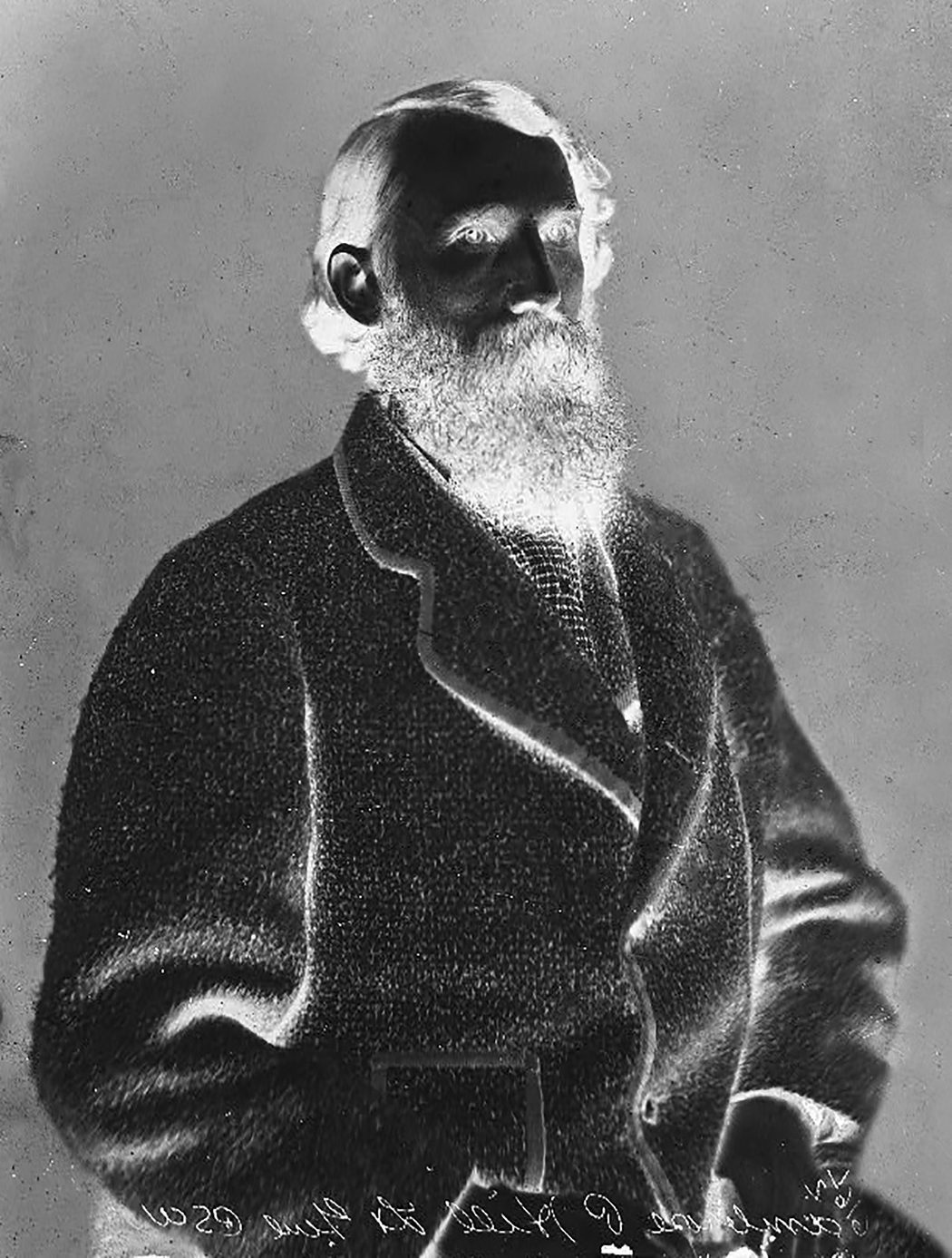
Brig. Gen. Robert Toombs. Library of Congress. Once across at these points, and after a final rush across the bridge, the Federals were in position to attack the Georgians’ right flank and rear, as well as their front. Toombs withdrew to a position designated earlier by his division commander, Maj. Gen. David R. Jones.
So now the Yankees are across the Antietam, but before they move up the hill, let’s go back to 6:30 a.m., when Maj. Gen. A.P. Hill, still at Harpers Ferry, received an urgent message from Lee: March to Sharpsburg without delay. Hill reported that his division left the Ferry an hour later. Hill drove his men at a frenzied pace. Many hundreds fell by the way. Forty percent of his force of 5,000, and perhaps more, did not appear in time to fight.
In his report Hill stated: “My troops were not in a moment too soon. The enemy had already advanced in three lines, had broken through Jones’ division, captured McIntosh’s guns, and were in the full tide of success.” Hill wrote that his brave men charged “with a yell of defiance” and stopped the enemy’s advance. “The three brigades of my division actively engaged did not number over 2,000 men, and these, with the help of my splendid batteries, drove back Burnside’s corps of
October 2020
Reports for two of the Hill’s brigades are contained in the Official Records. Brig. Gen. James Archer wrote that during the march from Harpers Ferry “many of the men fell, exhausted from the march…, so that when the four regiments of my brigade reached the battle-field there were only 350 men.” He re-formed his line after some initial confusion, then moved forward with this fraction of his brigade through a narrow cornfield and across a wider plowed field against Federals positioned behind a stone fence. “In passing over the short distance of 250 yards…, I lost nearly one-third of my already greatly reduced command, but it rushed forward alone at double-quick, giving the enemy but little time to estimate its small numbers, and drove him from his strong position.” Archer concluded by stating that “It was now nearly sunset” and reported casualties of 15 killed and 90 wounded.
Col. James H. Lane, commanding Brig. Gen. Lawrence Branch’s Brigade after Branch was killed, had little to say about the brigade’s actions during this phase of the battle. His brief report stated that the “three regiments principally engaged… fought well, and assisted in driving back three separate and distinct columns of the enemy.”
The reports of Hill, Archer, and Lane made little mention of General Jones’s division, which stood to the left of the line formed by Hill’s brigades. Hill wrote that when he reached the battlefield he conferred with Jones about the situation; that Jones’s division had been strengthened by a battery belonging to Hill; and that the enemy had already broken through when Hill arrived. Archer mentioned only that Toombs’s brigade, of Jones’s division, was on his left when he joined the fight. Lane did not mention Jones at all.
An officer in Toombs’s brigade, Col. Henry Benning, presented a different perspective in an article written 26 years later. Benning described how this brigade arrived just as Jones’s other units were breaking. Toombs’s Georgians struck the Federals with great force. “In ten or fifteen minutes,” he wrote, “[the Federal] line showed signs of wavering.” In the face of this deadly fire, and a sudden blast of artillery, “they broke and ran under the hill, and were out of sight in less than a minute.”
“These men…did all the fighting at the place where the enemy first broke, and nearly all afterwards,” Benning wrote. “There
were some troops on our right in the corn…, and others of A.P. Hill’s troops came up before night, but none of them had much part in the fight; none of them had any part in first breaking of the line.”
Toombs himself wrote of his brigade’s role when it re-entered the fray after withdrawing from the creek. He observed the crisis as the Federals pursued the disorganized Confederates toward the village. “A retreat would have left the town of Sharpsburg and General Longstreet’s rear open to the enemy, and it was inadmissible. I, therefore, with less than one-fifth of the enemy’s numbers, determined to give battle, and immediately and rapidly formed my line of battle…within 100 paces of the enemy’s lines.” The fire of Toombs’s men, supported by troops from another of Jones’s brigades, repelled the advancing Federals, who broke and “fled in confusion toward the river and bridge….”
It took more than muskets and bayonets, of course, to stymie the attack. Lee’s artillerymen also played a critical role. In his memoirs, General Longstreet listed seven individual batteries that were in the fray and, in addition, named three artillery battalions whose commanders “found places for parts of their batteries, ammunition replenished.” With the exception of three batteries under A.P. Hill, all these units had been hotly engaged all day and had lost many men, horses, and guns.
Officers writing soon after the battle and later had different perspectives on the counter-attack, and had varying views on how to apportion credit between Jones’s Division and Hill’s. This is inevitable. The commanders stood at different places on this confusing battlefield, commanded different men, and saw different things. Modern historians also have assigned varying measures of credit to the two Confederate divisions. This also is to be expected. However, to a large degree the Confederate’s success is due to another commander: Maj. Gen. George B. McClellan.
Lee’s force was stretched to the very limit. Toombs’s men held the enemy for hours, and re-entered the fight after retreating up the slope. The remainder of Jones’s Division was falling back in confusion. Hill’s men marched all day and entered the battle the moment they arrived. Nearly every Southern soldier was engaged in the desperate struggle. McClellan, in contrast, held a significant part of his army in reserve.
The Confederate counterattack was succeeding; Burnside was now hard pressed. He asked McClellan for more infantry and artillery. According to Stephen Sears, 5,500 men were readily available, most of whom “had yet to fire a shot,” but McClellan, exposing “the final dimension of his own loss of courage,” said no. Fearing that Lee was stronger than he actually was, and perhaps thinking that he needed these reserves to save his own
army rather than destroy Lee’s, McClellan refused to commit the fresh troops. He sent nothing but a single battery. Burnside, he said, must hold his ground until dark without additional support. Burnside did hold on, but could do no more.
The bloody day ended in a costly stalemate. Lee retreated on Sept. 19, along the road to Boteler’s Ford on the Potomac, a road held open thanks to A.P. Hill, Robert Toombs…and George McClellan.
The reports of all the officers named are in the Official Records, Series I, Vol. XIX, Part I. Benning’s account is in Vol. 16 of the Southern Historical Society Papers. Longstreet’s memoirs, From Manassas to Appomattox, were first published in 1896. Sears’s Landscape Turned Red:
The Battle of Antietam was published in 1983 by Ticknor & Fields. Sears’s battlefield maps diagram the various wooded areas and fields, and show how different fields were used—corn, orchards, grass, etc. These illustrations are a great aid for the reader trying to understand the officers’ descriptions of the action.