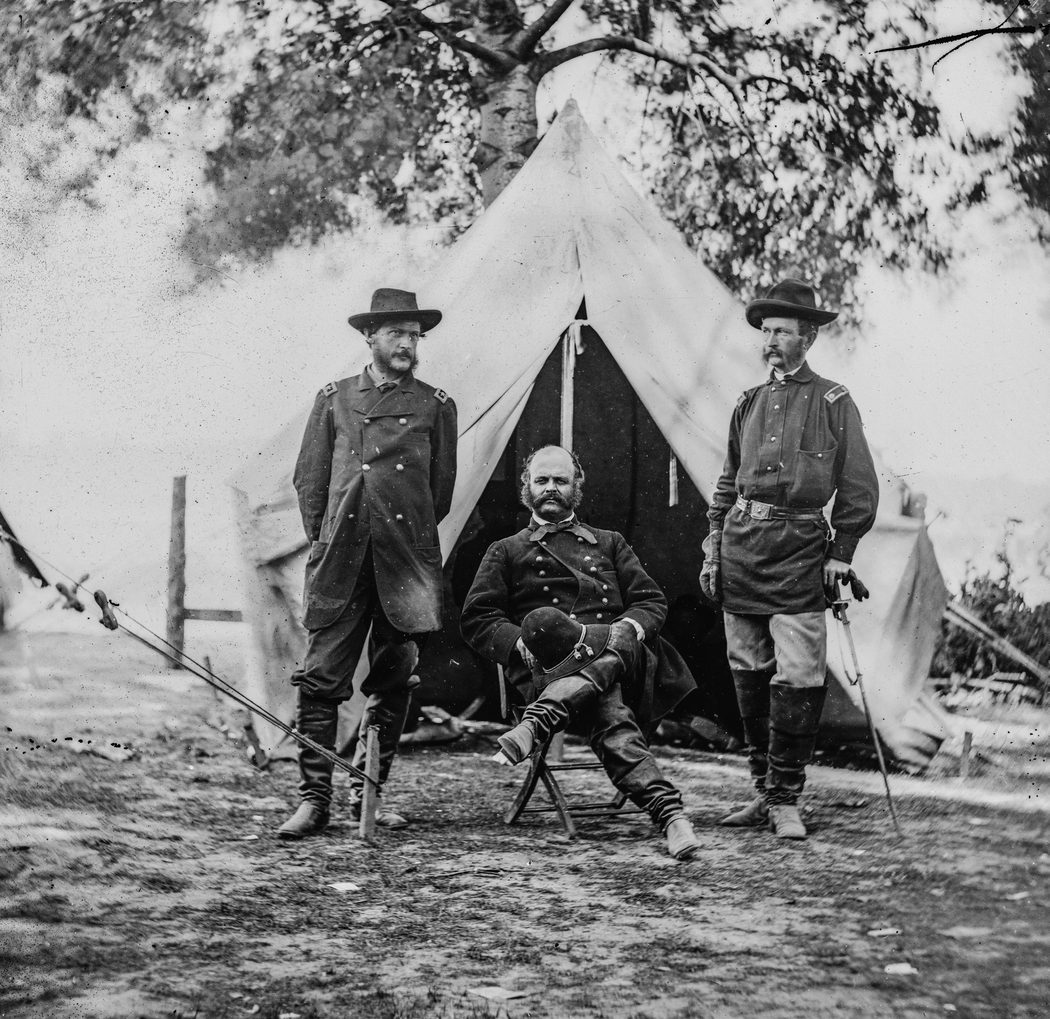
In December and January we observed, through the eyes of several Federal officers, the carnage in the first two phases of the Battle of Antietam, on the north and center of the line. Let’s now turn our attention to the Federal left, commanded by Maj. Gen. Ambrose Burnside.
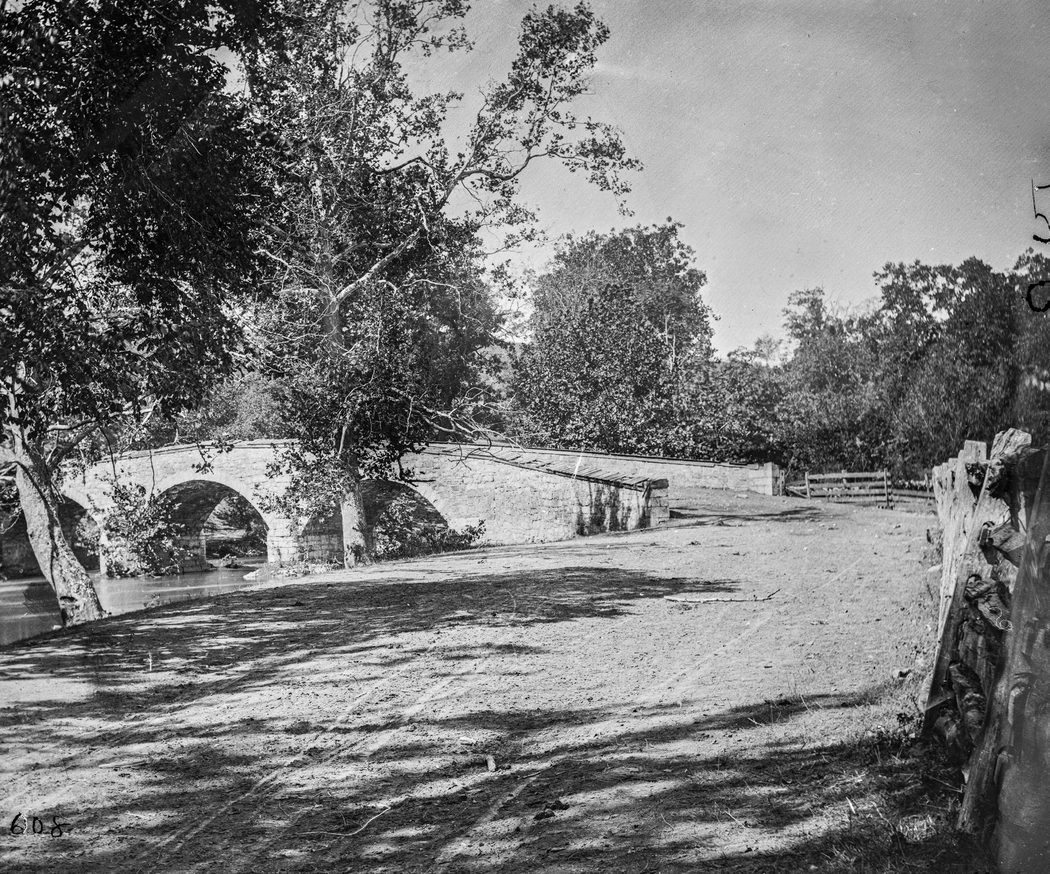
Like the Sunken Road and Miller’s Cornfield, Burnside’s Bridge (as it was named after the battle) is a famous Civil War icon. We will now hear from the commanders of the men who crossed the creek at the bridge and downstream at Snavely’s Ford, charged up the heights on the west bank, and fought on the plain above, in the final phase of the fighting at Sharpsburg on Sept. 17, 1862.
Brig. Gen. James Nagle’s Brigade made the first effort to cross the bridge. Nagle’s report described the ground. “The
position was a strong one for the enemy, as he was posted in a strong force on the bank of Antietam Creek, on the wooded banks of this stream, with precipitous banks that afforded them shelter from our artillery and infantry. Two roads diverge from this bridge, and the approach to it is through a narrow ravine, admitting not more than one regiment at a time, upon which a deadly volley could be easily poured from the enemy…on the other side of the bridge.”
Brig. Gen. Samuel Sturgis, the division commander, stated in his report that he ordered two of Nagle’s regiments “to move over at a double-quick and with bayonets fixed. They made a handsome effort to execute this order, but the fire was so heavy on them before they could reach the bridge that they were forced to give way and fall back.” Ordered by Burnside to “carry the bridge at all hazards,” Sturgis next called upon the brigade commanded by Brig. Gen. Edward Ferrero.
Ferrero, like Nagle, described the strength of the Confederate position and stated that he “awaited the result of the attack by some of our other forces [i.e., Nagle’s] that had preceded my brigade in the attempt to cross the creek.”
“The passage of the bridge was…very obstinately disputed,” Ferrero continued, “and at length I received orders…to move forward my brigade, and carry the bridge at all hazards. I accordingly moved forward my command and carried the bridge at the point of the bayonet at 1 o’clock….”
After crossing the stream Ferrero “moved forward one regiment to the summit of the hill, to retain the position until re-enforcements should arrive….”
The brigade commanded by Col. Harrison S. Fairchild was one of the units crossing at Snavely’s Ford. Fairchild wrote that after being exposed to fire for some time on the east side of the creek, he was ordered across by division commander Isaac Rodman. “The brigade then moved by the left flank down to the ford; crossing the creek, and forming in the woods, advanced and took a position opposite the bridge; there formed a line of battle on the crest of the hill..., remaining in position under heavy fire of shell.” Ordered forward, the brigade “continued to advance to the opposite hill under a tremendous fire from the enemy’s batteries up steep embankments…. Arriving near a stone fence, the enemy… opened on us with musketry. After returning their fire, I immediately ordered a charge, which the whole brigade gallantly responded to, moving with alacrity
GEORGIA’S CONFEDERATE MONUMENTS In Honor of a Fallen Nation Gould B. Hagler, Jr.
This unique work contains a complete photographic record of Georgia’s memorials to the Confederacy, a full transcription of the words engraved upon them, and carefully-researched information about the monuments and the organizations which built them. These works of art and their eloquent nation’s profound grief, praise the soldiers’ bravery and patriotism, and pay homage to the cause for which they fought.
and steadiness. Arriving at the fence, behind which the enemy were awaiting us, receiving their fire, losing large numbers of our men, we charged over the fence, dislodging them and driving them from their position down the hill toward the village….”
The Federals stood on the verge of the breakthrough for which they had struggled since daybreak, first on the right, then in the center, and finally here, on the far left. However, something was afoot on the left of Fairchild’s Brigade.
“It was…discovered that the enemy were moving up from the
corn-field on our left to flank us, and I ordered the brigade to retire about 250 yards to the rear…. The large force advancing on our left flank compelled us to retire from the position, which we could have held had we been properly supported.”
Col. Edward Harland led another brigade in Rodman’s Division, which, like Fairchild’s, crossed at Snavely’s Ford and advanced up the hill.
Harland’s report paints a vivid image of the confusing scene on the plain when the Federal troops were struck by Confederates approaching from their left.
“I advanced the Eighth Regiment Connecticut Volunteers and commenced firing. The [other regiments] not coming up, I turned to see if they were advancing, and saw some infantry belonging to the enemy advancing upon our left flank. Knowing that if they were not checked it would be impossible to hold this part of the field…, I put the spurs to my horse to hasten the arrival of the Sixteenth Regiment Connecticut Volunteers. My horse was almost immediately shot under me, which delayed my arrival. I found that the Sixteenth…had changed their front by order of General Rodman. The line was formed facing to the left, and was nearly a prolongation of the enemy’s lines, except that they faced in opposite directions [emphasis added].”
“I immediately ordered [the Sixteenth] to change… front, so as to attack the enemy on the right flank. This change was effected, though with some difficulty, owing to the fact that the regiment had been in service but three weeks, and the impossibility of seeing but a small portion of the line at once.”
The approaching Confederate troops opened fire. “Almost as soon as the change was effected, the right of the enemy’s lines, which was concealed in the edge of the corn-field, opened fire. Our men returned the fire and advanced, but were forced to fall back. Colonel Beach rallied them and returned to the attack, but they were again driven back, this time out of the corn-field, beyond the fence. Here they were again rallied, but it was impossible to see the enemy; and the men were under fire for the first time, they could not be held.”
Another of Harland’s regiments managed to hold its position and “changed front so as to reply to the enemy on the left. After a few rounds, as most of the men were out of ammunition, the order was given to fall back…. At the bridge I collected the shattered remnants of the brigade…but, owing to the large loss of officers and the failure of ammunition, it was impossible to render the men of any material service. I therefore conducted the brigade across the a past president of the Atlanta bridge, and bivouacked for the Civil War Round Table and the night….” author
The troops appearing on the Monuments: In Honor of a Fallen Federal left were, of course, the Nation, men of Maj. Gen. A.P. Hill’s University Press in 2014. Hagler Light Division, which had marched 17 miles from Harpers Ferry. This force arrived just in time to prevent Burnside’s troops from blocking the route to Boteler’s Ford, Lee’s only path of retreat across the Potomac. The final Federal push had failed. The fighting ended. The two exhausted armies slept, and then watched each other for a day as they tended to their wounded as best they could. On the 19th Lee began his retreat.
When this series continues, with Perspectives on Sharpsburg, we will listen to the Confederate commanders whose men braved the withering fire in Miller’s cornfield, endured the slaughter in the Sunken Road, slowed the Federals at the bridge and, just in time, halted the Federal advance on the Confederate right.
Official Records, Ser. I, Vol. XIX, Pt. I, Reports of Harrison Fairchild, Edward Ferrero, Edward Harland, James Nagle, Samuel Sturgis.
“Once a statement gets into the stream of history it is apt to flow on indefinitely.” Winston S. Churchill, Marlborough: His Life and Times
The Rohrabach Bridge over the Antietam below Sharpsburg is one of the famous landmarks of the Civil War. Since the battle this three-arched stone structure has been known as Burnside’s Bridge. The renaming is not generally taken as an honor for General Burnside, but rather as a snide denigration of his supposed incompetence at the Battle of Antietam.
But was the new name for the bridge ever intended as a slight? And was Burnside incompetent or even dilatory?
Thirteen years ago William Marvel wrote an interesting article on this subject in which he traced the unflattering interpretation to Henry Kyd Douglas’s memoirs (I Rode with Stonewall, written in 1899 and published in 1940) and to Bruce Catton’s Mr. Lincoln’s Army (1951). (You can find Marvel’s article at http://www.historynet.com/battle-of-antietam-controversial-crossing-on-burnsides-bridge.htm.)
Douglas opined that Burnside’s men could have easily “executed a hop, skip, and jump and landed on the other side” of the creek. Douglas also quoted an army officer (unnamed) who sarcastically expressed puzzlement that Burnside was able “to keep his troops from breaking over.” Catton relied on Douglas, Marvel wrote, and other scholars followed his example.
Based on his documentary research, conversations with locals familiar with the creek, and his own examination of the watercourse and nearby terrain, Marvel concluded that “the creek would have provided a perfectly effective military obstacle on June 5, 1994, and a great deal of evidence confirms that it served just as effectively on September 17, 1862.”
The accounts of the battle at the bridge written by Nagle, Fairchild, Sturgis and Ferrero support this assessment. The terrain was difficult for the attackers and they faced deadly Confederate fire.
Mark Twain was folksier than Churchill but he made the same point: “It ain’t what you don’t know that gets you into trouble. It’s what you know for sure that just ain’t so.”
The Civil War Water
Featuring nationally-recognized Civil War scholars John M. Coski, Anna Gibson
Holloway, Jonathan A. Noyalas, Karen Needles and Jonathan W. White