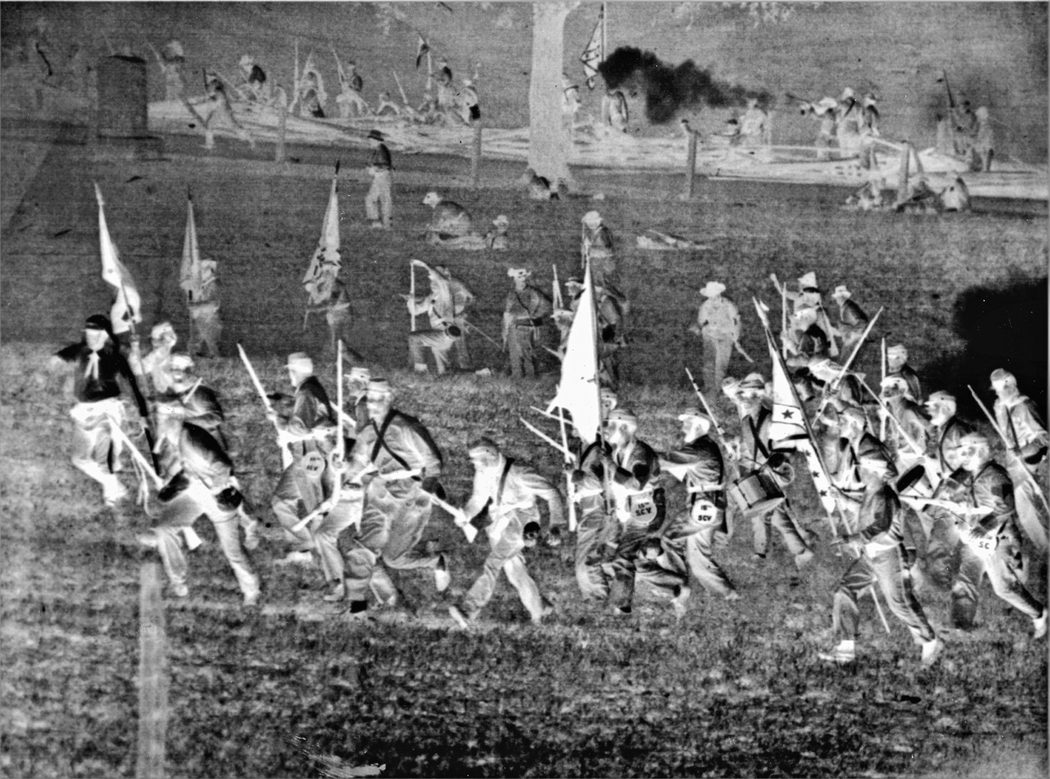
As most readers of this column know, I have been acquiring original news photos of twentieth century battle reenactments. A recent acquisition, showing a Confederate scramble at Antietam, is published along with this column.
In Centennial was well underway, and the Antietam/South Mountain Centennial Association invested $300,000 in staging a reenactment of the battle of Antietam on the original battlefield. The result would differ dramatically from the 1937 seventy-fifth anniversary show that was conducted by
We carry a very large inventory of Colt and Civil War firearms including muskets, carbines, rifles and accoutrements. Our inventory of historic antiques and firearms begin at the early collectors level and range all the way up to the advanced collector and investors level.
National Guardsmen in modern uniforms.
The 1962 “one half hour production” was intended to re-create “only the Sunken Road” segment of the battle, and “makeshift bleachers” were provided for the thousands of tourists who came to view the show. The participants, described by a reporter as “more than 1,500 from 21 states” included “men and boys and even some girls, in Union Blue and Confederate Gray.”
The script called for a series of advances, flank attacks, and retreats by both sides, but a rehearsal on Sept. 14 “didn’t work.” According to a report, “some of the troops did not know where they should be or which way to move.” One problem was that “somebody forgot the walkie talkies, which were used to cue the units.”
The “commanding general of the production, Rhonda Rohold,” described as “an energetic blonde attired in toreador pants and a sloppy shirt” by a reporter, ran around the battlefield “commanding her troops,” and concluded that they needed another rehearsal.
One reenactor compared the chaos of the scene to the Battle of Bull Run staged the previous year, saying: “there was a really mixed up situation.” The photo is of the actual reenactment held on Sept. 17. It still looks “mixed up.” If I recall correctly, it was the last Centennial reenactment staged on a National Battlefield Park.
An interesting sidelight to the Antietam Centennial reenactment is provided by the memoir of North-South Skirmish Association member Ross Kimmel, who describes himself as a “teenage Civil War zealot” at the time of the Centennial. Kimmel’s unit was involved in some early reenactments, including Bull Run, as well as N-SSA shooting, but had not registered for the Antietam event. Kimmel decided to go anyway, however, and, with a couple of friends, linked up with the Second North Carolina.
Kimmel recalled that the Second spent the morning of the reenactment “working out a system of battle maneuvers we were going to use in the battle… It was a series of facings and charging at a quickstep staying in step.” Following that brief training exercise, the unit marched to the rear through the cornfield by the Sunken Road and sat down to wait in a small woodlot, where, shortly afterward, the Second was surrounded by “a group of about 20 or 30 state police with a hound.” The police detachment did not arrest the reenactors but escorted them off the field, offering no explanation for the action. The unit and its guard detail marched in step along the Sunken Road while spectators and other reenactors looked on in bewilderment. When the Second’s commander finally halted his troops and demanded an explanation, he was advised that the action was taken to “prevent trouble during the reenactment.” The bizarre parade ended on the Sharpsburg road where the police took the names and addresses of the reenactors and they waited until cars and trucks arrived to take them home. It was later learned that someone from a rival unit, who held a grudge against the Second North Carolina for some reason, had “tipped” the police that the Second was planning to set Piper field afire and start “a riot.” This was, of course false, and no evidence was ever produced.
An interesting point came up in a discussion I was having with friends regarding Winslow Homer’s famous painting and subsequent print of the Union sharpshooter in a tree. I always wondered how the soldier lugged that heavy barreled scoped rifle up there, but the more interesting point is how he would reload up in the branches. The type of target rifle he is using required a false muzzle, measured powder charge, paper patched bullet, and bullet starter to load. In order to do that up in the tree, the shooter would have had to be a gymnast. Although Homer was obviously familiar with sharpshooter weapons, he may have let his artistic sense take over, or the guy climbed the tree for just one shot.
Last month I reported on the, to me, surprising lack of uniformity in British Enfield ammunition. Ammunition for the Whitworth rifle used by select British army units and Confederate sharpshooters was evidently a different story. My friend and expert on all things British, Bill Adams, provided the following specs for Whitworth cartridges: • “Projectiles are all .442" – these are “regulation”
cartridges • 530gr hexagonal bullet; 85grs powder; 3.9" total length (there were some longer hex
cartridges) • 530gr cylindrical bullet; 85grs
• 530gr cylindrical bullet; 70grs powder; 4.5" – this is listed by Lewis as a regulation 1865 Royal Lab service cartridge for the Rifle Corps with a grey wrapper and a total weight of
Joseph G. Bilby received his BA and MA degrees in history from Seton Hall University and served as a lieutenant in the 1st Infantry Division in 1966–1967. He is Assistant Curator of the New Jersey National Guard and Militia Museum, a freelance writer and
— MAKER — LEATHER WORKS
Museum Quality
42nd Annual Ohio Civil War Show | Including WWI & II 27th Annual Artillery Show Military Material From 1775 Through 1945 Saturday May 4th – Sunday May 5th 2019 Sat. 9:00 – 5:00 | Sun. 9:00 – 3:00
Richland County Fairgrounds, Mansfield, Ohio | Location: US-30 and Trimble Road 800 Tables of Military Items, Books, Prints and More For Buy, Sell, Trade & Display
Artillery Demonstrations & Cannon Firing Demonstrations • Civil War & WWII Encampments • Sutler’s Row • Field Hospital Scenario • Period Church Service rd OVI Regimental Band Camp Chase Fife & Drum & 73
Gettysburg Address Presented by President Lincoln Marlboro Volunteers Traveling Museum & Military Vehicles
Made In The USA
Established 1981
Gun Works, Inc.
First published in 1954 as a 12-page, pocket-sized booklet, the 2019DIxIE GuN WORkS catalog has more than 600 pages and more than 10,000 items— the world’s largest selection of blackpowder replica arms, accessories, antique parts, as well as muzzleloader hunting and sport shooting equipment. We thank our more than 75,000 loyal customers, including buckskinners, reenactors, modern blackpowder hunters and sport shooting enthusiasts, for 65 wonderful years.
VIEW ITEMS AND ORDER ONLINE!
Life Member, Company of Military Historians
DIXIE GUN WORKS, INC.
International Society of Appraisers Life Member, NC Division, SCV Federal Firearms Licensed Dealer