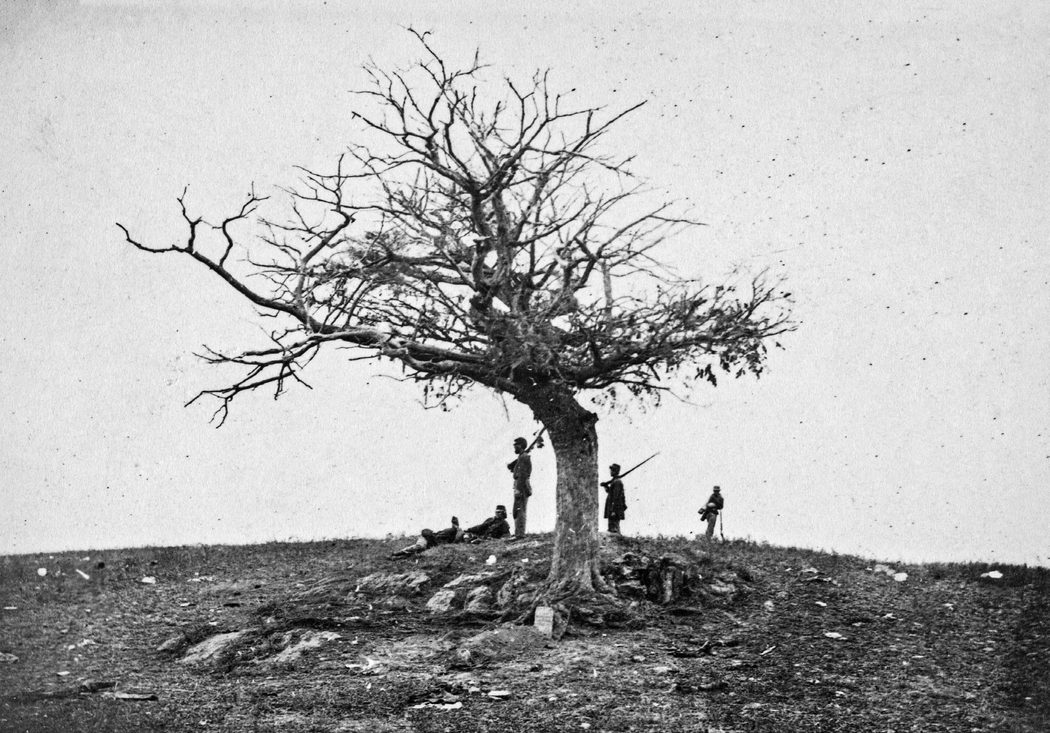
After his victory at the second battle fought at Manassas, Lee led his men across the Potomac. Lincoln, dissatisfied with Pope, turned again to McClellan, who pursued the Confederates into Maryland. Confident that his adversary would act with his usual caution, Lee sent part of his force to take Harpers Ferry and its garrison. The risk paid off for Lee, or seemed to, but his famously mislaid orders revealed his troop movements to McClellan. As the Confederates concentrated at Sharpsburg on the west side of Antietam Creek, Federals moved toward the creek from the southeast. The stage was set for the desperate fight on September 17, 1862, America’s bloodiest day.
Continuing our Perspectives Series, we will now turn our attention to the reports and memoirs of several Federal officers and listen to their stories as they led their men across the creek against the Confederates’ position. They will tell us of the havoc in the fields at the north end of the line, the carnage along the Sunken Road in the center, and the bloodshed on
GEORGIA’S CONFEDERATE MONUMENTS In Honor of a Fallen Nation Gould B. Hagler, Jr.
This unique work contains a complete photographic record of Georgia’s memorials to the Confederacy, a full transcription of the words engraved upon them, and carefully-researched information about the monuments and the organizations which built them. These works of art and their eloquent nation’s profound grief, praise the soldiers’ bravery and patriotism, and pay homage to the cause for which they fought.
the Confederates’ right flank as the Federals crossed the famous bridge and moved to the heights beyond.
Because of the scope and complexity of the Battle of Antietam, or Sharpsburg, we will break the battle into its three phases and examine each in turn. This month we start with the north end of the battlefield, the Federal right, where the battle began in the early hours of Sept. 17.
Let’s march toward the battlefield with Brig. Gen. John Gibbon, commander of a brigade in Abner Doubleday’s Division. As he moved from Frederick on Sept. 14, along the road to South Mountain, he overtook stragglers from other units. “An advance guard…was placed in front of the brigade and the whole drum corps united behind it,” Gibbon wrote in his memoirs. “In front of the guard all the stragglers were placed and the drums striking up ‘The Rogue’s March,’ the stragglers were thus forced forward amidst the laughter and jeers of our men.” These slow-footed warriors would be needed at South Mountain—a barrier that had to be passed to reach the main Confederate army—and in the far fiercer struggle to follow. Of Sept. 17, Gibbon wrote, “we needed no reveille, for at the earliest dawn firing commenced, and
our troops were rapidly formed, the shells commencing to scream over our heads.”
“As we moved forward…a shell struck in the very middle of the leading regiment…and bursting, as it struck, killed and wounded some 20 to 30 men. Such a calamity is the severest test of discipline. For a few moments the column was checked as the poor suffering men were removed, and then at the voice its Lt. Colonel, the [regiment] moved on again, followed by the rest of the brigade.”
Arriving at the front, Gibbon’s brigade attacked the Confederates in the West Woods. “No enemy was in sight,” he wrote, “but his shells were flying thick over our heads.” The brigade met the enemy infantry and became heavily engaged. “We knew but little of what was going on beyond our immediate vicinity. We were in the hottest of hornet’s nests and had all we could do to attend to what was in our front whilst the sounds of a severe battle reached our ears from all directions. Bullets, shot and shell whistled
and screamed around us, wounded men came to the rear in large numbers, and the six Napoleon guns of Battery ‘B’ hurled forth destruction in double rounds of canister as the enemy in increased numbers rushed forward to capture the guns. He seemed to be making headway against our troops in the cornfield and the [artillery] piece on the pike was firing in that direction.”
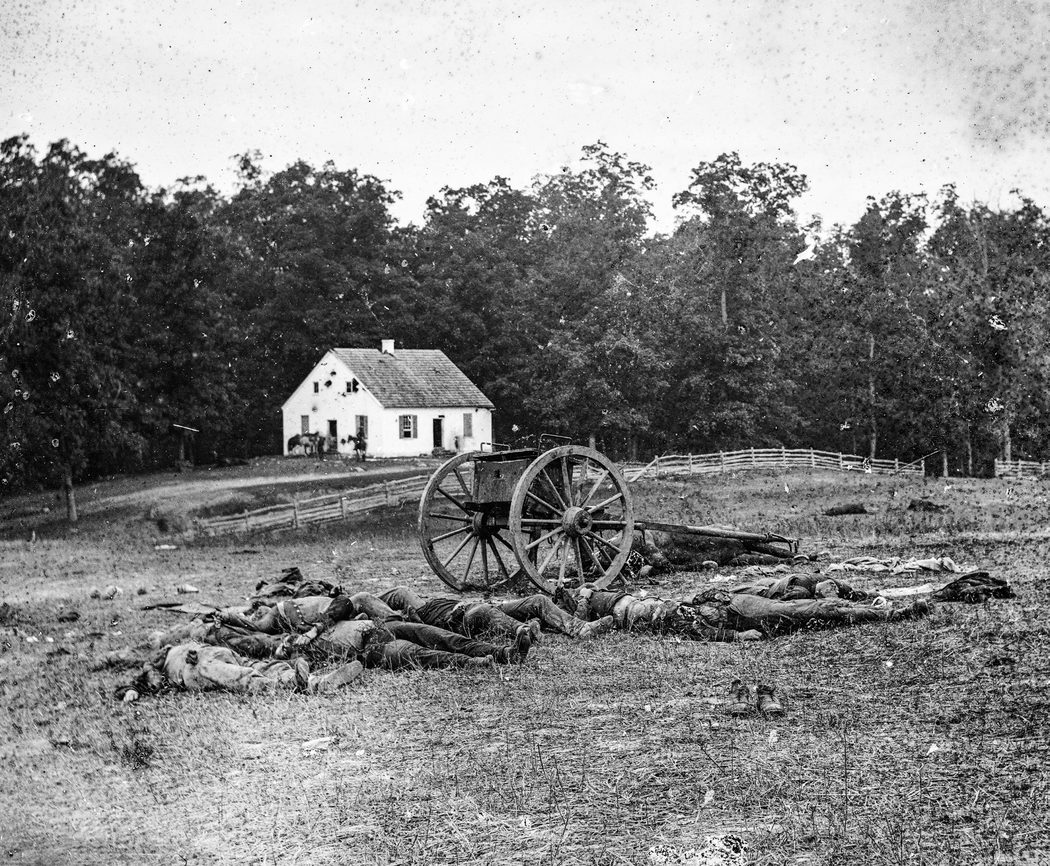
“The enemy got so close to the battery in his desperate attempt to capture it,” Gibbon continued, “that the pieces were double-shotted with canister before which whole ranks went down, and after we got possession of the field, dead men were found piled on top of each other.”
The fighting in this sector was far from over. Pushed back to the Dunker Church, the comrades of
these fallen men attacked again. After ferocious fighting in this area the Federals were repelled. From his vantage point Gibbon saw that “the whole open space between the ‘East’ and the ‘West’ woods was filled with a disorganized mass of panic-stricken men going to the rear.”
Gibbon credited his brigade with stopping this panic just as it had restored discipline when it encountered the stragglers on Sept. 14. “My brigade…was quickly brought to attention and formed to stop the stampede… and after some considerable difficulty a number of regiments were halted and reformed….”
The mad rush was halted, but “the disastrous result of [this] attack threw us back nearly to the line we had occupied when the fighting commenced in the morning and the enemy, during the day, established his picket line on our side of the straw-stacks where I had placed ‘Battery B’ when we went into action.”
Brig. Gen. Oliver O. Howard led a brigade in Sedgwick’s Division, the force that was struck by the Confederates and driven back in the panic described by Gibbon. In his memoirs Howard, like Gibbon, discussed the straggling that occurred as the Army of the Potomac moved into Maryland, though he focused on the cause rather than the remedy employed by Gibbon. “Putting together the sickness and discouragements that followed our second Bull Run and the Harper’s Ferry disaster, nobody will wonder that our army had many stragglers between Washington and Antietam.” Straggling notwithstanding, by the early hours of Sept. 17 Federal forces were engaged in the fierce back-and-forth fighting on the Federal right. We have listened to Gibbon’s description, and now turn to Howard’s account.
After this struggle had been underway for some time, Howard’s Brigade and the others of the division (commanded by brigadier generals Willis A. Gorman and Napoleon J.T. Dana) made their way onto the field via the upper crossings of the creek. Howard described the impact the fighting had on the units already engaged. “I saw abundant evidence of the preceding conflict, surely not encouraging to men just coming upon the field. Too many were busying themselves in carrying their wounded comrades to the rear. [Corps commander Maj. Gen. Edwin] Sumner sent a staff officer to the find the places where Hooker’s corps was to be found. He came upon General Ricketts, the only officer of rank left there, who declared that he couldn’t raise more than 300 men
of the corps for further work.”
When Sumner’s divisions attacked they were struck by Confederate reinforcements from the southern end of the line. Howard wrote: “We broke through the cornfield; we charged over an open space and across the turnpike and forward into the ‘West Woods’ till Gorman’s line encountered the enemy’s sharp musketry fire. Then all halted. Our three lines, each in two ranks, were so near together that a rifle bullet would often cross them all and disable five or six men at one time.”
While Gorman attacked, Dana and Howard’s brigades waited in reserve and “naturally sought to protect themselves by taking advantage of the rocks, trees, and hollows, or by…lying down. While I could hear the whizzing of the balls, the woods being thick thereabouts, I could see no enemy.”
At this point Howard realized that the units he thought were covering his left flank were not there. Instead he was struck by a Confederate attack. He described the ensuing chaos. “[General Sumner] was without his hat and with his arms outstretched motioned violently. His orders were not then intelligible; but I judged that Sedgwick’s left had been turned and immediately sent the necessary orders to protect my flank by changing the front of my brigade to the left.” Howard stated that others had a different understanding of Sumner’s order. Some heard “get out of here” or “you must face about.” Howard recorded that “quicker than I can write the words, my men faced about and took the back track…. When we reached the open ground Sumner himself and every other officer of courage and nerve were exerting themselves to the utmost to rally the men…. But it was simply impossible till we had traversed and cleared these fields; for now we had the enemy’s infantry and artillery in rear and on our flank against our broken brigades, pelting us with their rapid and deadly volleys.”
The Confederates drove this division back, but their strength was exhausted. The intense fighting on this flank petered out. The dead men lay thick on the ground and the wounded suffered from indescribable pain, suffering which for one poor soldier was unbearable. Gibbon wrote that an artillery sergeant “suffered much and when lying in the hospital, took his pistol and deliberately blew his brains out.”
We will pause here, with the sad end of this unfortunate sergeant. Next month we will look at the battle’s next phase, the center of the line, in and along a wagon road worn deep by long use, as if in preparation for the battle.
Sources and further reading: • •
• Official Records, Ser. I, Vol. XIX, Pt. I, Reports of John Gibbon and O.O. Howard.
General John Gibbon, At Gettysburg and Elsewhere: Personal Recollections, Big Byte Books, 2016, originally published in 1928.
O.O. Howard, Autobiography of Oliver Otis Howard,
Major General United States Army, The Baker & Taylor Company, 1907, Kindle Edition 2011.