After being repulsed Kennesaw Mountain, Sherman reverted to his tried-and-true tactic of maneuvering to his right, threatening Johnston’s communications and forcing the Confederates to retreat to the Chattahoochee. On July 8, 1864, a sizable Federal force crossed the river at Sope Creek.1 With his opponent gaining a bridgehead south2 of this last natural barrier, Johnston again pulled his army back, toward Atlanta’s fortifications, while the rest of Federal army crossed the undefended river at several other points.
Now the narrative is supposed to move forward to the dramatic change of command, the major
GEORGIA’S CONFEDERATE MONUMENTS In Honor of a Fallen Nation Gould B. Hagler, Jr.
This unique work contains a complete photographic record of Georgia’s memorials to the Confederacy, a full transcription of the words engraved upon them, and carefully-researched information about the monuments and the organizations which built them. These works of art and their eloquent nation’s profound grief, praise the soldiers’ bravery and patriotism, and pay homage to the cause for which they fought.
battles north, east, and west of Atlanta, then to the semi-siege, the bombardment, cutting the final railroad, and the evacuation of the city the night of September 1-2. Let’s not go there. Let’s stop at the river. What happened at Sope Creek on July 8? How was this crossing achieved?
In his report after the fall of Atlanta, Sherman explained that the Chattahoochee was a significant obstacle. He described the river as “a rapid and deep stream, only passable at that stage by means of bridges, except at one or two very difficult fords.” Sherman explained his plan in his memoirs: “I expected every possible resistance in crossing the Chattahoochee River and had made up my mind to feign on the right, but actually cross over by the left.” Maj. Gen. John Schofield’s Army of
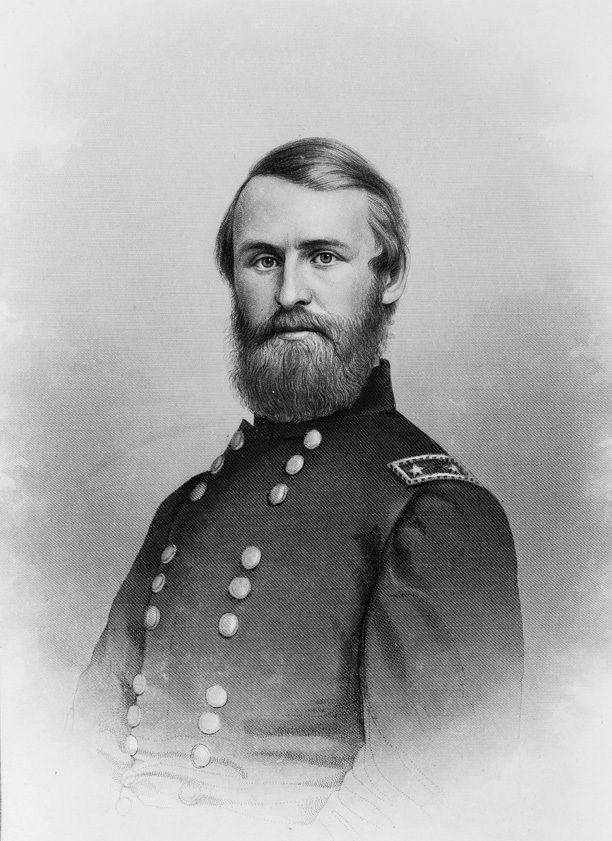
the Ohio was, in the first days of July, on the right of the Federal line on the Sandtown Road. Sherman ordered him to move to the far left, a distance of some 25 or 30 miles and, as Schofield stated in his report, “to prepare for crossing the river at some point from the mouth of Soap Creek to the Shallow Ford, near Roswell, while Generals Thomas, McPherson, and Stoneman should feign below.”
The river was wide, deep, and difficult to cross, but from Johnston’s perspective the river was certainly difficult to defend against an army double the size of his own. By Stephen Davis’s count, there were 15 crossing points from McAfee’s Bridge upstream near Roswell to Gorman’s Ferry near Campbellton, a 40-mile stretch of river. Johnston understood the magnitude of this challenge, one complicated further by the flow of Peachtree Creek, which enters the Chattahoochee some eight miles northwest of the city. Johnston explained in his report: “The character of Peach Tree Creek and the numerous fords on the Chattahoochee above its mouth prevented my attempting to defend that part of the river. The broad and muddy channel of the creek would have separated the two parts of the army. It and the river below its mouth were therefore taken as our line.” In his memoirs Johnston makes this same point, and adds that “the course of the river would have put us under the further disadvantage of a concave line.”
The reports of Sherman’s subordinate commanders and the communications sent back and forth give us a clear idea of the plan as it was being refined. Schofield to Sherman at 7:30 p.m. on the 7th: “Half a mile above [Sope] creek is a shallow ford where infantry can cross easily, but there is no road leading to it and it would be difficult to make one. Isham’s Ferry just below the mouth of the creek is a good place for a bridge. About 400 yards from the river on the east side is a commanding ridge very favorable for a bridgehead. The crossing would be very difficult if that ridge is held in force; but there appears at present only a squad of cavalry and one or two pieces of artillery.”
Schofield advised Sherman further: “If there be no greater force to oppose it, the crossing can be effected very easily by crossing infantry at the ford above, to clear the ridge and to cover to the construction of the bridge.”
But the decision had not yet been made to cross at Sope Creek. Schofield continued in his message to Sherman: “Johnston’s cavalry being gone, I take it for granted that I can cross [further upstream] at Roswell without difficulty. The higher up the river the less probability of opposition.” Sometime after Schofield sent this message, Sherman told him not to tarry and to cross at Sope. Schofield dropped his plan to reconnoiter points further upstream and examined in more detail the river at the chosen point.
“The ford above the mouth of Soap Creek is an old fish-dam,” Schofield told Sherman.3 “I do not think it can be made practicable for wagons, though it may be. I deem it important to have a bridge to throw across as soon as I have effected a lodgment, so that I can, without delay, put over
a force with artillery to make my position secure.”
Sherman provided the bridge, telling Schofield: “I will order a pontoon train to report to you on the road.”
At 9:30 p.m. Schofield sent a message to Brig. Gen. Jacob Cox, the commander of one of his divisions: “Please have your division ready to move promptly at 4 o’clock to-morrow morning.”
The orders moved down the chain of command. Resources were marshalled to put the plan into effect.
Early on the morning of the 8th Cox ordered one of his brigade commanders, Col. Daniel Cameron, “to reconnoiter for an old fish-dam…and ascertain…, without disclosing the presence of his force, whether the river was fordable at this point.” The rest of the division was “massed behind the ridge skirting the river below Soap Creek.” Cox directed his men “to preserve great silence.” He forbade fires. He studied the opposite bank and satisfied himself that the force opposing him was “of inconsiderable strength.”
Schofield directed Cox to begin the crossing at 3:30 p.m. Cox ordered Cameron to pick 50 men as an advance guard to cross the river at the fish dam but keep the rest of his brigade hidden in the woods nearby. All the brigade save one regiment were to follow after the advance guard gained a foothold and “to push down the river by the heights on the opposite side….”
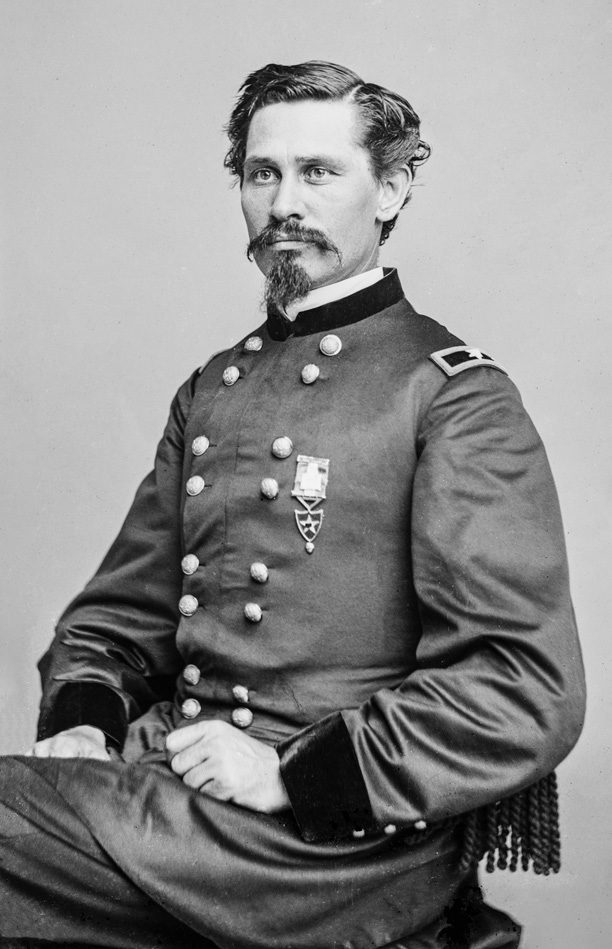
All this was coordinated with two other elements of the plan. Five hundred men detailed from Brig. Gen. Milo Hascall’s Division helped set up the canvas pontoons which were hidden in the creek. At 4 p.m. 25 pontoons emerged from the creek and rushed across the river with their cargo, the riflemen of the 12th Kentucky Infantry. Infantry and artillery then deployed at the river’s edge and fired on the Confederate force opposite. The surprised Confederates, vastly outnumbered and outgunned, fired and fled. The Kentuckians formed on the south bank and advanced to the ridge beyond. There they met the men of Cameron’s brigade who had crossed at the fish dam.
More men were ferried across. The Federals began entrenching on the ridge south of the river. The pioneers went to work. One bridge was finished by nightfall; a second one was under construction. Cox’s entire division crossed. Hascall’s followed the next day and “the two divisions occupied a secure tête-de-pont a mile in depth, giving ample room for the debouché of the
whole army.” Schofield reported that “The crossing was secured without the loss of a man.”
Sherman’s chief engineer, Capt. Orlando Poe, reported a few things about the pontoon bridges. The army began the campaign with two pontoon trains hauling two bridges, one 800 feet in length and the other 600. Two more of the same dimensions were held in reserve in Nashville. All were “of the kind known as the ‘canvas bateau bridge.’”
Sherman’s report states that he had four bridges at his disposal, so we know that the reserve pontoons were brought forward sometime between May and early July. Poe noted further that “The canvas bridges at Phillips’ Ferry were replaced by a trestle bridge built by the Engineer Battalion of the Twenty-third Corps. Another pontoon bridge was thrown meanwhile at Powers’ Ferry upon which the Fourth Army Corps crossed.” Poe also informed us that “whenever it was deemed necessary to use a bridge for a greater length of time than forty-eight hours the pontoon bridges were invariably replaced by wooden trestle bridges constructed from materials at hand…. The
object of this was to preserve the canvas covers of the bateaux, even at the expense of considerable labor, since we had the latter in greater abundance than the former.”
The narrative can now resume. The Federals are across the river. Johnston is sacked. Hood takes command. Sanguinary battles are fought. The railroad is cut. Atlanta falls.
One is struck by the immensity of the resources at Sherman’s disposal. Need a bridge? I will send you one. You could use some extra hands to assemble and paddle the bateaux? Hascall can spare 500 men. Want to get the canvas out of the water? We can put some men to work cutting logs and building trestle bridges. We have plenty of labor.
Schofield devised a very effective plan to cross the Chattahoochee at Sope Creek. Infantry and artillery remained hidden behind the ridge until the boats entered the river. The advance party at the fish dam crossed undetected and was immediately followed by the remainder of the assigned force. The pontoons were assembled in the creek and were ready to go at 4 p.m., according to schedule, a half hour after the men upstream began to cross at the fish dam. Before the men guarding the crossing were aware of the Federals’ presence they were struck with overwhelming force.
One wonders about the Confederate troops at the crossing. It seems they were not watching very carefully and not listening at all. There were thousands of Federals on the opposite bank the entire day, a few hundred feet from the Confederates, with artillery and infantry moving about, and with hundreds of men assembling 25 pontoon boats. How could the Confederates be unaware of their presence? Is it possible the Federal troops could be so quiet? But would it have mattered if the Confederates had been more alert? Could their commanders have gotten a sufficient force to Sope Creek in time to impede the crossing? And would they have even attempted to do so? After all, Johnston tells us that he had already determined not to defend the river above the mouth of Peachtree Creek.
We are all familiar with the adage that no plan survives contact with the enemy. In this case there was no significant contact with the foe. The plan was not hindered in any way. The crossing of the Hooch came off without a hitch.
Most Federal sources refer to Sope Creek as Soap Creek. There are also references to 2.
Sources: Atlanta Will Fall; Gen. Joseph E.
Isham’s Ferry, Isham’s Ford, and Phillips’ Ferry. These names all refer to the same crossing. Some accounts describe the Atlanta side of the river as the east side; some call the same bank the south side.
What the Federal reports call a fish-dam was, I believe, a fishing weir, a low dam built to direct the passage of fish to one part of the river channel where they could easily be trapped and caught. The “shallow ford” to which Schofield refers to is the ford here, not the “Shallow Ford” further upstream near Roswell.
Narrative of Johnston, Military Operations during the Civil War; William Tecumseh Sherman, Memoirs of General W.T. Sherman. O.R. Series 1, Vol. 38 contains the reports and correspondence cited.