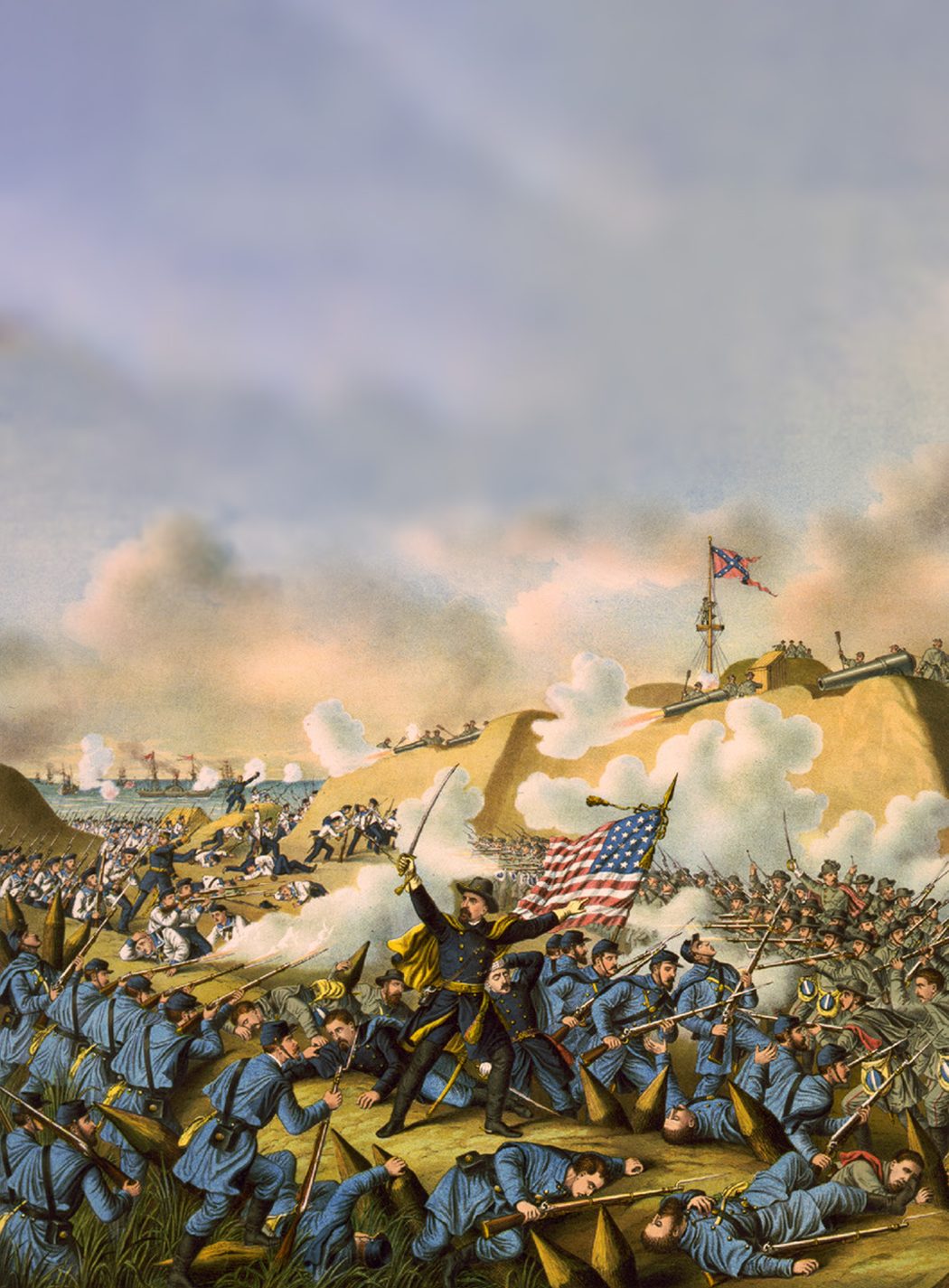
U.S. troops there. Owens describes the killing of the trapped Union soldiers in the crater as “the most revolting sight ever witnessed in this lost and ruined world.”
He was captured at the Battle of Dinwiddie Court House on March 31, 1865, and sent to the infamous prisoner of war camp at Point Lookout, Md. Here he suffered with the rest of the men what he termed “all the privations incidental to prison life,” but was paroled three months later and allowed to return home. On the rail trip home he was stricken with typhoid fever and once again the physicians pronounced that “he was bound to die.” According to his biography, Owens responded characteristically that was bound and determined to return home to distilling his cherry bounce. He purportedly said; “Doctor you say if I go I’ll be damned, and I say if I don’t go I’ll be damned.” A horse was brought around, and “…the audacious patient mounted him and rode home to the distillery, and then worked hard all night. From that time his recovery was rapid, and he was soon the picture of rugged health.”
Post-bellum, The King of Cherry Bounce continued to produce his liquor illegally as a moonshiner and vowed to never pay a dime of revenue tax on any of it. This, of course, put him on a collision course with Federal Revenue agents. He was arrested several times, and it was said that local sympathies were very much in his favor as most of the jury were his customers and the government had difficulty in getting any convictions. One time he was brought to court and the judge ordered him to pay a fine. The story goes that Owens had previously arranged to have a wagon with forty gallons of his cherry bounce for sale right outside the courthouse; this raised the money for the fine and still made a profit. Finally, in his seventies, Amos Owens was sent to prison one final time for a short term and subsequently decided he was tired of it all. After that he gave up selling his famous cherry bounce liquor and started going to church at Walls Baptist Church. Owens accumulated a small fortune which he buried on the farm in baskets over the years, since he also distrusted banks.
Amos Owens proved at least two Civil War physicians wrong and lived to be 85, if the dates on his tombstone in the church cemetery are to be trusted.
Craig L. Barry was born in Charlottesville, Va. He holds his BA and Masters degrees from the University of North Carolina The (Charlotte). Craig served Watchdog Civil War Quarterly as Associate Editor and Editor from 2003–2017. The Watchdog published books and columns on 19th-century material and donated all funds from publications to battlefield preservation. He is the author of several books including The Civil War Musket: A Handbook for Historical Accuracy The Unfinished (2006, 2011), Fight: Essays on Confederate Material Culture Vol. I and II (2012, 2013) and three books (soon to be four) in the Suppliers to the Confederacy series on English Arms & Accoutrements, Quartermaster stores and other European imports.
The deadline for submissions/advertising is the 20th of each month.
“You will soon hear of one of the damnedest fights or foot races that had taken place lately.” – U.S. Gen. James G. Blunt
After losing the March 7-8, 1862, Battle of Pea Ridge, Ark., C.S. Gen. Earl Van Dorn left the region for the Mississippi River, taking all available troops, artillery, and supplies with him. On May 13, 1862, C.S. Gen. Thomas C. Hindman took command of the Trans-Mississippi District. The “Fire-Eater” former U.S. Congressman was nationally known for his advocacy of state’s rights. On arrival Hindman announced, “I have come here to drive out the invader or perish in the attempt.” Within seventy days Hindman had instituted martial law, enforced conscription, established price controls, and pulled together a rudimentary army.
On Nov. 28, C.S. Gen. John S. Marmaduke’s cavalry fought Gen. James Blunt’s, 1st Division, Army of the Frontier cavalry. The Battle of Cane Hill, Ark., lasted nine hours as the fighting traversed 12 miles of woods, valleys, and hills. The fight ended with Blunt isolated from Federal forces 100 miles away in Springfield, Mo. Blunt was a Kansas physician and abolitionist who, with John Brown, aided slaves escaping into Canada. According to a Federal soldier, he was also, “a hearty fighter and seemed to think that it was the height of strategy to get himself surrounded by the enemy and fight his way out.” Blunt placed his men in a defensive position around Cane Hill and announced, “I have decided to hold on at all hazards.”
Hindman considered it an opportunity to drive out the invaders. He set out from Van Buren, Ark., on Dec. 3 with 9,000 infantry, 2,000 cavalry, and 22 pieces of artillery. Hindman’s plan was for the infantry to secure the mountains and attack the enemy’s front while the cavalry attacked the rear and flanks.
Blunt knew he was in a vulnerable position. As his men fortified the area, his scouts, mostly Native-Americans, watched Hindman. Twelve hours before the Confederates left Van Buren, Blunt sent a message to Gen Francis J. Herron, 2nd Division, Army of the Frontier, for reinforcements. During the Battle of Pea Ridge, Herron had earned the Medal of Honor for his actions. Months later Herron took his staff to see where he had been wounded and captured. His horse’s body still marked the spot.
The 1st Ark. and 7th Mo. U.S. Cavalry heeded Blunt’s call for reinforcements. The Dec. 7, Battle of Prairie Grove began between Fayetteville, Ark., and Cane Hill as the Federals were routed by the Marmaduke’s Cavalry. The Federals rushed back towards Fayetteville. The Confederates followed their fleeing foe, capturing prisoners and reaping the bounty left behind.
During the pursuit, Marmaduke was stunned to see Herron’s troops marching towards him. Herron had left Springfield on Dec. 3 for the 110-mile march with some units averaging 35 miles a day. Other units marched the final 66 miles in 30 hours. The pace caused attrition. “… Our boys are laying along the road side every mile between this point and Springfield entirely disheartened completely exhausted can go no farther,” wrote one soldier. An officer of the 37th Ill. recalled, “… men were carrying their shoes and marching in their stocking feet on account the blisters on their feet,” over roads covered in icy slush, mud, and sharp rocks. Another unit refused to continue to carry their packs and left them by the roadside. Their commander stowed them in the wagons.
Approximately ten miles before reaching Blunt, Herron was shocked to see blue coats riding “in wildest confusion” towards him. It took shooting a man out of his saddle to slow the stampede. Unlike their inexperienced brethren, the new arrivals got ready to face the rebels and advanced at the double-quick. “Nearly every one had sore feet from the effects of the hard march, but we all forgot our feet and pushed forward,” wrote William Clayton.
The Confederate cavalry reeled back and positioned their six 6-pdr. and four 12-pdr. howitzers on the foliage covered hill above the Illinois River. Herron placed his four 10-pdr. Parrotts, six 3-in. ordnance rifles, six 6-pdr. James rifles, one 6-pdr., and three 12-pdr. howitzers on Crawford’s Prairie across the river. About 1:30 p.m. the Confederates let loose their barrage. “So completely were the men exhausted that I saw them sleeping quietly around, paying no heed to the fierce missiles,” reported Lt. Col. John C. Black, 37th Ill. The Confederate firing stopped after Hindman told his men to stop wasting ammunition.
The Federals continued to fire. “Nothing makes a man shoot so coolly as not being shot at in return,” remarked a Confederate officer. Through the gaps of greenery only a few Confederates could be seen. Herron may not have realized that he was outnumbered two to one. He ordered about 500 men up the hill. The men were met with a “perfect hail of bullets” and the survivors chased off the hill. Their pursuers were charged out of the foliage were, in turn, met with cannon fire and escaped back up the hill. Herron again ordered about 500 men up the hillside, “littered with corpses, cripples, and discarded weapons and clothing,” repeating the cycle. According to Herron, “The fighting was desperate beyond description.”
In the meantime, Blunt hearing the shooting in the distance, realized that Herron’s troops were engaging the enemy. Rushing to the battlefield, the infantry left the road to double-quick through the fields, keeping up with the galloping cavalry. “We charged with a shout,” recalled a soldier. Blunt with his 22 cannon and men arrived just in time to bolster the Union line.
Both sides held firm as the battle raged until dusk. Herron had stragglers with supplies arriving. Hindman didn’t. His men lacked the ammunition and food to fight two armies or the ability to slip away without a ruse. Under a flag of truce, the two opponents met, ignoring the usual courtesies. “Well I suppose General you give up,” began Hindman. Instead Blunt agreed to give Hindman the opportunity to care for the wounded and gather the dead. To Blunt’s fury, during the night Hindman’s army slipped away. Despite Hindman’s efforts the “invader” remained. As a civilian described it, the battle was the “deathblow to rebel hopes in Arkansas.”
CANFIELD, Mahoning Valley Civil War Round Table has awarded its 2019 Hugh G. Earnhart Civil War Scholarship Award to Thomas J. Ryan and Richard R. Schaus for their groundbreaking work about the retreat from Gettysburg, “Lee is Trapped and Must be Taken,” Eleven Fateful Days after Gettysburg, July 4-14, 1863. Named after one of the round table’s founding members, the award is presented to recipients for their outstanding contributions in the field of Civil War historiography.
In this new study of the retreat from Gettysburg, the co-authors bring their years of experience in the military and intelligence fields into their research and writing. Following the events of the Confederate retreat and Union pursuit from Gettysburg through the lens of military intelligence, the narrative chronicles each army’s movements, day-by-day, and the intelligence used by each Shea, William L. Fields of Blood: The Prairie Grove Campaign: The University of
Civil War Artillery Book
army’s commander to make those movements. Readers will appreciate the thorough research of sources relating to the Bureau of Military Information, the Provost Marshal General, and many other previously unpublished accounts found within.
As readers of Civil War titles published by Savas Beatie have to come expect, excellent maps by cartographer Hal Jespersen aptly support Ryan and Schaus’ work. Deep research, penetrating analysis, and conclusions, the text is written in an easy-toread manner, “Lee is Trapped and Must be Taken” will remain a definitive voice in the field.
Founded in 1982 by Professor Hugh Earnhart, the Mahoning Valley Civil War Round Table has grown into a nationally recognized roundtable. This is only the second time this award has been presented.
North Carolina Press, 2009 Neal, Diane. Lion Of The South: General Thomas C. Hindman: Mercer University Press, 1997 Shea, William L. War in the West: Pea Ridge and Prairie Grove: State House/McWhiney Foundation Press, 2012
The Mahoning Valley Civil War Round Table has been in existence since the early 1980s. Throughout the years, the MVCWRT has enjoyed the company of many renowned local, regional, and national speakers, including Ed Bearss, Chief Historian Emeritus with the National Park Service; former Executive Director of Pamplin Historical Park and the National Museum of the Civil War Soldier, A. Wilson Greene; Wayne Motts, Chief Executive Officer of the National Civil War Museum, and scores of others. The MVCWRT has also spent dozens of hours volunteering on the Gettysburg battlefield, as part of the Adopta-Position at Gettysburg National Military Park, as well as building trails at Cedar Creek & Belle Grove National Historical Park. For the past ten years our organization has also donated raised funds to over twenty different historic sites and their missions of preservation and interpretation.
online at
“This is the magazine for all things Civil War Navy.
From ‘Uncle Sam’s web-feet’ to the ‘grey jacket navy’ raised by Jeff Davis! It is all here thoroughly researched and illustrated by beautiful contemporary navy images.”