killing the owner. The two most common Confederate issue canteens are the smaller (six-inch) tin drum which was inexpensive to produce, and some wooden varieties with iron bands and tin sling brackets which are attractive, but also more expensive. There is no doubt that cool water from a cedar canteen is sweeter tasting than the water from a tin canteen, which imparts a slightly metallic flavor. The Nuckolls and Gardiner pattern wooden canteens are the most often reproduced today. The major difference between the two was that the Nuckolls was two pieces of wood sealed and nailed together with a wooden spout, whereas the Gardiner had two wooden sides with slat-like pieces of wood between them banded together using a metal band with a spout of wood or tin on top. The Gardiner canteen was a little larger, wider and heavier than the Nuckolls and it held more water. Neither holds as much water as the standard U.S. 1858/62 tin canteens, which were prized possessions of those Confederates who had them. A question comes up about whether Union soldiers had wood canteens or if they were just used by Confederates. There are
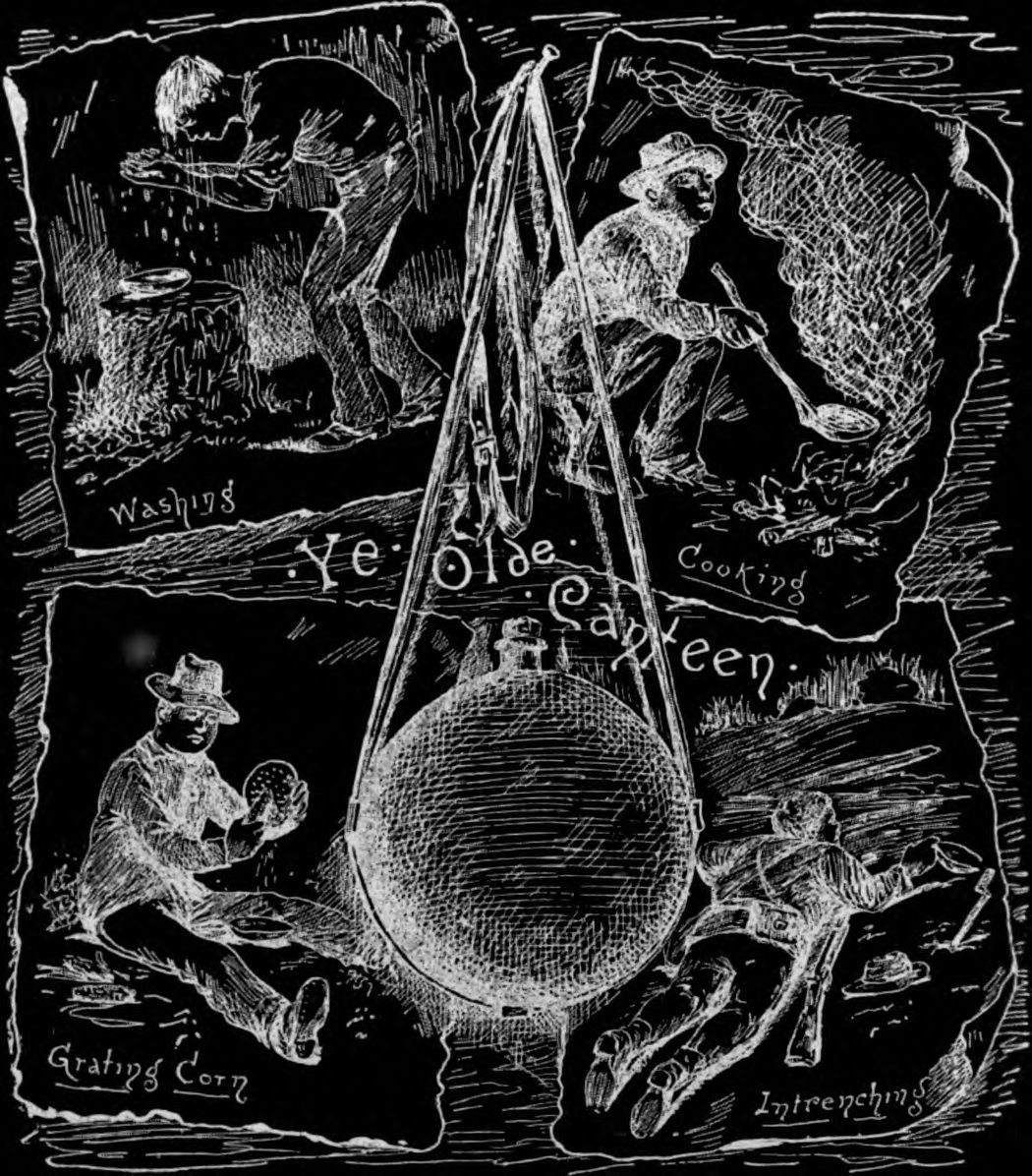
“Corporal Si Klegg and his “Pard.” Wilbur F. Hinman, p. 56, (1895). Original caption read “Useful career of the canteen.” period accounts of Union soldiers picking up Confederate wooden canteens off the battlefield (after Gettysburg) for souvenirs, and sending them home. It is doubtful that any soldier who depended on the water in his canteen for survival would trade down to a canteen that was heavier to carry, held less water, and was more prone to leaks.
Were there Union produced wood canteens in use during the Civil War? All Federal canteens produced during the Civil Warera were made from tin coated sheet iron. There could have been a few surviving 1840s U.S. “cheese-box” wooden canteens, and they may have been in use by one or two pre-war state militias. It is possible but unlikely that a few state militiamen marched off in 1861 with 1840s vintage wood canteens. These first volunteers were issued other equipment dating from the Mexican War-era such as flintlock muskets, cartridge boxes, etc, so who knows? There are one or two references to early war militia and (ninety day) recruits being issued surplus Mexican War gear that was on hand but the exact type canteen is not specified. And by the way, no known Civil War-era canteens were stamped “US” on the front or came painted with “US” on the cloth cover. The only place where the letters “US” were found on a Federal soldier were on his cartridge box and waist-belt plate. The tin drum canteen with raised “US” letters on the front dates from the Mexican War.
Confederate six-inch tin drum canteens were widely used and there were several variations on this particular design from the Mexican War-era. Research into Confederate records for this information is more difficult than it is for Federal items. Canteens were classed as Ordnance by the Confederate Government rather than as Quartermaster stock, as with the Union. The procedure for re-ordering canteens would have been similar to the procurement process for getting slings, cartridge boxes, or new muskets; hence the canteen was not an item that was re-issued at regular intervals. Many examples of Confederate canteens show no method of cork attachment. If surviving specimens are any indication, a variety of stoppers (besides cork) are found fitted to the spout of tin drum canteens. The question comes up about the practice during the Civil War of coating the inside of the canteen with beeswax. This step was not necessary nor is there any evidence that it was it done at the time.
Of the canteen’s usefulness, Wilber Hinman noted in Si Klegg and His Pard (1888) that a peculiarity of the [tin] canteen was that its usefulness did not end when it was no longer fit to serve in its legitimate sphere. When a lot of them became battered and leaky, and the company commander wanted to drop them from his monthly return of government property for which he was responsible, he would have them duly condemned by a board of officers appointed to hold a solemn inquest upon them. These regulation forms having been complied with, old canteens were then eagerly sought after by the soldiers, who were now at liberty to make such use of them as their ingenuity might suggest. The necessities and deprivations of active campaigning developed among the veterans a wonderful fertility of resource. Under such circumstances men become intensely practical. Everything that could in any way contribute to human welfare and comfort was brought into play, and the makeshifts resorted to were often startling and ludicrous. The old canteen was thrown into the fire and the heat soon melted the solder by which the halves were joined, and the soldier found himself in possession of two tin basins eight or ten inches across and in the center about two inches deep. One of these he carried day after day in his haversack. It was not often that the latter was so full of provisions that there was not plenty of room for it. Its weight was nothing, and he found it useful in ways that the man who made it never thought of.
Craig L Barry was born in Charlottesville, Va. He holds his BA and Masters degrees from the University of North Carolina The (Charlotte). Craig served Watchdog Civil War Quarterly as Associate Editor and Editor from 2003–2017. The Watchdog published books and columns on 19th-century material and donated all funds from publications to battlefield preservation.
He is the author of several books including The Civil War Musket: A Handbook for Historical Accuracy The Unfinished (2006, 2011), Fight: Essays on Confederate Material Culture Vol. I and II (2012, 2013) and three books (soon to be four) in the Suppliers to the Confederacy series on English Arms & Accoutrements, Quartermaster stores and other European imports.