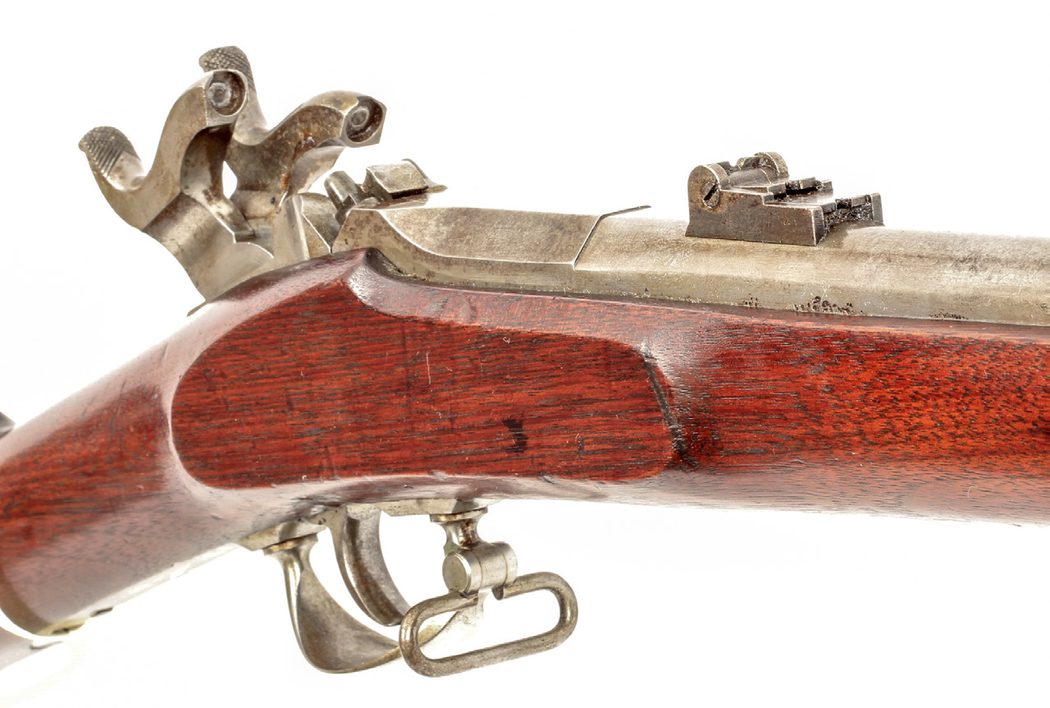
On October 9, 1860, John Parker Lindsay of New York City received U.S. Patent #30,332 for “improvement in locks for firearms.” The patent covered a unique, superimposed muzzleloading percussion firearms action that combined two hammers, a single trigger and two loads, fired from a single barrel. Lindsay’s patent actually claimed that his “new and useful Improvement in Locks for Fire-Arms” could be applied when “two or more hammers are used.” The primary patent coverage was for the firing mechanism, which combined a single trigger and two (or more) hammers. It is possible that Lindsay developed the concept for his mechanism circa 1859 while working with New York gun maker John Walch, who had patented a double-hammer percussion revolver that utilized superimposed loads to double the number of rounds fired from a percussion revolver.
Lindsay’s mechanism allowed two hammers to be fired sequentially from a single trigger. The auto-selecting single trigger would always release the right hammer first and the left hammer second on two consecutive pulls; not unlike a modern double-barreled sporting shotgun with a single trigger. Using his superimposed chamber concept, with one load on top of the other in the breech, the first hammer would fire the front chamber of the gun, and the second hammer would fire the rear chamber.
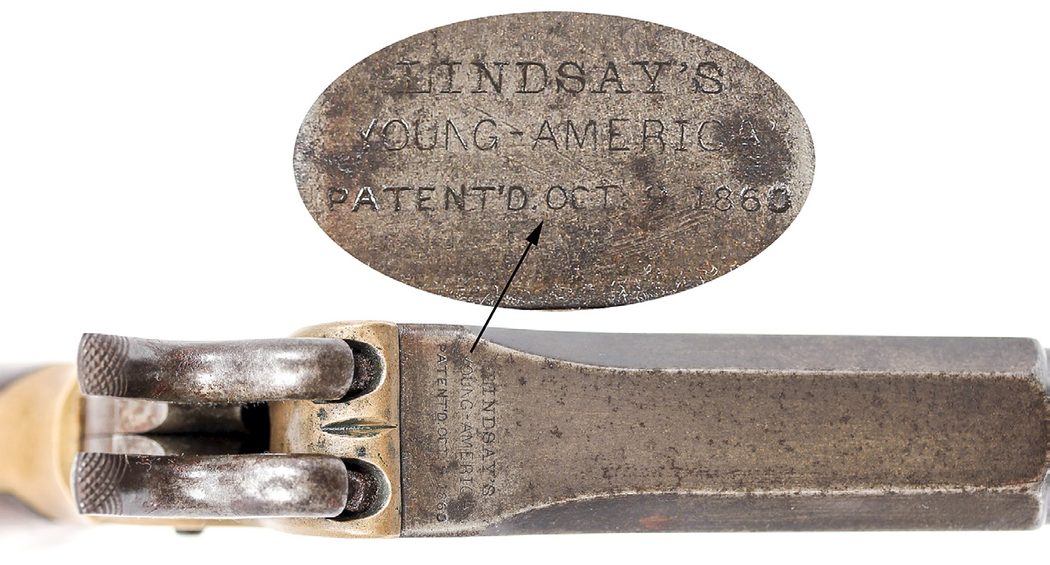
In 1861, Lindsay relocated from New York City to New Haven, Conn., and began to actively produce and promote his unique firearms. Lindsay initially applied his concept to a series of handguns that he marketed as the “Young America” line. The guns were produced for Lindsay circa 1860-62 by the Union Knife Company of Naugatuck, Conn. Two variations totaling less than three hundred guns were manufactured in .41 caliber, and another one hundred were produced in .45 caliber. With the outbreak of the Civil War, Lindsay became intrigued with applying his concept to a .58 rifle musket and obtaining a U.S. military contract.
Using the superimposed load concept, in combination with his patented double-hammer/single-trigger system, Lindsay produced a sample musket that effectively doubled the firepower of the average soldier in combat, as the design could be fired twice before it was reloaded. The design allowed the gun to retain a single barrel, keeping it virtually as light and handy as a standard percussion rifle musket. During the summer of 1863, Lindsay worked in vain to obtain an Ordnance Department contract for his “Double Musket;” however, Chief of Ordnance James Ripley was unimpressed and no orders were forthcoming. This was despite the fact that a trial musket, tested at West Point, had been found quite satisfactory, with the reviewing officer noting that, “In my opinion, the invention is a success.” In September 1863, Ripley was replaced by General George Ramsay, and Lindsay saw an opportunity to press his case again. In October, he submitted an improved version of the musket that had been tested at West Point, and managed to obtain a small contract to provide 1,000 of his patented double rifle muskets. The contact was officially issued in mid-December, with deliveries due to commence in April 1864 at a price of $25 each.
As with his pistol project, Lindsay had to turn to outside manufactures to actually produce the firearms. He appears to have relied upon his old contractor, the Union Knife Company, to manufacture the gun’s receiver and mechanical action, although some sources think that Lindsay may have manufactured this complicated lock work himself. The guns themselves were produced by Samuel Norris of Springfield, Mass. Norris had previously produced U.S. M1863 Rifle Muskets for the state of Massachusetts, but that contract was at an end and no further contracts appeared to be forthcoming. As such, Norris was more than happy to take on production of the Lindsay muskets, mating the Lindsay provided receivers with the rest of the components necessary to produce the completed rifle musket.
Due to various delays, the guns were not available for delivery in A rare Lindsay “Young America” .45 caliber double-hammer/ single-trigger pistol; only 100 were manufactured during the early 1860s.
April 1864, as had been specified in the contract and Lindsay had to request a contract extension. The production issues were resolved, and the entire order of 1,000 guns was delivered and accepted on Aug. 16, 1864. Less than one month later, on Sept. 12, 1864, half the muskets were issued for field trials.
Lindsay Double Rifle Muskets were issued to the 5th, 16th and 23rd Michigan Volunteer Infantry regiments, as well as to the 9th New Hampshire Volunteer Infantry. The 16th Mich. received 166 guns and used them at the battle of Peebles’ Farm, fought as part of the Petersburg Campaign from Sept. 30, through Oct. 2, 1864. The other regiments all received 83 guns each. Reports from both the 16th Mich. and 9th New Hampshire, indicate that some catastrophic failures occurred in the field, causing both injuries and deaths.
The failures of the guns in the field were completely understandable. While the superimposed loading concept worked fine in theory, it did not work so well in a combat situation. The system relied upon very careful loading, with the bullet from the rearmost charge preventing the second powder charge from going off when the first chamber was fired. This did not always happen (especially when the musket was loaded quickly or under duress),
(All photos by Tim Prince)
and would result in both chambers detonating simultaneously; usually with disastrous results for both the musket and the shooter. The other problem, which was equally disastrous, was that the long flash channel to the forward chamber could become fouled, preventing it from discharging. When the second charge was fired, with the first charge still blocking the barrel, the results were often catastrophic. Either problem ensured a bad day for the gun and the soldier using it, and as a result the weapons were universally despised by the men they were issued to. Due to the various calamities involving the use of the double musket in the field, the guns were fairly quickly condemned and withdrawn from service.
The U.S. M1863 Lindsay Patent Double Rifle Musket had the same basic profile of the U.S. M1861, M1863, and M1864 rifle muskets then in service. In fact, other than the special lock mechanism and breech, the majority of the parts were the same as found on U.S. M1863 Rifle Muskets; this is not surprising, as Norris likely had lots of spare parts from his M1863 contract on hand. The gun was .58 caliber, with a barrel that measured 41 1/8" in length rather than the usual 40" of the M1863 rifle musket. This was due primarily to the longer breech to accommodate the two superimposed loads.
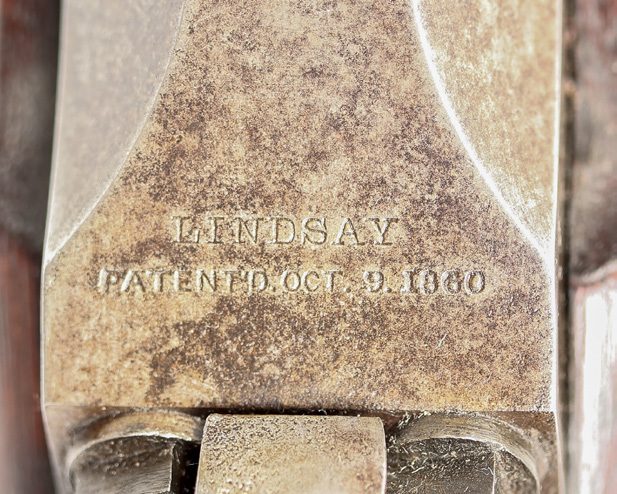
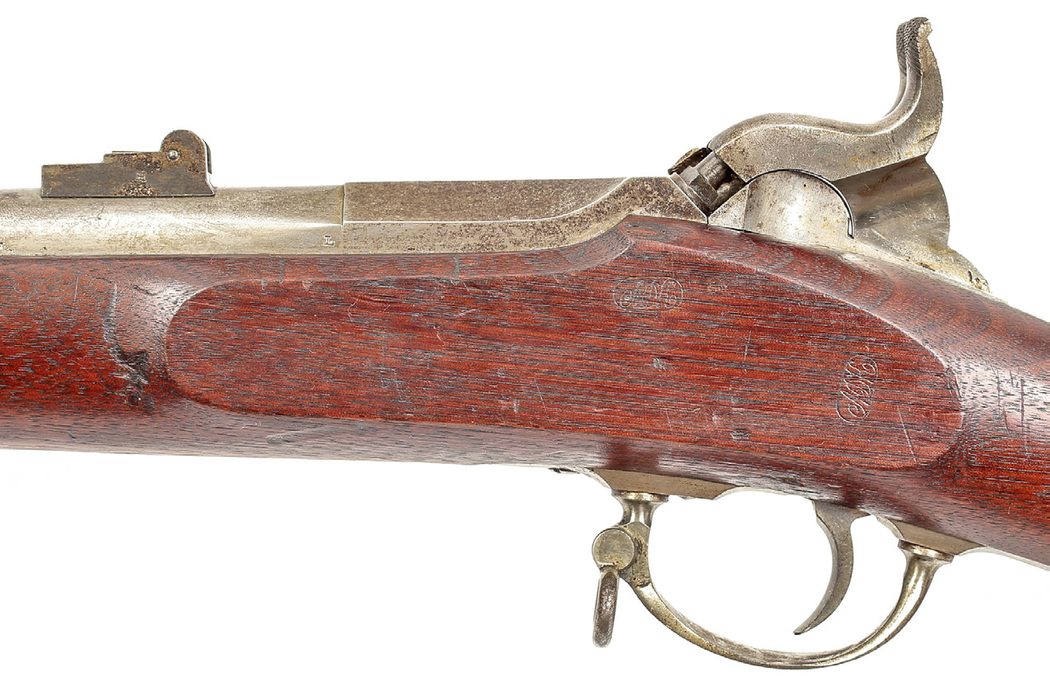
The top of the breech was marked in two lines, reading LINDSAY over PATENT’D OCT. 9. 1860. Due to the nature of the lock mechanism, the walnut stock has no external lock plate on the obverse, but still retained the same silhouette as the M1863 rifle musket. The barrel was secured to the stock with three rounded clamping barrel bands and a screw at the end of the extended breech tang. All metal parts were finished in the white and polished to “National Armory Bright.” Civilian Ordnance Department sub-inspector Andrew D. King inspected all examples of these muskets that I have ever encountered, with a pair of cartouches on the counterpane of the musket. King also sub-inspected the breech and trigger systems of the guns, with the balance of the components carrying various sub-inspector marks from other viewers. The standard U.S. M1861 pattern rear sight was used on the gun and the front sight doubled as a lug to accept the standard U.S. M1855 angular socket bayonet. Sling swivels were attached to the middle barrel band and to the forward bow of the triggerguard.
Due to the relatively low production figures, and the fact that some guns actually destroyed themselves in the field, the Lindsay Double Musket is a fairly scarce item on the collector market today. It is also possible that some guns were intentionally destroyed by soldiers in the field to make sure that they would not have to use them in the future. Although Lindsay’s loading concept was a dismal failure, his auto-selecting trigger mechanism lives on and continues to be used in many double-barreled sporting shotguns to this day.
Tim Prince is a full-time dealer in fine & collectible military arms from the Colonial Period through WWII. He operates College Hill Arsenal, a web-based antique arms retail site. A long time collector & researcher, Tim has been a contributing author to two major book projects about Civil War era arms including The English Connection and a new book on southern retailer marked and Confederate used shotguns. Tim is also a featured Arms & Militaria appraiser on the PBS Series Antiques Roadshow.
Every serious student of the Civil War begins to accumulate reference works, by purchase, borrowing, or by sitting in the library. The voluminous Official Records (often called simply the OR) is now on searchable disk. E.B. Long’s Civil War Day by Day is an essential and inexpensive “must have.” Frederick H. Dyer’s two-volume A Compendium of the War of the Rebellion, though expensive, is essential for studying northern armies. More advanced students might accumulate the eight volumes of Roy K. Basler’s Collected Works of Abraham Lincoln and the eight-volume Army Register of the Volunteer Force. Officers over a whole century can be found in Francis K. Heitman’s Historical Register and Dictionary of the U.S. Army.
Students of the South will find a thorough summary of relevant books in John H. Wright’s two-volume Compendium of the Confederacy. The best-written single-volume narrative history of the Confederacy is Frank Vandiver’s Their Tattered Flags. For the writer seeking scrupulous accuracy in describing battle events, there is no substitute for Robert K. Krick’s Civil War Weather in Virginia, a compilation of temperature and precipitation every day, 1861-1865.
Then we come to N.A. Strait’s Roster of All Regimental Surgeons and Assistant Surgeons in the Late War, with their Service, and Last-known Post-office Address, published in 1882. What was the purpose of this compilation and who was N.A. Strait? It all has to do with disability pensions in the Union Army.
After the shooting was over, the North demobilized at an astonishing rate. Whole armies mustered out and scattered like leaves in the autumn wind. Soon hundreds of thousands of former Union soldiers filed for disability pensions. There was no centralized system of medical records. For testimony about his wartime injuries the soldier needed an affidavit from his regimental surgeon, who was … where? California? Oregon? Florida? Maine? An enterprising young clerk in the Pension Bureau set himself the task of locating these scattered sawbones. His technique is unknown but he began compiling the addresses of thousands of surgeons, which was endlessly useful in processing claims of wartime injury or illness. Strait’s vast files finally took book form in 1882, as noted, and are still available in two formats. The ULAN Press produced a direct photographic copy of each page. Some of the original was damaged and the result is hard to read, but most of it is useful. The book is organized by state, then by regiment. An example of a legible entry follows: “Pennsylvania, 63rd Infantry, McFadden, James. Asst. S. 104 Fairmount Ave., Philadelphia, Pa.”
There are two other versions of Strait’s book. In the spring of 1989, Olde Soldier Books, Inc., reprinted the book, with an introduction and a name index, both by F. Terry Hambrecht, MD. About six months later, Jeremy Norman (Historyofscience.com) published his own version, with an independently-created index. The Army Register of the Volunteer Force also lists surgeons regiment by regiment and the typography is uniformly legible. Thus, we see the purpose and availability of Strait’s work, but what do we know of this long-forgotten compiler and author?
To begin, his full name was Newton Allen Strait. In 1850, farmer Thomas Strait, age 29, was living in Troy Township, Bradford County, Penn., with wife Minerva, and sons Eli, age eight and Newton, age four. A decade later, Thomas was a lumberman in Fairfield, Lycoming County. Minerva still kept house; Eli was a laborer and Newton was fourteen. He was too young for the Civil War, but a “Record of Burial Place of Veteran,” compiled in a 1939 WPA project, says he served in the Union army. A Fold3 search of all New York and Pennsylvania solders found no Newton Strait. The National Park Service Soldiers and Sailors site has no Newton Strait. His Findagrave entry states that he married Rebecca Eliza Smith in 1860, at age fourteen. This is of doubtful accuracy. In 1899, he did marry “Helen.”
In 1880, he was living in Washington, D.C., working as a clerk in the pension office. The 1890 census records no longer exist. In 1900, he was age 53, living on 13th Street in D.C., with 43-year old wife Helen, and two boarders, Mary Constantine and Sarah Rea. He was still a clerk at the pension office. The 1920 census shows him employed as “Librarian and Historian” at the Pension Bureau. He died June 1, 1922, and was buried in Wildwood Cemetery, Williamsport, Penn.
With assistance by: Rev. Dr. Albert H. Ledoux; Robert K. Krick; Findagrave.com; and the F.T. Hambrecht and J.L. Koste Biographical Register of Physicians who served the Confederacy in a Medical Capacity (unpublished database).