In 1847, the Whitney Arms Company made its first foray into the production of handguns. From the time the company was founded by the inventor of the cotton gin, the Whitneyville Armory had been engaged in producing military muskets for the United States government, as well for the various states. The firm started when it received a contract to produce U.S. M-1798 contract muskets and had not manufactured any civilian arms or handguns since its inception.
In 1847, the Whitney Arms Company was hired to produce Colt Walker revolvers. Samuel Colt no longer had his original Patterson, N.J., manufacturing facility and had received a U.S. government contract to manufacture 1,000 of the new “Walker Colt” .44 percussion revolvers. Colt had no way to complete the contract, so he arranged for Eli Whitney Jr. to manufacture 1,100 pistols; 1,000 for the U.S. contract and an additional 100 for commercial sale. This was a lucrative arrangement for the company, and Whitney decided it was time to enter the revolver business himself. Whether it was due to fear of Colt’s lawyers, or simple respect for Colt’s patents, the first Whitney revolvers did not violate Colt’s patents for the revolver mechanism, and were manually rotated, rather than rotating by cocking the hammer.
Circa 1850, Whitney introduced his “Hooded Cylinder” line of pocket percussion revolvers. The guns saw limited success and by 1853 only about 200 had been produced. At that point, Whitney introduced his “Two Trigger” series of pocket percussion revolvers. These were more conventional looking handguns, but were still manually rotated. Whitney manufactured about 650 of these pistols over the next year or so.
In 1854, Whitney introduced his “Ring Trigger” revolver. This was the first Whitney revolver that was not based upon manual cylinder rotation because a ring trigger operated the cylinder; the hammer still cocked manually and then fired by pulling the trigger fully to the rear. Almost immediately this variation was improved upon by Fordyce Beals, who would go on to become one of Remington’s most successful early handgun designers. The Whitney-Beals’ Pocket Revolver, better known as the “Walking Beam,” was moderately successfully with about 3,200 being produced between 1854 and mid- 1860s. All these early Whitney handguns were pocket models and were either .28 or .31 caliber. None were considered a “man stopping” combat caliber that could be considered for military use. Whitney knew that military contracts had always been the bread and butter of the company, and it was with the introduction of the Whitney “Navy” Revolver in .36 caliber that the company hit handgun pay dirt.
In 1857, Colt’s patents expired, and Whitney was free to produce a single action percussion revolver with a mechanism that rotated the cylinder when the hammer was cocked. Free from fear of legal reprisals, the company started producing an improved version of the Colt’s Model 1851 “Navy” revolver. The biggest weakness of the Colt design was that it was two-piece with the frame and barrel being separate components secured only by a tapered wedge that locked the barrel onto the cylinder arbor of the frame. The open top design had sleek lines and was probably less expensive to manufacture than a solid frame gun, but it was not as strong. The Whitney version used a solid frame with a top-strap that the barrel screwed into. This made a much stronger and more robust revolver.
Like the Colt Navy, the Whitney “Navy” was .36 caliber (hence the name “Navy” as that indicated .36 caliber, while “Army” indicated .44 caliber) and had a 6-shot cylinder. Like the Colt, the barrel was octagonal and 7 ½" was the standard length, although barrels could be had (and are known) in lengths from 4" to 8". The standard finish was blue, with a color case hardened hammer and two-piece walnut grips. The earliest production examples did not have loading levers, and came with iron triggerguards. In fact, the earliest guns were not even Whitney marked, but were typically marked EAGLE CO.
Very quickly (after about 100 guns) a loading lever was added. The lever was a compound linked lever that included the cylinder arbor pin. The entire assembly was retained by a wingnut on the left side of the frame that had a keyway machined into it. This allowed the entire assembly to be removed from the frame by turning the wingnut 180-degrees, freeing the arbor to be withdrawn. The cylinder could then be easily removed. This was a major improvement over the Colt wedge system, in both simplicity and ease of operation. The lever was retained in the “up” position by a spring-loaded ball detent that engaged a catch under the barrel, near the muzzle.
Approximately 1,500 of the 1st Model Whitney Navy revolvers were produced, in four subvariations. These changes were fairly subtle, with the exception of the difference between the 1st Model, 1st Type which had no loading lever, and the three following 1st Model types, all of which did have that mechanism. As with most Whitney made arms, these types were really production evolutions of the model, and were certainly never cataloged as different patterns or variants. Very quickly the 1st Model Whitney Navy was supplanted by the improved 2nd Model Whitney Navy. Between 33,000 and 34,000 of the 2nd Model were produced over slightly less than a decade.
The primary changes between the two models were that the 2nd Model had a heavier, thicker frame than the 1st Model, the triggerguard was now brass instead of iron, and the standard barrel marking was now E. WHITNEY over N. HAVEN in two lines on the barrel, rather than the original EAGLE CO. marking. Collectors divide the production of 2nd Model Whitney Navies into six “types”. Again, the changes between types were fairly minimal, with the most obvious being the replacement of the ball detent loading lever catch that had been introduced on the 1st Model, 2nd Type revolvers with a Colt-style “wedge shaped” catch on the 2nd Model 3rd Type Revolvers, somewhere around serial number 13,000. Like any product improvements, the changes appeared sporadically before they were in continuous use, as older parts were used up. The 2nd Model, 2nd Type Revolvers introduced safety notches on the rear of the cylinder between each chamber, a feature that originally was a single notch introduced on the 1st Model, 4th Type revolver. Another change that occurred during production was an addition to the motifs that were roll engraved on the cylinders. From the start of manufacture, the images showed an eagle, a shield, and a lion. The 2nd Model, 4th Type revolvers (circa serial number 15,000) introduced a naval engagement scene in addition to the other images, and added the legend “Whitneyville” to the shield. The two final changes were an increase in the size of the triggerguard (2nd Model, 5th Type circa s/n 25,000) and a change from 7-groove rifling to 5-groove rifling (2nd Model, 6th Type circa s/n 29,000).
Like most of Whitney’s earlier products, the new .36 caliber revolver found its primary customers to be the United States government and various states, who acquired them for military use. About half of all Whitney Navies were purchased by the U.S. Army or the U.S. Navy during the American Civil War. The U.S. Army acquired 10,587 revolvers between 1861 and 1864; the U.S. Navy purchased an additional 6,226 between 1863 and 1865. The state of New Jersey purchased 920 Whitney Navy revolvers in 1863, but 792 of those guns were subsequently resold to the U.S. Army in 1863 and 1864. Those guns are included in the U.S. Army purchases listed above.
The Army contract revolvers were sub-inspected on the frame, barrel, and cylinder like Colt and Remington revolvers, and received a final acceptance cartouche on the left grip. The Navy purchased guns were either inspected at the factory by Frank C. Warner (who was inspecting the Whitney Naval Rifle contract) or later by Naval inspectors during the period of “reinspection” that started in 1864. The Warner inspected guns usually have his block F.C.W. mark on the forward portion of the lower left side of the frame and his cartouche on the left grip. Those inspected later were viewed by Commanders Guert Gansevoort or John R. Goldsborough, who marked the guns they inspected either “G.G” or “J.R.G”, respectively on either the face or side of the cylinder. These guns were often additionally marked with an anchor on the top of the barrel.
A number of Whitney Navy revolvers also appear to have been acquired by the South and saw Confederate service during the Civil War. Some were purchased prior to the outbreak of hostilities, and these guns tend to be early production 2nd Model revolvers produced prior to the spring of 1861. A good example is Whitney Navy #3110; this was owned by Confederate cavalry general J.E.B. Stuart, and is now in the collection of the Virginia Historical Society. Confederate forces acquired many more Whitney Navy revolvers after the conflict started. These later production guns were no doubt obtained through a combination of capturing weapons and purchasing the guns surreptitiously from secondary retailers rather than directly from Whitney. At least two-dozen Whitney Navy revolvers (in the 2nd Model 3rd, 4th & 5th Type serial number ranges) are known to have been repaired by a Warrenton, Va., gunsmith for use by the 4th Va. “Black Horse” Cav., and a handful of identified Whitney Navy revolvers with Confederate provenance exist as well. It is not surprising that the revolver found favor on both sides of the Mason-Dixon line, as the robust design with a reinforcing top strap, a solid frame with a screwed in barrel, and the simple turn of a wing nut to release the loading lever and cylinder arbor were all significant improvements over the open top frame and wedge-retained barrel of the Colt design. The popularity of the revolvers in the south is further indicated by the fact that the design was copied by Confederate gunmakers like Spiller & Burr and T.W. Cofer, both of whom produced Whitney-inspired revolvers for the south.
With the end of the American Civil War, the era of the percussion revolver came to an end, and the period of metallic cartridge handguns began. Most Whitney Navy revolvers in government hands were sold off as obsolete, and some were altered to cartridge for resale to the general public. By the early 1870s, the only handguns being produced by Whitney were pocket sized, “suicide special” type metallic cartridge pistols, and by 1888, the company had sold its assets to the Winchester Arms Company. The Whitney “Navy” will go down in history as the only service sized combat handgun produced by the company and as a gun that saw significant use by both sides during the Civil War. Despite its superiority to the Colt design, the Whitney Navy would never achieve the same level of success.
Tim Prince is a full-time dealer in fine & collectible military arms from the Colonial Period through WWII. He operates College Hill Arsenal, a web-based antique arms retail site.
Want To Advertise In Civil War News?
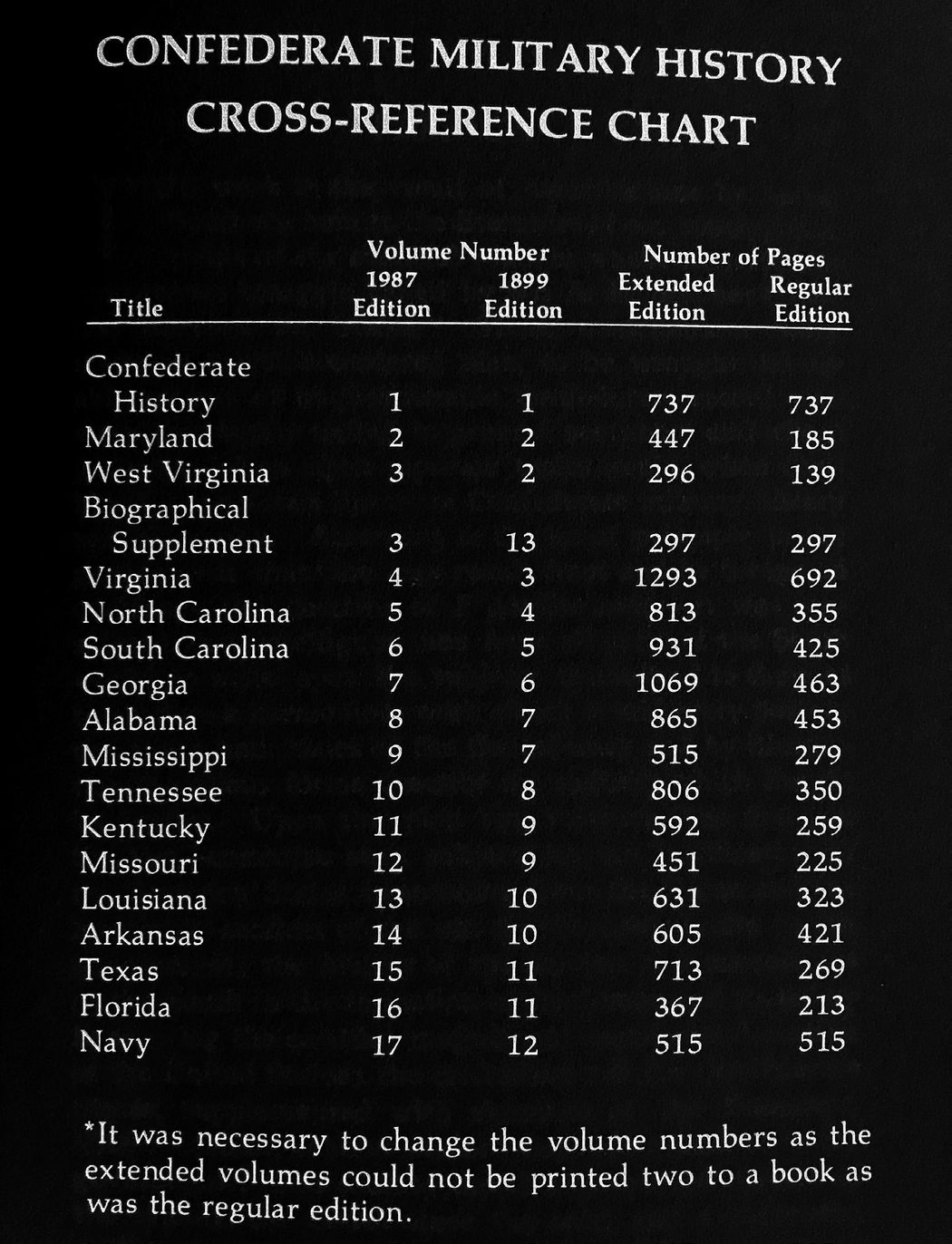
Confederate Military History – Extended
“This truly great contribution to Confederate literature, written by devoted Confederates, surpasses anything behalf of the Southern cause, and will be received and preserved as an invaluable compendium of the records of the most momentous period in American history.” This description, from a review in the August 1899 edition of Confederate Veteran Magazine, offers a glimpse into the wealth of information contained within the pages of Confederate Military
We carry a very large inventory of Colt and Civil War firearms including muskets, carbines, rifles and accoutrements. Our inventory of historic antiques and firearms begin at the early collectors level and range all the way up to the advanced collector and investors level.
History. Originally appearing in 1899 as a 12-volume set, printed in Atlanta by the Confederate Publishing Company, former Brig. Gen. Clement Anselm Evans served as editor and assembled a lineup of former Confederate officers to write the history of their respective states. The set also included the states of West Virginia and Maryland and a volume on naval operations.
Evans endeavored to capture the military history, which occurred within each state and encouraged writers to avoid political issues. In volume one, Evans and two other authors dispatched with many of the political topics. In addition to Evans, who wrote a section entitled ‘The Civil History of the Confederate States,’ J.L.M. Curry penned the ‘Legal Justification of the South in Secession,’ and William R. Garrett authored a section on ‘The South as a Factor in the Territorial Expansion of the United States.’
Working tirelessly with each volume’s author, Evans strove to ensure the timely completion of the entire series. Some writers battled ill health; Jed Hotchkiss completed his work shortly before dying. The authors of each of the state volumes follows: Bradley T. Johnson, Md.; Robert White, W.V.; Jed Hotchkiss, Va.; D.H. Hill (son of Lt. Gen. Daniel Harvey Hill), N.C.; Ellison Capers, S.C.; Joseph T. Derry, Ga.; Joe Wheeler, Ala.; Charles E. Hooker, Miss.; James D. Porter, Tenn.; J. Stoddard Johnston, Ky.; John C. Moore, Mo.; John Dimitry, La.; John M. Harrell, Ark.; Orin M. Roberts, Texas; J.J. Dickison, Fla.; and Lt. William Harwar Parker wrote the naval edition.
One benefit to modern researchers rests in the biographical sketches and images of general officers from each state. Following the military recap in each volume, these descriptions provide information on famous officers, as well as those of lesser renown. Some of these sketches offer details not found elsewhere.
The original set, sold on a subscription basis at the cost of $48 for a cloth edition or $60 for half-leather, proved out of financial reach for the primary target audience—the veterans. In 1910, Confederate Veteran Magazine